“Touch Her Again and I’ll Put You on the Ground.” — The Night a Scottsdale Tycoon Learned Money Can’t Silence Everyone
Scottsdale after dark has a way of pretending it’s peaceful, the palms glowing under careful landscape lighting, the stucco mansions perched against desert hills like polished trophies, the streets so still you can hear irrigation systems ticking on in synchronized obedience. From the outside, it feels curated, manicured, engineered to whisper success. But behind the private gates and imported stone, behind the walls that block not just noise but accountability, quiet doesn’t always mean calm. Sometimes it means control. Sometimes it means someone paid very well to make sure nobody hears what happens inside.
The Caldera estate sat at the top of a narrow incline where delivery drivers turned around nervously and neighbors pretended not to look. Its owner, Victor Hale, had built half the skyline in the valley, his name etched into office towers, hospital wings, university scholarships. If you attended a charity gala within a fifty-mile radius, you would see him at the center of the photograph, tuxedo immaculate, smile expensive, the kind of man who shook hands with senators and told reporters how deeply he believed in community.
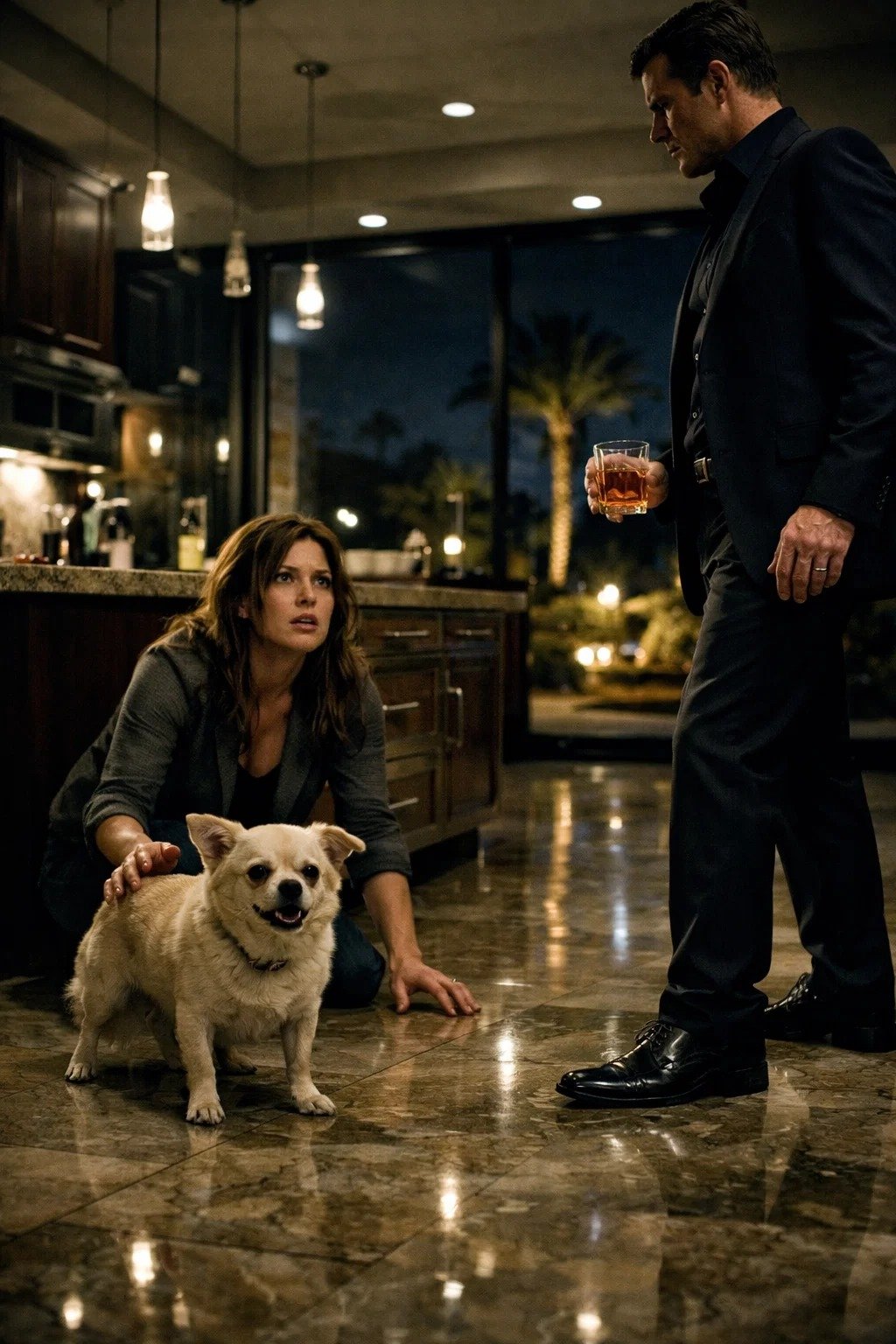
Inside his kitchen that night, community looked like a woman keeping her head down while a man twice her size decided what she had done wrong.
Marisol Vega had already wiped the granite island twice. The counters reflected the recessed lighting so clearly they might as well have been mirrors. She moved carefully, not because there was anything left to clean but because she had learned that the rhythm of her movements sometimes determined the rhythm of his temper. Slow and steady was safer than fast. Fast could look careless. Careless could turn into something else.
“You missed a smear,” Victor said from across the room, his voice calm in the way a storm is calm just before it tears through glass.
Marisol glanced at the counter, knowing there was nothing there, and nodded anyway. “I’ll take care of it.”
The crystal tumbler in his hand hit the marble with a sharp crack, whiskey sloshing over the rim. “You’ll take care of it the first time.”
The sound made her flinch before she could stop herself, and that movement — that small betrayal of fear — triggered the only creature in the house who had never learned to stay still.
A tiny cream-colored dog came scrambling from the hallway, paws skidding on the tile, body shaking but determined. His name was Nico, and he weighed less than a grocery bag, but he planted himself between Victor Hale and the woman who fed him.
He didn’t bark. He didn’t growl. He simply stood there, trembling so hard his tags rattled.
Victor stared down at him and laughed, a short, ugly sound. “Is this your security detail now?”
He stepped forward and kicked the dog.
Not a nudge. Not a shove. A kick with intent.
Nico’s body slid across the tile and hit the cabinet base with a sound Marisol would hear later in her dreams, a dull thud that ended too quickly.
She dropped to her knees so fast her palms burned. “No, no, no—please—”
Victor grabbed her by the wrist and yanked her upright. “You want to make noise?” he said softly, his breath hot with liquor. “Go ahead. Call the police. Tell them all about your immigration status. Tell them about the daughter you left behind. I’m sure they’ll be very sympathetic.”
Her face drained of color. She hadn’t told him about Lucia willingly. He had found out months ago, the way men like him find out everything when they decide they want leverage instead of information.
Lucia needed heart surgery in Honduras. The money Marisol sent home barely covered medications. Victor had offered to “help” once, his generosity packaged like salvation, and then he had handed her a paper to sign — an agreement that turned his kindness into debt.
“You owe me,” he reminded her now, tightening his grip. “And I collect.”
Across the narrow street, in a rental house that looked temporary next to the fortress-like estates around it, Owen Mercer woke with a jolt, sweat clinging to his back. The scream sliced through the night in a way his body recognized before his brain did. He was upright before he was conscious of moving, heart hammering in a rhythm he had once learned overseas when a single sound could mean life or death.
Beside his bed, Atlas lifted his head instantly.
Atlas was a retired military working dog, a shepherd with graying fur and eyes that held a steadiness Owen sometimes borrowed when his own fractured. Atlas didn’t bark. He stood, pressed against Owen’s leg, grounding him in the present.
Another sound drifted across the narrow gap between properties — a man’s voice, sharp and threatening.
Owen moved to the window. Through the slice of visibility between walls, he saw enough. He saw Victor Hale shove Marisol. He saw the small dog crumpled near the cabinets.
Something inside Owen split open.
There had been moments overseas when he had heard civilians cry out and been ordered to keep moving, to stay mission-focused, to ignore what wasn’t in the objective brief. Those moments followed him home like smoke in his lungs. He had promised himself that if he ever heard that sound again — that raw, helpless plea — and had the ability to act, he would.
Atlas nudged him.
Owen grabbed a hoodie and crossed the street.
He didn’t jump the gate. He didn’t break anything. He pressed the intercom and waited.
Victor opened the gate just enough to show his face, irritation already in place. “What?”
“I heard yelling,” Owen said evenly. “I saw you kick the dog. I’m taking the dog to a vet.”
Victor’s smile was thin and amused. “You didn’t see anything.”
“I did.”
Victor’s gaze flicked to Atlas, assessing. “You’re the veteran, right? The one who talks to his dog? I’ve heard about you.” He leaned closer. “Careful. Men with your history don’t get the benefit of the doubt.”
Owen felt the familiar tremor in his hands, the one he hated because it felt like weakness even when it wasn’t. He let them shake. “Open the gate.”
“Touch my property,” Victor murmured, “and I’ll have you committed before sunrise. Touch my employee and she’ll be on a plane back to Honduras before your coffee cools.”
Behind him, Marisol stood frozen, clutching Nico’s limp body, eyes wide with a silent plea not to make it worse.
Owen made a choice that didn’t feel heroic. It felt necessary.
“Hand me the dog,” he said.
Victor raised his phone, theatrically. “Let’s see how the police respond to a trespassing veteran making threats.”
That was the moment Owen understood the real battlefield wasn’t the driveway. It was the narrative. Victor Hale didn’t just have money. He had influence. He had reputation. He had the kind of credibility that could turn Owen’s service record into a liability and Marisol’s fear into evidence against her.
But Victor made one mistake that night.
He stepped forward again and grabbed Marisol’s arm, squeezing hard enough to make her cry out.
And Owen moved.
He didn’t shove first. He didn’t swing wildly. He stepped in, caught Victor’s wrist in a controlled grip honed by years of training, and said quietly, clearly, “Touch her again and I’ll put you on the ground.”
It wasn’t a threat screamed in rage. It was a boundary stated with absolute certainty.
Victor tried to pull free and stumbled instead, his expensive shoes slipping on the tile. He hit the floor hard, stunned more by disbelief than impact.
For a fraction of a second, everything was silent.
And in that silence, a red recording light blinked from the corner of the kitchen ceiling.
Owen saw it.
Victor saw him see it.
The mogul smiled from the floor.
“You just assaulted me,” he said softly. “On camera.”
The twist didn’t land immediately. It unfolded over the next forty-eight hours like a trap snapping shut.
Police arrived at Owen’s door the next morning. The report filed by Victor Hale described an “unstable neighbor with documented PTSD who violently attacked a homeowner without provocation.” The footage provided — edited, carefully trimmed — began seconds before Owen stepped inside. It did not include the kick to Nico. It did not include the threats about deportation.
It began with Owen’s hands on Victor’s wrist.
Marisol, terrified, told officers she “didn’t want trouble.”
Owen was taken in for questioning.
Atlas remained calm as always, though his eyes followed every movement.
Victor thought he had won.
He did not anticipate that the recording system he used to intimidate employees had a cloud backup he did not fully control. Nor did he anticipate that a tech consultant he had underpaid and belittled for years had quietly archived everything.
Three nights after Owen’s arrest, that consultant — a woman named Lena Corbett — contacted a local investigative journalist. Not out of altruism, at first, but because she had recognized the pattern. Victor had humiliated her in meetings, docked her pay for “attitude,” and once told her she was “replaceable.” She had stayed silent, collecting copies of data in case she ever needed protection.
The raw footage showed everything.
The kick. The threats. The leverage about Lucia’s surgery. The moment Victor squeezed Marisol’s arm. The second camera angle from the hallway that caught it all.
When the unedited video hit the newsroom, the story shifted.
Suddenly it wasn’t “Veteran Assaults Philanthropist.” It was “Philanthropist Accused of Coercion and Animal Cruelty.”
Federal investigators became interested when financial records revealed payments labeled as “charitable assistance” tied to private contracts that resembled indentured servitude. Immigration attorneys flagged potential coercion violations. Animal welfare groups demanded prosecution.
Victor’s attorneys tried to frame it as a misunderstanding, a “private dispute exaggerated by disgruntled individuals.” But Lena provided more. Emails. Audio files. A spreadsheet titled “Compliance,” listing names of employees with notes like “visa leverage” and “family dependent.”
The safe Victor thought contained his power became evidence.
Marisol did something harder than testifying.
She told the truth publicly.
She stood in front of cameras, voice shaking but steady enough, and described the debt, the threats, the night Nico was kicked across the kitchen. She described how help had been offered like a gift and turned into a leash.
Lucia’s surgery, funded eventually by a coalition of strangers, became symbolic of something larger than one family.
Victor Hale was indicted on charges that carried weight he couldn’t donate his way out of: coercion, immigration fraud, witness intimidation, assault, and financial exploitation.
At trial, his defense tried to undermine Owen’s mental health, suggesting instability. Owen answered questions plainly, without drama. Yes, he had PTSD. Yes, he received treatment. No, he had not attacked without cause. The full footage played in court.
Jurors watched Victor kick a ten-pound dog.
They watched him threaten deportation like it was a household tool.
They watched him smirk at his own camera.
Fifteen years.
That was the sentence.
Not symbolic. Not suspended. Real time.
Marisol received legal protection as a victim of coercion. Lucia underwent surgery successfully. Nico recovered, though he startled at sudden movements for months.
Owen did not magically heal from his past. Trauma doesn’t vanish because justice happens. But something shifted. The sound of a scream no longer felt like a reminder of failure. It felt like a moment he had answered.
Lena left the tech firm world and started consulting on digital ethics, speaking about the weaponization of surveillance.
And in a modest storefront near downtown Phoenix, a small center opened called Open Gate Collective — a place where exploited workers, veterans, and anyone leveraged by fear could walk in and find legal referrals, therapy connections, and, sometimes, just someone willing to listen without calculating advantage.
On the wall hung a sentence Owen had once spoken without thinking:
“Touch her again and I’ll put you on the ground.”
Not as a threat.
As a reminder that boundaries, when spoken aloud, change rooms.
The Lesson
Power built on silence is fragile. It depends on fear staying private and witnesses staying uncertain. Victor Hale believed money could edit reality the way his security footage was edited, trimming out context until only his preferred version remained. What he failed to understand is that control collapses the moment documentation meets courage. Owen did not defeat him alone. Marisol did not survive alone. Lena did not expose him alone. Justice arrived because multiple people, each afraid in their own way, decided to risk something at the same time. The lesson is not that heroes save the day. It is that systems of cruelty rely on isolation, and the fastest way to dismantle them is to connect the isolated until the powerful run out of shadows.
Website Disclaimer
The information provided on this website is for general informational and educational purposes only. While we strive to ensure that all content is accurate and up to date, we make no guarantees regarding the completeness, reliability, or accuracy of any information published.
The views and opinions expressed in articles belong to their respective authors and do not necessarily reflect the views of this website. Any action you take based on the information found on this website is strictly at your own risk. We will not be liable for any losses, damages, or inconveniences arising from the use of our content.
Some articles may contain opinions, third-party information, or external links. We do not endorse or guarantee the accuracy of content on external websites and are not responsible for their practices or policies.
All content on this website is provided in good faith and is intended for informational purposes only. Readers are encouraged to verify information independently and seek professional advice where appropriate.