An elderly couple found themselves stranded in a brutal blizzard—but the unexpected act of compassion shown by a group of bikers that night would move everyone to tears and restore faith in humanity.
People like to tell this story as if it began with a miracle, as if heaven itself had scheduled a dramatic intervention for Christmas Eve, but the truth is that it started the way most tragedies do, with a small, ordinary decision made by two stubborn people who believed they still had more time than they actually did, and by the time anyone called it a miracle, there was already blood in the snow, diesel fumes in the air, and a line of motorcycles cutting through a blizzard that should have killed them all.
The first voice that broke the storm that night did not belong to a biker, or a hero, or even to someone who believed in miracles anymore. It belonged to an eighty-year-old man named Raymond Halbrook, whose lungs had once endured the jungles of Vietnam and whose back had endured decades of factory shifts, but whose voice, when it cracked across the white chaos of that mountain road, sounded like a frightened child.
“She’s not breathing, Margaret. She’s not breathing,” he shouted, as if saying it twice might make it less true.
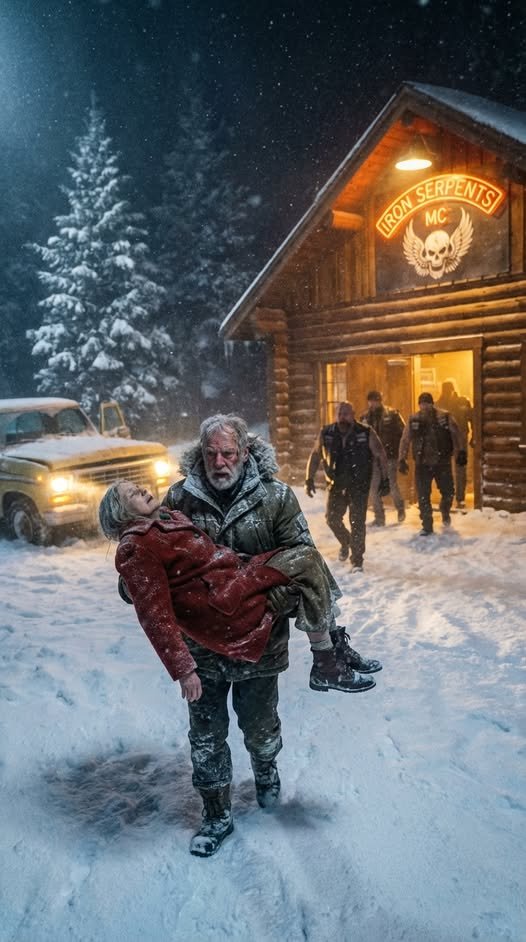
He was holding his wife of fifty-six years in his arms, her body wrapped in a wool coat that had once been red but now carried the dull, exhausted color of fabric that had survived too many winters, and snow was gathering in her hair, in the delicate crease of her eyelids, along the fine lines beside her mouth that he had memorized long before he realized he was memorizing anything at all.
The pickup truck they had been driving sat crumpled against a pine tree fifty yards behind them, the hood folded inward like a bent tin can, steam rising weakly before being swallowed by the wind, and if you traced their tire marks back along the mountain pass you would find the exact stretch of black ice where physics decided it did not care about nostalgia, or reconciliation, or elderly couples trying to surprise their estranged daughter on Christmas.
The road was called Ridgeway Pass, though locals referred to it less poetically as Widow’s Spine, because it curved along the mountain in a way that suggested it had been drawn by someone who did not believe in guardrails, and that night it had become a white corridor of disorientation, the sky and earth indistinguishable, the wind slicing sideways with a cruelty that felt personal.
Raymond had walked away from the crash with bruised ribs and a cut above his eyebrow, but Margaret had not been so fortunate. When he dragged her from the passenger seat, she had gasped once and pressed a trembling hand to her chest.
“It’s happening again,” she whispered, her voice thin but clear, and that was when he knew, because he had sat beside her hospital bed three years earlier when the cardiologist explained the blockage, the medication, the risk factors, the phrase “manageable if you’re careful,” which they both nodded at as though caution were something you could summon on demand.
“Not now,” Raymond had told her then, and he told her the same thing now, though the words had grown heavier with age. “You don’t get to do this now.”
He had scanned the horizon through the curtain of snow and seen, far down the pass, a faint amber glow that might have been a trick of his eyes or might have been light from a building tucked against the mountainside, and he made a decision in the space of a single heartbeat: he was not going to sit beside a wrecked truck and wait for the storm to finish what the ice had started.
He lifted her, ignoring the protest of muscles that had not carried anything heavier than groceries in years, and began walking.
Every step felt like a negotiation with gravity. Snow filled his boots. The wind stole his breath. Margaret’s head rested against his shoulder in a way that would have felt intimate under different circumstances, but now it only amplified his fear because her body was too still, too compliant.
“Ray,” she murmured at one point, and the fact that she used the nickname she had reserved for private moments made his throat tighten. “If I don’t make it—”
“You’re going to make it,” he cut in, not because he believed it, but because he could not survive the alternative. “You’re going to tell Lila yourself. You’re going to tell her you never stopped loving her.”
The mention of their daughter, the one they had not spoken to in nearly eight years after a fight that had spiraled from small grievances into something monstrous, seemed to flicker behind Margaret’s fading gaze.
“She thinks we chose pride over her,” Margaret whispered, and even now, even as her heart faltered, regret was what she carried. “We should have called.”
“We’ll fix it,” Raymond said, though the storm was beginning to convince him that time did not negotiate with intention.
When his legs began to tremble so violently he feared they would collapse, the amber glow ahead sharpened into something tangible: a low building with a wide porch, a neon sign flickering uncertainly above the door, and beneath it an emblem that would have stopped a younger, stronger version of him in his tracks—a winged skull, bold and unapologetic, the kind of symbol people crossed the street to avoid.
The sign beneath the emblem read: IRON SERPENTS MC – PRIVATE CLUBHOUSE.
Raymond had heard of them, of course. Everyone within fifty miles had. Stories traveled fast in small towns, and most of those stories painted the Iron Serpents as men who lived outside the lines—brawls at county fairs, arrests in distant cities, rumors of things darker and less easily named.
He hesitated only long enough to glance down at Margaret’s face, which had taken on the grayish tint of someone drifting further away than he could follow alone.
He kicked the door open with what strength he had left.
Inside, heat wrapped around him like a foreign language. The smell of oil, smoke, and whiskey hung in the air. A Christmas tree stood in one corner, crooked but decorated, lights blinking in uneven rhythm. A dozen men in leather vests turned toward the door at once, conversation snapping mid-sentence.
For a heartbeat, no one moved.
Then one of them, a broad-shouldered man with a shaved head and a thick gray beard, stood from the bar stool where he had been sitting and crossed the room in three long strides.
“Jesus,” he muttered under his breath, not in reverence but in recognition of urgency. “Get them inside.”
His name was Dominic Reyes, though most called him Reaper, a nickname earned decades earlier in circumstances he rarely discussed. Christmas Eve had always unsettled him, though he would never admit it openly. His younger sister had died on a snowy road not unlike this one, and he had been too late to reach her.
As the other bikers surged into motion—one grabbing blankets, another clearing a table, a third already digging into a medical kit that looked far more comprehensive than any roadside emergency supply had a right to be—Reaper met Raymond’s eyes.
“What happened?” he asked.
“Crash,” Raymond panted. “Heart. She’s had trouble before.”
A man with silver hair pulled back into a low ponytail knelt beside Margaret and pressed two fingers to her neck. He wore a patch that read PATCHWORK, though in another life he had been a paramedic named Louis Carter, and old habits do not fade simply because a man changes his uniform.
“She’s bradying,” Patchwork said calmly. “We need to get her horizontal. Blankets. Now.”
They laid Margaret near the fireplace, boots still dusted with snow, and Patchwork began assessing her with efficient precision—pulse, pupils, breathing, a quick scan for trauma beyond the obvious cardiac distress.
“She’s in serious trouble,” he said finally, glancing up at Reaper. “This isn’t something we can stabilize here for long.”
“There’s a hospital in Ashton,” one of the younger bikers offered. “Thirty miles east.”
“In this?” another shot back, jerking his chin toward the window where the storm raged like a living thing. “Road’s a death trap.”
Reaper’s jaw tightened. He looked from Margaret’s pale face to Raymond, whose hands were shaking so badly he could barely keep hold of her fingers.
“What’s your name?” Reaper asked.
“Raymond Halbrook.”
“And hers?”
“Margaret.”
Reaper nodded once, as though committing them to memory. “Raymond, that hospital is on the other side of this mountain. It’s not a safe ride tonight.”
Raymond’s laugh was hollow. “Neither is staying.”
Silence fell heavy across the room.
Reaper turned toward his club, the men who had ridden with him across state lines, through fights and funerals and more than a few questionable decisions. “We can wait this out,” he said evenly. “Storm’ll ease by morning. Or we can try to get her there now.”
“That pass is iced over,” a biker called Atlas said, arms crossed. “We lose traction up there, we’re done.”
Patchwork looked up from Margaret’s side. “She doesn’t have until morning.”
It was not a dramatic statement. It was clinical. Final.
Reaper exhaled slowly, the memory of his sister’s empty hospital bed pressing against his ribs like a ghost. “Prep the van,” he said. “Chain the bikes. We escort.”
A few men swore under their breath. One shook his head as if arguing silently with fate. But no one refused.
They moved with an efficiency that suggested this was not the first time they had mobilized for something larger than themselves. The club’s transport van, usually reserved for hauling equipment, was backed to the door. Snow chains were dragged from storage. Extra fuel cans were secured.
Margaret was lifted onto a makeshift stretcher in the van’s rear compartment. Raymond climbed in beside her, clutching her hand and whispering words that dissolved into prayers halfway through.
Reaper leaned into the van before the doors closed. “We’re not losing her,” he said, and for once, he did not say it like a man used to being obeyed; he said it like someone bargaining with the universe.
The convoy rolled out into the storm.
The first mile was manageable, the road still visible beneath a thin layer of snow, but as they began climbing toward the narrowest stretch of Ridgeway Pass, the wind intensified, pushing sideways with enough force to make even seasoned riders tense. Snow slashed against visors. Engines roared in defiance.
Inside the van, Patchwork monitored Margaret’s vitals with equipment that beeped too slowly for comfort. Her blood pressure dipped. Her breathing grew shallow.
“Stay with me, sweetheart,” Raymond murmured, pressing his forehead to her knuckles. “We’re almost there.”
They were not almost there. They had twenty more miles of mountain road that twisted like a question mark around cliffs no one wanted to look over in daylight, let alone in a blizzard.
Halfway up the pass, they encountered the first obstacle: a fallen pine tree blocking both lanes, branches heavy with snow, trunk thick as a telephone pole.
The bikes halted. The van idled.
Reaper killed his engine and dismounted, boots sinking into snow up to his calves. “Chains,” he barked.
Four men looped heavy-duty tow chains around the trunk. Two others secured the opposite ends to their bikes. Engines revved. Snow sprayed. The chains strained with a metallic groan that seemed to echo off the mountainside.
“On three!” Reaper shouted. “One—two—”
The tree shifted on “two and a half,” sliding inches, then feet, then finally rolling just enough to carve a narrow path wide enough for the van to squeeze through.
Cheers were swallowed by wind. They remounted and pushed forward.
Ten minutes later, Margaret’s heart stuttered and then flatlined.
The sound inside the van changed instantly—a steady tone where there had once been fragile rhythm.
“No, no, no,” Raymond whispered, as if denial might restart muscle fibers.
Patchwork moved with ruthless focus. “Clear,” he warned, pressing the defibrillator paddles to Margaret’s chest.
The shock jolted her body. Nothing.
Again. Nothing.
On the third attempt, a faint blip appeared on the monitor, then another.
“She’s back,” Patchwork said, but his voice carried no triumph, only urgency. “Barely.”
Reaper’s voice crackled through the van’s radio. “Status?”
“She’s fighting,” Patchwork replied. “So we ride.”
They reached the narrowest point of the pass just as a gust of wind strong enough to shove the van sideways hit them broadside. Tires skidded. One bike wobbled dangerously close to the edge before Atlas slammed his foot down and stabilized.
Ropes were deployed, tied from bike to van, men walking beside the vehicles inch by inch across a bridge that groaned beneath the weight of ice.
Time stretched into something unrecognizable.
When the first glow of Ashton General Hospital appeared through the snow, it did not look like a beacon; it looked like something fragile and far away, and yet it was enough.
They barreled into the emergency entrance without ceremony. Nurses rushed out with a gurney. Doctors took over. Margaret disappeared through double doors under harsh fluorescent lights.
Raymond stood in the hallway, soaked, shaking, unable to do anything except stare at the closed doors that separated him from fifty-six years of shared mornings.
Reaper stood beside him, leather jacket dripping onto sterile tile. “She’s strong,” he said quietly. “Has to be. She married you.”
Raymond let out a broken laugh that sounded more like a sob.
Hours passed. The storm eased. Christmas morning arrived unnoticed.
When the surgeon finally emerged, mask lowered, exhaustion etched into his face, he nodded once. “We got her stabilized. She’s critical, but she’s alive.”
Raymond sagged against the wall, relief hitting so hard it nearly knocked him over.
The twist came two days later, when Margaret regained consciousness in the ICU and asked, before anything else, “Did we make it to Lila’s?”
Raymond blinked, confused. “Lila?”
“Our daughter,” she said weakly. “She works here. Pediatrics.”
The room seemed to tilt again, but in a different direction this time.
A nurse overheard and paused. “Dr. Lila Halbrook?” she asked. “She’s on shift this afternoon.”
Within hours, a woman in her forties with tired eyes and a stethoscope around her neck stepped hesitantly into the ICU room.
There are moments when pride dissolves without ceremony, and this was one of them.
No dramatic speeches were made. No grand apologies rehearsed. There were simply hands reaching across a bed rail, tears falling without permission, and decades of silence collapsing under the weight of almost losing everything.
Reaper and the Iron Serpents did not attend the reunion. They had already slipped back into the anonymity they preferred, engines rumbling down a road that no longer seemed quite as hostile.
When a local reporter later tried to frame the story as a Christmas miracle orchestrated by “unlikely heroes,” Reaper shrugged. “We didn’t do anything special,” he said. “We just didn’t look away.”
The lesson, if one insists on distilling it, is not that bikers are saints or that storms exist to teach us gratitude, but that humanity rarely fits neatly into the categories we assign it, and sometimes the men you are taught to fear are the ones who show up when your world is collapsing, because brotherhood, when stripped of ego and myth, is simply the decision to risk comfort for someone else’s survival, and pride, when left unchecked, can steal more years than any blizzard ever could.
Website Disclaimer
The information provided on this website is for general informational and educational purposes only. While we strive to ensure that all content is accurate and up to date, we make no guarantees regarding the completeness, reliability, or accuracy of any information published.
The views and opinions expressed in articles belong to their respective authors and do not necessarily reflect the views of this website. Any action you take based on the information found on this website is strictly at your own risk. We will not be liable for any losses, damages, or inconveniences arising from the use of our content.
Some articles may contain opinions, third-party information, or external links. We do not endorse or guarantee the accuracy of content on external websites and are not responsible for their practices or policies.
All content on this website is provided in good faith and is intended for informational purposes only. Readers are encouraged to verify information independently and seek professional advice where appropriate.