I found out about my mother’s “family-only” sixty-fifth birthday party from photos.
Not a phone call. Not an invitation that got “lost in the mail.” Not even a text that said, Hey, it might be awkward, but I want you there.
Photos.
A balloon arch in pale gold. Champagne flutes clinking under warm lights. My mother in a satin wrap dress, smiling like a woman who’d never raised her voice in her life. My brother Ryan beside her, grinning and slightly stiff, like he’d been told to stand there and look grateful.
And the caption.
“Family only. The people who respect values.”
Then another post—because one wasn’t enough.
A longer one, typed like a statement to the public she always cared about more than the private reality.
“I don’t have a daughter anymore. I won’t enable a lifestyle of poor choices. Being a single mom isn’t something to celebrate.”
My phone felt heavy in my hand, like it had turned into a brick.
Lily was in the living room, humming to herself while she colored at the coffee table. Eight years old. Light brown hair that refused to stay in a ponytail. A face that still carried innocence even after life tried to sand it down.
“Mom?” she called without looking up. “Can we have pancakes tomorrow?”
I stared at the screen until the words blurred. I wanted to throw the phone. I wanted to scream. I wanted to call my mother and demand an explanation that would never be honest.
Instead, I set the phone down on the counter like it was hot.
“Yeah,” I said, keeping my voice even. “We can do pancakes.”
That was the moment I understood something I hadn’t had the language for before.
My mother didn’t want a relationship.
She wanted a role.
And she wanted me to crawl back into it.
Life doesn’t shift with swelling music or a cinematic moment. It reshapes itself through small, deliberate choices—stacked one on top of another—until the former version of you feels like a stranger.
I began with the only things fully within my reach: my mornings and my finances.
My alarm rang at 4:45 a.m.
It wasn’t heroic. It was survival. The kind that doesn’t look impressive on social media and doesn’t get applause at family dinners. The kind that happens in a quiet kitchen under a flickering light while the rest of the world sleeps.
I packed Lily’s lunch in the dark. Peanut butter sandwich. Apple slices. A note folded small—I love you. Be brave. I didn’t write it every day, but I wrote it often enough that she expected it.
Then I drove her to my neighbor, Ms. Calder.
Ms. Calder was retired, razor-sharp, and refreshingly uninterested in prying. Her small house smelled like black coffee and clean laundry. She’d open the door in a robe with her hair in curlers like she’d been awake for hours anyway.
Lily would run in, shoes barely tied.
Ms. Calder would nod once and say, “That child’s got a good head on her shoulders,” as if she were marking something important in the universe’s ledger.
Sometimes she’d add, “So do you.”
She never said it like pity.
She said it like fact.
Then I’d drive to the outpatient clinic, the sky still dark, the roads still empty. I’d put on the calm voice. I’d be the steady hands. I’d make small talk with patients who wanted reassurance more than answers.
After clinic hours, I cleaned offices downtown three evenings a week.
It wasn’t glamorous. It was fluorescent lights and empty desks and the smell of carpet cleaner. It was wiping fingerprints off glass doors and emptying trash cans full of shredded paper I wasn’t allowed to read.
On weekends, I logged into an online medical coding course—something dependable, something that didn’t hinge on anyone else’s temper or validation.
The fatigue was bone-deep, the kind that makes you feel hollowed out.
Yet inside that exhaustion was a quiet steadiness.
No raised voices.
No begging.
No waiting for someone else to determine my value.
When I passed my first certification exam, I kept it to myself. I printed the confirmation email and taped it inside a kitchen cabinet—where only I would see it.
A few weeks later, Lily found it while digging for cereal.
“Mom,” she asked, eyes shining like she’d uncovered treasure, “what’s this?”
I looked at the paper, then at her face.
“It’s proof,” I answered.
And realized I meant it more than I’d ever meant anything.
Within six months, I secured a better position: billing coordinator at a regional medical group.
It wasn’t flashy. It was paperwork. Insurance codes. Patient accounts. Calls to providers. The kind of work that required precision more than charm.
The benefits were solid, and the hours didn’t swallow my life whole.
I bought Lily a twin bed with a white frame and drawers underneath. She chose purple sheets dotted with tiny stars.
“This is our castle,” she announced, bouncing on it like royalty testing her throne.
I decided to believe her.
A year later, I was supervising a small team.
Two years later, another promotion came, and I moved us out of our cramped apartment into a modest home in a quiet neighborhood outside Columbus.
The stairs creaked. The backyard was small. The kitchen often smelled of cinnamon because Lily loved to “help” bake—usually by sending flour into the air like confetti.
The house wasn’t a statement.
It wasn’t retaliation.
It was peace.
I still didn’t speak to my mother.
Sometimes, long after Lily was asleep, I’d rehearse imaginary conversations—her sharp tone, her clipped phrases about family values and consequences. In my head, I’d finally say the perfect thing. The thing that would pierce her armor and make her understand.
But then I’d hear Lily’s laughter drifting down the hall after a silly dream, and the rehearsals would dissolve.
I didn’t want to waste my voice on someone who only listened when it benefited her.
One Saturday in early spring, my boss called me into her office.
Dr. Elaine Parker—crisp blazer, sharp intellect, warm eyes—closed the door behind me.
“We’re partnering with a women’s health nonprofit,” she said, sliding a folder across the desk. “They want to establish a patient-access scholarship fund—childcare stipends, transportation vouchers, job-training referrals. I’d like you to lead it.”
I blinked.
“Me?” I asked, because I couldn’t picture myself in the kind of role that came with visibility.
“You,” she said firmly. “You’re organized. You’re steady. And you understand what it means when a woman has to choose between survival and dignity.”
My hand trembled as I signed the paperwork.
That tremble wasn’t fear.
It was recognition.
This was the version of my life my mother couldn’t imagine.
A version that didn’t ask permission.
The nonprofit announced a summer fundraising gala.
My name would appear in the program.
My photo would be printed in the brochure.
I would introduce the speakers and unveil the new scholarship fund.
For the first time, the proof wouldn’t be hidden inside a cabinet.
It would be public.
And public was my mother’s favorite arena.
The week the promotional campaign went live, my phone buzzed with a name I hadn’t seen in years.
Hannah.
Hannah: Is this you?? I just saw your name on the Columbus Women’s Alliance website.
I stared at the text for a long moment before responding.
Instead, I opened the link she’d sent.
There I was—hair pulled back, strawberry-blonde highlights catching the light. Lily stood beside me in a simple yellow dress. We were both smiling like we truly belonged there.
The caption read:
“Program Director Erica Bennett and her daughter Lily—launching the Safe Steps Scholarship Fund.”
The next day, my phone wouldn’t stop buzzing.
Unknown numbers.
Voicemails layered with artificial warmth.
Then a message came from my mother.
Margaret: We need to talk.
No apology.
No mention of Lily.
Just the assumption of access—as though silence had been a temporary pause instead of a choice.
I didn’t reply.
I didn’t block her either. Not yet.
Because I knew how she worked.
If I blocked her, she’d frame it as cruelty.
If I stayed silent, she’d frame it as immaturity.
She could frame anything.
I wasn’t going to waste energy trying to control the picture she painted.
I was building something she couldn’t repaint.
But the gala invitations were already out.
And my mother—who thrived on public gatherings like they were air—was exactly the kind of person who would show up uninvited.
The gala took place in a downtown hotel ballroom with tall windows and soft lighting that softened everyone’s edges.
Lily and I arrived early.
She wore a navy dress with a satin ribbon and carried herself like she’d been invited to meet royalty.
“You look fancy, Mom,” she said.
“So do you,” I replied, brushing a strand of hair behind her ear. “If you feel overwhelmed, you can sit with Ms. Calder at our table.”
Ms. Calder had insisted on coming the moment she heard. She said, “I’ve been to enough events to know you always need one person in the room who doesn’t care about anyone’s nonsense.”
Lily nodded seriously. “I can do hard things.”
I smiled.
She could.
She already had.
As guests streamed in, I focused on logistics—greeting donors, confirming speaker order, checking the slideshow, ensuring the scholarship table was fully stocked.
The room filled with the clink of glasses and the low murmur of purpose meeting generosity.
While adjusting the podium microphone, I felt it—a familiar pressure in my chest, like a shift in weather.
I looked up.
My mother stood near the entrance.
A fitted cream blazer. Pale blonde hair styled in the same deliberate waves she’d worn to church for decades. Her posture perfect. Her smile ready.
Ryan stood beside her, hands in his pockets, gaze restless.
Her eyes found me.
Shock flickered first.
Then calculation.
Not because I looked dramatically different. I didn’t. I was still myself.
But I stood behind a podium in a tailored dark green dress, a staff badge clipped at my waist, speaking easily with a hotel coordinator who treated me like I belonged.
When she noticed Lily calmly holding my hand, her expression tightened.
My mother approached with the confidence of someone who assumed the carpet was hers.
“Erica,” she said brightly. “So it’s true.”
“Hi, Mom,” I replied.
Her gaze shifted to Lily. “Hello, Lily.”
“Hi,” Lily said politely.
For a split second, my mother’s smile faltered—as though she hadn’t expected Lily to be so… whole. Not ashamed. Not damaged. Not diminished.
“We should speak privately,” Margaret said.
My pulse thudded in my fingertips. Old reflexes urged me to shrink, to explain, to earn peace back.
But I wasn’t bargaining anymore.
My daughter was watching.
And my life no longer required pleading.
“Not tonight,” I said. “I’m working.”
“Working?” Her tone sharpened. “Erica, this is—”
“This is my program,” I said evenly. “I’m here to raise funds for women who need access to safe healthcare and stable footing. If you’re here to support that, you’re welcome.”
Ryan shifted awkwardly. “Erica… Mom didn’t mean—”
She silenced him with a glance and leaned closer.
“People are asking questions,” she said. “They already are. I won’t have our family embarrassed.”
A breath escaped me—almost a laugh.
“Embarrassed?” I repeated. “You publicly declared I wasn’t your daughter.”
Color rose in her cheeks—not guilt, but irritation at hearing it spoken aloud.
“I was teaching you responsibility,” she said.
I regarded her calmly, like someone observing a house they once lived in.
“Lily’s responsibility is to be a child,” I said. “Mine is to protect her. I did that. I’m still doing it.”
She noticed glances turning toward us and straightened, smoothing her blazer like she could smooth away truth with fabric.
“We can repair this,” she insisted, voice lowered but urgent. “Come to dinner. Let’s end this nonsense.”
I shook my head.
“You don’t get to erase us and reclaim us when it suits you.”
Lily’s fingers tightened around mine. I squeezed back.
And that’s when Dr. Parker approached with two board members.
“Erica,” she said warmly, “we’re ready for you. Oh—are these family?”
I didn’t hesitate.
“This is Lily,” I said, lifting my daughter’s hand slightly. “My favorite person.”
Dr. Parker beamed at her. “We’re honored to have you here.”
My mother stood suspended—caught between the polished world she curated and the life I had built without her permission.
For the first time, she couldn’t define me.
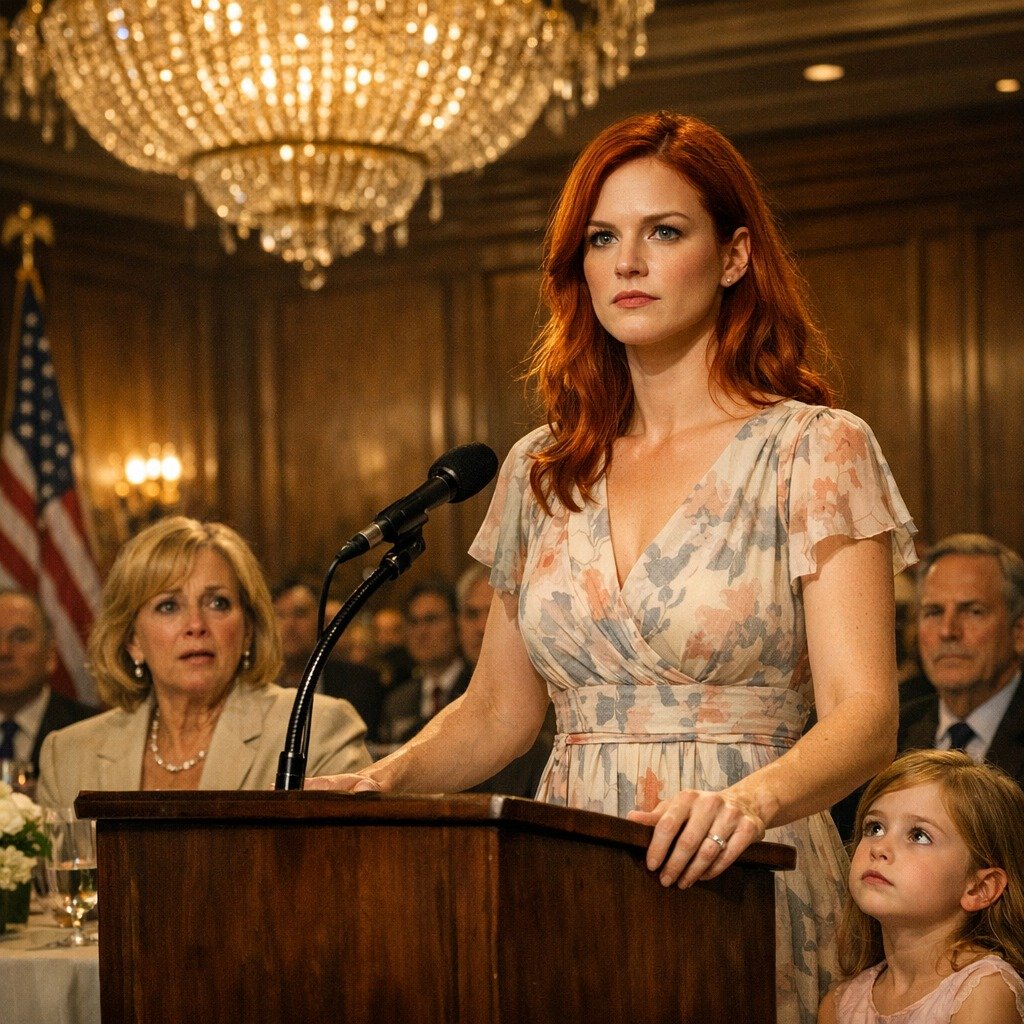
When I stepped to the podium, the room quieted.
Lily sat in the front row beside Ms. Calder, her legs swinging gently, her eyes fixed on me like I was something solid and safe.
I began my speech without glancing back.
I didn’t need to.
When I stepped to the podium, I felt the old reflex rise again—the one that expected judgment, that anticipated correction, that braced for someone to interrupt and remind me I was too much or not enough.
But the ballroom didn’t feel like my childhood dining room.
It felt like a place built for intention.
The lights were warm. The ceiling high. The clink of glasses softened into attentive quiet as the emcee introduced me.
“Please welcome Program Director Erica Bennett.”
There was applause.
Not polite. Not forced.
Real.
I adjusted the microphone slightly and let my hands rest on either side of the podium. I didn’t look at my mother. I didn’t look at Ryan. I didn’t scan for familiar faces that once knew me as someone who needed approval.
I looked at Lily.
She was sitting up straight in her chair, chin lifted, eyes steady.
I smiled.
“Good evening,” I began. “Thank you for being here—not just to attend an event, but to invest in something that changes the trajectory of a woman’s life.”
My voice didn’t tremble.
It wasn’t because I wasn’t nervous.
It was because I had practiced speaking from truth, not fear.
“I work in healthcare,” I continued. “And I’ve seen firsthand how many women delay appointments, skip follow-ups, or abandon job training because they have no childcare, no transportation, and no margin. They’re not irresponsible. They’re overwhelmed.”
A murmur of recognition moved through the crowd.
“Safe Steps,” I said, “exists to close those gaps. Not with pity. With structure. Childcare stipends. Transportation vouchers. Referrals to job-training programs that create sustainable change.”
I paused, just long enough to let it settle.
“This fund is about access. It’s about dignity. It’s about ensuring that survival doesn’t require humiliation.”
There was something about that last word that felt personal. I didn’t say it for my mother. I said it for the women who would never stand at this podium, who would never be asked to speak, who would never be given the benefit of the doubt.
Out of the corner of my eye, I saw Margaret straighten in her seat. I could almost hear her internal calculation—what parts of this could be interpreted as an indictment of her? What parts could be reshaped into a story about family perseverance?
But she wasn’t in control of this narrative.
Not tonight.
“I’m also a mother,” I said, and this time I did glance toward Lily. “And I know what it feels like to build stability one small decision at a time.”
The room softened.
“It doesn’t happen in grand gestures,” I continued. “It happens in 4:45 a.m. alarms. In packed lunches. In choosing long-term peace over short-term approval.”
There was quiet now. Not the brittle quiet of tension. The kind that meant people were listening.
“We are here tonight,” I finished, “because when one woman stands steady, others get to breathe easier. That’s not charity. That’s community.”
Applause rose again, stronger this time.
I stepped back.
Dr. Parker moved forward to introduce the keynote speaker, but I didn’t sit down immediately. I stayed by the podium long enough to feel it—the shift in energy, the subtle realignment of power.
Margaret’s world had always revolved around rooms like this.
But she had never stood in one as anything other than a guest.
When I returned to my seat at the front table, Ms. Calder leaned toward me.
“Well done,” she said simply.
Lily grabbed my hand under the table.
“You were brave,” she whispered.
I smiled at her. “So were you.”
Across the room, my mother stood abruptly and crossed the floor with practiced grace. A few donors stopped her, likely recognizing her from church boards or past events. She shook hands, laughed lightly, and nodded like she was part of this too.
Ryan lingered behind her, looking smaller than I remembered.
She approached our table during a brief break between speakers.
Her smile was composed, but her eyes were sharp.
“That was… moving,” she said. “Very well delivered.”
“Thank you,” I replied.
She glanced at Lily. “You’ve raised her to be articulate.”
There it was.
The subtle repositioning.
As if Lily’s steadiness reflected on her by default.
“I raised her to be safe,” I said evenly.
Margaret’s jaw tightened almost imperceptibly.
“Erica,” she murmured, leaning closer, “we can’t have this tension in public. It’s unbecoming.”
“Unbecoming of who?” I asked calmly.
Her eyes flicked around, making sure no one else was close enough to hear clearly.
“You’re painting a picture tonight,” she said, voice low. “People will connect dots.”
I met her gaze.
“I hope they do.”
For a moment, she looked stunned—not because I’d been rude, but because I’d refused to soften.
“Your brother is trying,” she added, nodding toward Ryan.
Ryan stepped forward, rubbing the back of his neck.
“Erica,” he said quietly, “Mom’s just worried about how things look.”
I looked at him fully for the first time that night.
“How did it look,” I asked gently, “when she posted that I wasn’t her daughter?”
Ryan didn’t answer.
Because he couldn’t.
Margaret straightened, her composure slipping.
“That was private,” she said sharply.
“It was public,” I corrected. “You tagged people.”
Her lips pressed into a thin line.
“You’re being dramatic,” she said.
I felt the old sting of that word—but it didn’t pierce like it used to.
“No,” I said quietly. “I’m being clear.”
Lily shifted in her chair, sensing the tension.
Margaret noticed and lowered her voice again.
“You’re still my daughter,” she said, but it sounded like strategy, not sentiment.
“Not when it’s convenient,” I replied.
Dr. Parker approached again, saving me from having to say more.
“Margaret, is it?” she asked pleasantly. “I hear you’re involved in several community boards.”
Margaret brightened instantly, seizing the opportunity.
“Yes,” she said. “I’ve always believed in service.”
Dr. Parker smiled. “Wonderful. We’ll be accepting pledge cards shortly. We’d love your support.”
There was a pause—tiny but noticeable.
Because service, in my mother’s vocabulary, had always meant visibility.
Not vulnerability.
Margaret reached into her purse slowly and withdrew a pen.
“I’ll consider it,” she said carefully.
Dr. Parker’s smile didn’t falter. “Tonight is about commitment,” she replied gently.
Margaret signed.
I watched her do it.
The pen moved in sharp strokes across the paper.
The amount she wrote wasn’t small.
And for the first time, I saw something flicker in her eyes that wasn’t control.
It was displacement.
She couldn’t reclaim me by force.
So she would try to stand beside me.
But the spotlight had already shifted.
As the evening progressed, donors mingled, checks were written, and the total on the large screen climbed steadily.
Lily slipped her hand into mine again.
“Mom,” she whispered, “this is working.”
I squeezed her fingers.
“Yes,” I said. “It is.”
At the close of the gala, I returned to the stage to announce the final fundraising total.
The number surpassed our goal.
Applause thundered.
Dr. Parker embraced me briefly before stepping aside.
“Thank you,” I said into the microphone, scanning the room once—not for my mother, but for the women seated near the back who had come to see if this fund was real.
“We built something tonight,” I said. “And it will outlast any single event.”
When the program ended, guests began to filter out.
Margaret approached one last time.
Her tone had changed.
Not softer.
Strategic.
“People were impressed,” she said. “You’ve done well.”
I nodded.
“Thank you.”
She hesitated.
“I may have been… harsh,” she admitted, the word chosen carefully to minimize impact.
“Publicly,” I said.
“Yes,” she conceded.
Silence hung between us.
“You don’t have to keep punishing me,” she said finally.
The old reflex stirred again—the urge to reassure her, to smooth it over.
But I wasn’t punishing her.
I was protecting myself.
“I’m not punishing you,” I said. “I’m living without you.”
Her eyes flashed.
“That’s dramatic.”
“No,” I said. “It’s accurate.”
Ryan stepped closer, looking between us like he wanted to mediate something he didn’t understand.
Margaret inhaled slowly.
“Dinner,” she said again, but this time it sounded less like a command and more like a question. “Just dinner.”
I considered it—not because I owed her, but because I needed to know if anything had shifted.
“Not yet,” I said.
Her lips thinned.
“Don’t make this permanent,” she warned.
“It already is,” I replied gently. “You made it that way.”
Lily tugged on my dress.
“Mom, Ms. Calder wants to take a picture.”
I smiled down at her.
“Let’s go.”
Margaret stood there as Lily and I walked toward the small cluster near the stage.
Ms. Calder positioned us in front of the scholarship banner.
“Stand tall,” she instructed.
Lily wrapped her arm around my waist.
The camera flashed.
For a moment, I caught my mother’s reflection in a mirrored wall behind us.
She looked smaller.
Not physically.
But in presence.
The room no longer revolved around her.
It revolved around purpose.
And that purpose didn’t require her permission.
When we stepped out into the cool night air, Lily slipped her hand into mine.
“You weren’t scared,” she said.
I thought about that.
“I was,” I admitted. “But I wasn’t alone.”
She nodded like that made perfect sense.
The city lights reflected off the hotel windows, and for the first time in years, I didn’t feel like I was standing outside something I was meant to be part of.
I felt rooted.
My phone buzzed in my purse.
A message from my mother.
Margaret: I didn’t expect you to do this without me.
I stared at it.
Then I typed back the only response that felt honest.
I didn’t do it without family. I just chose the right one.
I didn’t wait for her reply.
I slipped the phone back into my purse, lifted Lily into the car seat, and drove home to our creaky stairs and cinnamon-scented kitchen.
Our castle.
The house wasn’t flashy.
It wasn’t retaliation.
It was peace.
And for the first time, the spotlight didn’t feel like exposure.
It felt like proof.
The morning after the gala, my kitchen smelled like cinnamon and dish soap.
Lily sat at the table swinging her legs, sipping orange juice like she was still basking in the glow of last night’s ballroom. The scholarship banner had been folded and stored at the office, but the feeling—this strange mixture of pride and steadiness—lingered in the corners of our house like sunlight.
Ms. Calder had already dropped off a container of leftover rolls from the hotel because she said, “Waste is immoral.”
I was rinsing plates when my phone buzzed again.
Margaret.
We should have breakfast. Just us. It’s time.
No hello.
No How’s Lily?
No acknowledgment of the years she’d cut me off like a rotten branch.
Just the assumption that one gala, one applause line, one public display of my competence had flipped a switch back to normal.
I stared at the message long enough for Lily to notice.
“Is that Grandma?” she asked, too casually.
It always amazed me how children could sense tension without needing vocabulary for it.
“Yes,” I said.
Lily’s eyebrows pinched together. “Is she mad?”
I swallowed.
“She’s… complicated,” I said carefully.
Lily thought about that. Then she said something that made my throat tighten.
“Ms. Calder says complicated is grown-up for ‘someone who doesn’t say sorry.’”
I froze with a plate in my hands.
Ms. Calder had said that?
I shouldn’t have been surprised.
“I think Ms. Calder might be right,” I admitted.
Lily nodded once, satisfied, and returned to her juice.
I didn’t respond to my mother.
Not because I wanted revenge.
Because I wasn’t going to let her set the schedule of my healing.
By lunchtime, the nonprofit’s website had updated the gala recap.
Photos. Smiling donors. The final total. A quote from Dr. Parker about expanding access and building dignity.
And there, in the middle of it, was my mother’s name listed under “Major Sponsors.”
Margaret Bennett.
She hadn’t just pledged.
She’d branded.
My stomach tightened as I stared at it.
Not because the money was wrong. The fund needed it. Women would use it.
But because I knew my mother’s logic: if her name was attached, she could claim ownership. She could stand beside me in public and rewrite the past as “a misunderstanding.”
She could pretend she had supported me all along.
My phone buzzed again.
Margaret: People are calling me. Saying how proud they are. I told them we’re reconciling. Don’t embarrass me.
There it was.
The same old lever.
Don’t embarrass me.
I read it twice, then set my phone down on the counter like I was placing a dangerous object out of reach.
Lily was on the floor doing homework, her tongue sticking out slightly in concentration.
She looked up.
“Mom,” she said softly, “are you going to be sad today?”
The question hit me like a hand on the chest.
Because Lily had started measuring days in moods—sad days, normal days, safe days—without anyone teaching her to.
I crouched beside her.
“I’m not sad,” I said carefully. “I’m just… thinking.”
She looked at me with that too-wise calm she’d developed.
“About Grandma,” she guessed.
“Yes.”
Lily picked at the corner of her worksheet.
“She didn’t come to my school play,” she said quietly. “Even when I invited her.”
I swallowed hard.
“No,” I said. “She didn’t.”
Lily’s voice stayed small but firm. “Then she shouldn’t get to act like she likes us now just because other people clapped.”
I stared at my daughter.
At the clarity.
At the simple justice of it.
“You’re right,” I whispered.
Lily’s shoulders relaxed slightly, like she’d been holding that thought in her body for a long time.
That afternoon, I received an email from the nonprofit’s communications team.
They wanted a short interview for the local news segment—five minutes, filmed at the clinic. It would highlight Safe Steps, the scholarship fund, and “Erica Bennett’s story as a single mother rising into leadership.”
My stomach clenched again.
Not because I was ashamed.
Because I knew what my mother would do with it.
Public narrative was her home turf.
But it was also where she was weakest—because public narrative required witnesses.
And witnesses were no longer on her side by default.
I accepted the interview.
Not for my pride.
For the women who would see it and realize they weren’t alone.
The interview was scheduled for Friday.
Thursday night, my mother called for the first time in years.
Her name lit up my screen like an old alarm.
Margaret Bennett.
My thumb hovered over decline.
Then I answered—because sometimes you don’t answer to be pulled back in.
Sometimes you answer to confirm the line still holds.
“Hello,” I said.
Her inhale was sharp, like she hadn’t expected me to pick up.
“Erica,” she said quickly, voice already layered with warmth. “Thank God. I’ve been trying to reach you.”
I didn’t correct her.
There had been exactly one text. Two messages. No calls until now.
“I saw the email from the Alliance,” she continued. “About the interview. That’s wonderful.”
“Thanks,” I said flatly.
She barreled on. “I think it would be good if we did it together.”
Silence.
My stomach went cold.
“What?” I asked.
“My daughter,” she said, as if the word itself could erase what she’d written online. “People love a reconciliation story. They love family healing. If I sit beside you—just briefly—”
“No,” I said, calm as ice.
Margaret paused, then laughed softly like I was being cute.
“Erica, don’t be stubborn. Think about Lily. Think about what she deserves.”
There it was again.
The child as leverage.
I kept my voice steady.
“Lily deserves peace,” I said. “Not performance.”
Margaret’s tone tightened. “This is about our family.”
“You said I wasn’t family,” I replied. “Publicly.”
Her voice sharpened. “I was teaching you responsibility.”
I exhaled slowly.
“You keep saying that,” I said. “Like cruelty becomes virtue if you name it discipline.”
Margaret’s breath hissed. “I gave you everything.”
You gave me conditions, I wanted to say.
But I didn’t.
I didn’t need to argue with her reality.
I just needed to hold mine.
“You’re not coming to the interview,” I said.
Margaret’s warmth fell away.
“What are you doing?” she snapped. “Do you want people thinking I abandoned you?”
My mouth almost curved.
Because yes.
I wanted the truth.
“I don’t want people thinking anything,” I said. “I want them to know the fund exists. That’s the point.”
Margaret’s voice turned low. “If you keep this up, you’ll regret it.”
I didn’t raise my voice.
“I already lived the consequence of your love,” I said quietly. “It was loneliness. I survived it. Don’t threaten me with what you already gave me.”
Silence.
Then—softer, almost desperate—she tried again.
“Just dinner,” she said. “Come to dinner. We’ll talk like adults. Ryan will be there. We’ll fix this privately.”
I stared out my kitchen window at Lily’s chalk drawings on the patio—stars and hearts and a crooked house with smoke coming out of the chimney.
“No,” I said.
Margaret’s breath came quick now. “Erica—”
“I’m not refusing dinner,” I said gently. “I’m refusing the version of me that had to beg for a seat.”
I hung up before she could respond.
My hands were shaking, but not from fear.
From release.
Friday came.
The local news crew arrived at the clinic with a small camera and a reporter named Tessa who spoke with practiced kindness.
They filmed me walking through the office, speaking to staff, organizing scholarship packets. They filmed me at my desk explaining how the childcare stipends and transportation vouchers would work.
Then Tessa sat across from me in an empty conference room.
“So,” she began, “you’re a single mom who became a program director leading a scholarship fund. What do you want people to understand?”
I took a breath.
That old reflex again—brace for judgment.
Then I pictured Lily’s face in the front row at the gala, watching me like I was something safe.
And I spoke.
“I want them to understand,” I said, “that stability isn’t luck. It’s work. It’s community. It’s choosing peace even when people try to make you ashamed for surviving.”
Tessa nodded.
“And what gave you the courage?” she asked.
I didn’t mention my mother.
I didn’t give her that stage.
“My daughter,” I said simply. “And the women who come through our doors every day needing someone to believe them.”
They wrapped the interview, thanked me, and left.
As soon as the door closed, my phone buzzed.
A text from my mother.
Margaret: I saw the cameras. You can’t shut me out forever.
I stared at it.
Then, instead of replying, I did something I hadn’t done in years.
I opened my mother’s social media page.
Her birthday photos were still there.
Her post disowning me was still there.
But now, beneath it, there were comments I hadn’t seen before.
People from church.
Neighbors.
Old family friends.
“Margaret, is this true?”
“Why would you say that about your daughter?”
“Single moms are doing their best.”
“This feels harsh.”
The spotlight had shifted.
Not because I begged for it.
Because truth tends to surface when it has witnesses.
My mother had always believed she could control the narrative in public.
But she’d forgotten something.
Public means people.
And people sometimes disagree.
That evening, Lily and I baked cookies in our cinnamon kitchen.
She sprinkled chocolate chips with solemn concentration like it was a ritual.
“Mom,” she said, “are you mad at Grandma?”
I paused.
“I’m not mad,” I said honestly. “I’m just… done letting her decide who we are.”
Lily nodded like that made sense.
“Good,” she said, and dropped a chip into her mouth.
I smiled.
Outside, the sky darkened.
Inside, the house was warm.
My phone buzzed again.
This time it was Ryan.
Ryan: Can we talk? Just me. Not Mom.
I stared at the message for a long moment.
Because Ryan had always been the bridge that never held weight.
But bridges could be rebuilt—if they weren’t used as traps.
I set the phone down and turned back to Lily.
“Cookies first,” I said.
Lily grinned, flour on her nose.
“Cookies first,” she echoed.
Ryan’s text sat on my screen for an hour before I answered it.
Not because I needed time to craft the perfect response—those belonged to the version of me that still believed the right phrasing could unlock my mother’s approval. I waited because I had to check the feeling in my chest. Not fear. Not anger. Something more cautious.
Hope, maybe.
And hope was dangerous when it didn’t come with boundaries.
Lily sat cross-legged on the living room rug, lining up cookie cutters like they were tiny soldiers. She’d insisted on washing them herself, which meant there was still water on the floor and a towel draped over a chair like an exhausted flag.
“Are we doing another fancy thing?” she asked, glancing at my phone.
“No,” I said. “Just… maybe talking.”
“About Grandma?” she guessed, because she always did.
I didn’t lie.
“About Uncle Ryan,” I said.
Lily’s eyes narrowed the way they did when she was trying to solve a logic problem. “Is he the one who was in the pictures?”
“Yes.”
“Did he say you weren’t his sister anymore?”
My throat tightened.
“He didn’t say it,” I answered carefully. “But he didn’t stop it.”
Lily nodded once, absorbing it the way she absorbed everything: quietly, seriously, like she was filing the information in a place that didn’t lose it.
“Okay,” she said. “But cookies first.”
“Cookies first,” I agreed.
After she fell asleep that night—purple star sheets tucked around her like a promise—I sat at the kitchen table, the cinnamon smell still lingering, and texted Ryan back.
We can talk. Tomorrow. Public place.
He replied almost immediately.
Thank you. I’ll meet you anywhere.
I stared at the words, then typed the location before I could overthink it.
The diner off Broad Street. Noon.
A place with witnesses. A place where my mother’s kind of performance couldn’t flourish.
The next day, I wore my normal work clothes—black slacks, a simple blouse, hair pulled back. No gala dress. No staff badge. Just me, in the version of life I’d built brick by brick.
Ryan was already there when I arrived, sitting in a booth near the window. He looked like he hadn’t slept much. His hands were wrapped around a coffee mug like he needed warmth to stay upright.
He stood when he saw me.
“Hey,” he said softly.
“Hi,” I replied, sliding into the booth across from him.
For a moment, neither of us spoke. The diner noise filled the gap—plates clinking, a baby fussing in a high chair, the low hum of other people living normal lives.
Ryan cleared his throat.
“I didn’t know how to reach you,” he said.
I gave him a steady look. “My number didn’t change.”
He flinched.
“No,” he admitted. “I mean… I didn’t know how to reach you without Mom finding out.”
There it was.
The first honest sentence.
I didn’t soften.
“That’s part of the problem,” I said quietly.
Ryan’s jaw tightened. “I know.”
We sat with that for a moment.
Then he said, “I saw the gala photos. You looked… different.”
I almost laughed.
“Different how?” I asked.
He searched for the word like he didn’t want it to sound insulting.
“Like you weren’t waiting for something,” he said finally.
The statement hit harder than it should have, because it was true.
I wasn’t waiting anymore.
Ryan stared down into his coffee, then looked back up.
“Mom’s losing it,” he said, and it came out half warning, half confession.
“I’m not surprised,” I replied.
“She thought she could show up and you’d… I don’t know. Fold. She thought you’d be grateful.”
My mouth went dry with an old, familiar bitterness.
“She disowned me,” I said flatly. “On the internet. For being a single mom.”
Ryan’s shoulders hunched. “I saw.”
“And you still posed in the pictures,” I said.
He winced.
“I didn’t know what to do,” he said, voice rising with frustration. “You think I didn’t feel disgusting standing there? You think I didn’t argue with her?”
I held his gaze.
“Did you?” I asked.
Ryan swallowed.
“Yes,” he said. “Not enough. Not loudly enough. But yes.”
The admission didn’t erase anything. But it mattered.
I took a slow breath.
“Why are you here?” I asked.
Ryan’s expression tightened like he was bracing for impact.
“Because she’s trying to rewrite it,” he said. “She’s telling people you’re reconciling. She’s telling people she’s ‘so proud’ and she’s ‘always supported you.’ She’s using the scholarship fund like it’s her redemption arc.”
I nodded. “I know.”
Ryan leaned forward. “Erica… she’s going to show up at the clinic.”
My stomach clenched.
“She already tried to wedge herself into the interview,” I said.
Ryan’s eyes widened slightly. “You said no?”
“Yes,” I replied.
A flicker of something—respect, maybe—crossed his face.
“Good,” he muttered. Then he added, quieter, “She’s mad.”
“Again,” I said, unimpressed.
Ryan exhaled. “She’s not just mad. She’s… threatened.”
I didn’t respond right away.
Because that was the piece Ryan hadn’t understood when we were kids.
Our mother didn’t get angry when she was wrong.
She got angry when she couldn’t control the consequences of being wrong.
“What do you want from me?” I asked.
Ryan opened his mouth, then closed it, like he’d expected to deliver a speech and realized speeches didn’t work on me anymore.
“I want… I want you to know I’m not on her side,” he said finally.
I watched him carefully.
“That’s easy to say,” I replied.
“I know,” he admitted. “So I’m trying to do something that isn’t just words.”
He reached into his jacket pocket and slid his phone across the table.
“My screen recordings,” he said. “From the night she posted that thing. And some other stuff.”
I didn’t touch the phone.
“What other stuff?” I asked.
Ryan’s face flushed with shame.
“She’s been texting me nonstop since the gala,” he said. “Telling me to ‘handle you.’ Telling me to make you come to dinner. Telling me you’re humiliating her.”
I nodded slowly. “And?”
Ryan’s voice cracked slightly. “And I finally told her I wouldn’t.”
Something shifted in his eyes—like a door he’d been afraid to open had finally swung wide.
“She said if I don’t fix it, I’m not her son,” he said. “She said she’ll cut me out of everything.”
A small, bitter laugh escaped me.
“Welcome,” I said softly, “to the family values.”
Ryan stared at me, stunned, then looked down again.
“I deserved that,” he admitted.
The waitress arrived with menus, interrupting the tension with a bright, practiced smile. Ryan ordered without looking. I asked for coffee I didn’t need.
When the waitress left, Ryan pushed his phone closer.
“Just… watch,” he said.
I hesitated, then picked it up.
The first recording was my mother’s post—the one I’d already seen—but here it was from Ryan’s side, with the time stamps and the comments popping in real time.
Then the screen moved to their family group chat.
Margaret: She made her choice. I’m done.
Ryan: Mom, that’s Erica.
Margaret: Erica stopped being Erica when she stopped respecting herself.
Ryan: She has a kid.
Margaret: Exactly. She’s a cautionary tale.
My fingers tightened around the phone.
Another message came from my mother later that night.
Margaret: If she shows up tomorrow, don’t let her in. She needs to learn consequences.
I felt my stomach twist—not in surprise, but in confirmation.
This wasn’t grief. This wasn’t confusion. This wasn’t “a harsh lesson.”
It was control, dressed up as virtue.
I handed the phone back to Ryan, careful, like it held something sharp.
“What do you want me to do with this?” I asked.
Ryan swallowed. “Keep it,” he said quickly. “If you ever need it. If she tries to lie again.”
I stared at him.
“You’re giving me evidence against Mom,” I said.
He flinched. “I’m giving you truth,” he corrected, and his voice shook. “I’m tired of living in her version of things.”
For the first time, I saw him not as my mother’s extension, but as his own person—one who’d been shaped by her pressure the way I had, but who’d stayed inside it longer.
“What changed?” I asked.
Ryan’s eyes darted away, then back.
“The gala,” he admitted. “Watching you. Watching Lily. Watching people respect you without Mom’s approval. It made something… click.”
He rubbed a hand over his face.
“Mom kept saying you were going to be ruined,” he said. “That being a single mom was the end of your life. And then I watched you stand at that podium and—” His voice broke. “You weren’t ruined. You were… solid.”
I felt my throat tighten at his use of the word, the same one I’d learned to trust.
“You built something,” he said. “And she couldn’t stand it. Not because it was bad. Because it wasn’t hers.”
I sat back, exhaling slowly.
“What do you want, Ryan?” I asked again, more gently this time.
He stared at me like the answer mattered more than he’d expected.
“I want my niece to know I chose her,” he said.
The sentence landed like a stone dropping into still water.
I thought of Lily asking if he’d said I wasn’t his sister anymore.
I thought of Lily noticing who showed up.
I thought of her learning, too young, that love could be conditional.
“You can’t choose her when it’s convenient,” I said.
“I know,” he whispered.
“And you can’t choose her by trying to drag me back into Mom’s world,” I added.
He nodded quickly. “I won’t.”
I watched him for a long moment, feeling the old ache of sibling loyalty that had nowhere safe to go for years.
“Start small,” I said finally. “If you want to be in Lily’s life, be consistent. Show up. No speeches. No guilt. No pressure.”
Ryan’s eyes watered.
“I can do that,” he said, voice rough.
I took a slow breath and said the hardest part.
“And if Mom asks you to report back to her, you say no.”
Ryan swallowed hard, then nodded.
“I already did,” he said. “That’s why she’s furious.”
I believed him.
Not fully. Not blindly. But enough to open a door a crack.
“Okay,” I said quietly. “Then we’ll see.”
Ryan exhaled like he’d been holding his breath for years.
“Thank you,” he whispered.
I didn’t say you’re welcome.
I wasn’t that generous yet.
Instead, I said, “Don’t waste this.”
Ryan nodded, eyes fixed on mine like he was memorizing the boundary.
When I got home, Lily was on the porch with Ms. Calder, drawing chalk stars on the concrete.
Ms. Calder glanced up as I walked toward them.
“Well?” she asked, voice blunt.
“He wants to try,” I said.
Ms. Calder snorted. “Trying is cheap.”
“I know,” I replied.
Lily looked up, hopeful but cautious.
“Was Uncle Ryan nice?” she asked.
“He was honest,” I said. “That’s a start.”
Lily nodded slowly, then returned to her chalk.
A few minutes later, my phone buzzed again.
Margaret.
Ryan told me you two met. Don’t think I don’t know. Dinner. Sunday. 6 p.m.
I stared at the message and felt the old pressure try to rise again—her demand, her schedule, her assumption.
Then I looked at Lily, safe in the afternoon light, and the pressure dissolved into something calmer.
I typed one sentence.
You don’t get to summon me. Please stop contacting me.
Then I blocked her number.
Not as punishment.
As protection.
Inside the house, Lily laughed at something Ms. Calder said, and the sound made my chest loosen.
My mother could still talk to the world.
But she couldn’t talk to me.
Not anymore.
My mother showed up anyway.
Of course she did.
Blocking her number didn’t block her entitlement. It didn’t block her belief that blood was a key she could use to enter any door, any room, any version of my life.
The difference now was simple:
I didn’t panic.
I planned.
Sunday night came with a soft spring rain, the kind that made the porch light glow warmer and the streets shine like polished stone. Lily was at Ms. Calder’s for the evening, not because I was hiding her, but because I’d learned to protect my peace the way I protected her sleep—with foresight.
I had told Ms. Calder the basics.
“She might show up,” I’d said.
Ms. Calder had snorted. “If she does, I’ll enjoy watching you not fold.”
I’d smiled despite myself.
Because Ms. Calder’s confidence in me was a strange kind of medicine.
At six-thirty, Dr. Parker hosted a small follow-up dinner for key donors at the same downtown hotel where the gala had been held. It wasn’t as grand as the fundraiser—no stage, no big screen. Just a private room, a long table, and conversation about next steps: expanding Safe Steps, creating an outreach calendar, building partnerships.
My name wasn’t hidden anymore.
Neither was my work.
I arrived early anyway, like always. I checked place cards. I spoke with the hotel coordinator. I made sure the scholarship packets were stacked neatly near the door.
The dinner wasn’t about me.
But I had learned that when you are visible, people will try to make it about you.
At seven-ten, the room filled with donors and board members. Dr. Parker greeted everyone with calm warmth, introducing staff, thanking supporters. Ryan arrived too—alone, a quiet choice that felt intentional.
He approached me near the sideboard.
“Hey,” he said softly.
“Hi,” I replied.
He looked nervous, but he didn’t flinch away from the tension he’d helped create.
“I told her not to come,” he said.
I didn’t ask who “her” was. I didn’t need to.
“She said she had a right,” he added, jaw tight.
I nodded. “She thinks she has a right to everything.”
Ryan’s mouth tightened. “I’m sorry.”
“Don’t apologize,” I said quietly. “Just stand where you said you would.”
Ryan swallowed, then nodded once.
“I will,” he said.
It wasn’t a dramatic vow.
It was a steady one.
That mattered more.
At seven-thirty-five, the door opened.
And my mother walked in.
Cream blazer again, as if she’d decided it was her uniform for reclamation. Pearls at her throat. Hair in deliberate waves. The same polished expression she wore to church—smiling while judging.
She wasn’t on the guest list.
The hotel coordinator’s eyes widened for a split second, then she glanced toward me instinctively—as if checking whether I wanted this.
I didn’t move.
My mother took two steps into the room as if she belonged there.
“Elaine,” she called brightly, voice carrying. “What a lovely evening. I hope you don’t mind.”
The room quieted in a way that felt both subtle and immediate—like a conversation pausing when a siren passes outside.
Dr. Parker turned slowly.
Her smile was polite but controlled.
“I’m sorry,” Dr. Parker said, tone gentle. “And you are…?”
My mother blinked, caught off guard. Not because she expected to be recognized personally, but because she expected her presence to be accepted.
“Margaret Bennett,” she said smoothly. “Erica’s mother.”
A few eyes drifted toward me.
Old reflexes sparked in my body—brace, shrink, explain.
But that reflex belonged to the old version of me.
The one my mother disowned publicly.
The one she expected to still exist in private.
Dr. Parker’s expression didn’t change much.
“Oh,” she said pleasantly. “Erica hasn’t mentioned that she’d be joining us tonight.”
My mother’s smile tightened at the edges.
“She didn’t,” Margaret said lightly. “But I’m family.”
Ryan stood up from his seat before I could.
His chair scraped softly against the floor.
“Mom,” he said, voice low but firm, “you weren’t invited.”
Margaret’s head snapped toward him.
Her eyes flashed—the old command.
“Ryan,” she said sharply, “sit down.”
He didn’t.
Something in the room shifted again.
Because people noticed when someone refused to obey a woman like my mother.
“No,” Ryan said, voice shaking slightly but steady. “You need to leave.”
A murmur moved through the table—quiet surprise.
Margaret’s gaze flicked around, calculating. She tried to recover with a laugh.
“This is ridiculous,” she said. “I supported the fund. I pledged. I have every right to be here.”
Dr. Parker’s voice stayed calm. “We appreciate your donation,” she said, “but this is a private strategy dinner for invited partners.”
Margaret’s smile turned brittle.
Then she did what she always did when the room stopped bending for her.
She aimed at me.
“Erica,” she said, voice loud enough for everyone to hear, “are you really going to humiliate your own mother?”
The word humiliate hit the room like a thrown object.
Twenty faces turned fully toward me now.
This was the moment my mother lived for.
A public confrontation. A stage.
She expected me to stammer. To smooth it over. To sacrifice my dignity so she could keep hers.
Instead, I stood.
Not abruptly. Not dramatically.
With the same deliberate steadiness I’d built in early mornings and long years.
“My mother humiliated herself,” I said calmly.
Silence.
Margaret’s eyes widened.
I continued, voice even.
“She posted online that I wasn’t her daughter anymore because I’m a single mom,” I said. “She called my child and me an embarrassment. That wasn’t private. That was public.”
A few faces tightened—discomfort, sympathy, surprise. Dr. Parker’s eyes flicked briefly to me, warm but steady. She didn’t interrupt. She didn’t rescue.
She let me own my truth.
Margaret’s cheeks flushed—not with guilt, but with rage at being exposed.
“That was discipline,” she snapped.
“No,” I said simply. “That was control.”
Ryan’s breath caught behind me.
Margaret’s voice sharpened. “You’re turning everyone against me.”
I tilted my head slightly.
“I didn’t have to,” I said. “You did that with your own words.”
Margaret’s mouth opened, then closed, searching for the next lever.
“What about Lily?” she demanded, like Lily was a bargaining chip she could pull out of her purse. “She deserves her grandmother.”
My pulse thudded, but I kept my tone level.
“Lily deserves consistency,” I said. “And safety. And love that doesn’t disappear when other people clap.”
The room stayed silent.
My mother’s breathing quickened. Her eyes flicked toward the table—toward the donors, toward Dr. Parker, toward anyone who might rescue her.
No one moved.
Because this wasn’t a church hallway.
This wasn’t a birthday party full of relatives trained to nod and smile.
These were professionals and advocates and people who didn’t owe my mother politeness at the cost of truth.
Dr. Parker stepped forward slightly—not to take over, but to close the moment with grace.
“Margaret,” she said gently, “I think it would be best if you left.”
Margaret’s face tightened, and for a second, she looked almost… uncertain.
Not because she regretted her choices.
Because she couldn’t control the outcome.
Ryan took a small step toward her.
“Mom,” he said again, quieter now, “please go.”
Margaret stared at him like she was seeing him for the first time.
“You’re choosing her,” she whispered.
Ryan swallowed hard.
“I’m choosing what’s right,” he said.
Margaret’s eyes glittered with fury.
Then she straightened, smoothing her blazer like fabric could smooth away humiliation.
“This isn’t over,” she hissed at me.
I met her gaze, steady.
“It is for me,” I said softly.
Margaret turned and walked out.
Her heels clicked on the carpet.
The door shut behind her.
And for a moment, the room didn’t move.
Then someone exhaled.
The conversation resumed in small, careful waves.
But something had changed.
Not just for me.
For Ryan.
For everyone who had just witnessed the dynamic my mother depended on—control through shame—collapse in real time.
After dinner, Dr. Parker caught my arm near the hallway.
“You handled that beautifully,” she said, voice quiet.
I exhaled slowly.
“I didn’t want to bring that into this room,” I admitted.
“You didn’t,” she replied. “She did. And you protected the mission anyway.”
I blinked hard, throat tightening unexpectedly.
“Thank you,” I whispered.
Dr. Parker squeezed my hand once, then let go. “Go home,” she said. “Rest.”
Ryan waited for me near the elevator.
He looked shaken.
“I’m sorry,” he said.
I studied him.
“You didn’t sit down,” I said.
His eyes were wet. “I almost did,” he admitted. “It’s like my body wanted to obey.”
“I know,” I said gently. “That’s how she trained us.”
Ryan swallowed hard. “I won’t let her train Lily.”
The sentence landed like a promise.
I nodded slowly.
“Then show up,” I said. “Not for Mom. For Lily.”
He nodded. “I will.”
When I picked Lily up from Ms. Calder’s, she ran to me in pajamas, hair messy, cheeks flushed from sleep.
“Did you have your dinner?” she asked, rubbing her eyes.
“I did,” I said, lifting her into my arms.
Ms. Calder stood in the doorway, arms crossed.
“She show up?” she asked.
“Yes,” I said.
Ms. Calder’s eyes narrowed. “And?”
I looked down at Lily, then back at Ms. Calder.
“And she left,” I said.
Ms. Calder’s mouth curved into a satisfied smile.
“Good,” she said. “That’s what people like her hate most. Not being yelled at.”
Lily yawned. “Who left?”
I kissed her forehead.
“Someone who doesn’t get to decide our story anymore,” I whispered.
At home, I tucked Lily into her star sheets and turned off the light.
When I walked back into the cinnamon kitchen, the quiet felt different—deeper, cleaner.
I opened the cabinet where I’d once taped my first exam pass confirmation.
The paper was still there.
Faded slightly at the edges now.
But steady.
Proof.
Not hidden because I was ashamed.
Hidden because it had been mine before anyone else deserved to see it.
I closed the cabinet gently.
Then I went to bed in the house I’d earned, with the life I’d built, and felt the kind of peace that didn’t require anyone’s permission.
My mother could throw parties and post captions and call me dramatic.
But she couldn’t erase me.
Not anymore.
Not in public.
Not in private.
Not in the spotlight she no longer controlled.
Website Disclaimer
The information provided on this website is for general informational and educational purposes only. While we strive to ensure that all content is accurate and up to date, we make no guarantees regarding the completeness, reliability, or accuracy of any information published.
The views and opinions expressed in articles belong to their respective authors and do not necessarily reflect the views of this website. Any action you take based on the information found on this website is strictly at your own risk. We will not be liable for any losses, damages, or inconveniences arising from the use of our content.
Some articles may contain opinions, third-party information, or external links. We do not endorse or guarantee the accuracy of content on external websites and are not responsible for their practices or policies.
All content on this website is provided in good faith and is intended for informational purposes only. Readers are encouraged to verify information independently and seek professional advice where appropriate.