My name is Adriana Keller, and five years ago my husband ended our marriage in a way that made sure I’d remember every word.
It wasn’t the divorce itself that stayed with me.
It was the certainty in his voice—cold, deliberate, practiced—like he’d already rehearsed how to make me feel small enough to justify his exit.
“You don’t fit the life I’m building,” Damien said. “You don’t bring money, influence, or anything that moves me forward.”
He didn’t shout. He didn’t throw things. He didn’t need to. He stood in our living room with his keys in his hand and his pride in his eyes, and he spoke the sentence that finished the last fragile piece of hope I’d been carrying.
“I’m going to find someone who understands success.”
Then he walked out.
The door clicked shut.
And the silence afterward felt loud enough to bruise.
He left me in a small apartment that didn’t have curtains yet, with boxes still half-packed because we’d moved recently, convinced we were “starting fresh.” I sat on the edge of the couch that came with the unit and stared at my hands like they belonged to someone else.
Hours passed. The city outside kept moving.
And sometime after midnight—when grief and shock had turned into the heavy exhaustion that makes you feel hollow—I held a pregnancy test in my trembling fingers.
Two lines.
I blinked hard, convinced it was a trick.
Two lines again.
I took another test.
Then another.
All the same.
I was pregnant.
Not with one heartbeat—though I didn’t know it yet.
Just pregnant.
And Damien had left believing I was disposable.
I sat on the bathroom floor until the tile went cold under my legs and whispered the same sentence into the air like a promise and a warning.
“Okay,” I said softly. “I’ll do this.”
The first months were survival.
I didn’t call Damien. Not to beg, not to announce, not to bargain. I didn’t trust what he’d do with my truth. He had a way of turning other people’s vulnerability into a bargaining chip.
I had to work. I had to keep insurance. I had to find a stable rhythm while my body changed and my mind tried to keep up.
The one asset Damien had never valued was the one thing that kept me moving:
I could cook.
Not “follow a recipe” cook. Real cook. The kind that comes from learning early how to stretch ingredients, how to make something comforting out of what’s left. The kind of cooking that carries care in its scent.
I started small.
Mornings before my shift, I baked trays of pastries in a cramped kitchen with an oven that ran hot on the left side. Croissants were too ambitious at first, so I made what I knew: hand pies, savory rolls, lemon bars. I packaged them neatly and walked them to neighbors, small offices, and local shops that had bulletin boards where people still posted flyers for dog walkers and piano lessons.
“Homemade,” I wrote on a simple sign.
My first regular customer was a yoga studio manager who said, “People will buy anything if it tastes like someone cares.”
That sentence kept me alive more than she knew.
Orders grew slowly—nothing explosive, nothing cinematic. Just steady. Word-of-mouth. A few catering requests. A baby shower here, a small corporate lunch there.
It wasn’t glamorous.
But it was mine.
And every week my belly grew heavier and my fear grew quieter.
At twenty weeks, the ultrasound tech smiled oddly.
“Do you want to know the sex?” she asked.
“I don’t care,” I said quickly. “I just want them healthy.”
Her expression held the kind of calm professionalism that can’t fully hide surprise.
“They,” she repeated gently.
I turned my head toward the screen.
Two shapes.
Two heartbeats.
The room tilted.
Twins.
I felt my throat tighten, not with panic, but with awe that carried a shadow of grief behind it. Because twins meant double everything—double diapers, double sleepless nights, double responsibility.
But it also meant something else.
It meant Damien was wrong about the last thing he’d thrown at me on his way out. The thing he’d said like it was proof of my insufficiency.
He had walked away believing I could never build a family.
And inside my body, life was already proving otherwise.
I left the clinic with a picture printout tucked into my bag and sat in my car for a long time, hands on the steering wheel, breathing slowly like I was calming two hearts—not just my own.
Then I wiped my face and drove home because that’s what mothers do: they keep moving.
The twins were born on a clear spring morning.
Two girls.
Perfectly loud.
Perfectly alive.
The nurses placed them on my chest one after the other and I cried—not in a dramatic way, but in a quiet, leaking way that felt like my body finally releasing everything it had carried alone.
I named them Sophie and Chloe.
They were my miracle and my anchor.
My entire world shrank to their breathing, their warmth, their cries, the way their tiny fingers wrapped around mine as if holding on to proof.
I didn’t expect help.
I didn’t expect Damien.
And I didn’t get him.
He never called. Never asked. Never checked.
For a while, I told myself it didn’t matter.
I had two daughters.
I had a life to build.
Years passed.
Effort multiplied.
Opportunity expanded.
The small catering service became a neighborhood café. The café became a respected restaurant. The restaurant became a second location. And then—slowly, quietly—a chain across Southern California built not on investor hype, but on consistency.
People don’t realize how rare consistency is until they find it.
My brand grew because I delivered what I promised. Because I treated staff like people. Because my food tasted like it came from someone who had survived.
Money arrived gradually but decisively.
The kind that doesn’t need to be shown off to be real.
I stayed simple anyway.
I wore jeans and soft sweaters. I drove a reliable car. I lived in a home that was comfortable but not loud.
Wealth can be a trap when you’ve spent your life being judged by it.
I told very few people how much I had built.
Because I learned the lesson early:
Some people only show up when they smell profit.
Then one afternoon, an invitation arrived.
The sender’s name made my stomach go cold.
Damien Keller.
The message was written with politeness that felt like mockery dressed in a suit.
Adriana,
I hope you can attend my wedding to Vivienne Laurent. You deserve the chance to witness what an authentic celebration looks like among people who truly understand refinement and success. Transportation is arranged, so you need not worry about cost.
I read it twice.
The intention was obvious.
He wanted to humiliate me publicly.
He wanted me seated somewhere in the back like proof that he’d “upgraded.”
He wanted me small.
I accepted without hesitation.
Not because I wanted revenge.
Because I wanted closure.
And because there are moments in life where you stop avoiding rooms that once hurt you and walk into them like they can’t touch you anymore.
The ceremony was scheduled at an opulent coastal resort.
Ocean views. Marble floors. Flowers arranged like living sculptures. Guests in designer clothes, laughter polished and expensive.
Vivienne Laurent was the daughter of a powerful real estate magnate—exactly the kind of alliance Damien had always chased. He was marrying status. He was marrying a surname.
As I approached the entrance alone, I heard whispers.
“Is that Damien’s ex-wife?”
“Poor thing. She probably came hoping to taste luxury.”
“Can you imagine being left behind like that?”
I didn’t look at them.
I didn’t need to.
Damien stood near the altar, glowing with satisfaction. His eyes flicked toward me like he’d been waiting for this moment.
He looked pleased.
Then the atmosphere cracked beneath the sound of an engine too smooth to ignore.
A gleaming Rolls-Royce rolled forward, silver as moonlight.
Two dark SUVs followed behind it with discreet security.
Conversation halted mid-sentence.
Phones froze in people’s hands.
Damien’s smile faltered slightly, confusion flashing across his face.
The driver stepped forward.
The rear door opened.
And I stepped out.
Not as the woman Damien expected.
I wore an emerald gown tailored with quiet precision, the kind that doesn’t beg for attention but receives it anyway. Sapphire earrings caught the light. My hair was pinned neatly. My posture was calm.
Damien stared like his brain couldn’t find the right file to place me in.
But the real revelation didn’t arrive with my dress.
It arrived when I turned back to the car and said softly—
“Come on, my loves.”
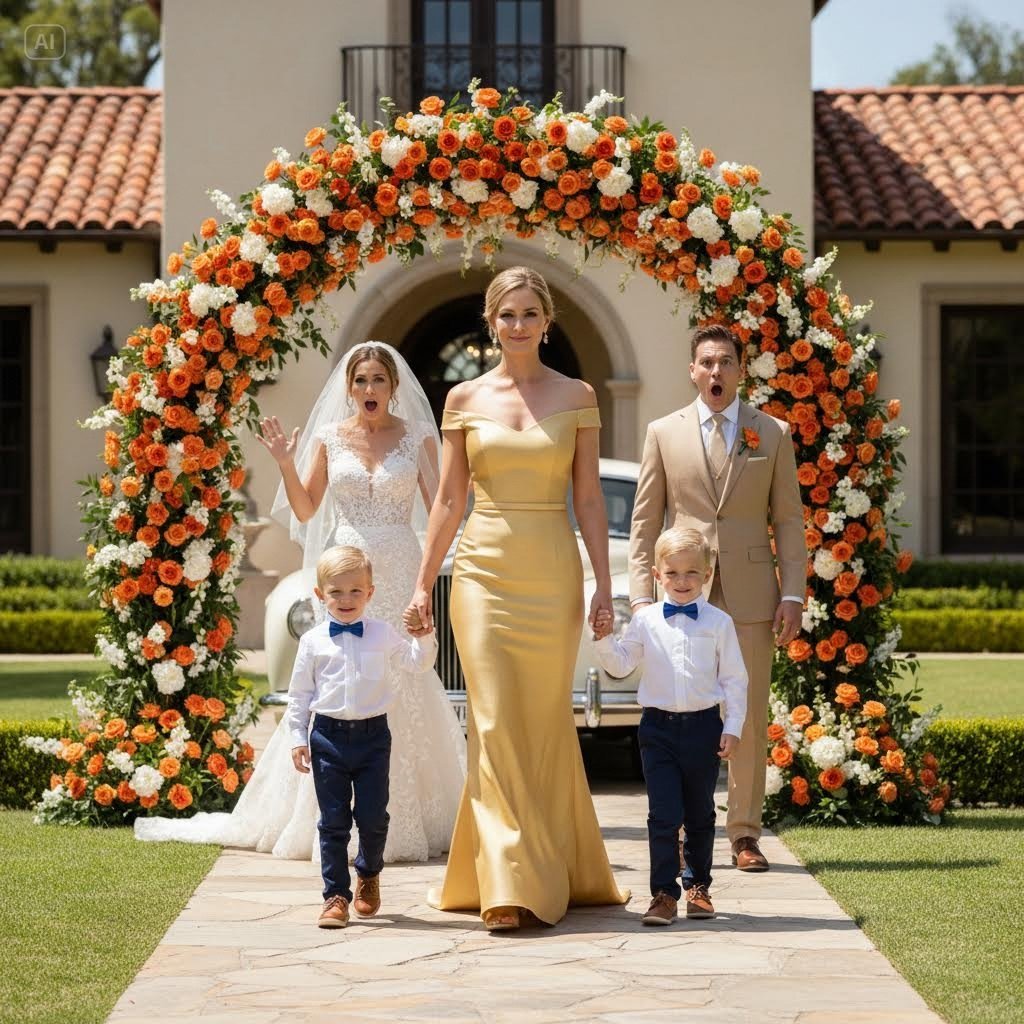
Two five-year-old girls stepped out.
Identical in posture.
Identical in expression.
And unmistakably, mathematically, undeniably Damien’s.
The symmetry of their eyes.
The shape of their smiles.
The structure of their faces.
The truth walked into the aisle and didn’t need a microphone.
The entire room went silent.
And Damien Keller’s perfect world began to crack.
The ocean wind carried salt and tension across the courtyard.
Every guest turned to look at us.
Not because of the car.
Not because of the gown.
Because of the children.
Sophie held my left hand. Chloe held my right. Their small fingers were warm and steady, completely unaware of the earthquake they’d just triggered.
Damien’s face drained of color.
His first reaction wasn’t denial.
It was calculation.
He scanned the crowd quickly, as if measuring how much damage this could cause.
“Adriana,” he said sharply, stepping forward. “What is this?”
His voice tried for control. It landed somewhere between panic and performance.
I didn’t respond immediately.
I didn’t rush.
The most powerful thing in that moment was the space between his question and my answer.
Vivienne stood beside him in a fitted ivory gown, her posture immaculate. She followed his gaze to the twins and her expression shifted—not jealousy, not insecurity.
Recognition.
Children don’t lie with their faces.
The resemblance was undeniable.
“Who are they?” she asked quietly.
Damien opened his mouth.
I spoke before he could.
“They’re five,” I said calmly. “Born three months after you walked out of our apartment.”
The silence deepened.
A few guests shifted uncomfortably. Someone in the back whispered, “Oh my God.”
Damien’s voice hardened.
“You’re trying to embarrass me,” he said. “This is inappropriate.”
“Inappropriate?” I echoed softly.
“You could have told me,” he snapped.
“I tried,” I replied evenly. “You changed your number.”
That detail landed.
Because it was simple.
Verifiable.
Real.
Vivienne’s eyes never left the girls.
“Are they yours?” she asked him directly.
Damien hesitated.
That hesitation told her everything.
“They could be,” he said finally.
The words were weak.
Calculated.
Cowardly.
Sophie squeezed my hand.
Chloe tilted her head slightly, studying the man in the suit like she was trying to match him to a memory she didn’t have.
I looked at Damien calmly.
“They’re yours,” I said. “DNA results are in my purse if you’d like to make this more public.”
A few gasps rippled through the crowd.
The officiant shifted awkwardly, unsure whether to continue pretending this was still a wedding.
Vivienne turned to face Damien fully now.
“You told me you didn’t have children,” she said.
“I don’t—” he started, then corrected himself. “I didn’t know.”
“You didn’t know?” I asked quietly.
“You never told me,” he shot back, desperate.
“You never asked,” I replied.
That was the first crack in his composure.
The second came when Vivienne’s father stepped forward.
Mr. Laurent was a man who wore authority the way some men wear watches—visible and expensive.
“Is this true?” he asked Damien, voice cold.
Damien tried to pivot.
“This is a manipulation,” he said quickly. “She wants money. She always wanted—”
I laughed softly.
It wasn’t hysterical.
It wasn’t loud.
It was controlled.
“I don’t need your money,” I said calmly.
That line shifted the energy more than anything else.
Vivienne’s father narrowed his eyes.
“What do you mean?” he asked.
I met his gaze.
“I built something,” I said. “Quietly.”
Damien scoffed.
“You ran a bakery,” he said dismissively.
“Three restaurants,” I corrected. “Then eight. Then twelve. All profitable.”
The murmurs began again.
Damien’s jaw tightened.
“You’re exaggerating,” he said.
I reached into my purse and pulled out a slim folder.
Inside were documents—corporate filings, financial statements, valuation summaries.
I handed them to Mr. Laurent.
He scanned the first page.
Then the second.
His expression didn’t explode into shock.
It tightened.
Calculating in a way Damien had never mastered.
“You’re telling me,” Mr. Laurent said slowly, “that you operate Keller Culinary Group?”
“Yes.”
The name landed like thunder.
Keller.
Damien had tried to erase me.
He’d unknowingly funded the growth of a name he thought he owned.
“You used my name,” he snapped.
“I kept it,” I corrected. “Because I built it.”
Vivienne’s grip on her bouquet tightened.
“You told me she was struggling,” she said to Damien. “That you left because she couldn’t keep up.”
Damien’s mouth opened.
Closed.
There was no version of the truth he could spin now.
But I wasn’t finished.
“I didn’t come here for money,” I said clearly, projecting enough for the back rows to hear. “I came because your fiancé invited me to witness what ‘success’ looks like.”
I gestured around.
“Let’s talk about success.”
Mr. Laurent’s eyes sharpened further.
“Continue,” he said.
“Damien’s last two ventures were financed partly through funds diverted from a vendor contract he signed with my company,” I said calmly.
The words hung in the air.
Damien’s head snapped toward me.
“That’s a lie,” he said quickly.
“Is it?” I asked.
I opened another folder.
Emails.
Invoices.
Payment discrepancies.
He’d assumed I wouldn’t notice.
He’d assumed I wouldn’t audit.
But I did.
Quietly.
Like everything else.
“Three hundred thousand dollars redirected through shell accounts,” I said evenly. “I didn’t pursue it at the time. I was focused on raising our daughters.”
Vivienne looked at him slowly.
“You stole from her?” she asked.
“I didn’t steal,” Damien snapped. “It was a temporary reallocation.”
Mr. Laurent’s face went stone still.
“Temporary?” he repeated.
“The funds were returned—” Damien started.
“They weren’t,” I said calmly. “Because I absorbed the loss.”
The crowd had stopped pretending.
Phones were out again—but this time not in mockery.
In documentation.
Vivienne removed her hand from Damien’s arm.
“You lied about children,” she said quietly. “You lied about finances. What else?”
Damien reached for her.
“Vivienne, don’t let her—”
She stepped back.
“Don’t,” she said.
Her father handed the documents to his assistant.
“This wedding is paused,” he said sharply. “Effective immediately.”
The officiant lowered his book.
Guests shifted uneasily.
Damien’s face twisted.
“You’re overreacting,” he said.
Vivienne’s eyes were steady now.
“No,” she replied. “I’m reacting appropriately.”
She slipped the ring off her finger.
The metallic sound of it hitting the tray beside the altar echoed.
“You didn’t lose her,” I said quietly to Damien.
“You forfeited her.”
His knees seemed to weaken.
He turned toward the twins instinctively.
“My daughters,” he whispered.
Sophie stepped slightly behind me.
Chloe looked up at me instead of him.
“You walked away before you knew them,” I said calmly. “That was your choice.”
The security team from the SUVs remained still—but present.
Mr. Laurent signaled subtly.
“Mr. Keller,” he said coolly, “you will leave.”
The guests parted slightly as Damien stood there, stripped of confidence.
He had invited me to humiliate me.
Instead, the aisle had gone silent for him.
Part Three: After the Silence
We didn’t stay for applause.
We didn’t wait for commentary.
I took the girls’ hands and walked back down the aisle.
No rush.
No dramatic exit.
Just steady steps.
As we reached the Rolls-Royce, Sophie looked up at me.
“Was that our dad?” she asked quietly.
I knelt to their level.
“Yes,” I said honestly.
“Why didn’t he hug us?” Chloe asked.
I swallowed.
“Because he doesn’t know how,” I replied.
Children accept truth differently than adults.
They nodded, as if that explanation fit into the world they understood.
We got into the car.
The door closed.
And the noise of the resort faded behind tinted glass.
In the days that followed, the story spread.
Not because I told it.
Because weddings don’t collapse quietly.
But I didn’t give interviews.
I didn’t issue statements.
I didn’t celebrate.
I filed a formal fraud complaint through my legal team.
And I moved on.
Damien called once.
I didn’t answer.
He sent one message:
You ruined my life.
I responded with one sentence.
You did that yourself.
Then I blocked him.
Months later, Sophie and Chloe started kindergarten.
They drew pictures of their “family.”
It was always the same.
Me in the center.
Two girls on either side.
A house by the ocean.
No empty spaces.
No missing figures.
That’s when I knew something important.
They hadn’t lost anything.
They had never known him.
I had never needed him.
And the only humiliation that day had belonged to the man who thought success meant spectacle.
Real success had been quieter.
It was built in kitchens at 2 a.m.
In spreadsheets.
In school pickups.
In patience.
Damien wanted the aisle to prove he’d upgraded.
Instead, it proved he’d miscalculated.
Because real wealth isn’t measured in status.
It’s measured in what you protect.
And I walked away protecting exactly what mattered.
Website Disclaimer
The information provided on this website is for general informational and educational purposes only. While we strive to ensure that all content is accurate and up to date, we make no guarantees regarding the completeness, reliability, or accuracy of any information published.
The views and opinions expressed in articles belong to their respective authors and do not necessarily reflect the views of this website. Any action you take based on the information found on this website is strictly at your own risk. We will not be liable for any losses, damages, or inconveniences arising from the use of our content.
Some articles may contain opinions, third-party information, or external links. We do not endorse or guarantee the accuracy of content on external websites and are not responsible for their practices or policies.
All content on this website is provided in good faith and is intended for informational purposes only. Readers are encouraged to verify information independently and seek professional advice where appropriate.