The United States Federal Communications Commission has given SpaceX the green light to deploy a constellation of up to one million satellites designed to work as data centres in orbit, in what the regulator itself has described as a historic first in the race to power artificial intelligence from space.
The decision, announced on Wednesday 25 November 2026, authorises the company’s proposed Starmind constellation, a fleet of solar-powered “orbital compute modules” that would process enormous volumes of data high above the Earth and beam the results back down. It is the first time any regulator has approved a full constellation of orbital data centres, and it comes as rivals including Google and Blue Origin pursue similar ideas of their own.
What Starmind Actually Is
Starmind is not an extension of Starlink, SpaceX’s broadband network. The two projects share rockets and engineering, but they do different jobs. Starlink satellites beam internet connections down to dishes on the ground. Starmind satellites, by contrast, would carry powerful AI chips and work together as a giant computing system in space, using the sun’s energy to run calculations that would be far more expensive, and far more power-hungry, to run in data centres on Earth.
SpaceX first put the idea formally to the FCC in an application filed on 30 January 2026. In that filing, the company described Starmind as “capturing solar energy in space to power low-cost, high-performance AI compute for Earth.” The satellites would be linked to one another by high-speed laser communications, forming a single interconnected machine that could take on the most demanding AI workloads, from training giant models to processing vast streams of data in real time.
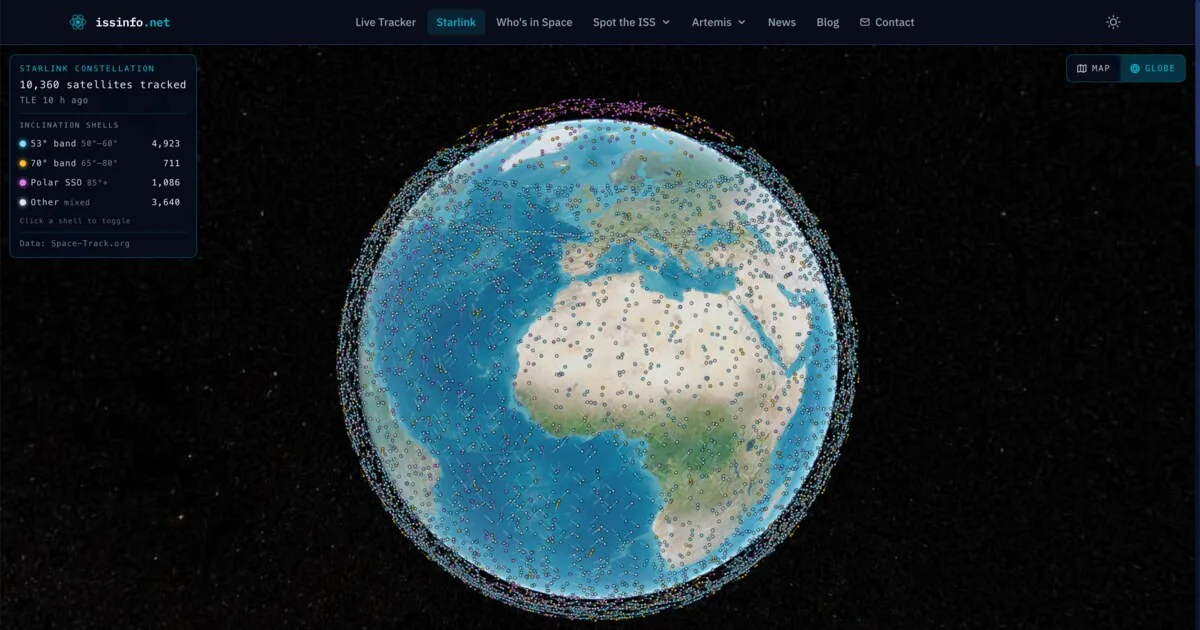
The scale is staggering. SpaceX already operates the largest satellite fleet ever assembled, with just over 11,000 Starlink satellites in orbit. Starmind, at its full size, would increase the total number of satellites in Earth orbit roughly fifty-fold. Today only about 17,000 satellites of all kinds circle the planet, so a million-strong constellation would transform low Earth orbit beyond recognition.
A Fourteen-Year Deadline
The FCC’s authorisation comes with strict milestones spread over fourteen years. SpaceX must have its first operational Starmind satellite in orbit by November 2033. It must then deploy ten percent of the constellation, or 100,000 satellites, by November 2035, and half of it, 500,000 satellites, by November 2038. The full million must be in place by 2040.
The satellites would fly in six orbital shells between roughly 500 and 1,002 kilometres above the Earth, lower than the 2,000-kilometre ceiling SpaceX originally proposed. The radio side of the licence is narrow: Starmind is granted Ka-band spectrum only for backup and emergency telemetry, tracking and command, since the satellites are expected to talk to each other mainly by laser rather than radio.
Not everything SpaceX asked for was granted. The company sought a waiver allowing satellites operating above 600 kilometres to be moved into so-called graveyard orbits at the end of their lives, rather than being brought down to burn up in the atmosphere. The FCC deferred that request. Before any Starmind satellite can fly above 600 kilometres, SpaceX must file a modification with an orbital debris plan the agency accepts, because satellites at that height are not pulled down by atmospheric drag within a few years.
Why Space, and Why Now
The driving force behind the project is the exploding demand for AI computing. Training and running modern AI systems consumes vast amounts of electricity, and data centres on Earth are running into limits of power supply, cooling and land. In space, sunlight is constant and abundant, and heat can be radiated away into the vacuum. SpaceX’s pitch is that orbit offers a nearly unlimited supply of clean energy and natural cooling for the world’s hungriest computers.
FCC Chairman Brendan Carr, appointed by President Donald Trump, praised the decision as a step that would advance American leadership in space and artificial intelligence. In its order, the FCC’s Space Bureau found that granting the application would serve the public interest by allowing SpaceX to pioneer emerging technology in both fields.
The authorisation also sidestepped a major environmental question. Consistent with an FCC order from October 2026, the agency said it would not require further environmental review under the National Environmental Policy Act, concluding that space-based operations do not count as a major federal action because they take place outside United States territory.
Scientists Sound the Alarm
Not everyone is celebrating. Scientists and astronomers have reacted with scepticism and alarm, warning that a million new satellites could have massive consequences for low Earth orbit, for the atmosphere and for the night sky. The fear is twofold: collisions and debris could cascade through crowded orbital lanes, and thousands of satellites burning up on re-entry could alter the chemistry of the upper atmosphere.
Astronomers also worry about the view from the ground. Even today’s roughly 17,000 satellites leave bright streaks across telescope images. A fleet fifty times larger could make parts of the sky unusable for ground-based astronomy, and the glow of so many objects could change what ordinary people see when they look up at night.
Supporters of the project reply that the licence is only a first step. SpaceX still needs separate launch licensing, and meeting the FCC’s own milestones will require a launch rate far beyond anything achieved so far. Whether the concept can live up to its promises, and whether the economics of building and launching a million computing satellites can ever work, remains an open question. But with the FCC’s approval in hand, the idea of data centres in orbit has moved from a pitch deck into the realm of official policy.
Website Disclaimer
The information provided on this website is for general informational and educational purposes only. While we strive to ensure that all content is accurate and up to date, we make no guarantees regarding the completeness, reliability, or accuracy of any information published.
The views and opinions expressed in articles belong to their respective authors and do not necessarily reflect the views of this website. Any action you take based on the information found on this website is strictly at your own risk. We will not be liable for any losses, damages, or inconveniences arising from the use of our content.
Some articles may contain opinions, third-party information, or external links. We do not endorse or guarantee the accuracy of content on external websites and are not responsible for their practices or policies.
All content on this website is provided in good faith and is intended for informational purposes only. Readers are encouraged to verify information independently and seek professional advice where appropriate.