A fuel tanker overturned and burst into flames on the Ring Road encircling Cairo on Wednesday evening, killing at least 31 people and injuring 21 others in one of the deadliest road disasters Egypt has seen in years.
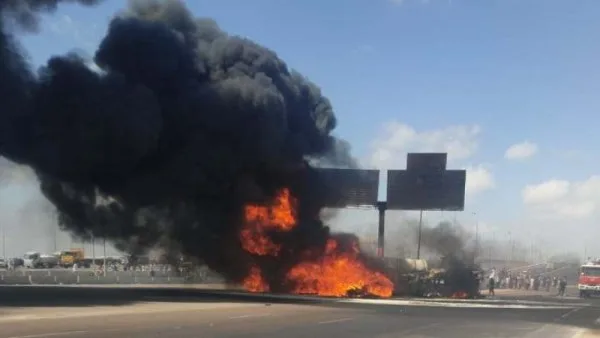
The crash happened at around 6:08 p.m. local time on 25 November above Tunnel 10 in the Al Warraq district of Giza, part of the Greater Cairo area. According to Egypt’s health ministry, the tanker was carrying petroleum products and gas cylinders when it veered off the road, struck a concrete barrier and overturned, spilling fuel that ignited within moments and spread to nearby vehicles.
A Fire That Spread in Seconds
Witnesses described a scene of sudden horror on one of the capital’s busiest highways. The tanker exploded after overturning, and the fire raced across the carriageway, engulfing more than two dozen cars and motorcycles caught in the evening traffic. Thick black smoke rose over the Ring Road as drivers abandoned their vehicles and fled on foot.
State-owned media reported that the tanker had overturned after a high-voltage cable fell in front of it, forcing the driver to lose control. Al-Ahram newspaper, citing sources familiar with the investigation, said the tanker belonged to a private contractor. The country’s Public Prosecution has opened a criminal investigation and ordered DNA tests to identify victims who were burned beyond recognition, while its preliminary inspection found that the driver lost control of the steering wheel before the vehicle hit the barrier.
Emergency Response and the Rising Toll
Emergency teams sent 39 ambulances to the scene, pulled survivors from burning vehicles and moved the injured to nearby hospitals. Some of the injured are in critical condition, with burns covering 70 to 80 percent of their bodies, according to reports. Health Minister Khaled Abdel Ghaffar visited the site and warned that the death toll was preliminary and could rise further.
Initial reports put the number of injured at 25, but the health ministry later revised the figure down to 21. Hundreds of people gathered near the scene in Warraq, a densely populated neighbourhood, as firefighters worked to bring the blaze under control and clear the wreckage. The highway was later reopened after emergency responders cleared the scene.
A Familiar Danger on Egypt’s Roads
The disaster has once again thrown a spotlight on road safety in Egypt, where fatal crashes are a grimly regular occurrence. The Ring Road is a key artery that carries heavy traffic around the capital, and tankers carrying fuel and gas cylinders travel it every day through densely populated districts. The fact that the explosion happened above a tunnel in a crowded neighbourhood made the consequences far worse than they might have been on an open stretch of highway.
Questions are already being asked about how the tanker came to be on the road, the condition of the vehicle, and whether the fallen power cable played the decisive role. Investigators will also want to know why a vehicle carrying such a dangerous load was travelling through one of the most congested parts of the city at the height of the evening rush.
Families Wait for Answers
For the families of the victims, the wait for news has been agonising. With some bodies badly burned, identification through DNA testing will take time, and hospitals across Cairo are treating the injured. The health ministry has said it will update the casualty figures as more information becomes available.
The scale of the tragedy has shocked a country that has seen several deadly tanker accidents in recent years. Previous fires involving fuel trucks on busy highways have killed dozens at a time, and safety campaigners say little has changed in how dangerous cargo is moved through crowded urban areas. Each disaster prompts the same promises of tougher inspections and stricter rules for heavy vehicles, yet tankers continue to share the roads with ordinary commuters at the busiest hours of the day.
The tragedy comes as Egypt continues to grapple with the human cost of its road network. Each year thousands of people die in crashes across the country, and campaigners have long called for stricter enforcement of safety rules for heavy vehicles, better road maintenance and tighter controls on the transport of hazardous cargo. For now, though, the focus in Warraq is on the dead, the injured and the families left behind after an ordinary evening journey turned into a catastrophe in under a minute.
Website Disclaimer
The information provided on this website is for general informational and educational purposes only. While we strive to ensure that all content is accurate and up to date, we make no guarantees regarding the completeness, reliability, or accuracy of any information published.
The views and opinions expressed in articles belong to their respective authors and do not necessarily reflect the views of this website. Any action you take based on the information found on this website is strictly at your own risk. We will not be liable for any losses, damages, or inconveniences arising from the use of our content.
Some articles may contain opinions, third-party information, or external links. We do not endorse or guarantee the accuracy of content on external websites and are not responsible for their practices or policies.
All content on this website is provided in good faith and is intended for informational purposes only. Readers are encouraged to verify information independently and seek professional advice where appropriate.