A second United States judge has blocked enforcement of President Donald Trump’s executive order limiting birthright citizenship, dealing another blow to one of the flagship policies of his administration’s hardline immigration crackdown.
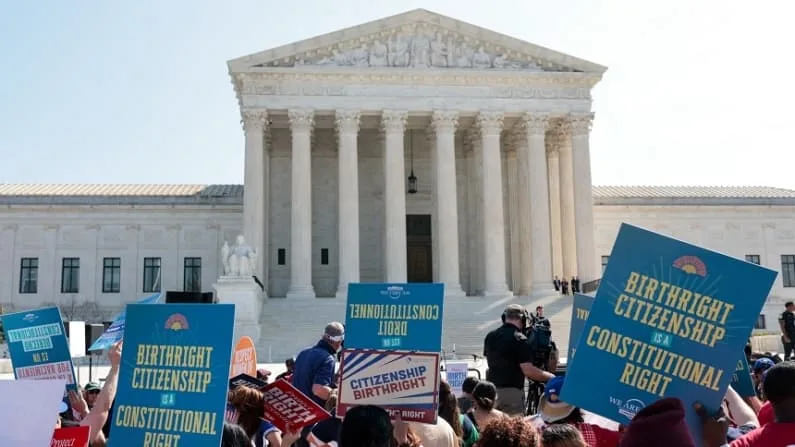
US District Judge Christopher Cooper in Washington, DC, issued a preliminary injunction on Wednesday in a class action lawsuit filed on behalf of children who would be denied citizenship under the August executive order. The ruling means the administration will now need to overturn two separate court decisions before the order can ever be enforced.
A Second Courtroom Defeat
Another federal judge in Maryland had already blocked Trump’s order in September. With Judge Cooper’s ruling, the administration faces two injunctions standing in its way, each issued by a different court, in different parts of the country.
The preliminary injunction issued by Judge Cooper bars the US Department of State, the US Department of Homeland Security and the Social Security Administration from enforcing Trump’s order against any children covered by the class action. In practice, that means the government cannot refuse passports, deny Social Security numbers, or withhold recognition of citizenship from the children in the case while the litigation continues.
The order Trump signed in August was his second attempt to restrict birthright citizenship, issued after the US Supreme Court rejected his initial effort to impose restrictions. The new order was drafted in the hope of surviving the legal challenges that had sunk the first one. Instead, it has now been blocked twice in the space of a few months.
What the Order Would Have Done
Birthright citizenship is the principle, rooted in the Fourteenth Amendment to the US Constitution, that almost anyone born on American soil is an American citizen. It has been the law of the land for more than 150 years and is one of the most distinctive features of American citizenship.
Trump’s executive order sought to narrow that principle sharply, limiting the number of people eligible for citizenship at birth. Under the order, children born in the United States would have been denied citizenship in certain circumstances, notably where their parents were in the country unlawfully or only temporarily. The class action before Judge Cooper was brought on behalf of children who would have lost their citizenship under that rule.
For the families involved, the stakes could hardly be higher. A child denied citizenship at birth faces a lifetime of legal uncertainty: no passport, no Social Security number, difficulty enrolling in school or obtaining healthcare, and the constant threat of removal from the only country they have ever known.
The Legal Battle So Far
The Trump administration has argued that the Fourteenth Amendment was never intended to guarantee citizenship to the children of people who entered the country unlawfully or who were present only on a temporary basis. That reading of the amendment is fiercely contested by constitutional scholars and immigrant rights groups, who say the amendment’s text, “all persons born or naturalized in the United States, and subject to the jurisdiction thereof,” is clear and has been settled law since the Supreme Court’s 1898 decision in United States v. Wong Kim Ark.
The courts have so far sided with the challengers. The Supreme Court’s rejection of Trump’s initial effort, followed by the Maryland injunction in September and now the Washington ruling, means the administration has lost at every stage of the fight. Each ruling has found that the challengers are likely to succeed on the merits of their claim, and that the harm of allowing the order to take effect while the case proceeds would be severe and irreversible.
What Happens Next
The administration is expected to appeal both injunctions, and the case could eventually return to the Supreme Court. But for now, the order cannot be enforced against the children covered by either class action, and the government must win on appeal in both cases before it can put the policy into practice.
That is a steep hill to climb. Two different judges, in two different jurisdictions, have now concluded that the order is likely unlawful, and each has been willing to block it nationwide in scope for the children it covers.
The ruling also lands in the middle of a broader political fight over immigration, the issue on which Trump built much of his political career. Restricting birthright citizenship has long been one of his most popular promises with his supporters, and also one of the most legally ambitious. Wednesday’s decision is a reminder that even the most determined presidential agenda still has to pass through the courts, and that the Constitution’s oldest promises are not easily rewritten by executive order.
Website Disclaimer
The information provided on this website is for general informational and educational purposes only. While we strive to ensure that all content is accurate and up to date, we make no guarantees regarding the completeness, reliability, or accuracy of any information published.
The views and opinions expressed in articles belong to their respective authors and do not necessarily reflect the views of this website. Any action you take based on the information found on this website is strictly at your own risk. We will not be liable for any losses, damages, or inconveniences arising from the use of our content.
Some articles may contain opinions, third-party information, or external links. We do not endorse or guarantee the accuracy of content on external websites and are not responsible for their practices or policies.
All content on this website is provided in good faith and is intended for informational purposes only. Readers are encouraged to verify information independently and seek professional advice where appropriate.