Hell didn’t arrive with fire.
It arrived with a sound.
A door slamming against drywall at five in the morning—sharp, violent, final. The kind of sound that doesn’t wake you so much as drag you out of sleep, heart already racing, body already bracing for what comes next.
I was six months pregnant, and my body no longer belonged to me in the way it used to. Everything had weight. My stomach was a planet I orbited carefully. My back burned like a live wire if I moved the wrong way. My hips ached constantly, and my legs never quite felt steady anymore. Sleep came in pieces, and fear filled the gaps, because fear always moves into whatever space you give it.
The bedroom door flew open so hard it bounced.
Víctor stood there, framed by the hallway light, already furious. His face wasn’t twisted with surprise or concern. It was twisted with entitlement—rage that believed it had the right to exist, rage that believed the world owed it obedience.
“Get up, useless cow!” he shouted.
The words hit before his footsteps did. They landed heavy, familiar, practiced. They weren’t the kind of words said in a moment of anger. They were the kind used as a tool, sharpened over time.
He crossed the room in two strides and ripped the blankets off me so hard they tangled around my legs. Cold air rushed in and I gasped, instinctively wrapping both arms around my stomach like I could shield the baby from the way his anger filled the room.
“Do you think being pregnant makes you a queen?” he continued, voice rising. “My parents are hungry!”
I tried to sit up. Pain shot through my lower back, sharp enough to steal my breath. My legs shook as I lowered my feet to the floor. The room spun, that faint dizziness that had been haunting me for weeks, like my body was always one step away from collapse.
“It hurts,” I whispered. “I can’t move fast.”
I wasn’t asking for sympathy. I wasn’t even asking for kindness. I was asking for time.
Víctor laughed.
It wasn’t loud. It wasn’t wild. It was controlled and cruel, the laugh of someone who enjoyed the imbalance of power, someone who needed it the way others needed water.
“Other women hurt and don’t complain,” he said. “Stop acting like a princess. Get downstairs and cook—now.”
He stepped back, already turning away, already done with me. That was the part that used to break me the most: how quickly he could treat my pain like an inconvenience and move on as if nothing had happened.
I stood slowly, one hand pressed to the wall for balance. Every movement felt exaggerated, like my body had become an object I had to drag through life. The hallway felt colder than it should have. The stairs loomed ahead, steep and unforgiving, each step a little cliff. I took them one at a time, gripping the railing so hard my fingers cramped.
The kitchen lights were already on.
Helena and Raúl—his parents—sat at the table like they were waiting for a show. Coffee cups in front of them. Plates empty, expectant. Their posture said this was normal. Their faces said they liked it.
Nora, Víctor’s sister, leaned against the counter, phone raised casually, recording.
Not hiding it.
Not ashamed.
“Look at her,” Helena said, smiling thinly. “She thinks carrying a baby makes her special.”
Her eyes swept over me with open disgust, like I was a stain on her kitchen tiles. “So slow. So clumsy,” she added. “Víctor, you’re far too soft on her.”
“Sorry, Mom,” Víctor replied instantly, as if he was being graded.
Then he looked at me, and his face hardened the way it always did when he was about to remind me who owned the air in the room.
“Did you hear that?” he snapped. “Faster. Eggs, bacon, pancakes. And don’t burn them like you always do.”
My hands trembled as I opened the refrigerator. The light inside was too bright, almost painful. I stared at the shelves—eggs, milk, leftover containers—trying to make my body move faster than it could. The baby kicked, a sudden flutter, and for a second my instinct was to smile at the reminder that life was still inside me.
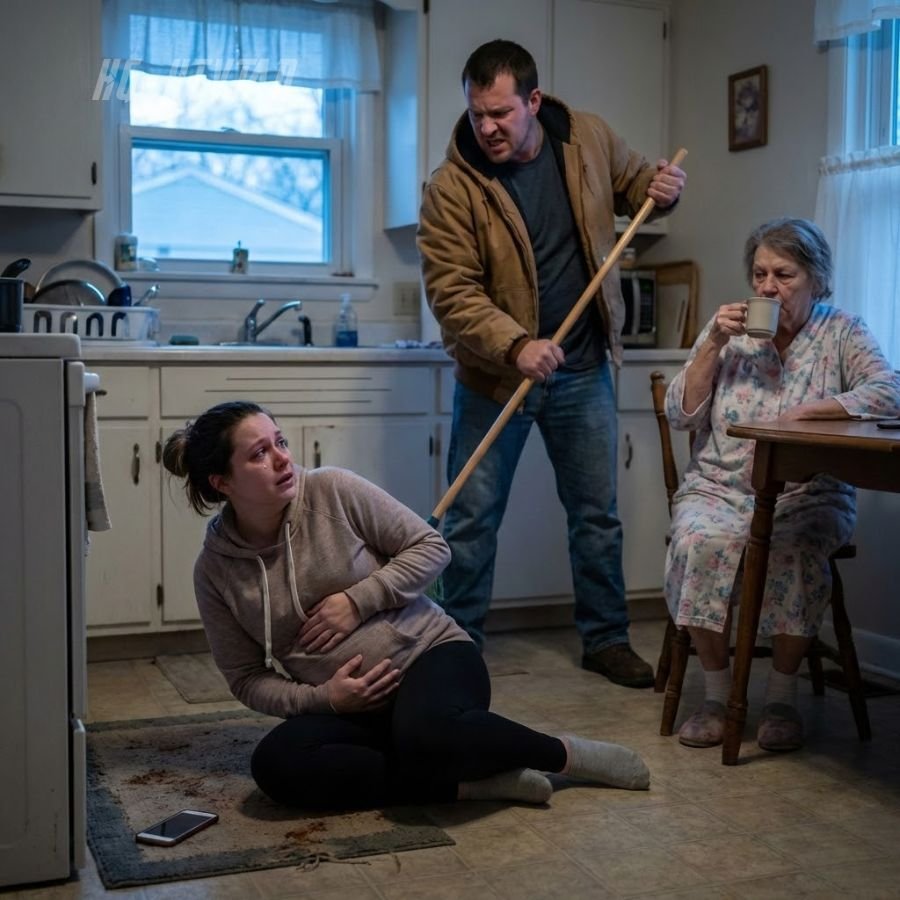
Then a wave of dizziness crashed over me—violent and disorienting. The room tilted. My ears rang. I tried to grab the counter, but my fingers missed, skimming air like I was falling in a dream.
The floor rushed up.
The impact knocked the breath out of me. Pain exploded through my hip and thigh. I curled instinctively, both arms wrapping around my stomach, heart hammering in terror because I couldn’t tell if the pain was only mine.
“What an exaggeration,” Raúl growled from the table. “Get up!”
I tried. My body didn’t respond. It was like my limbs were no longer connected to my thoughts.
Víctor sighed dramatically, as if I had inconvenienced him.
He walked to the corner of the kitchen.
I saw the stick before I understood what was happening.
Thick. Wooden. Something he had used before. He called it “discipline,” like abuse could be baptized into something respectable if you named it right.
“I told you to get up!” he roared.
The blow landed on my thigh.
White-hot pain tore through me and I screamed. The sound ripped out of my body before I could stop it. I curled tighter, shielding my belly with everything I had, every instinct, every ounce of muscle I could still command. Tears streamed down my face, humiliating and uncontrollable.
“She deserves it,” Helena laughed. “Hit her again. She needs to learn her place.”
“Please,” I sobbed. “Please—the baby—”
“Is that all you care about?” Víctor shouted, as if my fear for my child was an insult to him. He raised the stick again. “You don’t respect me!”
Time slowed into fragments. A breath. A blink. The creak of a chair. The buzz of the overhead light. My phone lay on the floor a few feet away, having slipped from my pocket when I fell. The screen was cracked but lit.
Hope.
Desperate, fragile hope.
I lunged.
“Grab her!” Raúl shouted.
Hands reached for me, but pain fueled something animal inside my chest. My fingers scraped the floor, nails bending until I felt the edge of broken glass under my fingertips. I hooked the phone, dragged it closer, unlocked it by muscle memory.
Opened the chat.
Alex.
My brother.
Ex-Marine.
Ten minutes away.
I typed with shaking hands, the letters blurring.
Help. Please.
I hit send.
For one second, the world became a narrow tunnel where only that message existed.
Víctor was on me in an instant. He ripped the phone from my hand and smashed it against the wall. Plastic shattered. The screen went dark.
He grabbed my hair and yanked my head back until my neck screamed.
“You think someone’s coming to save you?” he whispered into my ear, voice low and intimate in the way nightmares are intimate. “Today you learn.”
The room closed in. My vision tunneled. The edges of everything went gray, then black, like someone had turned the lights off behind my eyes.
But before everything disappeared—before pain swallowed sound and light—I held onto one thought with a kind of fierce certainty.
The message had gone through.
And whatever came next would change everything.
I came back to the world in pieces.
First sound—high and sharp, a ringing that drilled through my skull. Then light, white and relentless, flashing past my closed eyelids. My body felt split down the middle, every nerve screaming as if it had been pulled too tight and left there.
I tried to move.
Pain answered.
“She’s waking up,” a voice said. Calm. Professional.
I forced my eyes open. The ceiling above me was too close, too bright. Plastic panels. Metal rails. The air smelled like antiseptic and rubber.
An ambulance.
My hand was being squeezed—hard, grounding, like an anchor thrown into storm water.
“I’m here,” someone said. A familiar voice, rough around the edges. “It’s over.”
I turned my head slowly.
Alex.
My brother’s face hovered above me, eyes red, jaw clenched so tightly the muscle jumped beneath his skin. One hand held mine like he was afraid I might disappear if he let go. He looked older than he had the last time I’d seen him, older and sharper, like fury had carved him into something harder.
Tears blurred my vision instantly.
“The baby…?” I whispered. The word scraped my throat raw.
Alex leaned closer. “He’s okay,” he said quickly. “They checked. The doctors say it was a miracle you didn’t lose consciousness sooner.”
A sob tore out of me, half relief, half terror finally releasing its grip. My whole body shook with it.
I couldn’t remember how I’d gotten here. Everything after the kitchen floor blurred into darkness, then scattered fragments—someone shouting, the sound of something crashing, the word police like a distant echo.
Later, much later, I learned what happened in full.
Alex had been tying his boots for work when his phone buzzed. One message. Two words.
Help. Please.
He didn’t call first.
He called the police.
Then he drove.
He ran every red light.
The patrol cars arrived seconds behind him, lights flashing blue and red across the quiet street like the world had finally decided to pay attention. The front door of the house didn’t open—it came down. The sound of it breaking was a kind of justice all by itself.
Víctor was mid-swing, the wooden stick raised again, his face twisted with rage.
“Police! On the ground—now!”
Chaos erupted. Helena screamed. Nora dropped her phone, scrambling to shut it off, her hands shaking too late. Raúl shouted excuses, words tumbling over each other—family matter, misunderstanding, she’s dramatic—as if the right phrases could dissolve evidence.
Alex didn’t hear any of it.
All he saw was me on the kitchen floor, curled around my stomach, blood on my leg, my face swollen, eyes half-open.
He said later he had never known rage like that. Not in war zones. Not in training. Not anywhere. A rage so pure it made his hands shake.
Víctor tried to argue, tried to posture, tried to insist he was in control even while the world was shifting beneath his feet.
The police didn’t listen.
They took him down hard. Handcuffs snapped shut with a sound that felt like the end of a long, ugly sentence.
At the hospital, everything moved fast. Doctors, nurses, machines. Gentle hands and efficient voices. They examined me thoroughly—ultrasounds, monitors, careful pressure on my abdomen, questions asked softly, patiently. Every time I flinched, someone noticed. Every bruise was documented. Every injury was measured, photographed, recorded in language that turned my private terror into public fact.
A social worker sat beside my bed for hours. She didn’t rush. She didn’t look away when I struggled to speak. She asked questions that made my throat tighten, not because they were cruel but because they were finally honest.
How long has this been happening?
Do you feel safe going home?
Has he threatened you?
Has he ever used a weapon?
And for the first time, I told the truth. Not just about that morning, but about everything that led to it. The insults that came like rain—constant, soaking, wearing me down. The control disguised as concern. The way my phone was checked. The way money was monitored. The way my world shrank until it was only the house, only the rules, only the fear of the next door slam.
The charges were clear. Aggravated domestic violence. Abuse of a pregnant woman. Threats. Serious bodily injury.
When Helena tried to visit, security turned her away. The hospital barred all contact. When Raúl called, voice shaking, saying it was “a misunderstanding,” the social worker listened once and then said, calmly, “Sir, do not contact her again. Any further attempts will be documented.”
Nora’s video ended what little argument anyone might have tried to make.
She had sent it to a friend, probably thinking it would become a joke later, a story about how “dramatic” I was.
It showed everything.
The laughter.
The stick.
My screams.
The casual cruelty in Helena’s voice, the pleasure in it, like hurting me was a shared hobby.
The judge issued an immediate restraining order. Víctor didn’t come near me again.
The days that followed were strange. Quiet, but not peaceful. My body was in a hospital bed, but my mind was still on that kitchen floor. I slept in short bursts, waking from nightmares soaked in sweat, heart racing as if I could still hear the door slam. Every loud noise made me flinch. Every creak of a door sent panic crawling up my ribs.
But there was something new too, something so unfamiliar it felt like a foreign language.
Safety.
Alex took me to his house when I was discharged. A small place. Simple. Clean. Quiet. No yelling through walls. No footsteps that meant danger. No commands disguised as “family rules.” Just the hum of a refrigerator, the tick of a clock, and the steady reassurance of someone who didn’t ask what I had done to “provoke” him.
The first nights, I slept with the light on. I slept curled around my stomach even in a safe bed, my body refusing to forget what it had learned. Alex didn’t comment. He understood that healing wasn’t something you rushed and that telling someone “you’re safe now” doesn’t make their nervous system believe it.
Medical appointments filled my calendar. Checkups. Ultrasounds. Gentle voices telling me again and again that the baby was strong, that he was still there, that the heartbeat was steady.
“Minutes,” one doctor said quietly. “That’s all it came down to. A few minutes.”
Minutes.
A single message.
Two words.
Those minutes separated life from catastrophe.
A pro bono lawyer took my case. Divorce papers were filed. Emergency custody protections were set in place for the baby the moment he was born. Every step of the process felt like walking through a hallway where I’d been blindfolded for years, finally seeing the doors and realizing I had choices.
“You’re not alone,” Alex kept saying. “You never were.”
The hearings moved quickly because the evidence was overwhelming. Medical reports documented injuries consistent with repeated abuse. Photos showed bruises in different stages of healing. The audio from Nora’s recording—Helena laughing, Víctor threatening—played in court like a confession nobody could undo.
Víctor denied everything until the recording played, and then his denial collapsed into silence. He lowered his head, not in shame but in calculation, as if he was already thinking about the smallest sentence he could get.
The judge ordered him held in pretrial detention while the case proceeded. The first time I heard the words “held without bail,” my lungs filled for the first time in years like they remembered how.
Leaving the hospital didn’t mean I was suddenly okay. Safety is not a switch. It’s a place you learn to inhabit. My body was out of immediate danger, but my mind still woke up at five in the morning expecting a door slam. Fear has a memory longer than bruises. It lingers in silence, in shadows, in the way your body reacts before your thoughts catch up.
Therapy taught me to recognize the guilt when it came, because it came anyway. It came quiet and sneaky, wearing doubt like perfume.
Maybe you could have endured longer.
Maybe you made it worse by speaking up.
Maybe this is your fault.
My therapist named it for what it was: residue. A leftover poison from years of being told I was the problem. Abuse plants false beliefs the way weeds plant seeds—small at first, then everywhere. Naming them stripped them of power.
Two months later, I went into labor.
The hospital room was bright and busy, filled with calm urgency instead of chaos. Alex was there. A nurse held my hand. Pain ripped through me, intense and overwhelming—but it was pain with purpose, pain that ended with life instead of fear.
When I heard my son cry for the first time, something in me cracked open.
Lucas.
They placed him on my chest, warm and perfect and real. His tiny fingers curled instinctively, grasping at nothing and everything at once. I stared at his face and felt a kind of grief and rage and love all at the same time.
Fear loosened its grip for one long breath.
Something stronger took its place.
Determination.
My son would not grow up thinking cruelty was normal. He would not learn that love humiliates. He would not be taught that silence is safety. He would not watch a woman flinch at footsteps and think that was marriage.
The trial came later. I didn’t attend every hearing. My lawyer shielded me from what I didn’t need to relive. But when it was time to testify, I stood.
My legs trembled. My hands shook. My voice wavered on the first sentence, and then steadied, because truth has a weight that holds you up if you let it.
I told the truth plainly. I described mornings that began with fear. Words that cut deeper than blows. A household where obedience was demanded and dignity punished. I told them about the stick, about Helena’s laughter, about the way Nora recorded like it was entertainment. I told them about being six months pregnant and being called a useless cow.
I did cry once, not because I was weak, but because I saw Lucas’s face in my mind and realized how close he came to never existing outside my body.
When the sentence was delivered—years in prison, a permanent no-contact order—I didn’t feel triumph. I didn’t feel like I’d won.
I felt closure.
Justice doesn’t erase what happened. It doesn’t return the version of you that believed in safety. It doesn’t rewind years and give you different choices. But it draws a line.
And I crossed it.
Starting over wasn’t dramatic. It wasn’t a montage. It was small and stubborn.
A modest apartment near a park where sunlight filtered through trees instead of blinds. A job that allowed flexibility. Quiet routines that slowly rewired my nervous system. Folding baby clothes without flinching. Cooking without being watched. Sleeping with the door open one night and realizing nothing bad happened. Hearing footsteps in the hallway and recognizing they were mine.
Every step forward looked insignificant to the outside world, but to me it was monumental. It was proof I was rebuilding a self that had been erased one insult at a time.
I began to write, too. At first it was just notes—fragments, sentences, memories I needed to get out of my body. Then pages. Writing gave shape to pain that had lived unspoken for too long. It turned memory into something I could hold, examine, and finally set down.
Alex returned to his life eventually. He went back to work, back to routines, back to the world outside my crisis. But not before making sure I was steady. Not before installing new locks, helping me fill out paperwork, showing me how to check my surroundings without letting it become paranoia. He never treated me like a burden. He treated me like family.
That’s what I learned, in the end: family doesn’t demand sacrifice until you disappear. It stands beside you while you find your way back.
Sometimes I still think about that dawn. About how close I came to never telling this story. About how fragile safety can be when power is used to destroy instead of protect. And then I think about the smallest thing that changed everything.
Not strength.
Not luck.
Not even courage.
A message.
Sent in time.
I learned truths I now live by, the kind I want Lucas to grow up hearing as normal.
Love does not humiliate.
Respect is not begged for.
Violence is not negotiated.
Asking for help saves lives.
If someone reads this and recognizes the signs—insults, control, fear, isolation—don’t wait for it to get worse. Speak. Write. Call. Tell one person who will take you seriously. Save evidence if you can. Leave when you can. And if you can’t leave yet, plant the first small seed of escape in whatever way is possible: a message, a plan, a number memorized, a bag tucked away, a friend who knows.
There is always a way out, even when it feels invisible.
I found mine in two words I typed with shaking hands on a cracked screen.
Help. Please.
And on the day Lucas laughed for the first time—real, bright, unafraid—I realized something else.
Surviving was not the end of my story.
It was the beginning of a life I finally got to live.
Website Disclaimer
The information provided on this website is for general informational and educational purposes only. While we strive to ensure that all content is accurate and up to date, we make no guarantees regarding the completeness, reliability, or accuracy of any information published.
The views and opinions expressed in articles belong to their respective authors and do not necessarily reflect the views of this website. Any action you take based on the information found on this website is strictly at your own risk. We will not be liable for any losses, damages, or inconveniences arising from the use of our content.
Some articles may contain opinions, third-party information, or external links. We do not endorse or guarantee the accuracy of content on external websites and are not responsible for their practices or policies.
All content on this website is provided in good faith and is intended for informational purposes only. Readers are encouraged to verify information independently and seek professional advice where appropriate.