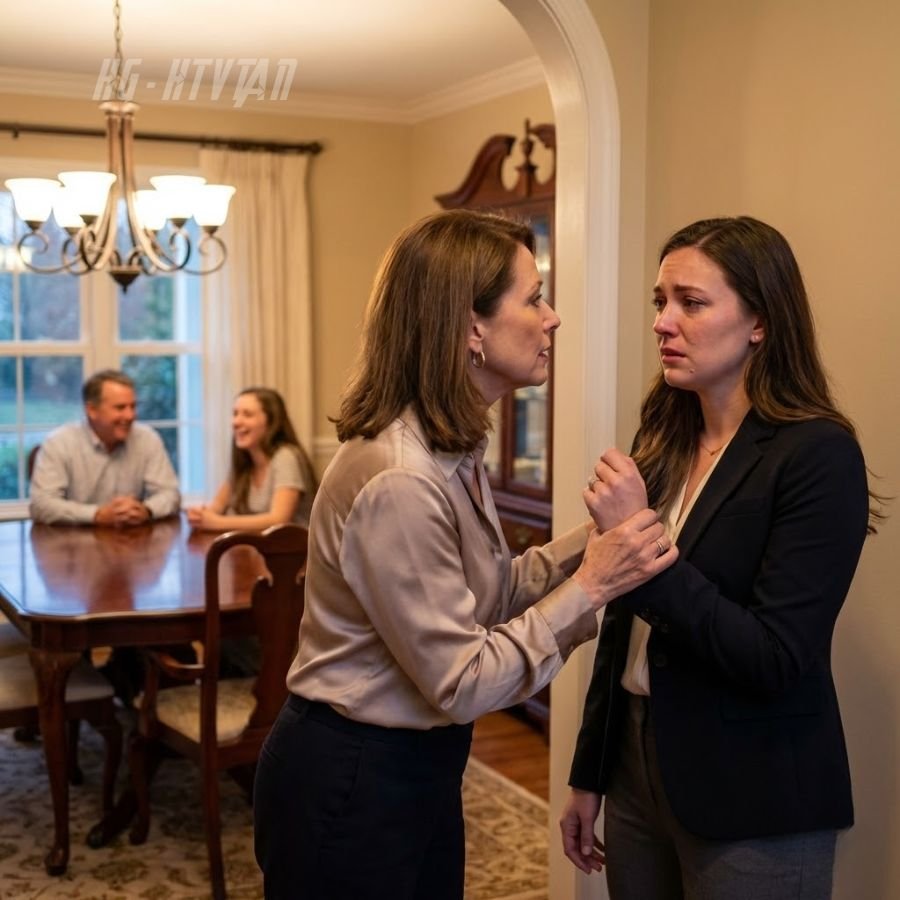
The crystal chandelier in my parents’ dining room cast familiar shadows across the polished mahogany table, the same slow-moving patterns I had watched since childhood, back when I believed being part of this family meant something shared, something balanced, something even remotely fair. That illusion had survived graduations, promotions, and weddings, bruised but intact, until the night my mother’s perfectly manicured fingers clamped around my wrist and pulled me out of the dining room as if I were still twelve years old and in trouble.
“Don’t have kids until your sister has her first,” she said, low and sharp, her voice stripped of warmth the second the door to the hallway closed behind us. It was a tone I knew intimately, one she reserved only for me, never for Bethany, never for the golden child whose laughter still floated from the dining room like background music to my humiliation.
My stomach dropped so hard I felt dizzy. “What?” I managed, my voice smaller than I intended, already bracing for the dismissal I knew was coming.
“Your father’s been working on a new house for ten years,” she interrupted smoothly, releasing my wrist only to straighten an invisible crease in her silk blouse. Her smile didn’t reach her eyes. “We’ve prepared something special just for her. A nursery with custom wallpaper from France. A play area that opens into the garden. Everything a young family could need.”
Ten years. The number echoed in my head like a struck bell. Ten years of planning while I’d been surviving overnight shifts in medical school, while I’d taken on student loans that still made my chest tighten when I looked at the balance, while Marcus and I postponed vacations, postponed upgrades, postponed everything that wasn’t strictly necessary. Ten years, quietly poured into Bethany’s future.
“What about me?” I asked, the words barely audible.
She waved her hand, dismissive, effortless. “You’ll be fine. You always are.”
And then she walked back into the dining room, where my father was already pouring wine for Bethany and her husband, Derek, their laughter spilling through the doorway as if nothing important had just happened.
I stood there alone, staring at my reflection in the antique mirror my grandmother had left to me in her will, the same mirror that now hung in my parents’ house because Bethany had cried and said it would “fit her aesthetic better.” My face looked older than it had an hour earlier, lines of understanding settling in places I hadn’t noticed before.
Marcus found me there minutes later, his hand warm and steady on my shoulder. “Everything okay?”
“Let’s go home,” I whispered.
The drive back to our townhouse was quiet, the city lights blurring past the windows while I replayed that hallway conversation over and over. Thirty-two years of being the afterthought, the responsible one, the daughter who was praised for surviving instead of celebrated for succeeding, had taught me how to swallow pain without making a mess.
But that night, lying beside Marcus in the dark, I let it spill. “They’ve been building her a house,” I said, staring at the ceiling. “For ten years. While I was drowning in loans, while we saved every dollar, they were constructing a mansion for Bethany.”
Marcus pulled me closer. “Your parents have always been blind when it comes to her.”
“Blind?” I let out a bitter laugh. “They see perfectly. They just don’t care about seeing me.”
Three months later, Bethany announced her pregnancy at another family dinner. My mother burst into tears before Bethany even finished her sentence. My father opened a bottle of champagne he’d apparently been saving for this exact moment, the cork popping like a signal flare. Derek beamed as if he’d personally accomplished something monumental.
The attention was overwhelming, the joy unfiltered, radiant. It was everything I’d never received for any of my milestones. Medical degree? A quick hug. Marriage to Marcus? Complaints about the guest list. Promotion to senior physician? A distracted congratulations. But Bethany getting pregnant stopped time itself.
I smiled. I clapped. I went home hollow.
A week later, standing in the hospital bathroom between rounds, I took three pregnancy tests. All positive. Marcus lifted me off the kitchen floor that night, laughing and crying at the same time. The joy was real, but tangled, knotted around my mother’s words in that hallway.
When I told her the next day, there was silence on the line. Then, “How far along?”
“Five weeks.”
“Beth’s twelve,” she said immediately. “She’s been so sick. I make her ginger tea every morning. Listen, I have to go. I’m meeting the interior designer at the new house. We’re choosing nursery paint.”
Over the months that followed, my parents transformed entirely into Bethany’s grandparents-in-waiting. Weekly Facebook updates. Custom furniture. A baby shower that looked like a wedding spread. I received a generic card in the mail.
Bethany went into labor first.
I was finishing rounds when Marcus called, his voice tight. “Your mom’s trying to reach you. It’s Bethany.”
The words that followed tilted the room. The cord. The silence. The baby didn’t make it.
At the funeral, my pregnancy was impossible to hide, an uncomfortable truth standing just a few feet away from their grief. I kept my distance. I said nothing.
A week and a half later, my doorbell rang at seven in the morning.
My parents stood in our living room, strangers in a space they’d never cared to see before. My mother twisted her hands together. My father looked suddenly older, smaller.
“We need to talk,” he said.
My mother swallowed hard. “It’s about Bethany.”
Continue in C0mment 👇👇
(Please be patience with us as the full story is too long to be told here, but F.B. might hide the l.i.n.k to the full st0ry so we will have to update later. Thank you!)
The crystal chandelier in my parents’ dining room cast familiar shadows across the mahogany table. I grown up watching those same patterns dance on the walls during countless family dinners.
back when I believed being part of this family meant something equal, something fair. That illusion shattered the moment my mother’s perfectly manicured hand gripped my wrist and pulled me into the hallway. “Don’t have kids until your sister has her first,” she said, her voice carrying that particular coldness I’d learned to recognize over 32 years.
“The tone she reserved specifically for me, never for Bethany.” “My stomach dropped.” “What? Mom, that’s Your father’s been working on a new house for 10 years, she interrupted, smoothing an invisible wrinkle from her silk blouse. Her smile didn’t reach her eyes. We’ve prepared something special just for her.
A nursery with custom wallpaper from France. A play area that connects to the garden. Everything a young family could need. The words hit me like physical blows. 10 years. They’d been planning this for a decade while I was finishing medical school, building my career, getting married to Marcus, creating a life they barely acknowledged.
What about me? The question came out smaller than I intended. She waved her hand dismissively, the gesture so casual it burned. You’ll be fine. You always are. Then she turned and walked back to the dining room where my father was pouring wine for Bethany and her husband Derek. Their laughter floating through the doorway like a taunt.
I stood in that hallway for several minutes, my reflection staring back at me from the antique mirror my grandmother had left us. The mirror that now hung in their house, despite grandma specifically leaving it to me in her will. just another thing that had been redirected to Bethany because she’d cried and said it would look better in her apartment.
Marcus found me there. Everything okay? His hand on my shoulder was warm, grounding. Let’s go home, I whispered. The drive back to our townhouse was quiet. Marcus knew better than to push when I got like this. 32 years of being the afterthought, the consolation prize, the daughter who existed in Bethy’s shadow had taught me to process pain internally.
But that night, lying in bed, I told him everything. “They’ve been building her a house,” I said, staring at the ceiling. “For 10 years. While I was drowning in student loans from medical school, while we were saving every penny for our own place, they were constructing a mansion for Bethany.” Marcus pulled me closer.
“Your parents have always been blind when it comes to her.” “Blind?” I laughed bitterly. “They see perfectly. They just don’t care about seeing me.” 3 months later, Bethany announced her pregnancy at another family dinner. My mother burst into tears of joy. My father opened a bottle of champagne he’d apparently been saving for this exact moment.
Dererick beamed like he’d accomplished something extraordinary. The attention, the celebration, the pure unadulterated happiness radiating from my parents. It was everything I’d never received for any of my accomplishments. Medical degree. That’s nice, dear. Marriage to Marcus. Smaller wedding than we planned, but fine.
promotion to senior physician. Good for you. But Bethany getting pregnant. The world stopped spinning on its axis to applaud. I smiled through the dinner, made appropriate congratulatory noises, and went home feeling hollowed out. A week later, I took three pregnancy tests in the bathroom of the hospital where I worked, all positive.
Marcus and I had been trying for 8 months. The joy should have been overwhelming, pure, untainted. Instead, my first thought was about that conversation in the hallway. Don’t have kids until your sister has her first. We’re pregnant. I told Marcus that evening, holding up the test. He lifted me off the ground, spinning me around our small kitchen.
We’re going to be parents. The happiness existed, buried under layers of complicated feelings about my family. But it was there. We were creating something of our own, something they couldn’t take from us or redirect to Bethany. I called my mother the next day. Mom, I have news. I’m pregnant. Silence stretched across the phone line.
“Oh, how far along?” “About 5 weeks.” “Beth at 12 weeks,” she said, as if that was somehow relevant to my announcement. She’s having terrible morning sickness. I’ve been making her ginger tea every morning. “That’s nice of you.” “Yes, well, she needs her mother right now. Listen, I have to go. I’m meeting the interior designer at the new house.
We’re selecting paint colors for the nursery.” The call ended before I could say goodbye. Over the following months, my parents transformed into grandparents and waiting for Bethany. My mother posted weekly updates on Facebook about her soon to arrive first grandchild. My father built a custom crib, handcarving details into the wood. They threw Bethany a baby shower that looked like something from a wedding magazine, complete with a professional photographer, and a dessert table that cost more than my monthly rent.
I received a card in the mail. Generic, store-bought. Congratulations on your pregnancy. No shower. No visits, no excited phone calls asking about doctor appointments or nursery plans. Marcus kept me sane. Their loss, he’d say, his hand resting on my growing belly. This baby is going to have parents who actually care. That’s what matters.
My best friend from medical school, Jennifer, was more blunt. Your family is toxic, Rachel. Why do you keep subjecting yourself to this? Because they were my family. Because some small, stubborn part of me kept hoping they’d wake up and see me. Because hope is a vicious thing that refuses to die even when you’re actively trying to kill it.
Bethany and I were due three weeks apart. She went first. I was at the hospital finishing rounds when Marcus called. Your mom’s been trying to reach you. It’s Bethany. My heart jumped. Is she okay? I don’t know. Your mom just said to call immediately. I stepped into an empty consultation room and dialed. My mother answered on the first ring, her voice thick with tears.
Rachel, thank God it’s Bethany. The baby. She broke down sobbing. Eyes flooded my veins. What happened? The cord was wrapped around his neck. They tried everything. He didn’t make it. The room tilted. For all my complicated feelings about my sister, about my parents’ favoritism. I’d never wish this on anyone. Oh my god. Is Bethany.
She’s devastated. We’re all devastated. The baby we’ve been preparing for, waiting for. Her voice cracked. 10 years of planning, Rachel. The house, the nursery, everything. All for nothing. Something in her phrasing snagged in my brain, but I pushed it aside. I’m so sorry, Mom. Tell Bethany I’m thinking of her.
I attended the small funeral service they held. Bethany looked like a ghost, her eyes vacant. Dererick stood beside her, equally shattered. My parents flanked them like guards, their grief palpable and consuming. I kept my distance. my own pregnancy, now at 37 weeks, obvious and awkward in the face of their loss.
A week and a half after the funeral, my doorbell rang at 7:00 in the morning. Marcus answered while I was getting ready for a doctor’s appointment. I heard my parents’ voices in the entryway and my stomach tightened. They never visited our townhouse before. Never asked for the address, actually. I walked downstairs carefully, one hand on the railing, the other on my belly.
My mother and father stood in our small living room looking out of place among our modest furniture and family photos. “We need to talk to you,” my father said. His face was aggered, aged a decade in less than a week. “Of course. Sit down. Can I get you? This is important, Rachel.” My mother’s hands twisted together. “It’s about Bethany.
” I lowered myself onto the couch. Marcus sat beside me, his body tense. “She’s not doing well,” my mother continued. She won’t eat, won’t sleep. The doctors are worried about her mental state. She keeps talking about the nursery we built, about all the plans we had. Sympathy wared with unease in my chest. That’s understandable.
She needs time to grieve. Time isn’t going to fix this, my father said sharply. She needs a baby. Her baby. The one we’ve all been waiting for. The room went silent. Marcus’s hand found mine. What are you saying? I asked slowly. My mother leaned forward. You’re about to have a baby any day now. And we have this beautiful house, this nursery, all these preparations.
None of it can go to waste, Rachel. You understand that, don’t you? The words weren’t computing. I don’t. We need you to give Bethany your baby, my father said bluntly. Let her raise it in the house we built. Let her be the mother we’ve been preparing her to be. Everything we’ve worked for, it can’t all be for nothing. The air left the room.
I stared at them waiting for the punchline for the indication this was some kind of sick joke. But they sat there as serious eyes pleading. You want me to give away my child? My voice came out strangled. Just think about it rationally. My mother said you’ll have other children. You’re young, healthy, but Bethany has the house, the resources.
We’ve invested so much into creating the perfect environment, and she needs this. Rachel, she’s your sister. Marcus stood up. Get out. My father’s face reened. “Stay out of this. This is a family matter.” “Rachel is my family,” Marcus said, his voice deadly calm. “And you’re asking her to give away our child like it’s a piece of furniture.
Get out of our house, Rachel. Please.” My mother’s eyes filled with tears. Don’t be selfish. Think about what Bethy’s going through. Think about all the preparations, the house, the money we’ve spent. If you don’t do this, everything will go to waste. 10 years of your father’s work. Can you really let that happen? I stood up slowly, my hands shaking.
So, I don’t deserve a family of my own. Don’t be dramatic, my father snapped. You can have more children. This isn’t about what you deserve. Stop being selfish. It’s always about you. What about your sister? What about what she’s lost? The accusation of selfishness hit me like a physical blow. Me selfish? The daughter who’d worked three jobs to put herself through college because they’d spent my tuition money on Bethy’s dream apartment.
The woman who’d skipped her own honeymoon because they’d guilted her into contributing to Bethy’s elaborate wedding. The sisterhood donated bone marrow to Bethany when she’d had that health scare in her 20s, spending weeks in painful recovery while my parents thanked me once and then spent the next month fawning over Bethy’s miraculous recovery.
Selfish, I repeated the word tasting bitter. That’s what you’re calling me. My mother’s expression shifted into something I recognized too well. The martyed victim. We’ve given you everything, Rachel. a roof over your head, food, and education. You gave me the legal minimum required by law, I interrupted. Let me tell you what you actually gave me.
You gave me anxiety every time I achieved something because I knew you wouldn’t care. You gave me trust issues because I learned early that family doesn’t mean loyalty. You gave me the understanding that love is conditional and only flows to the child who fits your perfect image. My father stood abruptly.
How dare you? Sit down, Marcus said, his voice like steel. You came to our home with an insane demand. The least you can do is listen to what your daughter has to say. Something in Marcus’ tone made my father hesitate. He said, but his body radiated anger. I pressed my hand to my belly, feeling my daughter move inside me.
She kicked strong and alive, completely unaware of the people who wanted to take her from me before she’d even taken her first breath. The protective surge that went through me was primal, fierce, uncompromising. Do you remember my college graduation? I asked quietly. I was validictorian, top of my class.
I’d worked myself to exhaustion for 4 years. You know where you were. Silence. You were at Bethy’s boyfriend’s graduation party. Not even her graduation, her boyfriends. When I asked why you couldn’t come to mine, Mom, you said Dererick’s family is very important to Bethy’s future. We need to make a good impression. My future apparently didn’t require any impressions at all.
My mother’s lips pressed into a thin line. That’s not fair. We were building connections for both of you. Stop. The word came out sharp. Just stop lying. You weren’t building anything for me. You never have been. I moved toward the window, needing distance from them, needing air. Outside, our neighbor, Mrs. Chen, was watering her garden.
Normal life continuing while mine was fracturing. When I got into medical school, I called you both crying with happiness. Do you remember what you said, Dad? He didn’t answer. You said, “That’s a lot of debt, Rachel. Are you sure you want to burden yourself like that? Not congratulations. Not we are proud of you.
Just concern about debt. But when Bethany decided she wanted to open that boutique that failed within a year, you gave her $50,000 as an investment in her dreams. Bethany needed support. My mother protested. She was going through a difficult time. I was going through medical school. My voice cracked.
Do you have any idea how hard that was? The 80our weeks, the constant stress, living on ramen because I couldn’t afford anything else. I called you once, just once, asking if you could help with even a small amount. You said you were financially stretched and couldn’t spare anything. That same month, you bought Bethany a car because hers had too many miles on it.
The memories were flooding back now, each one a small cut that had scarred over, but never truly healed. When Marcus proposed, I was so happy. I thought maybe my wedding would be a time when you’d actually see me, actually celebrate something about my life. We planned a small ceremony because we were paying for it ourselves.
We asked you for nothing, just your presence and your happiness for us. We were there, my father said defensively. You were an hour late, I shot back. An hour? You missed the entire ceremony because you were helping Bethany pick out decorations for Derek’s surprise birthday party. You walked into the reception like nothing was wrong, like you hadn’t missed your own daughter getting married.
Bethany wasn’t even there. She was sick, remember? But you still prioritized her party planning over my actual wedding. My mother’s face had gone pale. We apologize for that. You made excuses. I corrected. There’s a difference. An apology requires acknowledgement of wrongdoing. You’ve never actually acknowledged anything. Marcus squeezed my shoulder, grounding me.
I could feel the tension radiating from him, his protective instincts fighting against his respect for my need to handle this myself. When I had my first miscarriage two years ago, I continued, my voice dropping. I called to tell you. I was devastated. It was early, only 8 weeks, but I’d already started imagining the future. Mom, do you remember what you said? She wouldn’t meet my eyes.
You said, “These things happen, Rachel. You’re young. You’ll have other chances.” Then you changed the subject to Bethy’s new hair stylist. The conversation lasted 3 minutes. Three. That same week, Bethany got a parking ticket, and you spent two hours on the phone comforting her about it. The injustice of it burned in my throat. A parking ticket received more empathy than my miscarriage.
Do you understand how that feels to know that your sister’s minor inconvenience is more important to your parents than your actual grief? You never told us how much it affected you, my mother said weekly. I shouldn’t have had to. The words exploded out of me. I was your daughter calling to tell you I’d lost a baby. The fact that you couldn’t muster basic compassion without me explicitly requesting it says everything about how you see me.
My father shifted uncomfortably. For the first time since they’d arrived, I saw something flicker across his face. Maybe guilt, maybe just discomfort at being confronted. This pregnancy, I gestured to my belly, was terrifying to announce because I knew how you’d react. And I was right. You couldn’t even pretend to be happy.
5 weeks along and already I could see the calculations in your eyes. How this would affect Bethany, how it would take attention from her, how inconvenient it was that I hadn’t waited like you’d commanded. That’s not, my mother started. Yes, it is. I interrupted. You literally told me not to have children until after Bethany.
You tried to control my reproductive choices because you couldn’t stand the idea of me having something at the same time as your precious golden child. Something was building inside me. Decades of swallowed words and suppressed feelings rising like a tide. Every birthday, every holiday, every single family gathering has been about Bethany.
Her achievements, her relationships, her problems, her dreams. I’ve been background noise a supporting character in her story and I accepted it because I kept hoping that someday somehow you’d wake up and realize you had two daughters. I turned back to face them fully. But you won’t. You can’t. Because to do that, you’d have to admit you’ve been wrong for 32 years.
You’d have to acknowledge that you systematically favored one child over the other, that you’ve damaged me in ways I’m still discovering, and that would require self-reflection you’re not capable of. My mother’s tears were flowing freely now. We love you, Rachel. We’ve always loved you. Love is a verb, I said coldly. It requires action.
You can’t just say you love someone while treating them like they’re disposable. That’s not love. That’s something else entirely. That’s convenience. You love me when it’s convenient. When I’m not asking for anything, when I’m quietly existing in the margins of Bethy’s spotlight. The baby kicked again harder this time.
I imagined her in there listening to all of this, absorbing the stress hormones flooding my system. After today, she’d never have to hear these voices again. She’d never know the pain of being second choice to a sibling who could do no wrong. You built a house for 10 years, I said. My voice steadier now. Planned every detail for Bethy’s future family.
You know what you built for me? Nothing. Literally nothing. When Marcus and I were looking for our first place, struggling to save a down payment, living in a studio apartment barely big enough for one person, you never once offered help. But you were spending six figures on a customuilt home for Bethany. She’s always needed more support. My father tried.
No, I cut him off. She’s always demanded more support and you’ve given it. There’s a difference between need and want. Bethany has never needed anything. She’s wanted everything and you’ve provided it. Meanwhile, I’ve needed basic parental interest and received indifference. Something inside me crystallized.
32 years of being second best, of watching them pour love and resources into Bethany while treating me like an inconvenience. The medical school they wouldn’t help pay for while buying Bethany a car. The wedding they showed up late to while planning Bethy’s engagement party for months. The pregnancy they ignored while throwing Bethany a shower that cost thousands.
And now they wanted my child. I walked to the door and opened it. Gab. Rachel, you’re being unreasonable. My mother started. Gab. The scream tore from somewhere deep inside me. Get out of my house and never come back. My father stood, his face purple with rage. How dare you speak to your mother that way? After everything we’ve After everything you’ve done? I laughed.
The sound harsh and foreign. You mean ignoring my entire existence unless you needed something from me? You mean building a house for one daughter while the other one struggled to pay rent? You mean celebrating one pregnancy while dismissing the other? Or maybe you mean showing up here to the house you’ve never visited before to ask me to hand over my baby like it’s nothing.
We raised you, my mother said coldly. Clothed you, fed you, put a roof over your head. You owe us. I owe you. Something shifted in my chest, a lock clicking open. You want to talk about debts? Fine, let’s talk about debts. I walked to the small desk in the corner where we kept important papers. Marcus watched me, confusion, and concern on his face.
My hands were steady now, eerily calm as I pulled out a folder I had compiled over the years. Documentation, evidence, things I kept without knowing exactly why, just feeling that someday I might need them. You want your 10-year investment protected? I turned back to my parents. Let me tell you about investments. I pulled out the first document.
Grandma’s will. She left me her mirror, her pearl necklace, and $10,000 for my education. I never saw a penny. You told me she changed the will, but I requested a copy from her lawyer several months ago. Funny thing about legal documents, they’re on record. My mother’s face pad. I pulled out another paper.
The college fund my aunt Margaret set up for me when I was born. $50,000 by the time I graduated high school. You told me it never existed. That Aunt Margaret had been confused. But I got the bank statements. The fund existed. It was empty the same month Bethany bought her condo. Rachel, my father started. I’m not done. My voice could have cut glass.
The life insurance policy from Grandpa. He left equal amounts to both his granddaughters. I got a copy of that policy, too. Interesting that Bethy’s share bought her a car and mine apparently evaporated into thin air. The papers spread across the coffee table like evidence at a trial. Years of financial abuse, of stolen inheritance, of resources redirected from me to my sister while they told me I was imagining things, being paranoid, making trouble.
Here’s my favorite, I said, pulling out a final document. The house you’re living in right now, the one you supposedly bought with your retirement savings. It was my maternal grandmother’s house. Left to both you and aunt Carol and her will to be divided equally. But you convinced Carol to sign over her half to you instead of selling it.
You know what you used as leverage? You told her that I was sick, that I needed money for medical treatment, and that’s where her share would go. Carol showed me the emails last Christmas. She’d been putting money aside for years to help with my ongoing treatments. My mother sank back onto the couch. My father’s face had gone from red to ashen.
So, here’s what’s going to happen. I continued, my voice eerily steady. You’re going to leave my house. You’re going to stop contacting me. And if you ever, ever try to claim any relationship with my child, I will file for full accounting of every inheritance, every trust fund, every penny that should have come to me over the last 32 years.
I’ll file a lawsuit for the recovery of stolen inheritance, fraud, and embezzlement of money held in trust for a minor. I’ve already spoken with a lawyer. The statute of limitations doesn’t start until the victim discovers the fraud. I only discovered it recently. You’d sue your own parents? My mother’s voice shook. You asked me to give away my baby to save your investment in my sister’s happiness, I said quietly.
Yes, I would sue my own parents. Marcus handed me another folder, one I prepared last week after receiving unexpected information from a cousin who had grown disgusted with the family dynamics. Also, about the house you’ve been building for Bethany, the one you’ve spent 10 years on. My father’s jaw clenched. I had a property record search done.
The land it’s built on. You purchased it using a home equity loan against the house you’re living in, the one you obtained through fraud. You then transferred partial ownership to Bethany and Derek, likely to shield assets. which means if I pursue legal action for the stolen inheritances and win, that property transfer can be challenged as fraudulent conveyance and the house will be part of the assets used to pay the settlement.
The implications hung in the air. Everything they’d built for Bethany, the golden child, the perfect daughter, all of it could come crashing down if I pursued what was legally mine. You wouldn’t, my father said, but his voice wavered. Try me. I opened the door wider. You taught me that family only matters when it benefits you.
Well, congratulations. I learned the lesson perfectly. My mother stood, her hands trembling. We’re your parents, Rachel. You can’t just cut us off. Watch me. I pulled out my phone. I’m also sending copies of all this documentation to Bethany and Derek. Let them know that the house they’re living in, the one built on stolen inheritance money, might need to be sold to pay for your fraud.
Let them understand that the investment you’re so worried about protecting was funded by stealing from your other daughter. You’re destroying this family, my father said horsoarsely. No, I replied. I’m just finally refusing to be destroyed by it. There’s a difference. They left. My mother was crying. My father was rigid with fury.
I closed the door behind them and locked it, my hands finally starting to shake. Marcus wrapped his arms around me. Are you okay? No, I whispered. But I will be. 3 days later, I went into labor. My daughter was born at 6:32 in the morning, weighing 7 lb 4 o. She had Marcus’s dark hair in my nose. We named her Ellaner after my maternal grandmother, the one whose will had been manipulated, whose wishes for me had been ignored. My parents never met her.
Neither did Bethany. The lawyers I consulted did take my case. Turned out what my parents had done wasn’t just morally reprehensible. It was actually illegal. Financial exploitation of inheritances, fraudulent representation to family members, misappropriation of trust funds. The case took 18 months to work through the system.
During those 18 months, my life transformed in ways I couldn’t have predicted. Elellanar became the center of my universe. Her tiny fingers wrapping around mine. Her first smile lighting up rooms. Marcus and I fell into the exhausting, beautiful rhythm of new parenthood. Sleepless nights that somehow felt sacred.
First laughs that made everything worth it, watching this tiny human discover the world. My parents tried to reach out three times during the legal proceedings. The first attempt came through Aunt Carol, who called me in tears. Your mother is devastated. Carol said she’s lost weight. She’s not sleeping. Rachel, she’s your mother.
Can’t you find it in your heart to forgive her? I was feeding Ellaner at the time, her tiny body warm against me. Did mom tell you what she asked me to do? Silence on the other end. She asked me to give away my baby, my newborn daughter, to hand her over to Bethany like she was a toy I could replace. Does that sound like something a mother should ask? She was desperate.
Carol whispered. Bethany was in such a bad place and I wasn’t. My voice rose, causing Ellanar to startle. I lowered it, soothing her. I was about to give birth. I was hormonal, scared, excited, overwhelmed. And my parents showed up asking me to sacrifice my child to make their other daughter happy. Where was their concern for my mental state, my well-being, my rights as a mother? Carol had no answer for that.
The conversation ended shortly after. She never called again, and I wondered what family narrative was being spun. What version of events had me as the villain rather than the victim who finally fought back? The second attempt came through a letter forwarded by my lawyers since my parents no longer had my direct address.
My mother’s handwriting, shaky and uncertain. Dear Rachel, we never meant to hurt you. We were only thinking of Bethy’s pain. Please understand that a mother’s love makes you do irrational things when your child is suffering. We thought we were helping. We miss you. We miss Elellanar even though we’ve never met her.
Please give us a chance to make this right. I read the letter twice, looking for an actual apology, an acknowledgement of wrongdoing, an admission that they’ve been systematically unfair for decades. It wasn’t there, just excuses wrapped in sentiment, justifications coded in maternal love for Bethany. Still nothing for me.
I filed the letter with the other legal documents and never responded. The third attempt was the most painful. My father showed up at the hospital where I worked. Security called me to the front desk, and there he was, older, grayer, diminished somehow. The commanding presence I’d grown up fearing had been replaced by something that looked almost like remorse.
“Five minutes,” he said. “Just give me 5 minutes to explain.” Against my better judgment, I led him to a consultation room. We sat on opposite sides of a table that felt like a canyon. “Your mother and I,” he began, his voice rough. “We made mistakes. We know that now, but we were just trying to protect Bethany.
She’s always been more fragile, more sensitive. You’ve always been so strong, so capable. We thought you didn’t need us the way she did. The words should have meant something. Maybe once they would have, but sitting there 3 months into motherhood, I finally understood the fatal flaw in his logic. You created her fragility, I said quietly.
You taught her that crying gets attention, that helplessness earns concern, that being delicate means being protected. And you taught me that being strong means being ignored, that capability means being taken for granted, that independence is just another word for disposable. His face crumpled. We failed you. I see that now. You didn’t just fail me. I corrected.
You stole from me systematically. For decades, you took my inheritance money and used it for Bethany. You manipulated family members into thinking I was sick so you could redirect their financial support. You asked me to give away my child. These aren’t mistakes, Dad. These are choices, deliberate, calculated choices that benefited one daughter at the expense of the other.
The lawsuit, he said, his voice breaking. If you win, we’ll lose everything. The house, our retirement, everything we’ve built. Is that what you want? To destroy us? I stood up. You want to know what I wanted? I wanted parents who loved both their children equally. I wanted a childhood where I didn’t have to compete for basic affection.
I wanted to achieve something, anything, and have you be proud without immediately pivoting to what Bethany was doing. I wanted to call my mother when I was hurting and have her care. I wanted my father to show up to my wedding on time. I wanted a family. I moved toward the door, but you can’t give me any of that. The past is gone.
So now what I want is compensation for what you took from me legally and financially. I want the money you stole. I want the inheritance that should have been mine. And I want you to stay away from my daughter so she never has to feel the way you made me feel. Rachel, please. Your 5 minutes are up. I open the door.
If you come to my workplace again, I’ll have you arrested for harassment. All further communication goes through my lawyer. He left. Watching him walk away, shoulders hunched, I waited for guilt to hit me. It didn’t. What came instead was a strange sort of peace. The piece of finally choosing myself, finally protecting what mattered.
The legal process ground on. Depositions were taken. Documents were submitted. My grandmother’s lawyer testified about the will that had been ignored. Aunt Carol, bless her, provided the emails showing how my parents had manipulated her. The bank released records of the trust fund that had been emptied without my knowledge or consent.
Even Derek, my brother-in-law, was deposed. He admitted under oath that he’d known the land for their house was purchased with questionable funds, but hadn’t asked too many questions because family business isn’t my business. Bethany refused to cooperate with Discovery. She took the Fifth Amendment when asked about her knowledge of the misappropriated funds.
Her lawyer painted her as an innocent party who’d simply accepted her parents’ generosity without questioning its source. Maybe that was true. Maybe she genuinely never wondered why she got so much while I got so little. Or maybe she just never cared enough to ask. The hardest part wasn’t the legal maneuvering or the family drama.
It was the moments when I’d see other families, grandmother holding a grandchild at the park, extended family gathering for a birthday, multiple generations laughing together, and feeling the ghost of what I’d lost, or rather what I never really had. Jennifer found me crying once, sitting in my car after a particularly brutal deposition where my mother’s lawyer had tried to paint me as a vindictive daughter seeking revenge rather than justice.
“You okay?” Jennifer slid into the passenger seat without asking. “I’m suing my parents,” I said, wiping my eyes. “What kind of person does that?” “The kind whose parents stole from her for 30 years and then tried to take her baby.” Jennifer’s voice was matterof fact. The kind who finally decided she deserved better.
the kind who’s protecting her daughter from toxic people. You want me to keep going? I laughed despite the tears. I just keep wondering if I’m being too harsh. If I should just let it go. Let what go? Jennifer challenged. The money they stole. The childhood they ruined. The baby they tried to take. Which part should you forgive and forget? Rachel, tell me which part doesn’t deserve consequences.
She was right. Intellectually, I knew she was right. But emotionally, I was still that little girl wanting her parents approval. Still hoping that somehow someway they transform into the people I’d always needed them to be. Therapy helped. Dr. Morrison, a specialist in family trauma, walked me through the grieving process because that’s what it was, she explained.
Grieving the parents I deserved but never had. Mourning the childhood that should have been mine. Accepting that some relationships are too damaged to salvage, too maintain. You’re not losing your parents, Dr. Morrison said during one session, “You’re acknowledging that you never truly had them. There’s a difference.
” Ellanar started sleeping through the night around the same time the settlement negotiations began. Marcus joked that she had perfect timing, giving us the energy we needed for the final push. My lawyer, Margaret Chen, no relation to our neighbor, was a bulldog in designer heels. She’d taken my case on contingency after hearing the full story.
Her own experiences with family financial abuse driving her passion. They’re offering 75,000. Margaret told me during a phone call, “They claim it’s all they can liquidate without selling their home. What’s the actual number?” I asked, “What did they take from me?” Conservatively, based on the documented evidence, 230,000 plus interest.
We’re asking for 300 to account for emotional damages and punitive charges. The numbers were staggering. More money than I’d ever seen in one place. enough to change my life, to secure Elellanar’s future, to finally stop struggling with the debt from medical school. They’ll never agree to 300, I said. Then they can take their chances with a jury, Margaret replied.
Rachel, I’ve seen the evidence. I’ve read the depositions. Any reasonable jury would award you even more than we’re asking. Your parents know this. They’re hoping you’ll settle for less out of guilt or family obligation. What do you think I should do? I think you should decide what justice looks like for you.
Is it the money? The acknowledgement of wrongdoing? The protection of Elellanar from these people? Only you can answer that. In the end, I settled. They pay back $230,000. Every penny they’d stolen from me over the years, plus interest. The house they were living in went into a trust that would eventually be divided between all grandchildren equally.
The house they built for Bethany had to be sold to pay part of the settlement. Bethany called me once during all of this, screaming that I was a vindictive monster who was destroying her life to punish our parents. I listened to the whole tirade, then said, “Remember when you cried because you wanted grandma’s mirror even though she left it to me in her will? Remember how mom and dad just took it from my apartment and gave it to you? You knew it was supposed to be mine.
You just didn’t care.” She hung up. We haven’t spoken since. My parents tried to apologize once 6 months after the settlement. My mother showed up at my door with a teddy bear for Elanar. “Please,” she said. “I’m sorry. We made mistakes, but we’re still your parents. We’re still her grandparents. I took the teddy bear. Thank you for this.
I’ll donate it to the children’s hospital where I work. I started to close the door. Rachel, wait. You had a choice, I said quietly. Every single day of my life, you had a choice to treat both your daughters equally. To love us both, to support us both. You chose Bethany every time. When you showed up here asking for my baby, you made your final choice.
I’m just living with the consequences of your decisions. The door closed. I never saw them again. Elellanar is three now. She has Marcus’s laugh and my determination. We live in a beautiful house we bought with a settlement money, the money that should have been mine all along. The nursery has handpainted murals of storybook characters.
The backyard has a swing set Marcus built himself. Jennifer comes over every Sunday for brunch. Her daughter and Ellanar are best friends already. My colleagues from the hospital throw birthday parties for Elellanar that are full of love and laughter. Marcus’s parents visit twice a month, building grandparents who spoil Elellanar with attention and homemade cookies.
Sometimes I think about that dinner where my mother pulled me aside and told me not to have children until Bethany had hers first. I think about how different my life might have been if I’d obeyed that command, if I’d stayed small and obedient and invisible. I think about the moment my parents asked me to hand over my baby and how their faces looked when I pulled out those documents instead.
the shock, the fear, the sudden realization that the daughter they’d spent decades training to be meek had finally learned to bite back. People ask if I feel guilty about what I did. If I regret destroying my relationship with my family over money and pride, I look at Ellaner playing in the backyard, secure in the knowledge that both her parents love her unconditionally.
I think about the college fund we’ve started for her, the one no one will steal. I remember the feeling of my mother’s hand gripping my wrist in that hallway, pulling me aside to deliver a command about my own reproductive choices, as if my body and my future were just extensions of Bethy’s needs. Guilt? No. Regret? Not even a little.
I protected my daughter from people who would have taught her the same lessons they taught me. That she only mattered when she was useful to them. That love was conditional on compliance. That her worth was measured by how well she served someone else’s happiness. Sometimes the most powerful thing you can do is refuse to carry the weight someone else has decided you should bear.
Sometimes the bravest thing is simply saying no. I said no. I stood my ground. I fought back. And every time I tuck Ellanar into bed at night, reading her stories and the nursery we created with resources that were always rightfully mine, I know I made exactly the right choice. My parents wanted me to sacrifice everything for a house they built for Bethany.
Instead, I built a home for my daughter, one with a foundation they can never touch, walls they can never breach, and a future they’ll never be able to manipulate. They asked me to give away my baby to save their investment. I saved my baby instead and let their investment crumble. Some bridges deserve to burn. Some families are only family in name.
And some inheritances aren’t money or houses. They’re the lessons we learn about what we will and won’t tolerate, what we will and won’t sacrifice, who we will and won’t become. I inherited my grandmother’s strength even if I never got her mirror. And I’m passing that strength on to Ellaner along with something my parents never gave me.
The absolute certainty that she is loved, valued, and irreplaceable exactly as she is. That’s the only inheritance that matters.
Website Disclaimer
The information provided on this website is for general informational and educational purposes only. While we strive to ensure that all content is accurate and up to date, we make no guarantees regarding the completeness, reliability, or accuracy of any information published.
The views and opinions expressed in articles belong to their respective authors and do not necessarily reflect the views of this website. Any action you take based on the information found on this website is strictly at your own risk. We will not be liable for any losses, damages, or inconveniences arising from the use of our content.
Some articles may contain opinions, third-party information, or external links. We do not endorse or guarantee the accuracy of content on external websites and are not responsible for their practices or policies.
All content on this website is provided in good faith and is intended for informational purposes only. Readers are encouraged to verify information independently and seek professional advice where appropriate.