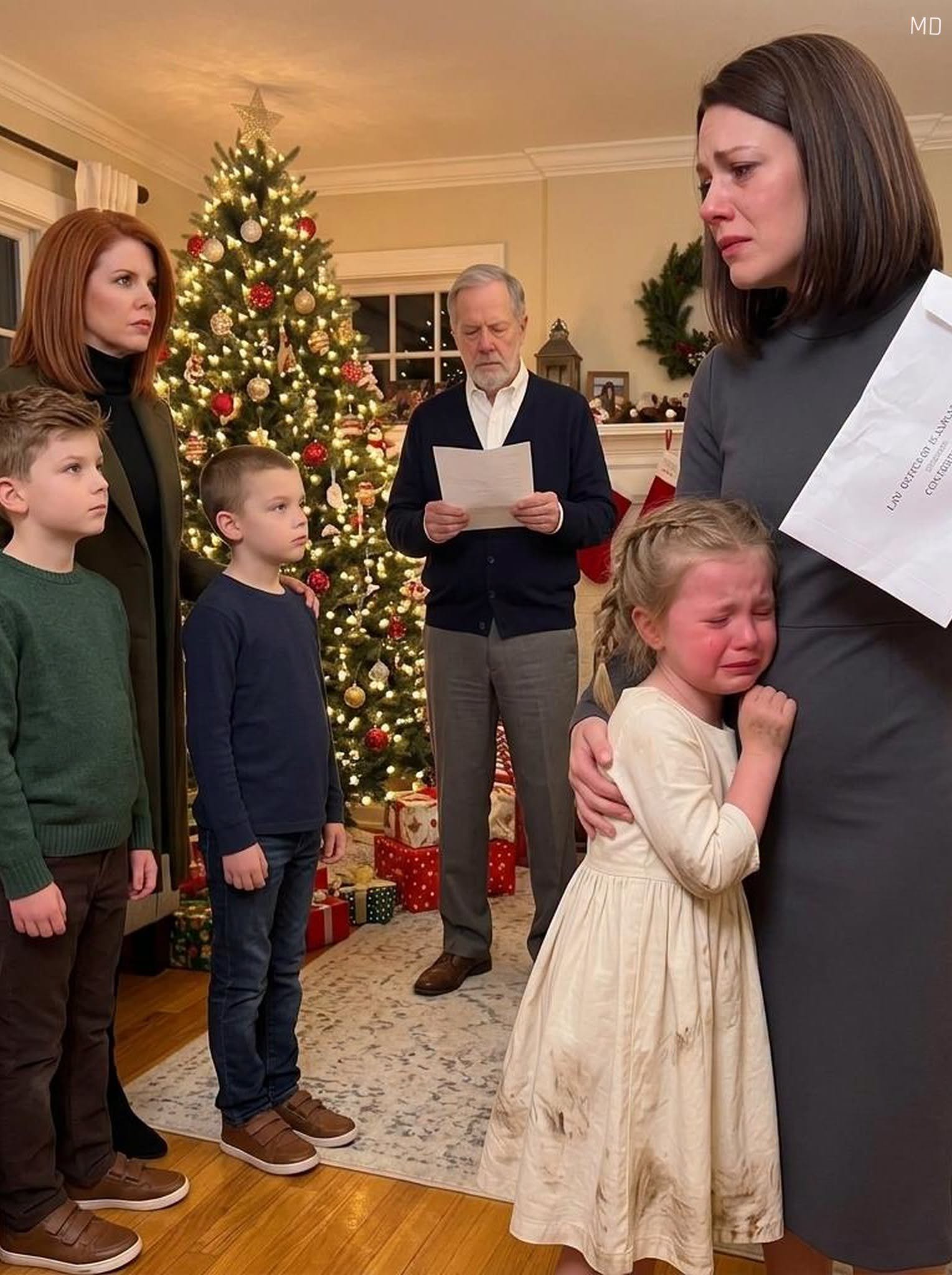
My six-year-old daughter, Lily, stood in the middle of my kitchen crying while mud dripped from the hem of her pale yellow Easter dress. Her eight-year-old cousins, Mason and Miles, had pulled her toward a muddy part of the yard after she refused to give them the chocolate rabbit from her basket. When Lily came inside upset, my sister Vanessa barely looked at what had happened. Instead, she told me to make Lily stop crying because she was “spoiling Easter” for everyone else. My father sighed as though I were creating a problem, while my mother focused on the holiday meal. Standing inside my own Columbus, Ohio, home, I realized everyone expected Lily to stay quiet so the adults could remain comfortable. I sent her upstairs to change, turned back toward my family, and said, “Everyone needs to leave.”
Vanessa laughed and accused me of overreacting over a dress, but the dress was only part of it. I walked to the desk near the hallway and removed a sealed envelope I had prepared three days earlier. My father recognized the attorney’s letterhead immediately, and his expression changed before he had finished the first paragraph. Vanessa stopped smiling. Mom asked what the letter was about, but I already knew this conversation had moved far beyond Easter brunch. Three days earlier, a phone call from a local credit union had revealed something my family apparently believed I would eventually accept without being asked—and the envelope explained exactly why they were wrong.
After my husband Daniel passed away two years earlier, I used his life-insurance payment to eliminate the remaining mortgage on the home Lily and I still lived in. During those difficult months, Dad helped organize insurance paperwork, tax documents, and other financial records, so I trusted him with copies. What I did not know was that Vanessa’s struggling boutique was deep in debt and needed approximately $110,000. Dad had begun discussing a loan using my house as collateral, telling Vanessa that I had “more or less agreed.” He even supplied preliminary financial information to the lender and included an expired limited power of attorney that had once covered only Daniel’s insurance claim and vehicle title. My attorney made the situation clear: Dad had no authority to refinance, encumber, or represent my property. There was no valid loan, no hidden investment agreement, and no legal claim against my estate. The house was mine, free of the mortgage they apparently viewed as an opportunity, and I was not risking Lily’s security to rescue someone else’s business.Family
That revelation changed much more than our Easter gathering. Vanessa eventually discovered that Dad had also misled her about a $20,000 wedding gift he once gave Daniel and me, claiming it somehow represented an investment in our home when the original mortgage paperwork clearly identified it as a gift. Her second boutique later closed, and she began restructuring her finances with professional guidance. Months afterward, she finally watched the complete backyard security recording and admitted her sons had intentionally pushed and splashed Lily because they believed their mother would defend them. The boys eventually apologized, Mom admitted she should have protected Lily, and Dad later acknowledged that he knew his authority had expired. I kept Lily’s stained yellow dress after Mom repaired it with tiny embroidered flowers. The marks never disappeared completely, and I was glad they didn’t. That Easter became the day Lily learned she was allowed to be upset when someone treated her badly—and the day my family learned that my silence could no longer be mistaken for permission.Marriage
Website Disclaimer
The information provided on this website is for general informational and educational purposes only. While we strive to ensure that all content is accurate and up to date, we make no guarantees regarding the completeness, reliability, or accuracy of any information published.
The views and opinions expressed in articles belong to their respective authors and do not necessarily reflect the views of this website. Any action you take based on the information found on this website is strictly at your own risk. We will not be liable for any losses, damages, or inconveniences arising from the use of our content.
Some articles may contain opinions, third-party information, or external links. We do not endorse or guarantee the accuracy of content on external websites and are not responsible for their practices or policies.
All content on this website is provided in good faith and is intended for informational purposes only. Readers are encouraged to verify information independently and seek professional advice where appropriate.