“Your granddaughter was caught stealing.” — I almost laughed, because she was in another country. But when I arrived at the station, a little girl was crying in the waiting room. She looked up at me with trembling eyes and whispered, “Grandma, help me…”
The night the police cruiser rolled up behind me, washing my porch in harsh white light just as I was fishing my keys out of my purse, I remember thinking it had to be some mistake involving the neighbors, because nothing in my quiet, predictable life as a retired elementary school principal prepared me for a uniformed officer stepping out of that car and saying, in a tone that was calm but unmistakably serious, “Ma’am, are you Mrs. Eleanor Brooks?” and then, before I could fully register the question, adding, “We took your ten-year-old granddaughter into custody for theft.”
For a moment I honestly wondered whether I had misheard her, because my granddaughter, Sophie, had been living in Lisbon with her mother for the past year, and I had carefully adjusted to the time difference for weekly video calls and mailed birthday cards with international postage, and told my book club that my only grandchild was thriving overseas, so I blinked at the officer and said, “That’s not possible. My granddaughter moved abroad last year. She’s in Portugal. She can’t be here.”
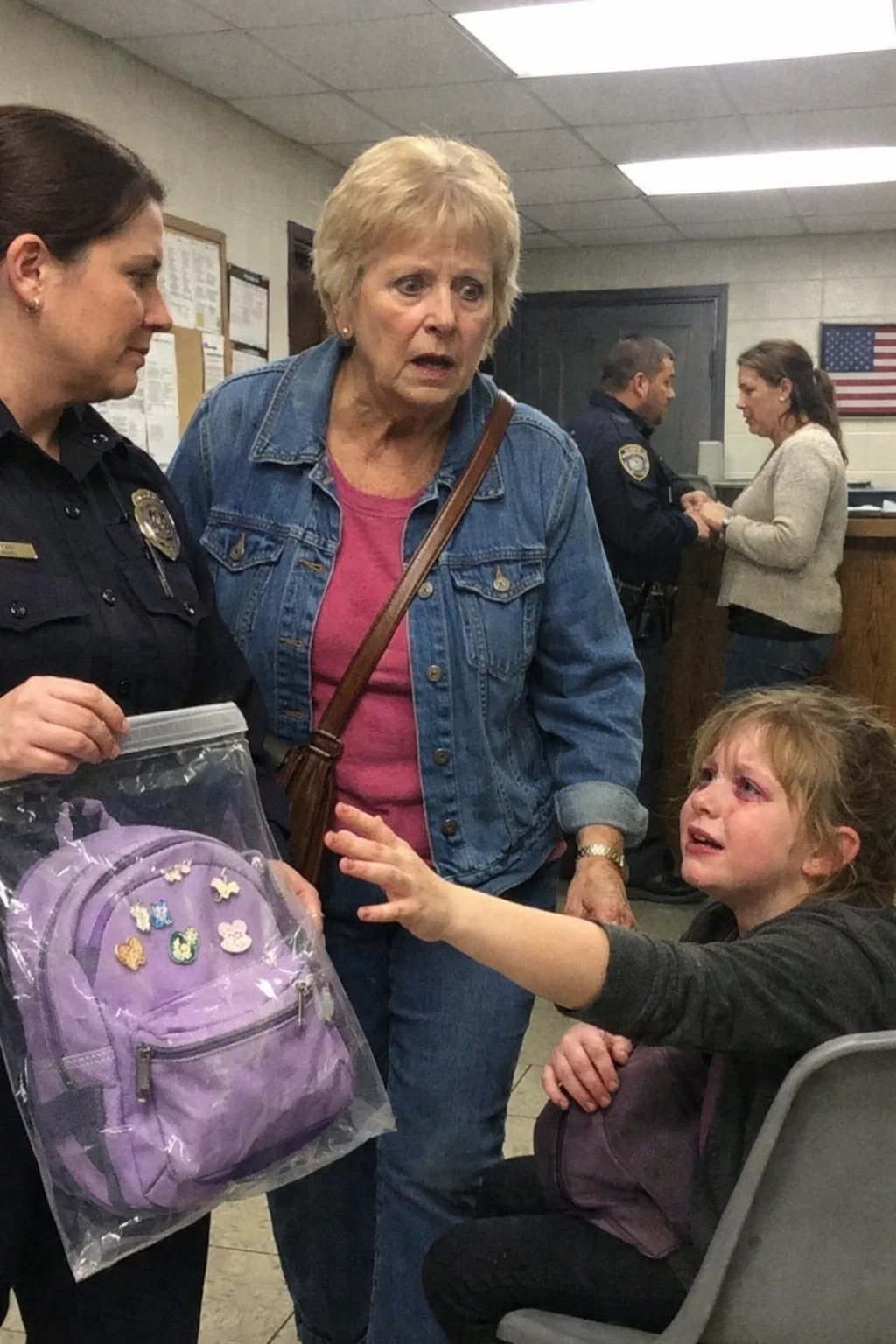
The officer, whose badge read MARTINEZ, did not argue. Instead, she reached into the back seat of her cruiser and brought out a small lavender backpack sealed inside a clear evidence bag. The backpack was covered in enamel pins—tiny strawberries, a cartoon cat, a glittery star—and my breath caught because I had mailed Sophie two of those pins myself the previous Christmas, carefully wrapped in tissue paper.
“This was recovered when the child was detained at Ridgeway Market,” Officer Martinez said. “There’s an emergency contact card inside listing your name and address. The child is asking for you.”
My hand trembled as I reached toward the plastic. “Backpacks get resold,” I said weakly, clinging to logic. “Children trade things.”
“Of course,” she replied evenly. “But she specifically asked for Grandma Eleanor.”
That did it. Sophie had called me “Grandma Eleanor” ever since she learned my full name in kindergarten and decided it sounded more important than just Grandma. The fact that this unknown child knew that detail hollowed something out in my chest.
The drive to the station felt like descending into a reality I had not agreed to. I called my daughter, Claire, three times. Each call went to voicemail, and her recorded greeting—cheerful, breezy, slightly rushed—chirped, “Olá! You’ve reached Claire and Sophie’s European adventure line!” The sound, which had once made me smile, now felt rehearsed and distant.
Inside the precinct, fluorescent lights hummed overhead. The waiting area smelled faintly of burnt coffee. And there, on a hard plastic chair, sat a small girl with tangled light-brown hair and red-rimmed eyes, clutching her knees to her chest.
When she saw me, she sprang up.
“Grandma!” she cried. “Please help me!”
The word pierced me. She looked like Sophie in ways that made my heart stutter—the same dimple in her right cheek, the same slight tilt to her chin—but something about her posture was different, guarded, as though she had been bracing for impact her entire life.
I approached slowly. “Sophie?” I asked, my voice barely above a whisper.
She hesitated for half a second, then nodded too quickly. “Yes. It’s me.”
Officer Martinez stepped closer. “She was caught attempting to leave the store with food items and a pack of batteries,” she explained. “Store security detained her. No injuries. She refused to give any name other than Sophie Brooks.”
Brooks. My maiden name. Claire had kept it after her divorce. My head spun.
I crouched in front of the girl. “Look at me,” I said gently. “When did you get back from Portugal?”
Her eyes flickered, confusion flashing across them. “Last week,” she said.
“Which school did you go to there?” I pressed softly, not accusatory, but careful.
She swallowed. “The… the big one.”
My heart sank. Sophie would have launched into a detailed description of her classmates and the bakery across the street.
Officer Martinez glanced at me. “We can move to an interview room.”
Inside the small room, the girl’s composure cracked. Tears streamed down her face, and she leaned toward me as though proximity alone could shield her.
“Please don’t call her,” she whispered urgently.
“Call who?” I asked.
“My mom,” she said. “She’ll be mad.”
My pulse pounded in my ears. “Why would your mother be mad that you’re safe?”
She bit her lip so hard I thought it might bleed. Then she shook her head. “She told me to say I’m Sophie. She said you’d come.”
The room tilted.
“What’s your name?” I asked carefully.
Silence stretched between us, heavy and fragile.
“My name is Lucy,” she whispered.
Officer Martinez’s pen stopped moving. “Lucy what?” she asked gently.
Lucy’s shoulders trembled. “Lucy Reed. But Mom says Reed doesn’t exist on paper.”
My hands went cold. “Where is Sophie?” I asked, my voice steady only because decades of managing frightened children had trained me to stay calm when everything inside me was unraveling.
Lucy stared at the tabletop. “She’s close,” she murmured. “Mom said if I got caught, you’d think it was Sophie and you’d come get me. Then she could fix the rest.”
Fix the rest.
Officer Martinez stepped outside to make a call, leaving me alone with Lucy in the humming quiet.
“Lucy,” I said softly, “where have you been living?”
“In the car sometimes,” she admitted. “Sometimes in a motel. Sometimes at this man’s apartment.”
“What man?”
“Rick,” she said, eyes darting toward the door. “Mom says he’s helping.”
I felt a surge of anger so sharp it almost blinded me, but I forced it down. Anger would not help this child.
When Martinez returned, she was accompanied by a detective and a social worker. The detective, a broad-shouldered man named Harris, laid out what they knew: a string of minor shoplifting incidents across three counties, always involving a woman and a child, always small items that could be resold or easily consumed.
“Your daughter’s name came up in connection with a vehicle registered in this area,” Harris said carefully. “We’re trying to locate her.”
“She told me she was in Portugal,” I said, hearing the foolishness in my own voice.
The social worker, Ms. Delgado, placed a folder on the table. “Lucy has no birth certificate on file under that name in this state,” she explained. “No school enrollment. No medical records. That suggests deliberate concealment.”
Lucy’s hand slid into mine, fingers cold and desperate. “Don’t let them send me back,” she whispered.
“I won’t,” I said automatically, though I had no idea yet how to keep that promise.
They asked if I would be willing to take temporary kinship placement while the investigation unfolded. I did not hesitate.
“Yes,” I said. “If this child believes I’m her safest option, then she is not going back to a motel tonight.”
While paperwork was processed, I stepped into the hallway and called Claire again. This time, after three rings, she answered.
“Mom?” she said, breathless.
“Where are you?” I demanded.
There was a pause too long to ignore. “Why?”
“I am at a police station with a ten-year-old girl who says her name is Lucy Reed and that you told her to pretend to be Sophie.”
Silence.
Then, faintly, I heard traffic noise.
“You weren’t supposed to find out like this,” Claire said.
The words landed like a confession.
“Find out what?” I asked.
“That Lucy is Sophie’s half-sister,” she said in a rush. “I didn’t tell you because I was embarrassed. It was complicated. I didn’t have the money. Rick said he’d help. We were going to go to Europe eventually, I just—”
“Where is Sophie?” I interrupted, my voice turning to steel.
“She’s with Rick,” Claire admitted.
My heart slammed against my ribs. “Put him on the phone.”
“I can’t,” she said. “He doesn’t like—”
“I do not care what he likes,” I snapped. “You have involved two children in something dangerous, and I am done pretending this is an adventure story.”
Within hours, Detective Harris had traced Claire’s phone to a budget motel off the interstate. Officers found Rick in the parking lot and Sophie inside the room, unharmed but frightened. She ran into my arms when they brought her to the station later that night, sobbing apologies for things that were never her responsibility.
Lucy stood behind me, uncertain, until Sophie looked at her and said quietly, “You don’t have to lie anymore.”
The truth unfolded in fragments: Claire had struggled financially after a failed business venture and a messy breakup. Rick had convinced her that staging small thefts using a child would draw less suspicion. When Sophie resisted, Rick suggested using Lucy instead, a daughter Claire had from a brief relationship years earlier, whose existence she had hidden from most of us out of shame and fear of judgment.
She had constructed the Portugal narrative to avoid questions, sending me pre-recorded video clips and using time-zone excuses to limit live calls. I had believed her because believing required less confrontation than doubt.
Rick was charged with multiple offenses related to exploitation and theft. Claire faced legal consequences as well, though the court ordered treatment and parenting education as part of her sentence, recognizing the layers of coercion involved.
The judge granted me temporary guardianship of both girls.
The first weeks were difficult. Lucy startled at loud noises. Sophie hoarded snacks under her pillow. Both woke from nightmares.
But slowly, structure replaced chaos. They enrolled in the local elementary school. Lucy discovered she loved math. Sophie joined the art club. Therapy sessions helped untangle guilt from responsibility.
One evening, as we sat around my kitchen table working on homework, Lucy looked up and asked, “Are you really my grandma?”
I reached across the table and squeezed her hand. “If you want me to be,” I said.
Sophie grinned. “She makes the best pancakes,” she added, as though that settled the matter.
Months later, when the court finalized a long-term guardianship arrangement and mandated supervised visitation for Claire after she completed rehabilitation, I felt something shift from crisis to stability.
I do not know what the future holds for my daughter, but I know this: the truth, however painful, is kinder than any carefully constructed lie.
The night the officer came to my door, I thought my world was collapsing. Instead, it was rearranging itself into something more honest.
Now, when I lock that same front door each evening, I hear two sets of footsteps racing down the hallway, arguing about whose turn it is to set the table, and I am reminded that sometimes the most unexpected knock is not the end of your story, but the beginning of the one you were meant to tell.
Website Disclaimer
The information provided on this website is for general informational and educational purposes only. While we strive to ensure that all content is accurate and up to date, we make no guarantees regarding the completeness, reliability, or accuracy of any information published.
The views and opinions expressed in articles belong to their respective authors and do not necessarily reflect the views of this website. Any action you take based on the information found on this website is strictly at your own risk. We will not be liable for any losses, damages, or inconveniences arising from the use of our content.
Some articles may contain opinions, third-party information, or external links. We do not endorse or guarantee the accuracy of content on external websites and are not responsible for their practices or policies.
All content on this website is provided in good faith and is intended for informational purposes only. Readers are encouraged to verify information independently and seek professional advice where appropriate.