The Silent Passenger
Chapter 1: The Fracture in the Routine
It began with a question that was innocuous enough to be a greeting, yet sharp enough to sever the artery of my daily routine.
The Tuesday morning air was crisp, smelling of damp earth and the impending autumn. I was balancing a travel mug of coffee, my leather laptop satchel, and the mental load of a thousand uncompleted tasks as I locked the front door of our suburban colonial. Daniel, my husband of twelve years, had already left—or so I thought—and our ten-year-old daughter, Emma, had walked to the bus stop forty minutes prior.
I was halfway to my car when Mrs. Keller, our neighbor to the left, looked up from her hydrangeas. She was a woman of sharp eyes and loose boundaries, the neighborhood’s unofficial sentry.
“Elena!” she called out, wiping soil from her gardening gloves. “Running late?”
I forced a polite smile. “Just the usual chaos, Mrs. Keller. Have a good day.”
I reached for my car door handle, but her next words stopped me cold.
“Is Emma skipping school again today?”
I froze. The morning sounds—the distant traffic, the chirp of a cardinal—seemed to mute instantly. I turned slowly, my brow furrowing.
“Excuse me?” I asked, assuming I had misheard.
Mrs. Keller tilted her head, her expression one of genuine curiosity mixed with a hint of judgment. “Your daughter. Is she sick again? I noticed she didn’t take the bus.”
“No,” I said, my voice firm. “Emma goes to school every day. She hasn’t missed a day since the flu in February.”
Mrs. Keller shrugged, returning her attention to a wilting bloom. “Oh. I must be mistaken then. It’s just… I see her leave with Daniel almost every Tuesday and Thursday around nine. I assumed she had some sort of… arrangement.”
My heart performed a strange, syncopated rhythm against my ribs.
“That can’t be right,” I said, the defensive tone rising in my throat. “Daniel leaves for the firm at seven-thirty. Emma’s bus comes at eight-ten. You must be seeing things.”
Mrs. Keller looked up again, her eyes meeting mine with an unsettling clarity. “Maybe,” she said, though her tone suggested she knew exactly what she had seen. “But I know your husband’s car, Elena. And I know your daughter’s pink backpack.”
I drove to work in a fugue state.
The logic of my life, the schedule I adhered to with religious fervor, had been challenged. Daniel was a creature of habit. He was a senior actuary; he lived his life in spreadsheets and predictable outcomes. The idea of him returning home mid-morning was absurd. The idea of him taking Emma… somewhere… was impossible.
But doubt is a parasite. It needs only a single entry point to infect the whole host.
By 2:00 PM, I was staring at a quarterly report, seeing nothing but Mrs. Keller’s face. I always see her leave with your husband.
When I got home that evening, the house felt normal. The scent of garlic and roasting chicken filled the kitchen. Emma was at the table, her head bent over a math worksheet. Daniel was chopping vegetables, his sleeves rolled up, looking for all the world like the devoted partner I believed him to be.
“Hey,” I said, dropping my keys on the counter, trying to keep my voice casual. “How was everyone’s day?”
“Fine,” Daniel said, not looking up from the cutting board. “Long meetings. You?”
“Fine,” I echoed. I looked at Emma. “How was school, sweetie? Anything interesting happen?”
Emma didn’t look up. She kept her pencil moving, scratching out numbers with an intensity that seemed excessive for fourth-grade division. “It was okay. Mrs. Gable gave us extra reading.”
“Did you… go anywhere else?” I asked. The question hung in the air, clumsy and heavy.
Daniel paused mid-chop. He turned to me, a flicker of confusion in his brow. “Go anywhere? Like where?”
“I don’t know,” I lied, forcing a laugh. “Field trip? Doctor’s appointment I forgot?”
“No,” Daniel said, his eyes scanning my face. “Just a normal Tuesday, El. You okay?”
“I’m tired,” I said. “Just tired.”
But as I watched them that night—Emma retreating to her room immediately after dinner, Daniel spending the evening on the patio staring at his phone—the unease didn’t fade. It calcified.
They were hiding something. Both of them.
Cliffhanger: I decided then that I wouldn’t ask again. Questions invite lies. If I wanted the truth, I had to become a ghost in my own life. I had to disappear to see what happened when I wasn’t there.
Chapter 2: The Stowaway
Wednesday passed in a blur of paranoia. I checked the school’s online attendance portal. Present. But I knew the secretary, Mrs. Higgins, was elderly and often marked the default “P” down the list before her morning coffee. The system wasn’t infallible.
Thursday morning arrived with a sky the color of a bruise.
“I have an early site visit,” I told Daniel as I poured my coffee down the sink. “I need to be on the road by six-thirty.”
He kissed my cheek, his lips warm, his demeanor utterly unchanged. “Okay. Drive safe. Love you.”
“Love you too,” I said, the words tasting like ash.
I walked out the front door, got into my car, and drove around the block. I parked three streets over, behind a dense row of hedges, and doubled back on foot through the neighbor’s wooded lot.
My heart was hammering a frantic code against my sternum. I felt ridiculous. I felt like a criminal. I was spying on my own family.
I let myself into the detached garage through the side door, moving silently past the lawnmower and the stacks of recycling bins. Daniel’s sedan sat there, a grey sentinel.
I checked my watch. 7:15 AM.
He should be leaving now.
But the house remained silent.
I waited, crouched behind a stack of winter tires. Ten minutes. Twenty. Thirty.
At 8:00 AM, the bus rumbled past on the street. Emma did not come out to meet it.
My stomach dropped. Mrs. Keller was right.
At 9:10 AM, the door connecting the house to the garage opened.
I pressed myself into the shadows, holding my breath until my lungs burned.
Daniel stepped out. He wasn’t wearing his suit jacket. He looked tired, his shoulders slumped. He walked to the car, opened the rear door, and placed Emma’s backpack inside. Then he opened the driver’s side door and started the engine.
He didn’t back out. He sat there, idling. Waiting.
“Ready, Em?” his voice echoed in the garage. Soft. conspiratorial.
Emma stepped into the garage. She looked pale. She wasn’t wearing her school uniform; she was in leggings and an oversized hoodie. She looked small—smaller than I remembered.
“Yeah,” she whispered.
“Okay. Let’s go.”
As Daniel leaned over to adjust something in the center console, blocking his view of the rearview mirror, I made the most insane decision of my life.
I didn’t confront them. I didn’t scream. I needed to know the destination. If I stopped them now, they would lie. They would invent an excuse. I needed to see the truth with my own eyes.
I moved like liquid shadow. I reached the back of the sedan, popped the trunk latch—thank God he hadn’t locked the doors yet—and lifted it just enough.
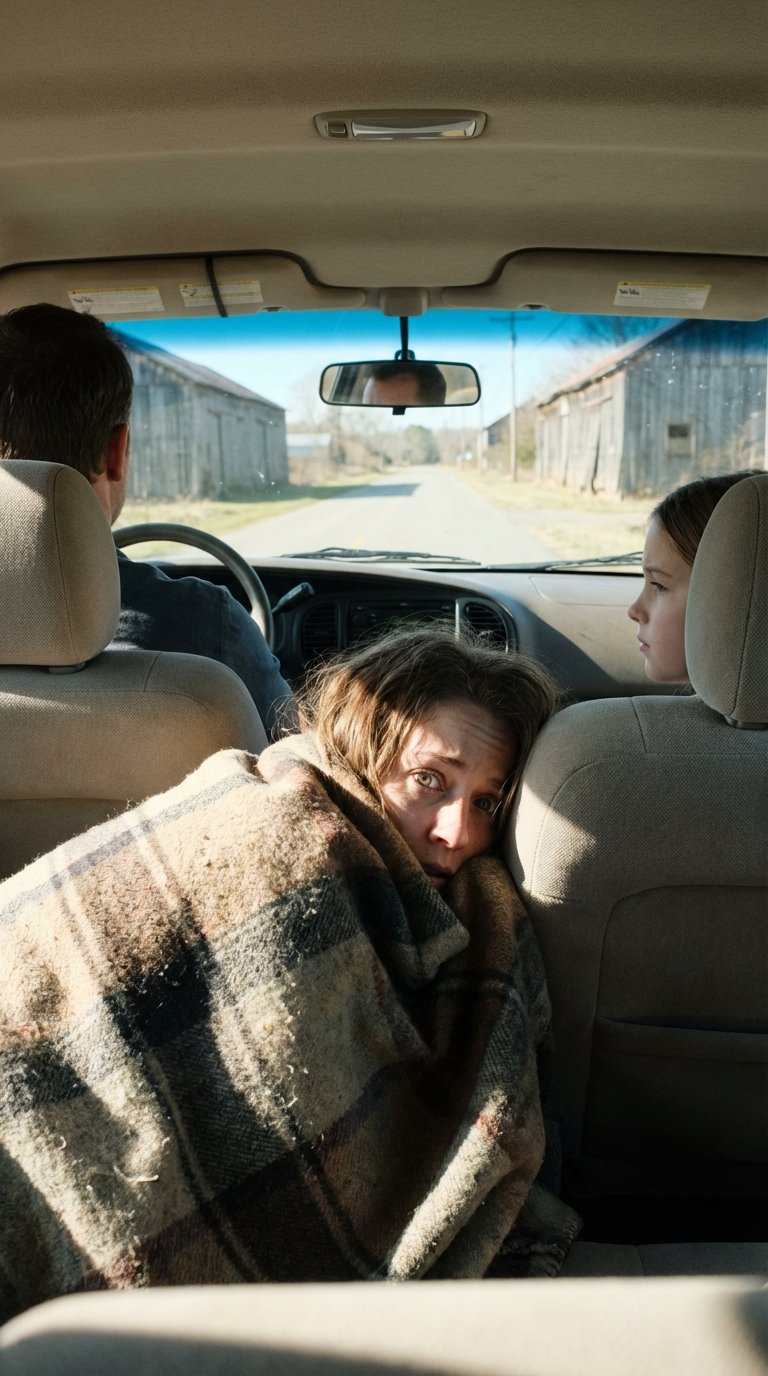
I slid inside, curling my legs into the fetal position against the spare tire well. I pulled the lid down until it clicked softly, praying the latch didn’t engage fully, leaving a sliver of light, a sliver of air.
It was dark. It smelled of rubber, old gym clothes, and secrets.
Seconds later, I heard the car doors slam.
The transmission shifted. The car began to roll.
I was trapped. I was a stowaway in my husband’s vehicle, heading toward a destination that I was terrified would destroy my marriage.
Cliffhanger: As the car accelerated, the vibrations traveled through my spine. I squeezed my eyes shut, images flashing through my mind—a secret apartment? A biological mother I didn’t know about? A cult? But where we were going was somewhere I never, in my darkest nightmares, expected.
Chapter 3: The Cargo of Fear
There is a specific kind of claustrophobia that comes from hiding in a trunk. It’s not just the lack of space; it’s the lack of control. I was essentially cargo. I was luggage.
Every turn sent me sliding against the carpeted wall. My hip bone bruised against the jack kit. The smell of exhaust fumes began to seep in, mingling with the metallic tang of my own fear.
I strained to hear their voices through the backseat.
“…water bottle?” Daniel’s voice, muffled.
“Yeah. I have it.” Emma.
“Did you do the worksheet?”
“Most of it. It’s hard, Dad.”
“I know, kiddo. We’ll talk about it when we get there.”
Get where? My mind raced. Why was he helping her with worksheets if she wasn’t at school? Was he homeschooling her in secret? Was he taking her to a private tutor because he thought I would judge her grades?
The car turned. The smooth hum of asphalt changed to the crunch of gravel.
We had left the main road.
Panic, cold and sharp, spiked in my chest. We weren’t near the school. We weren’t near the city center where the tutors and doctors were. We were somewhere… else.
The car slowed to a crawl. The gravel popped and hissed under the tires. Then, silence. The engine cut.
For a moment, nobody moved.
Then Daniel spoke, his voice clearer now that the engine hum was gone.
“Okay, Emma. Take a deep breath. You know the routine. Shoulders down. Unclench the jaw.”
Routine.
This had happened enough times to have a protocol.
My hands shook so violently I had to clasp them together to keep them from banging against the trunk lid.
I heard the car doors open. Footsteps on gravel.
“I’m scared today,” Emma whispered. Her voice sounded fragile, like thin glass.
“I know,” Daniel said. “But you’re brave. You’re the bravest girl I know. And I’ll be right here in the waiting room.”
Waiting room.
That was my cue. I couldn’t wait another second. The narrative in my head—of kidnapping, of nefarious secrets—was cracking, replaced by a confusion that was somehow worse.
I pushed up on the trunk lid. It groaned, the latch releasing.
Sunlight flooded in, blinding me. I scrambled out, my legs stiff, almost falling onto the dusty white stones of the parking lot.
“Stop!” I screamed, the word tearing out of my throat before I could check it.
Daniel spun around.
His face didn’t register anger. It registered pure, unadulterated shock. The color drained from his skin, leaving him grey.
“Elena?” he choked out. “What… how…?”
Emma let out a small, sharp cry and shrank behind her father’s legs.
I stood there, panting, brushing dust from my blazer, looking wildly around for the source of the danger.
We weren’t at a motel. We weren’t at a stranger’s house.
We were parked in front of a modest, red-brick bungalow converted into an office. A discreet wooden sign hung by the door.
The Oakwood Center for Child & Family Therapy.
I blinked, the adrenaline crashing into confusion.
“A therapist?” I whispered.
Daniel stepped in front of Emma, shielding her, his eyes wide with a mixture of fear and protectiveness. “Elena, what are you doing in the trunk? Are you insane?”
“Me?” I stepped forward, my voice rising. “You’ve been lying to me for weeks! You’re pulling our daughter out of school! I thought… God, Daniel, I didn’t know what to think!”
“I tried to tell you,” Daniel said, his voice lowering, desperate to de-escalate. “I tried to bring it up a dozen times.”
“When?” I demanded. “When did you say, ‘Hey, I’m kidnapping our daughter to see a shrink’?”
“Don’t call it that,” Emma whispered.
I looked at her. She was peeking out from behind Daniel’s coat. Her eyes were red-rimmed. She looked terrified. Not of the place. Of me.
That look stopped me dead.
“Emma,” I said, softening my voice. “Sweetie, why are you here? Why aren’t you in math class?”
She looked at Daniel. He nodded, a silent permission.
“Because I can’t breathe there,” she said, her voice trembling. “I get the chest pains. The nurse sends me home anyway. Dad just… Dad started picking me up before it happens.”
I felt the ground sway. “Chest pains? Since when?”
“Since the shouting started,” Daniel said. He wasn’t yelling. He sounded defeated.
“We don’t shout,” I said reflexively. It was our rule. We were civilized. We didn’t yell.
“No,” Daniel said. “We don’t shout. We hiss. We freeze. We slam cupboards. We ignore each other for three days at a time. It’s worse, Elena. It’s so much worse than shouting.”
Cliffhanger: The therapist opened the front door of the building, drawn by the commotion. She looked from me, covered in trunk dust, to Daniel, looking broken, to Emma, who looked like she wanted to disappear. “I think,” the therapist said gently, “we should all come inside today.”
Chapter 4: The Invisible War
The office smelled of vanilla and old books. It was safe. It was quiet. It was everything our house had not been for the last year.
I sat on a beige sofa, my hands still dirty from the car. Daniel sat in the armchair. Emma sat between us, but she leaned toward the therapist, a woman named Dr. Evans who had kind eyes and steel in her spine.
“I didn’t want Mom to know,” Emma said, picking at a loose thread on her hoodie.
“Why is that, Emma?” Dr. Evans asked gently.
I leaned forward, my heart aching. “Yes, why? Baby, I would have taken you myself. I would have helped.”
Emma looked at me, and her gaze was devastatingly adult.
“Because you’re already mad all the time,” she said.
The air left the room.
“I’m not mad,” I protested weakly. “I’m stressed. Work is…”
“It’s not work,” Emma said. “It’s Dad. You’re mad at Dad. And Dad is sad at you. And when I tell you I have a problem, you look… tired. You look like I’m just one more thing you have to fix.”
I opened my mouth to argue, but the words died in my throat. I replayed the last six months.
Mom, I forgot my lunch. (Me sighing, grabbing keys with aggressive force.)
Mom, can you sign this? (Me signing it without looking up from my email.)
Mom, my stomach hurts. (Me: “Take a Tums, Emma, I have a conference call in five minutes.”)
I hadn’t been abusive. I hadn’t been cruel. I had been efficient. I had treated my family like a logistics problem to be managed, not people to be loved.
Daniel spoke up, his voice rough. “She started having panic attacks in the cafeteria. She thought she was having a heart attack. The school called me the first time because you were in a client meeting and didn’t answer.”
I flinched.
“I picked her up,” Daniel continued. “She was hyperventilating. We sat in the car for an hour until she could breathe. She made me promise not to tell you because she said, ‘Mom will just say I need to toughen up.’”
I closed my eyes. Toughen up. I had said that. I had said exactly that when she complained about drama with her friends.
“I brought her here,” Daniel said. “Dr. Evans suggested we bring you in, but Emma… she wasn’t ready. She was terrified that if you knew she was ‘broken,’ you’d snap.”
“I wouldn’t,” I whispered, tears finally spilling over. “I wouldn’t.”
“You did today,” Emma said softly. “You hid in the trunk because you didn’t trust us.”
The truth of it hit me like a physical blow. I had assumed the worst—infidelity, deception—because I was disconnected. I projected my own distance onto them.
Dr. Evans looked at me. “Anxiety in children is often a mirror, Elena. It reflects the unprocessed tension in the household. Emma is carrying the weight of the marriage you two are refusing to fix.”
“We don’t fight,” I repeated the lie I had told myself for years.
“You wage a cold war,” Dr. Evans corrected. “And the civilians are taking the casualties.”
I looked at Daniel. Really looked at him. I saw the gray in his temples I hadn’t noticed. I saw the exhaustion in his eyes that mirrored my own. We had been running on a treadmill of resentment for so long, we forgot how to get off.
And in the middle of it was Emma, holding her breath so she wouldn’t disturb the fragile house of cards we were living in.
Chapter 5: The Driver’s Seat
The drive home was quiet, but it wasn’t the heavy, suffocating silence of before. It was the silence of a forest after a storm has passed.
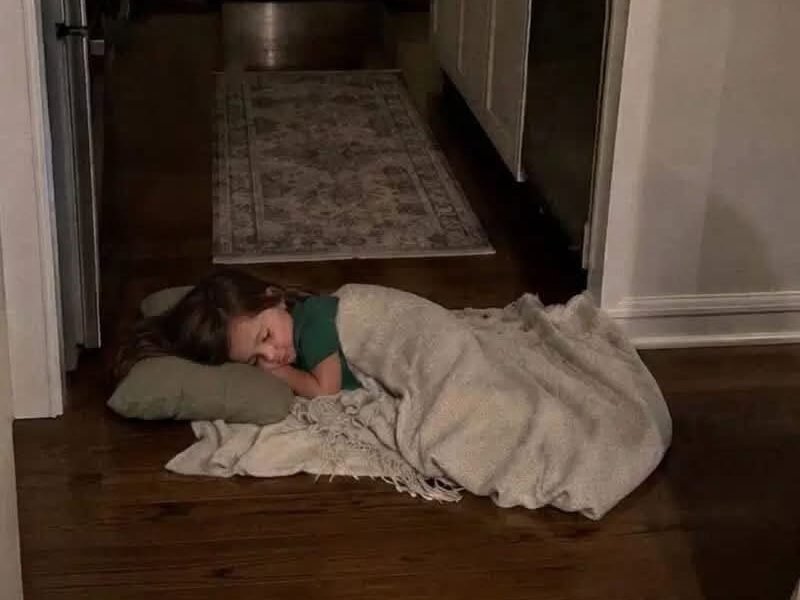
I didn’t ride in the trunk. I sat in the passenger seat. Emma was in the back, sleeping. The emotional exhaustion had finally overtaken her anxiety.
Daniel kept his eyes on the road.
“I’m sorry,” I said. The words felt rusty. “I’m sorry I hid. I’m sorry I accused you.”
Daniel sighed, tapping his fingers on the wheel. “I’m sorry I hid her. I thought I was protecting her from your stress, but… I was just driving a wedge between you two. I made you the enemy.”
“We need to fix this,” I said. “Not just for her. For us.”
He nodded. “I know. I miss you, El. I miss the version of us that wasn’t just managing schedules and bank accounts.”
“I miss us too,” I whispered.
When we pulled into the driveway, Mrs. Keller was outside again, sweeping her porch. She watched us pull in—Daniel driving, me in the front seat, Emma waking up in the back.
She looked confused. This didn’t fit her narrative of the cheating husband or the truant child.
I got out of the car. I walked over to the fence.
“Mrs. Keller,” I called out.
She looked up, eager for gossip. “Everything alright, Elena? I saw you leave… unusually.”
“Everything is fine,” I said, my voice strong. “Emma has been dealing with some health issues. Daniel and I are handling it. Together.”
Her face fell slightly, disappointed by the lack of scandal. “Oh. Well. Good.”
“And Mrs. Keller?”
“Yes?”
“Next time you see my family, you don’t need to report it. We see each other now.”
I walked back to my family. Daniel had his arm around Emma. They were waiting for me at the front door.
I realized then that hiding in the trunk had been the lowest point of my life, but it was also the turning point. It forced me to stop driving blindly. It forced me to stop assuming I knew the destination.
We walked inside, and for the first time in years, I didn’t immediately check my email. I didn’t start cooking or cleaning.
I sat down on the floor with my daughter and my husband.
“So,” I said to Emma. “Teach me that breathing exercise. The one for when your chest feels tight.”
She smiled, a genuine, relieved smile. “Okay, Mom. It’s easy. You just have to stop moving first.”
And so, I did.
[If you were in my place, realizing your child was hiding their pain to protect you, would you feel guilty or grateful they had someone else to lean on? How would you handle the “Cold War” in your own home? Like and share this post if you believe we need to listen to the silence in our children just as much as their words.]
Website Disclaimer
The information provided on this website is for general informational and educational purposes only. While we strive to ensure that all content is accurate and up to date, we make no guarantees regarding the completeness, reliability, or accuracy of any information published.
The views and opinions expressed in articles belong to their respective authors and do not necessarily reflect the views of this website. Any action you take based on the information found on this website is strictly at your own risk. We will not be liable for any losses, damages, or inconveniences arising from the use of our content.
Some articles may contain opinions, third-party information, or external links. We do not endorse or guarantee the accuracy of content on external websites and are not responsible for their practices or policies.
All content on this website is provided in good faith and is intended for informational purposes only. Readers are encouraged to verify information independently and seek professional advice where appropriate.