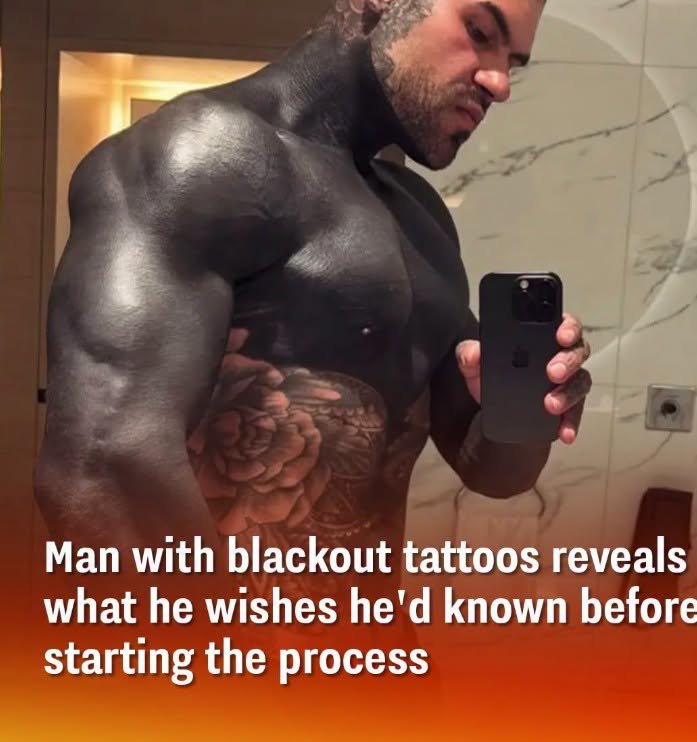
Dave Chudley, known for his extensive blackout tattoos covering large parts of his body, has reflected on the mistakes and lessons he learned after entering the trend early.
He began his blackout tattoo journey in 2020, at a time when the style was still relatively new and techniques were less refined.
Chudley admits he initially underestimated the process, believing it was simply a matter of filling the skin with solid black ink.
He later discovered that achieving a smooth, fully saturated result without damaging the skin requires significant technical skill and experience.
His first attempt on his forearm reportedly did not heal correctly, forcing him to remove it and restart the work.
Looking back, he says he now understands three key lessons: blackout tattoos are extremely difficult, they require a specialist artist, and the technique was still evolving when he began.
He now works exclusively with artists who specialize in blackout styles and says the industry has improved with better methods, equipment, and knowledge of healing.
Despite their dramatic appearance, Chudley says most reactions come from online attention rather than in everyday life.
The trend has grown in visibility in recent years, partly influenced by celebrities such as Machine Gun Kelly, who have embraced large-scale black ink body art.
However, medical professionals caution that blackout tattoos may carry risks due to the large volume of ink used in the skin.
Experts note that heavy pigmentation can increase the chance of reactions and may complicate certain medical procedures, including skin examinations and imaging tests like MRIs.
Chudley encourages anyone considering blackout tattoos to research carefully, choose experienced specialists, and understand the complexity involved.
For him, the experience ultimately became a lesson in patience, preparation, and respecting the craft behind the artwork.
Website Disclaimer
The information provided on this website is for general informational and educational purposes only. While we strive to ensure that all content is accurate and up to date, we make no guarantees regarding the completeness, reliability, or accuracy of any information published.
The views and opinions expressed in articles belong to their respective authors and do not necessarily reflect the views of this website. Any action you take based on the information found on this website is strictly at your own risk. We will not be liable for any losses, damages, or inconveniences arising from the use of our content.
Some articles may contain opinions, third-party information, or external links. We do not endorse or guarantee the accuracy of content on external websites and are not responsible for their practices or policies.
All content on this website is provided in good faith and is intended for informational purposes only. Readers are encouraged to verify information independently and seek professional advice where appropriate.