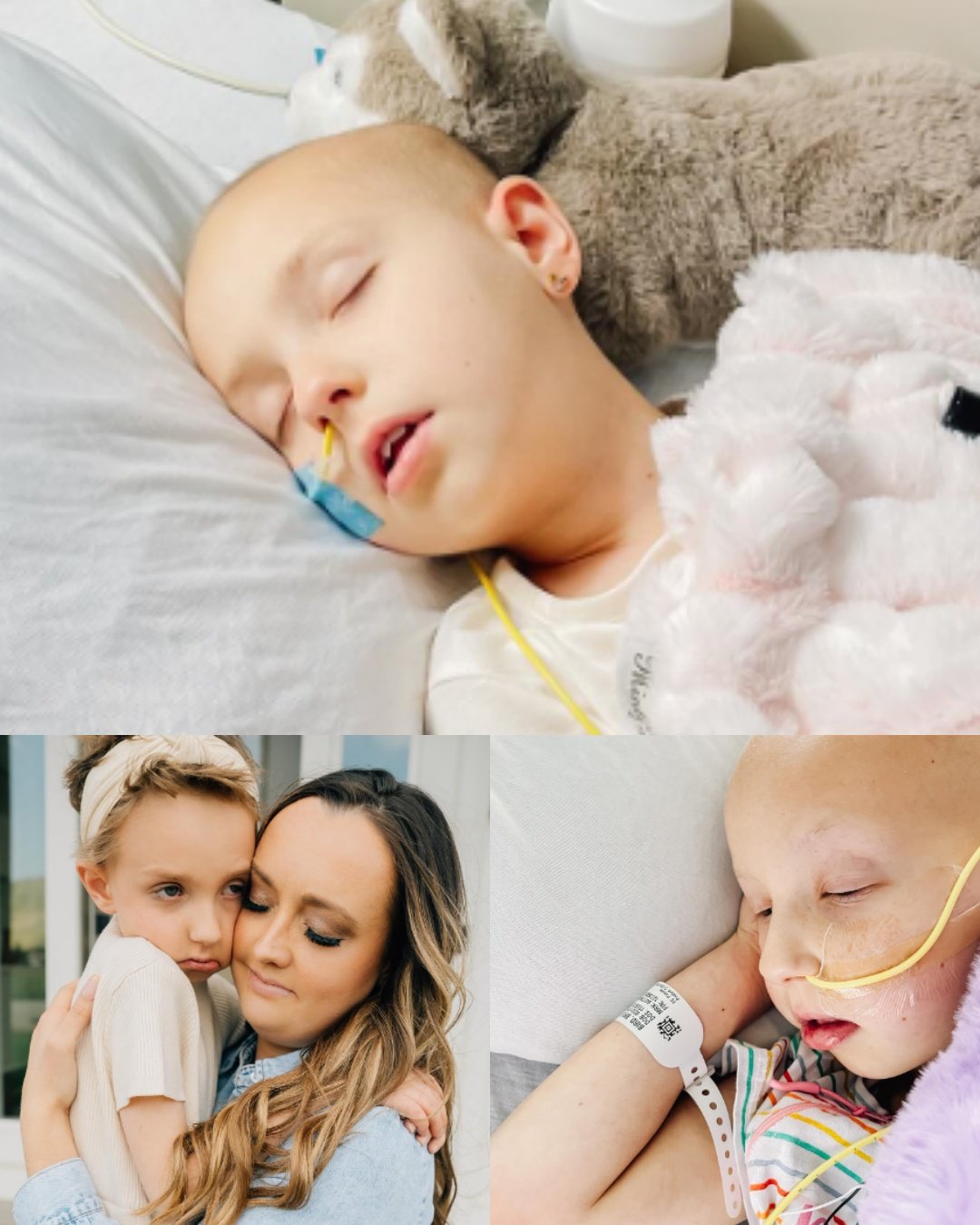
The last three days have been the most Brielle has slept since those terrifying early days in August. I can’t even describe the relief and the dread wrapped up together in this tiny window of calm. Her chest rises and falls in slow, even rhythms, and for the first time in months, the house doesn’t feel like it’s holding its breath with every beep of the monitor. But there’s an unease underneath it all—a knowledge that tomorrow will bring needles and numbers, tests that could very well confirm what we’ve been fearing. Tomorrow, Brielle will have her blood drawn to see if she needs a transfusion. And just thinking about it makes my stomach twist.
A blood transfusion, for most people, is routine. A simple thing. But for Brielle, it’s a marker. It’s a measure of how much her little body has been beaten down by a disease that never rests. Every day she’s awake, every laugh, every question, every soft word she whispers in the quiet hours, becomes a precious memory, a moment we try to tuck into our hearts because we can’t take for granted that there will be a next one. And the transfusion itself, while necessary, carries with it the weight of reality—the undeniable fact that her bone marrow is struggling, that her body may not be able to keep up, that every cell is working overtime just to let her breathe another day.
The signs are subtle at first. Less wakeful moments. Longer stretches where she’s curled up under her blanket, eyes half-closed, too tired to push herself to sit up and talk. More oxygen is needed to keep her levels steady, and even drinking slows down because her body is too exhausted to do anything that requires effort. Watching her is like standing at the edge of a cliff, not knowing if the next step is safe or if it will give way under your feet. It’s terrifying, this fragile dance between hope and fear.
We try to focus on the moments that are ours to keep. Every conversation we have with her, every story she tells, every joke, every little complaint about being hungry or tired, is being stored in our long-term memory as though our lives depend on it. Because, in some ways, they do. I can’t imagine not ever hearing her voice again. The sound of it—the inflections, the cadence, the way she giggles when she’s genuinely amused—is irreplaceable. It’s stitched into the fabric of our family, and the thought of it gone is unbearable.
August feels like a lifetime ago, and yet it was just yesterday that we first realized how serious this had become. The panic, the hospital lights, the sterile smell of disinfectant and antiseptic, the rush of nurses moving quickly but calmly, the constant hum of machines—those images are burned into my mind. Every time I close my eyes, I can see her tiny body lying in the hospital bed, wires and tubes everywhere, eyes wide, trusting us to hold on and make it all right. It’s impossible to explain to anyone who hasn’t sat through days, nights, weeks of uncertainty, constantly hoping and praying that the next monitor reading won’t bring devastating news.
Brielle’s courage during all of this is beyond what words can capture. She doesn’t complain about the needles or the procedures, though I know they hurt. She doesn’t wail when the IV goes in or when they take blood, though I can see the tension in her tiny hands and the flinch in her shoulders. She just looks at us, a mixture of confusion, trust, and something else—something older than her years. She has learned that life has rules that are cruel, that there are moments when you have no control over your body or your future, and yet, somehow, she meets them with a bravery that humbles me.
But the fatigue, the illness, it shows itself in little ways. Some days, she doesn’t have the energy to play. She can’t finish her breakfast, can’t drink a full glass of juice. And those small things—they should be trivial, everyday childhood complaints—but in her world, they are magnified. Each sip not taken, each meal not eaten, becomes a reminder of the fragility of her health. And each time we see her need extra oxygen, our hearts tighten because we know it’s not just a number on a chart—it’s a reflection of her bone marrow’s struggle, of how much her body has already fought and how much it may not be able to continue fighting without help.
We have become experts in reading the quiet signs, in noticing the subtle shifts that mean she’s more tired than usual, that her body might be calling for a transfusion soon. Every flinch, every pause in her breathing, every whispered word is analyzed and stored away in our minds, like mental snapshots. We try to prepare ourselves for what’s next while staying in the present, holding her hand as she sleeps, watching her chest rise and fall, knowing that this—this very moment—is a gift.
The anticipation of the transfusion brings with it a mixture of relief and terror. Relief, because if she needs it, it will help her, it will give her bone marrow the support it can’t provide on its own. Terrifying, because needing it is proof of how much her body is struggling, how close we are to that edge we’ve been trying not to look over. It’s a strange dichotomy—wanting the help for her body while fearing what it reveals about her health.
In these moments, we talk to her softly, telling her things that might seem small to anyone else: “You’re doing so well, Brielle,” “We love you so much,” “We’re right here.” But inside, every word carries the weight of our fear, the hope that she hears us and understands not just our love, but the urgency, the fragility, and the absolute desire to hold onto every moment. Every conversation is precious because each could be the last. Every joke shared, every question answered, every smile is a victory.
Even as we speak to her, I notice how her little body responds. She curls into our arms, a faint smile crossing her lips, eyes half-lidded but bright. It’s as if she knows, in her own way, that we are holding onto her as tightly as we can—not just physically, but emotionally, spiritually. It’s a reminder of how resilient children can be, even when the world is cruel and unpredictable.
Nighttime brings a different kind of reflection. The house is quiet, the lights dimmed, and the only sounds are the soft breathing of Brielle and the occasional rustle of sheets. In these hours, my mind races through the possibilities, the plans, the what-ifs. I think about the transfusion tomorrow, about the doctors’ assessments, about the potential complications. And I realize that, no matter how many scenarios I run through, none of them feel complete without her laughter, her voice, her presence.
The more her body shows signs of struggle, the more the reality of her condition presses down on us. Less wakefulness, less energy, more need for oxygen—it’s a slow accumulation of evidence, each piece telling the same story: that her bone marrow can’t keep up. And yet, in spite of it all, she keeps fighting. She keeps living. And we are here, desperate to protect her, desperate to give her the life that is rightfully hers, desperate to remember every moment, every detail.
We talk about the future in fragments. Not in terms of plans or schedules, but in terms of hopes: hopes for more laughter, more conversations, more bedtime stories. Every hope is steeped in the knowledge that we cannot take them for granted. Each one is precious because each one could be the last. Every shared word becomes a memory stored carefully, deliberately, as if etching them into permanence.
Sometimes, when I watch her sleep, I imagine a life that’s ordinary—school days, birthday parties, friendships, dances, sports, graduations. I imagine her voice, still bright, still full of questions, still laughing. And then I remember that reality is different, that her life has been measured not in ordinary milestones, but in oxygen levels, blood counts, and transfusions. And yet, in that small, fragile body, there is a bravery and a light that outshines everything else.
The fear never goes away. It ebbs and flows, receding a little when she sleeps peacefully, surging when we anticipate tomorrow’s tests. It lives in every corner of our minds, a constant hum beneath the surface of every conversation, every smile, every quiet moment. And still, in spite of the fear, there is hope—hope that the transfusion will help, hope that her bone marrow will catch up, hope that she will continue to live, to laugh, to be Brielle.
We are forced to live in the tension between fear and hope, between the fragility of her body and the resilience of her spirit. We are forced to notice every breath, every small movement, every slight change in her expression. And in doing so, we become acutely aware of the depth of love that can exist for a child. It’s an all-consuming awareness, a focus that sharpens the senses, a reminder that life is both precious and precarious.
I sit beside her tonight, listening to her steady breathing, tracing the outline of her small hand with my own. Every line, every contour becomes a memory. I want to remember it all—the warmth, the softness, the rhythm of life flowing through her. Every sigh, every murmur, every blink is a treasure. And I know that tomorrow, no matter what the results of her blood draw are, we will face it together.
Because in the midst of this struggle, there is clarity. There is purpose. There is a profound understanding that each moment with her is a gift. And while the transfusions, the oxygen, the fatigue—they all tell a story of a body under siege—there is also a story of courage, of love, of presence. Brielle is not defined solely by her illness; she is defined by her strength, her spirit, her capacity to bring joy and love even in the darkest times.
And so, we prepare for tomorrow. We talk to her gently, we hold her close, we soak in every word and every gesture, knowing that these are the things that last. In our hearts, every laugh, every conversation, every shared glance becomes permanent. We are storing them away because we know the fragility of life, because we know that nothing is guaranteed, because we love her more than words can convey.
Brielle’s journey is far from over, but tonight, as she sleeps more than she has in months, there is a quiet strength in our hearts. There is love, unspoken but palpable. There is gratitude for this small reprieve. And there is a commitment—to stand by her, to remember every moment, to face the next day with courage, even as the fear looms.
We talk about the future in fragments. Not in terms of plans or schedules, but in terms of hopes: hopes for more laughter, more conversations, more bedtime stories. Every hope is steeped in the knowledge that we cannot take them for granted. Each one is precious because each one could be the last. Every shared word becomes a memory stored carefully, deliberately, as if etching them into permanence.
Sometimes, when I watch her sleep, I imagine a life that’s ordinary—school days, birthday parties, friendships, dances, sports, graduations. I imagine her voice, still bright, still full of questions, still laughing. And then I remember that reality is different, that her life has been measured not in ordinary milestones, but in oxygen levels, blood counts, and transfusions. And yet, in that small, fragile body, there is a bravery and a light that outshines everything else.
The fear never goes away. It ebbs and flows, receding a little when she sleeps peacefully, surging when we anticipate tomorrow’s tests. It lives in every corner of our minds, a constant hum beneath the surface of every conversation, every smile, every quiet moment. And still, in spite of the fear, there is hope—hope that the transfusion will help, hope that her bone marrow will catch up, hope that she will continue to live, to laugh, to be Brielle.
We are forced to live in the tension between fear and hope, between the fragility of her body and the resilience of her spirit. We are forced to notice every breath, every small movement, every slight change in her expression. And in doing so, we become acutely aware of the depth of love that can exist for a child. It’s an all-consuming awareness, a focus that sharpens the senses, a reminder that life is both precious and precarious.
I sit beside her tonight, listening to her steady breathing, tracing the outline of her small hand with my own. Every line, every contour becomes a memory. I want to remember it all—the warmth, the softness, the rhythm of life flowing through her. Every sigh, every murmur, every blink is a treasure. And I know that tomorrow, no matter what the results of her blood draw are, we will face it together.
Because in the midst of this struggle, there is clarity. There is purpose. There is a profound understanding that each moment with her is a gift. And while the transfusions, the oxygen, the fatigue—they all tell a story of a body under siege—there is also a story of courage, of love, of presence. Brielle is not defined solely by her illness; she is defined by her strength, her spirit, her capacity to bring joy and love even in the darkest times.
And so, we prepare for tomorrow. We talk to her gently, we hold her close, we soak in every word and every gesture, knowing that these are the things that last. In our hearts, every laugh, every conversation, every shared glance becomes permanent. We are storing them away because we know the fragility of life, because we know that nothing is guaranteed, because we love her more than words can convey.
Brielle’s journey is far from over, but tonight, as she sleeps more than she has in months, there is a quiet strength in our hearts. There is love, unspoken but palpable. There is gratitude for this small reprieve. And there is a commitment—to stand by her, to remember every moment, to face the next day with courage, even as the fear looms.
Brielle’s story is a story of survival, of tenacity, and of the preciousness of every single day. It’s a story of parents holding onto moments as if they are lifelines, of a family learning to navigate fear and hope simultaneously, and of a little girl teaching all of us how to live fully, even when life is unpredictable and terrifying.
And as I sit here, watching her chest rise and fall, I whisper a silent promise: that every word will be remembered, every laugh stored, every moment treasured. That even when the transfusion comes, even when the tests confirm the truth we fear, we will continue to love her with everything we have. Because she is worth it. Because she is Brielle. And because no matter what tomorrow brings, these moments—these hours, these breaths, these quiet conversations—are ours to hold forever.
Website Disclaimer
The information provided on this website is for general informational and educational purposes only. While we strive to ensure that all content is accurate and up to date, we make no guarantees regarding the completeness, reliability, or accuracy of any information published.
The views and opinions expressed in articles belong to their respective authors and do not necessarily reflect the views of this website. Any action you take based on the information found on this website is strictly at your own risk. We will not be liable for any losses, damages, or inconveniences arising from the use of our content.
Some articles may contain opinions, third-party information, or external links. We do not endorse or guarantee the accuracy of content on external websites and are not responsible for their practices or policies.
All content on this website is provided in good faith and is intended for informational purposes only. Readers are encouraged to verify information independently and seek professional advice where appropriate.