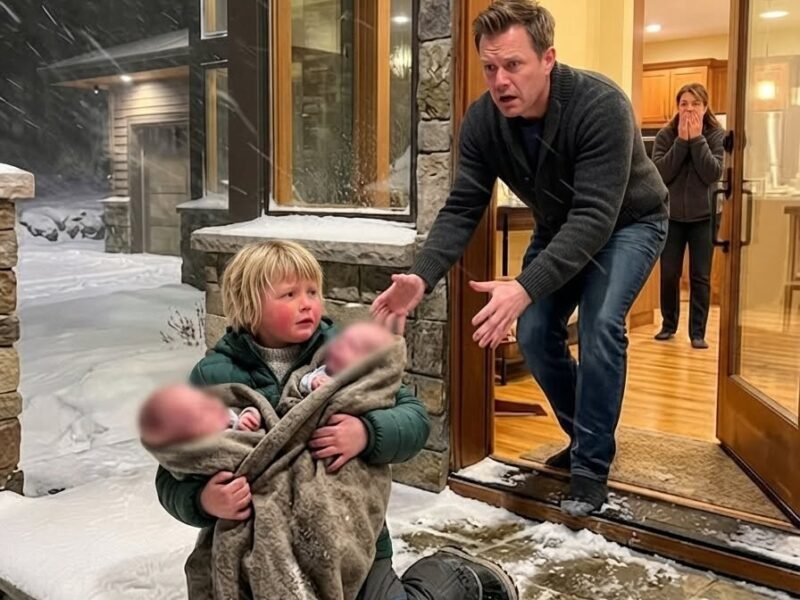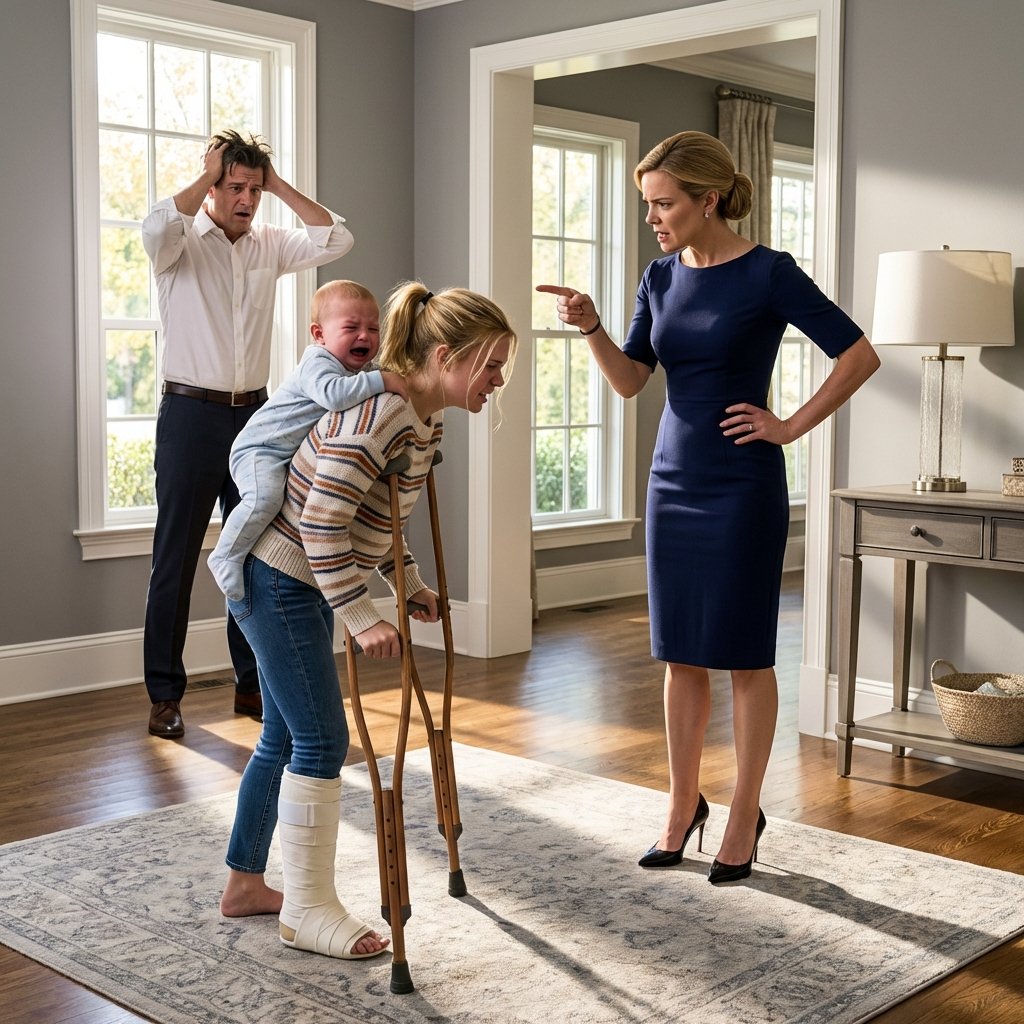
The rain hammered against the floor-to-ceiling windows of the Greenwich estate, a rhythmic drumming that masked the horrific silence of the house. Jonathan Whitmore, a man who commanded markets and moved nations with a signature, felt the air vanish from his lungs. The smell of the foyer was not the familiar scent of expensive lilies and floor wax; it was the stench of neglect—the metallic tang of dried blood and the cloying sweetness of infection.
Emily’s fingers, raw and weeping at the tips, dug into the grout between the marble tiles one last time. When she heard his voice, her head lolled back, her eyes sunken into hollow sockets that made her seven-year-old face look ancient.
“Daddy?” she rasped. The word was barely a vibration, a ghost of a sound.
She didn’t ask for help for herself. With a trembling, skeletal hand, she pushed the limp, gray form of her brother toward him. “Noah… he won’t wake up. He’s so… so hungry.”
Jonathan let out a sound that wasn’t human—a strangled, guttural sob that tore through his chest. He reached for Noah first, the baby’s weight so negligible it was as if he were picking up a bundle of dry sticks. The boy’s skin was ice-cold, his breathing so thready that Jonathan had to press his ear to the tiny, protruding ribs to hear the stuttering rhythm of a heart nearly finished with its labor.
“I’ve got you,” Jonathan choked out, pulling both children into the soaked fabric of his charcoal suit. “I’ve got you. God, Emily, your leg…”
He looked down at the limb. The bone had pierced the skin days ago; the fabric of her leggings was fused to the wound by dried yellow pus and dark, angry blood. The sight was a testament to a level of cruelty Jonathan couldn’t fathom, happening within the very walls he had built to protect them.
“I tried to find the milk,” Emily whispered, her fevered breath hot against his neck. “But she locked the kitchen. She said… she said we weren’t allowed to be loud while you were gone.”
The front door, left ajar, caught a gust of wind and slammed shut. The sound echoed like a gunshot.
From the top of the grand spiral staircase, a shadow moved.
Rachel Whitmore stood there, draped in a silk robe the color of a bruised plum. She held a glass of amber liquid in one hand, her expression one of mild annoyance, as if she had been awakened by a noisy pet. She didn’t look at the blood on the floor. She didn’t look at the dying infant. She looked at Jonathan.
“You’re home early,” she said, her voice smooth and devoid of a single tremor. “I told the help to take the week off. I wanted some peace and quiet with the children. Emily had a little trip down the stairs—you know how clumsy she is when she’s seeking attention.”
Jonathan looked up. The man who had entered the house—the billionaire, the negotiator, the strategist—was gone. In his place was a father who had seen the abyss.
“Peace and quiet?” Jonathan’s voice was dangerously low, a vibrating chord of pure, unfiltered rage. He looked at the trail of blood Emily had left across his foyer—a thirty-foot map of agony. “You locked them in the dark. You let them starve. You let my daughter’s leg rot while you sat up there and drank?”
Rachel took a slow sip of her drink, leaning against the mahogany railing. “They’re resilient, Jonathan. Don’t be so dramatic. A few missed meals and a fracture—they’ll be fine by the time the gala—”
“Get out.”
The words weren’t shouted. They were a sentence.
“Excuse me?” Rachel scoffed, a flicker of uncertainty finally crossing her sharp features. “This is my home. We have a contract—”
“There is no contract for what you’ve done,” Jonathan said, his eyes turning to ice as he fumbled for his phone with a shaking hand, never letting go of his children. He hit a speed-dial button. “Marcus? I need the private jet prepped for a medical transport. Get the trauma team from Yale-New Haven on the line. Now. And Marcus… call the District Attorney. Tell him I have a monster in my house, and I want her in chains before the sun comes up.”
Rachel’s glass slipped from her hand, shattering on the stairs. “Jonathan, you can’t be serious. Think of the press. Think of the scandal—”
“I am thinking of my daughter,” Jonathan roared, his voice finally breaking the silence of the mansion. “Who crawled through her own blood to save her brother while you watched! I am thinking of the life you almost stole!”
He didn’t wait for her response. He gathered both children into his arms, ignoring the way the movement made Emily cry out in white-hot agony. He ran. He ran through the rain, his billion-dollar world collapsing behind him, his only focus the two heartbeats thudding weakly against his chest.
The sirens began to wail in the distance, a choir of vengeance approaching the gilded gates of the Whitmore estate.
The hospital wing was a fortress of glass and steel, silent save for the rhythmic hum of life-support machines.
Jonathan sat in a chair between two beds, his suit still stained with the salt of the sea and the blood of his children. He hadn’t slept in seventy-two hours. He hadn’t left their side.
Noah was hooked to a TPN line, the nutrient-rich fluid slowly bringing the color back to his translucent skin. He was sleeping, his tiny hand curled around Jonathan’s thumb.
Emily’s leg was in a complex external fixator, a cage of metal rods holding the shattered bone in place. The surgeons had told Jonathan that if she had arrived an hour later, the infection would have turned septic. She would have died on that marble floor.
A soft knock came at the door. Marcus, Jonathan’s head of security, stepped in. He looked at the floor, unable to meet his boss’s eyes.
“She’s been processed, sir,” Marcus whispered. “The DA isn’t just going for child endangerment. With the evidence of the locked room and the medical neglect, they’re looking at attempted murder. She won’t see the sun from anything but a barred window for twenty years.”
Jonathan didn’t look up. He was watching Emily’s eyes flutter open.
“Daddy?” she murmured, the fever finally broken. She looked around the bright, clean room, her eyes landing on Noah’s crib. “Is he… is he okay?”
“He’s okay, Emily,” Jonathan said, his voice thick with a promise that would never be broken again. “He’s okay because of you. You saved him.”
A small, weary smile touched her lips. “I told him you were coming. I told him you’d hear us.”
Jonathan leaned down, pressing a kiss to her forehead. He was one of the wealthiest men on the planet, but in that moment, as he felt the warmth of his daughter’s skin and the steady grip of his son’s hand, he realized he had been a pauper until this very second.
The Whitmore name would be dragged through the dirt. The tabloids would scream. But as the sun rose over the hospital, Jonathan knew the reckoning was over. The cruel had been judged. And for the innocent, the long, cold night was finally over
The courtroom was a cathedral of cold oak and judgment, but the air inside felt thin, as if the sheer weight of the evidence had sucked the oxygen from the room.
Jonathan Whitmore sat behind the prosecution table, his posture a rigid line of tempered steel. He didn’t look like a billionaire today; he looked like an executioner. Beside him, a folder lay open, containing the high-resolution photographs of the trail of blood on the marble foyer and the medical imaging of a seven-year-old’s femur shattered into four distinct pieces.
When the side door opened, a hush fell over the gallery. Rachel was led in, handcuffed, her designer suit replaced by a drab, orange jumpsuit that drained the life from her skin. She looked frantic, her eyes darting across the room until they landed on Jonathan. She tried to muster a look of indignant betrayal, but it crumbled under the absolute vacuum of his gaze.
“The People call Jonathan Whitmore to the stand,” the prosecutor announced.
Jonathan stood. The walk to the witness box felt like a mile. He took the oath with a voice that didn’t tremble.
“Mr. Whitmore,” the prosecutor began, pacing slowly. “Tell the jury what you found when you opened your front door on the night of the sixteenth.”
Jonathan’s eyes never left Rachel’s. “I found the aftermath of a war zone,” he said, his voice low and vibrating with a resonant power. “I found a three-week-old trail of human suffering. My daughter was dragging her dying brother across a floor that cost more than most people’s homes, while the woman I trusted to protect them sat upstairs and waited for them to stop making noise.”
“Objection!” Rachel’s lawyer shouted. “Speculation!”
“Overruled,” the judge snapped, her eyes fixed on Rachel with a simmering disgust.
“She didn’t just neglect them,” Jonathan continued, leaning forward. “She hunted their spirit. She locked the kitchen. She silenced the help. She watched through a security feed as my daughter’s leg turned black with infection, and she did nothing because she wanted to be the only thing left in my life. She wanted to erase my children so she could inherit my world.”
Rachel jumped to her feet, her chains rattling violently against the wood. “They were spoiled! They wouldn’t stop crying for their mother! I was trying to discipline them, Jonathan! I was trying to make them respect me!”
The courtroom went dead silent. It was the confession the prosecution hadn’t even had to work for. Rachel realized what she’d said, her mouth hanging open as the jury stared at her with a collective expression of horror.
Jonathan didn’t flinch. “You didn’t want respect, Rachel. You wanted a graveyard.”
The verdict came back in less than an hour: Guilty on all counts. Attempted murder, aggravated child abuse, and kidnapping. The judge, bypassing the standard sentencing guidelines, handed down the maximum. Rachel would be eighty years old before she ever felt the sun on her face without a chain around her waist.
Six months later, the Greenwich estate was a pile of rubble. Jonathan had watched the wrecking ball swing into the master bedroom himself. He wouldn’t sell it; he wouldn’t let another soul live in a place where such darkness had breathed.
Instead, he bought a sprawling ranch in the hills of Montana—a place of big skies and grass that went on forever.
On a warm afternoon, Jonathan sat on the porch, a glass of lemonade in his hand. Below him, in a field of wildflowers, he saw them.
Noah was running—truly running. His legs were sturdy, his cheeks flushed with a healthy, vibrant pink. He was chasing a golden retriever, his laughter ringing out across the valley like a bell.
And then there was Emily.
She walked with a slight, almost imperceptible hitch in her stride, a permanent reminder of the night she became a hero. She was throwing a ball for the dog, her movements fluid and strong. She stopped for a moment, looking up at the porch.
She didn’t look like the ghost on the marble floor anymore. She looked like a girl who knew she was safe. She blew a kiss to her father, her eyes bright and clear, before turning back to her brother.
Jonathan felt a lump form in his throat, but for the first time in a year, it wasn’t a lump of grief. It was the heavy, golden weight of peace. He had lost his wife, he had nearly lost his children, and he had destroyed his old life to save what remained.
He picked up his phone and sent a final message to Marcus. The foundation papers are signed. The ‘Emily & Noah Center for Child Protection’ opens Monday. Let’s make sure no child ever has to crawl toward the light again.
He set the phone down and walked into the field, his shadow joining theirs in the tall grass. The billionaire had found his fortune, and it wasn’t in a bank. It was in the sound of two heartbeats, loud and steady, echoing against the mountains.
The End.
Website Disclaimer
The information provided on this website is for general informational and educational purposes only. While we strive to ensure that all content is accurate and up to date, we make no guarantees regarding the completeness, reliability, or accuracy of any information published.
The views and opinions expressed in articles belong to their respective authors and do not necessarily reflect the views of this website. Any action you take based on the information found on this website is strictly at your own risk. We will not be liable for any losses, damages, or inconveniences arising from the use of our content.
Some articles may contain opinions, third-party information, or external links. We do not endorse or guarantee the accuracy of content on external websites and are not responsible for their practices or policies.
All content on this website is provided in good faith and is intended for informational purposes only. Readers are encouraged to verify information independently and seek professional advice where appropriate.