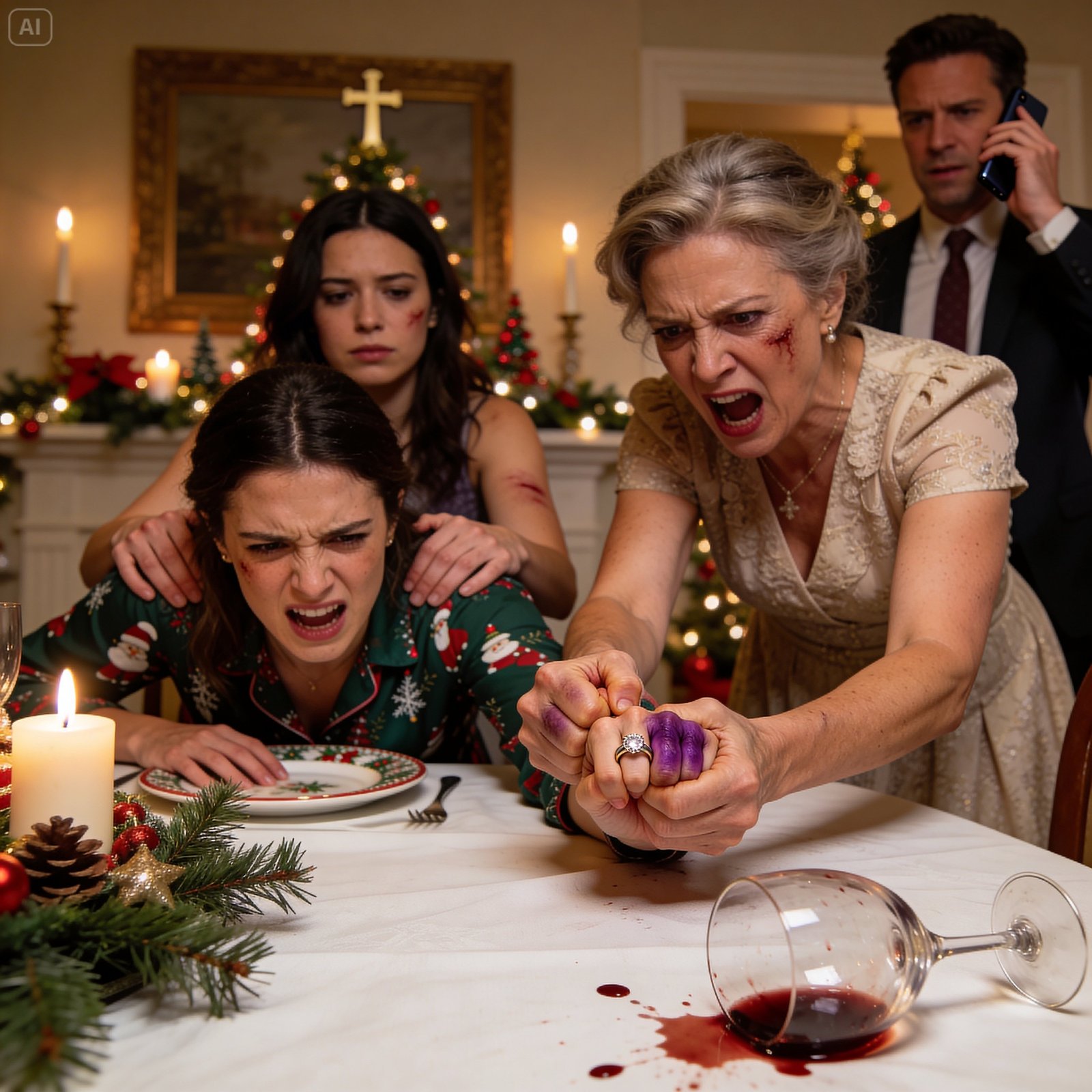
Part 1 — The House Where Girls Learned to Disappear
“Congrats, honey. But I really wish you’d put this much effort into finding a nice boy to take care of you.”
She said it without blinking. Then she picked up my Northwestern acceptance letter — the one I’d carried home trembling with pride — and dropped it into the kitchen trash can like a grocery receipt.
I’m Mia Calloway. And that moment wasn’t the worst thing my mother ever did to me. It wasn’t even close.
Growing up, our house had rules that other kids’ houses didn’t. My sister Rena and I didn’t play on weekends — we practiced. Books balanced on our heads, trays of food in our hands, walking slow circles around the living room while our mother watched with her arms crossed. Drop a single drop? You’d scrub the kitchen floor with a toothbrush until your fingers bled.
At bedtime, we didn’t read stories. We rehearsed sentences. “Whatever you think is best, honey.” “I’m sorry for speaking out of turn.” Over and over until the words stopped feeling like words and started feeling like a collar around your throat.
Rena took to it. By fifteen, she was ironing her boyfriend Dererick’s shirts every morning before school and packing his lunches with little notes that read: “I exist to make you happy.” My mother rewarded her with a $300 KitchenAid mixer. I watched and felt sick.
I chose a different path. I buried myself in school — extracurriculars, honor roll, student council, every teacher’s favorite. I thought if I could just prove myself in a way she understood — achievement, success, results — she would finally look at me the way she looked at Rena.
Instead, she threw my future in the trash.
A week later, I came home to find Rena with a black eye, hidden under a thick layer of concealer. When I tried to talk to her, she laughed. “Oh, Dererick just gets carried away sometimes. It means he can’t control himself around me because he loves me that much.”
That was the day I understood: I hadn’t just lost my mother. I’d lost my sister too.
Before I left for college, I made one desperate attempt to earn a single approving nod. I dated Tyrone — checked my phone, cut off my friends, demanded my location 24/7. Every red flag I knew how to read, I ignored. Because when I brought him to the Fourth of July cookout, my mother’s face lit up. She hugged me. First time in three years.
I should have felt relieved. Instead, I felt hollow.
Four years later, I graduated with a finance degree, found a therapist, and met James — the kind of man who listens when you talk, plans dates, makes you laugh without trying. When Christmas came around, I actually let myself hope. Maybe they’d see how happy I was. Maybe things would be different.
I knocked on that door with more confidence than I’d felt in years.
Rena answered. She looked like a ghost. Bruises under Dollar Store concealer. A limp she was trying to hide.
And when she saw James help me off with my coat, she gasped — “Mia, you’re emasculating him in public.”
That’s when I knew. Nothing had changed.
What happened next… I never could have prepared for.
*Part 2 *
The week after Christmas felt like walking through wet cement.
My finger was wrapped in a soft splint, the dislocated joint still aching every time I reached for anything — a coffee cup, a door handle, the remote control. James had bought me one of those ergonomic pillow things you prop your arm on, and I’d wake up in the middle of the night to find him adjusting it while I slept, making sure the swelling didn’t get worse. He never made a big deal out of it. That was the thing about James. He never made a big deal out of anything he did for me, only out of things I did for myself.
“How’s the finger?” he asked on the third morning, sliding a plate of eggs across the kitchen counter.
“Still attached,” I said. “Which is more than my mother was hoping for.”
He didn’t laugh, but the corner of his mouth twitched. That was enough.
I picked up my phone and stared at the screen. Forty-seven missed calls. Fourteen voicemails. Eleven texts from relatives I barely remembered — cousins, aunts, my mother’s church friends who’d somehow gotten my number. The texts all had the same flavor, different wording.
*Your mama is worried sick.*
*Mia, baby, she loves you. Call her back.*
*I’m praying for your family right now.*
I set the phone face-down on the counter.
“She’s going to call everyone she knows,” I said.
James poured his coffee slowly. “She already is.”
I looked up.
“My sister Ashley called me last night after you fell asleep,” he said carefully. “Apparently your mother reached out to three people in my family. My mom’s hairdresser. One of my dad’s old coworkers. And Mrs. Patterson from the neighborhood association.” He paused. “She told all of them I was holding you against your will.”
I stared at him.
“Against my will,” I repeated.
“Against your will,” he confirmed.
I pushed the eggs around my plate and tried to think clearly. Outside the kitchen window, the street was quiet and gray. The kind of gray that makes everything look like it’s already over.
“Okay,” I said finally. “Then we document everything. Every call. Every voicemail. Every text from every person she contacts. We write it down with dates and times.”
James nodded. “Ashley said the same thing. She wants to meet with us this week.”
Ashley Mercer was the middle of James’s three sisters, and she operated at a frequency that most people found slightly alarming. She drank black coffee at nine in the evening, kept color-coded folders for every active case, and had a way of looking at you over the top of her reading glasses that made you feel like you were being evaluated by someone significantly more intelligent than yourself. She was the kind of person you wanted furiously on your side.
She met us at her kitchen table on a Wednesday evening with a recorder, a legal pad, and a stack of intake forms from her firm.
“Start from the beginning,” she said, clicking the recorder on. “Not Christmas. Before Christmas. How long has this behavior pattern been going on?”
I looked at James. He nodded.
So I started talking.
I talked for two hours. I told Ashley about the books balanced on our heads as children, about the toothbrush and the kitchen floor, about the bedtime phrases rehearsed like prayers. I told her about Rena ironing Dererick’s shirts at fifteen, about my mother’s face the day I showed her my acceptance letter, about Tyrone and the Fourth of July and the first hug my mother had given me in three years — earned by dating a man who tracked my location.
Ashley wrote steadily, occasionally asking for clarification. *What year was that? What exactly did she say? Do you have any written record of that conversation?*
When I got to Christmas, I described it clinically, the way my therapist had taught me. Event. Response. Impact. I kept my voice even until I got to the part about the knife, and then my voice cracked a little and James reached under the table and covered my hand with his.
Ashley set her pen down.
“Mia,” she said. “I want to be straight with you. What you’re describing is not a difficult family situation. It is not a communication breakdown. It is a sustained, multi-year pattern of psychological abuse with a documented violent escalation. We are going to treat it like what it is.”
I blinked. Something in my chest shifted.
Nobody had ever said it that plainly before. Not even my therapist, who was careful and measured and always framed things as *perspectives* and *experiences.* Ashley just said it like a fact, the way you’d say the sky is gray or water is cold.
“Okay,” I said. My voice was smaller than I expected.
“Okay,” she agreed, and picked her pen back up. “Now. The police report from Christmas — do you have a copy?”
“James filed it. It’s on his phone.”
“I need a printed copy and a digital backup. I also need photos of your finger, the ones the paramedics took and any you’ve taken since. I need names of the officers who responded, and if you remember anything they said, write it down tonight while it’s still fresh.” She flipped to a new page. “Going forward, every contact attempt gets logged. Every single one. Time, date, method, content. If she calls you, don’t answer, but save the voicemail. If she texts, screenshot it immediately. If she contacts someone you know, get a written statement from that person about what she said.”
“That’s a lot,” I admitted.
Ashley looked at me over her glasses. “Yes,” she said simply. “It is. But if we want a restraining order that sticks — and we do — we need a paper trail she can’t argue with.”
We left her apartment at eleven-thirty with a folder full of forms and a list of next steps typed out in Ashley’s precise font. Walking to the car, I felt something I hadn’t felt since Christmas. Not happy, exactly. Not even hopeful.
Just — armed.
The paper trail started immediately.
James bought a dedicated notebook — a plain black one from the drugstore — and we kept it on the kitchen counter beside the coffee maker. Every call my mother made got logged. Every missed call. Every voicemail transcribed word for word in James’s neat handwriting, with a timestamp and a note about my emotional state at the time.
*January 4th, 8:42 a.m. Voicemail, duration 3 min 17 sec. Caller: Mom. Content: Crying, asking me to call her back, saying she can’t sleep, saying what happened at Christmas was “a misunderstanding.” No apology for the assault. No mention of the knife. Asked me to “not let that man turn me against my family.” Logged by James.*
*January 5th, 11:15 p.m. Text from Aunt Carol (mother’s side). Content: “Your mama called me crying tonight. She says you won’t speak to her after the holidays. Whatever happened, please reach out. Family is everything.” Screenshot saved.*
*January 7th, 2:30 p.m. Call to James’s cell from unknown number. Mother’s voice. Said James was “trapping” me. Said she would “do what a mother has to do.” Duration 47 seconds before James ended the call. Audio saved.*
The notebook filled up faster than I expected.
The call to my workplace came on a Thursday.
I was in the middle of reviewing quarterly projections when my desk phone rang — internal line, from reception.
“Mia, I have a woman on hold for you. She says she’s your mother and it’s a family emergency.”
I felt my stomach drop straight through the floor.
“Put her through,” I said, before I could think better of it.
The line clicked.
“Mia.” My mother’s voice was honey and broken glass, the way it always was when she wanted something. “Baby, I’ve been trying to reach you. I’m so worried.”
“Mom.” I kept my voice level, low. I was aware of Cassandra in the next cubicle pretending not to listen. “You cannot call me at work.”
“I’m your mother. I can —”
“You assaulted me at Christmas. You lunged at my fiancé with a kitchen knife. You dislocated my finger.” I said each sentence separately, like items on a list. “Do not call this number again.”
I hung up.
My hands were shaking. I put them flat on my desk and pressed down hard until they stopped.
Twenty minutes later, my boss called me into her office.
Macatherine Okafor was fifty-two years old, had built her career from a junior analyst position at twenty-four, and ran her department with a calm precision that I had admired for two and a half years. She was the kind of boss who remembered your birthday without being reminded and sent handwritten notes when you hit a milestone. She was also, I noticed the moment I walked in, doing the thing she did when she was deeply uncomfortable — tapping her pen against the corner of her desk in a rhythm of three.
Tap. Tap. Tap.
“Close the door,” she said.
I closed it.
“Mia. I received a call this morning. Before you arrived.” She chose her words carefully, the way she always did when the situation was delicate. “From a woman who identified herself as your mother. She told me —” she paused, glancing at a notepad, “— that you had stolen jewelry and heirlooms from the family home. That you were experiencing a mental health crisis. And that your boyfriend was — her words — ‘controlling and isolating you from your support system.’”
The room felt like it tilted slightly.
“That’s not true,” I said. My voice came out steadier than I felt. “Any of it.”
“I know.” Macatherine held my gaze. “I’ve worked with you for two years, Mia. This doesn’t match anything I’ve observed. But I had to ask.”
“She assaulted me on Christmas Day.” I reached into my bag and pulled out the police report — I’d started carrying a copy everywhere, folded into thirds in the front pocket. I slid it across the desk. “She tried to pull my engagement ring off my finger. The paramedics said the joint was dislocated. She also picked up a kitchen knife and went at my fiancé before the police arrived.”
Macatherine read the report in silence. Her expression moved through several things — shock, then a controlled kind of anger, then something softer.
“I’m filing for a restraining order,” I said. “My fiancé’s sister is an attorney. We’ve been documenting everything.”
Macatherine set the report down. “I’m sorry you’re dealing with this.” She pushed the report back toward me gently. “But Mia — she called three times yesterday. My assistant fielded two more calls this morning before you arrived. If this continues, it creates a disruption issue I’m going to have difficulty managing around your promotion review.”
I heard the words clearly. Not a threat — a warning. A practical, professional warning from a woman who was actually trying to help me.
“I understand,” I said.
“File that restraining order quickly,” she said. “And keep me updated.”
I made it to the parking lot before I had to stop walking.
I stood beside my car with my keys in my hand and breathed the cold January air in through my nose and out through my mouth, the way my therapist had taught me. Four counts in. Hold. Six counts out.
Three years. Three years of sixty-hour weeks, of bringing in clients, of presenting to the board, of covering for colleagues and staying late and arriving early. Three years of building something carefully from nothing, the way my mother had always said wasn’t worth building.
And in three phone calls, she’d put all of it on a ledge.
My phone buzzed. James.
*I’m in the parking lot. Second row. Look left.*
I looked left. There he was, leaning against his car with two coffees and a brown paper bag from the deli on Fifth that I’d mentioned liking once, four months ago, in passing.
I walked over and he handed me the coffee without saying anything. We stood side by side against the car and I sipped and let the warmth move through me.
“She called my work,” I said finally.
“I know. Ashley already left a message for the courthouse.”
“She told Macatherine I stole from the family. That I’m having a mental breakdown. That you’re controlling me.”
“Of course she did.” His voice was quiet but not gentle, exactly — more like certain. Like someone who has already decided the outcome. “We’re filing harassment charges today, Mia. Ashley’s sister is a paralegal at family court. She can expedite the intake.”
I looked at him sideways. “Your entire family has somehow mobilized for me.”
“They like you better than they like most people.” He bumped my shoulder with his. “Also, none of them are afraid of a fight.”
I laughed. Just a short one, surprised out of me. It felt strange in my chest, like a window being opened in a room that had been shut too long.
“Okay,” I said. “We file today.”
Ashley’s kitchen table had become our unofficial war room.
By the end of that first week, the surface was covered in color-coded folders. Blue for police reports. Red for contact logs. Yellow for witness statements. Green for medical documentation — the ER visit, the follow-up with the orthopedic specialist, the photos of my finger at each stage of healing.
“Twenty pages,” Ashley said, flipping through the compiled documentation on the fourth evening. She was eating an apple and reading simultaneously, which was somehow not at all surprising. “This is good. This is genuinely good. It shows a clear pattern of escalating behavior over an extended period. No judge worth their degree is going to look at this and see a concerned mother.”
“My therapist can submit a statement,” I said. “Confirming the history of psychological pressure going back to childhood.”
“Get that in writing as soon as possible.” Ashley made a note. “Also, James — the voicemail where she tells you that you’re trapping her daughter and that she’ll do ‘what a mother has to do.’ That’s a veiled threat on record. We’re including it.”
James nodded.
“One more thing.” Ashley set the apple down and looked at me directly. “Mia, does your mother have access to any of your accounts? Email, social media, anything?”
I frowned. “She knows some of my passwords. Or she knew them. From years ago when I was living at home.”
Ashley and James exchanged a look.
“Change everything tonight,” Ashley said. “Every password. Every security question. Enable two-factor authentication on your email and your banking. Anything connected to your professional identity — your work email, your LinkedIn — make sure she can’t access it.”
“You think she’d do that?”
Ashley gave me a look that said she had seen people do significantly worse.
“Change everything tonight,” she repeated.
We filed the paperwork on a Friday.
The courthouse clerk was a tired-looking man named Gerald who ate a granola bar at his desk while we stood at the window and organized our documents. He reviewed the stack we slid through the gap — methodically, without expression — and then he looked up at us over his reading glasses.
“This is thorough,” he said. It wasn’t a compliment exactly, more like an observation. “Good job documenting.”
“Thank you,” Ashley said crisply. “We’d like to request expedited review given the documented assault and the ongoing workplace harassment.”
Gerald made a note. Stamped three things. Handed us a receipt.
Walking out of the courthouse into the pale winter sunlight, I felt the first real loosening in my chest since Christmas. Not resolution. Not safety. But movement. Like something that had been static for weeks had finally, slowly, begun to turn.
James took my good hand.
“One step,” he said.
“One step,” I agreed.
But my mother, as I should have known by then, never waited for us to catch up.
Saturday morning, I woke to pounding.
Not knocking — pounding, the kind that carries through walls and sits in your sternum. I was out of bed before I was fully awake, and James was already at the door, eye to the peephole.
He turned around and held one hand out flat — *stay back* — and his face was the controlled, careful expression he got when he was actively not panicking.
“It’s police,” he said quietly.
“What?”
“Two officers. Stay in the bedroom.”
“James —”
“Mia. Please.”
I stayed in the doorway of the bedroom, close enough to hear. The apartment door opened. I heard James’s voice, even and polite.
*”Good morning, officers. What can I do for you?”*
A man’s voice, older: *”Sir, we received a report that a woman at this address is being held against her will. Her name is Mia Calloway. Is she present?”*
*”She’s present. She’s not being held against anything. This is her home.”*
*”Can we speak with her?”*
I walked out before James could answer for me. I was wearing pajamas and my hair was still half-pinned from sleep, and one of the officers — the younger one — looked slightly startled.
“I’m Mia Calloway,” I said. “And I’m not being held anywhere.”
The older officer had the look of a man who had done this exact errand too many times. “Ma’am, we received a report from a concerned family member stating that your boyfriend — ”
“Fiancé.”
“— your fiancé was preventing you from leaving or contacting family.”
“He’s not.” I kept my voice even. “Would you like to see the police report from Christmas Day? My mother assaulted me at a family dinner. She dislocated my finger trying to remove my engagement ring and picked up a kitchen knife when my fiancé tried to intervene.” I went to the counter, pulled the folded report from my bag — *always in the bag now, always within reach* — and handed it over.
The officer read it. His expression didn’t change, exactly, but something behind it shifted.
“We’re in the process of filing for a restraining order,” I continued. “We filed harassment paperwork yesterday at the courthouse. The case number is on the receipt, which I can also show you.”
The younger officer exhaled. “Third wellness check this week that’s turned out to be a family situation,” he said, not quite under his breath.
“Ma’am,” the older one said, handing the report back to me, “you’re going to want to finalize that restraining order quickly. If your family continues to file reports, we’re obligated to respond.”
“I understand,” I said. “Thank you for coming.”
After they left, James closed the door and stood with his back to it for a moment.
“She sent the police to our home,” I said.
“Yes.”
“On a Saturday morning.”
“Yes.”
I sat down on the couch. Pulled the blanket his grandmother had made over my knees — an old quilt in blues and greens, soft from years of washing. I held it there and looked at the middle distance and tried to locate the feeling living in my chest. It wasn’t fear anymore, I realized. It had moved past fear.
It was something colder. Something that was just beginning to harden into shape.
“She’s not going to stop,” I said.
James sat beside me. “No,” he agreed. “Not on her own.”
“Then we make her stop.”
He looked at me.
“I mean it,” I said. “We stop managing this. We stop reacting. We go after her legally, completely, with everything we have, and we don’t stop until there’s a court order with her name on it that has actual teeth.”
James was quiet for a moment. Then he said, “Ashley’s going to want to add this wellness check to the documentation.”
“Then call her,” I said. “Call her right now.”
He pulled out his phone. And I sat in the blanket his grandmother made and listened to him explain the morning to his sister, and I felt the thing in my chest finish hardening into exactly what it needed to be.
Not rage.
Resolution.
The days that followed moved in a strange double rhythm — ordinary on the surface, relentless underneath. I went to work. I reviewed reports. I ate lunch at my desk and answered emails and smiled at colleagues in the hallway. And underneath all of it, the machine kept running. Ashley filed. The courthouse processed. The notebook on the counter filled up, page after page, James’s handwriting getting smaller to fit more in.
My mother, meanwhile, was getting creative.
She couldn’t reach me directly — I’d changed my number. She couldn’t reach James — he’d blocked her. She couldn’t get through to my work email without being immediately flagged by reception. So she moved sideways.
She called my former college roommate, a woman named Priya who I still texted occasionally. *”I’m just so worried about Mia. She’s changed so much. That man she’s with — I don’t think he’s good for her.”*
She left a note under the door of our upstairs neighbor. *”If you see anything concerning, please call this number. A mother is very worried.”*
She sent a card — an actual greeting card, floral, the kind you find in the pharmacy aisle — to James’s parents’ address. Inside, in her careful handwriting: *”I know you raised your son to be a good man. Please ask him to return my daughter.”*
O’Catherine Mercer — James’s mother, a retired schoolteacher who made soup when people were struggling and had opinions about everything and was afraid of absolutely nothing — called me personally after receiving the card.
“I need you to know,” she said, her voice warm and precise, “that I have placed this in a plastic sleeve and given it to Ashley for the file. I also need you to know that if that woman shows her face anywhere near my family, she will have a very different kind of problem on her hands.”
I laughed — a real one this time, full and surprised.
“Thank you, O’Catherine.”
“Don’t thank me. Come to dinner Sunday. You both look like you haven’t slept properly in a week.”
We went to dinner Sunday. She made chicken and dumplings and didn’t ask a single question about the case, just kept refilling our plates and talking about her garden and the neighborhood association’s ongoing dispute about the Hendersons’ fence. James’s youngest sister, Victoria, did homework at the kitchen table and periodically asked me to explain things she was studying for her economics class. The third sister, Jenny, arrived late with her boyfriend and a bottle of wine and started an argument with Ashley about something that had happened in 2019 that none of them could fully remember.
It was the most normal evening I’d had since before Christmas.
Driving home, I cried the whole way without entirely knowing why. James drove and didn’t say anything and handed me a napkin from the glove compartment that had a gas station logo on it.
“Sorry,” I said, wiping my face.
“Don’t be.”
“I just —” I searched for the words. “I forgot what it felt like. To just *be* somewhere.”
He glanced over at me. “We’re going to have more of those evenings,” he said. “That’s what we’re building toward. Not just stopping her. That.”
I looked out the window at the dark street.
“Okay,” I said quietly. “Yeah. That.”
Eleven days after Christmas, the restraining order was approved.
Ashley called me at work at two-seventeen in the afternoon. I stepped into the hallway to take it, turned to face the wall, and listened to her read the conditions — five hundred feet from my person, my home, my workplace. Prohibited from contacting me by any means, directly or through a third party.
“She’ll be served today,” Ashley said.
“Okay,” I said.
“Mia. This is good. This is a real thing we did.”
“I know.” I pressed my free hand against the wall. The paint was cool and slightly textured. “Thank you, Ash.”
“Save the thanks. She’s going to escalate when she gets served. They almost always do.” A pause. “Are you ready for that?”
I thought about Christmas. About the knife. About forty-seven missed calls and the police at our door on a Saturday morning and the card sent to James’s parents and the note slipped under our neighbor’s door.
“Yes,” I said.
I hung up, smoothed my jacket, and walked back into the office.
At my desk, I opened the black notebook to a new page and wrote:
*January 16th, 2:17 p.m. Restraining order approved and issued. She’ll be served today. We are ready.*
PART 3
She was served on a Tuesday.
I know because Ashley called me at four fifty-three in the afternoon, just as I was shutting down my computer, and said in that flat, factual tone she used when she was controlling something bigger underneath: “The sheriff’s deputy served her at home forty minutes ago. She signed the acknowledgment.”
“How did she react?”
A pause. “The deputy noted she was, quote, ‘verbally combative and required explanation of consequences three separate times.’”
I stared at my monitor’s blank screen. My own reflection looked back at me, dim and flattened.
“Okay,” I said.
“Mia. Listen to me carefully.” Ashley’s voice dropped just slightly. “I’ve seen this pattern before. A restraining order is not a wall. It’s a line on paper. For people like your mother — people who believe they are fundamentally right — a line on paper is an invitation to find the edges. So we watch. We document everything. Any contact, any proximity, any third-party message, any social media activity directed at you. Everything.”
“I know.”
“I mean *everything*, Mia. The things that feel too small to mention — mention them anyway.”
I picked up my bag, turned off the office light, and stood for a moment in the dark.
“She’s going to get worse before this is over,” I said. It wasn’t a question.
“Yes,” Ashley said. “She is. But so are we.”
The first violation came four days later.
It didn’t come from my mother directly. It came from Rena.
James’s phone buzzed at dinner — we were eating takeout at the kitchen table, reviewing some of the documents Ashley had sent over — and he glanced at the screen and went very still.
“It’s your sister,” he said carefully. “Voicemail.”
I set my chopsticks down. “Play it.”
He hesitated.
“James. Play it.”
He put the phone between us, volume low, and pressed play.
Rena’s voice came through the speaker, and immediately I could tell something was wrong. Not wrong like crisis — wrong like *altered.* Her words were slightly loose at the edges, her consonants soft in a way they hadn’t been when we were kids.
*”Mia. Hey. It’s me. I know you blocked my number so I’m calling James because… I just needed to say something. Dererick left. He’s gone. He said — he said our family is too much drama. That it makes him look bad.”* A wet sound, like she was crying or had been. *”This is your fault. You know that? If you’d just — if you’d just played along, none of this would have happened. He was the only man who ever really loved me and you — you and your feminist whatever — you drove him away. You think you’re better than us. With your degree and your fancy ring and your — your —”* The message cut out for a second. *”You’re going to end up alone, Mia. Just like me. You’ll see.”*
The voicemail ended.
The kitchen was very quiet.
I looked at the table. At the white takeout container. At the paper napkin folded under my chopsticks. I focused on the small, specific details of things because it was the only way to stay in the room.
“She’s been drinking,” I said.
“Yeah.”
“Or something.”
“Yeah.”
I breathed slowly. “Dererick leaving her isn’t my fault.”
“No,” James said. “It’s not.”
“Dererick leaving her is the best thing that could have happened to her. Even if she can’t see that.”
“Also true.”
I pushed my food away. Not angrily — just gently, like I didn’t need it anymore. “I want to call her. I know I shouldn’t. I know it’s a trap, even if she doesn’t mean it as one. But she’s my sister and she sounds—”
“Lost,” James said quietly.
“Yeah.” I looked at him. “Yeah. That’s exactly it.”
He was quiet for a moment. Then: “Document the voicemail. Tell Ashley. And then — if you want to think about how to safely reach out to Rena somewhere down the line, we can figure that out. But not now. Not while your mother is using her.”
“What if my mother is the reason Rena sounds like that?”
James held my gaze. “Then Rena needs help we can’t give her right now. And getting you both dragged back into your mother’s orbit doesn’t help either of you.”
I picked up my chopsticks. Put them down again. “When did you get this smart about all of it?”
“I’ve been taking notes,” he said simply. “Literally. Have you seen how long that black notebook is getting?”
I almost smiled. Almost.
The harassment charges were filed on a Thursday.
Ashley walked us through it step by step at the courthouse, making sure we had originals and three copies of everything. The clerk — a different one this time, a young woman with reading glasses pushed up on her forehead — looked at the stack of materials we presented and let out a low whistle.
“This is thorough,” she said.
“Thank you,” Ashley said, in the same crisp tone she always used for compliments she considered merely accurate. “We’re requesting that the filing be time-stamped against the restraining order service date to establish the escalation timeline clearly.”
The clerk made a note, stamped everything, and handed us our receipts.
Outside, on the courthouse steps, Ashley turned to us and said: “Now we wait. And while we wait, your mother is going to find new angles. So I need you both thinking about what she knows. What information does she have access to? Who in your lives might she be able to reach that we haven’t considered?”
James and I looked at each other.
“My work,” I said slowly. “She’s already called Macatherine.”
“Documented,” Ashley said. “What else?”
“My professional email. We changed the passwords, but she knows where I work. She could call different departments.”
“We should warn HR preemptively,” Ashley said, making a note. “Give them the restraining order number. Ask them to log any calls from her as potential harassment violations. What else?”
I thought. “My college professors. A couple of my old supervisors. I had an internship three years ago at Hargrove Financial — my supervisor there, a man named Clifton, he wrote me a reference letter. She might try to reach him.”
“I’ll prepare a brief letter explaining the situation that you can send to any professional contacts who might be vulnerable to her reaching out. Factual, no drama, just a heads-up with the restraining order on file.” Ashley capped her pen. “Anything I’m missing?”
“Cousin Thawn,” James said.
Ashley looked at him.
“He works in city hall records,” James said. “If we apply for anything that goes through city hall — marriage license, permit, anything — he could potentially tip her off.”
Ashley stared at him for a long moment. “And this is relevant because—”
“Because we’re getting married in three months.”
A silence.
“You’re filing a marriage license,” Ashley said, in the tone of someone realizing a problem they should have anticipated.
“We were planning to,” I said carefully.
“Change the date. Change the venue. File under the quietest circumstances possible and do not tell anyone outside this immediate circle.” She looked between us. “Anyone. Not friends, not coworkers, not —”
“Ashley,” James said. “We told nobody.”
She relaxed, fractionally. “Good. Keep it that way.”
But somehow, my mother found out anyway.
We filed the marriage license on a quiet Wednesday morning, no announcement, no celebration, just a quick trip to the clerk’s office and back. We didn’t tell anyone. We didn’t post anything. We didn’t so much as text each other about it on our phones.
And still, four days later, Ashley called me at work, her voice tight with an anger she was very carefully managing.
“Mia. Does your mother have a cousin named Thawn who works in the records department at city hall?”
My blood went cold.
“Yes,” I said.
“Because someone flagged your marriage license application this morning. Your mother now has the date, time, and location of your ceremony.”
I gripped the edge of my desk. Around me the office continued its ordinary noise — keyboards, a ringing phone down the hall, Cassandra asking someone about the Henderson account.
“How do we fix it?” I said.
“We don’t, fully. I called the clerk’s office. You could refile with a new date, but that creates new paperwork and a new record, and if your cousin has access to those records, he’ll find the new date just as easily.” A pause. “James and I talked while you were in your morning meeting. Our suggestion is that you stick to the original plan. Let her come. Whatever she does becomes evidence.”
“She’ll make a scene,” I said.
“Yes,” Ashley said. “She will. And every second of it gets documented.”
I stared at the wall across from my desk. There was a motivational poster there that I had never once found motivating, something about mountain peaks and persistence. I had looked at it approximately four hundred times without seeing it.
“Okay,” I said. “We stick to the plan.”
“Mia.” Ashley’s voice shifted slightly — still precise, but warmer. “You’re going to get married. That’s what’s happening that day. Whatever she does is just noise around the actual event.”
I breathed. “Yeah.”
“Say it like you mean it.”
“We’re getting married,” I said, and this time it landed somewhere solid.
“There it is,” Ashley said. “See you Saturday.”
The weeks between the license filing and the ceremony were, as I would describe them to my therapist later, a special category of terrible.
The police wellness checks increased to three in one week. Each time, James answered the door with the restraining order number ready and a printed copy of the original police report on the counter within reach. Each time, we answered the same questions — Are you here voluntarily? Do you feel safe? Is there anything you need? — and each time, the officers left looking slightly tired in the way that people look tired when they keep being dispatched to situations that aren’t what they were told they were.
The property manager sent us a written warning about disturbances.
Cassandra from the next cubicle stopped making small talk in the break room.
The man from the apartment three doors down — big guy, quiet, kept to himself mostly — stopped James in the hallway one evening and asked, in a very careful way, “Hey man, everything okay at home? Someone in the building mentioned some concerns.”
James, who had the patience of someone trained by years of having three sisters, said calmly: “We’re dealing with a difficult family situation involving harassment. We have a restraining order. If you have specific concerns, here’s the contact information for our attorney.” He produced Ashley’s card from his wallet. The man from 3B took it, looked at it, and said, “Alright, man. Sorry to bother you.”
I heard about this secondhand from James that evening and felt something complicated move through me. Not shame, exactly. Something adjacent to it. The exhaustion of having your private life become a matter of public neighborhood concern because someone else decided to make it one.
“I hate this,” I said.
“I know.”
“Not you. Not us. Just — this. All of it. The way she’s everywhere without being here. The way she’s managed to make me feel like a stranger in my own building.”
James set down whatever he’d been reading. “Do you remember what you said in the car after dinner at my parents’ house? About forgetting what it felt like to just be somewhere?”
“Yes.”
“We’re building toward that. Every day of this is a day closer to the other side.”
I looked at him. “Do you actually believe that, or are you saying it for my benefit?”
He thought about it genuinely — I could tell because he got quiet in a specific way when he was actually considering something versus when he was managing me. “Both,” he said finally. “I believe it and I’m saying it for your benefit. Those things aren’t mutually exclusive.”
I laughed. Short, surprised. The window-opening feeling again.
“You’re very annoying,” I told him.
“I know,” he said. “You love it.”
Rena called James’s phone again ten days before the wedding.
This time, James played it for me at low volume while I sat on the couch with my knees pulled up, listening. Rena’s voice was clearer this time — not the loose, blurred quality of the first message. This version of her was angry in a focused way.
*”James. Tell Mia that Brandon is single. Dererick’s brother. Mom thinks he’d be right for her — a real man, she said. Someone who knows how to keep a woman grounded. Not like whatever you are. No offense.”*
She paused. We could hear her breathing.
*”Mia, if you just — if you’d just tried. If you’d just been what mom needed you to be, all of this would have been fine. I know you think you’re doing the right thing. But you’re not. You’re just making everything harder for everyone. Brandon would treat you well. Mom says he —”*
The message cut to the maximum length and ended.
I sat very still.
“Brandon,” I said.
“Dererick’s brother,” James confirmed.
“She’s found a replacement. For me.” I worked through it slowly. “She can’t get to me directly. She can’t call. She can’t come near the building. So she’s trying to get Rena to sell me on marrying someone she approves of. As if — as if a different man would fix this. As if the problem was ever the man.”
“The problem was never the man,” James said.
“I know that. You know that. Rena doesn’t know that yet.” I set my phone down. “She doesn’t know she’s being used right now. She thinks she’s helping.”
“Save the voicemail,” James said gently.
“I know.” I reached for the black notebook. Opened it to the current page. Wrote the date, time, content summary. My handwriting was getting steadier as the weeks went on, I noticed. Less cramped with anxiety, more deliberate. Like writing a thing down had started to feel like authority over it rather than just record of it.
Four days before the wedding, I arrived at work to find three things waiting:
First, a message from Macatherine asking me to come in before the morning meeting.
Second, an email from HR flagged URGENT with a subject line that read: *Regarding External Contact re: Calloway, Mia.*
Third, a voicemail from the IT department.
I stood at my desk with my coat still on and read all three notifications in sequence. Then I sat down, put my bag on the floor, and called James.
“She’s found new angles,” I said when he picked up.
“Tell me.”
“She’s called multiple departments. HR has a flag on my file. IT left me a voicemail — I haven’t listened to it yet.” I kept my voice low and even. Around me, the office was filling up with morning arrivals. “She’s escalating because the wedding is this week.”
“I’ll call Ashley right now,” James said. “You go see Macatherine.”
Macatherine’s office smelled like coffee and the particular expensive hand cream she kept on her desk. She was already sitting when I came in, which meant she’d been waiting. The blinds were angled to let in light without the view, which was what she did when she wanted to minimize distraction.
“Close the door,” she said.
I closed it. Sat. Waited.
“Mia.” She folded her hands on the desk. “I’m going to be straightforward with you because I think you deserve that. Your mother has been calling multiple departments in this building. She told accounting you’ve been embezzling from petty cash. She told HR that you’ve been selling prescription medications in the building parking lot.” She paused. “She called our largest client — the Donovan account — and told their office manager that you’ve been stealing proprietary data.”
The floor dropped.
“The Donovan account,” I repeated. “That’s a two-million-dollar —”
“I know what it is.” Macatherine’s voice was not unkind but it was very direct. “I’ve already spoken with legal. They’re aware of the situation and they have the restraining order on file. But Mia — the promotion committee meets in three weeks. This kind of disruption, even when it is entirely not your fault, does not read well in that room.”
I gripped the armrest of the chair. Felt the firmness of it under my fingers — solid, real, present.
“I have harassment charges filed,” I said. “She’s violating the restraining order every time she contacts anyone associated with me. I’m documenting every incident.”
“I know.” Macatherine’s expression softened by degrees — not much, but enough. “I want you to know that I personally believe everything you’ve told me. But I also have a responsibility to this office, and I can’t — in good conscience — promise you that the committee will see it the way I see it.”
I looked at her. Felt the three years of sixty-hour weeks sitting in the room between us like a presence.
“Thank you for being honest with me,” I said.
“Take whatever time you need this morning,” she said. “And Mia — go get married. Whatever happens with the promotion, go get married.”
I made it to the parking lot and sat in my car with the engine off for eleven minutes.
I know it was eleven minutes because I watched the clock. I gave myself those eleven minutes to feel everything — the fury, the grief, the specific exhaustion of having done everything right and still watching it get dismantled from the edges by someone who had decided that my success was her enemy.
Three years.
Sixty-hour weeks.
New clients brought in. Presentations delivered. The Donovan account, which I had personally cultivated over fourteen months of careful relationship-building, coffee meetings, quarterly check-ins, remembering the office manager’s daughter’s college graduation and sending a card.
All of it balanced on the edge of a few phone calls from a woman in a church dress who believed that my career was a symptom of a spiritual disease.
At minute eleven, I started the car.
I drove to Ashley’s office — not home, not back to work, but there, to the place where the fight was actually being run — and walked in without an appointment and sat down across from her desk and said: “She called my biggest client. She told them I’m stealing data. She called accounting and HR with fabricated stories. She is going to cost me this promotion and possibly this job.”
Ashley set down what she was reading. She looked at me with the full, undivided attention she reserved for situations that required it.
“Tell me everything,” she said. “All of it. Then we figure out what we do next.”
So I told her. And when I was done, Ashley leaned back in her chair and was quiet for a long moment in the way that meant she was thinking at full speed rather than not thinking at all.
“She’s not just harassing you,” Ashley said finally. “She’s running a coordinated campaign. Every angle she’s found — your employer, your client, your building neighbors, your family contacts — she’s using each one as a separate lever. That’s not reactive behavior. That’s deliberate.” She tapped her pen. “Which means we don’t just file individual violations. We build a pattern argument. Every call she makes is another data point in a documented pattern of coordinated harassment. When we go before a judge — and we will go before a judge — we present this as a campaign, not a collection of incidents.”
“How long does that take?”
“Longer than you want.” She looked at me steadily. “But Mia — she is building our case for us. Every call she makes, every lie she tells, every department she contacts — she is adding to a stack of evidence that a judge is eventually going to look at and have no room to question.”
I leaned forward. Elbows on knees. “And in the meantime?”
“In the meantime, you get married on Saturday,” Ashley said. “And whatever she does, you walk out of that courthouse with your husband and a marriage certificate. And then we come back Monday and we keep building.”
I looked at her for a moment. At the color-coded folders behind her. At the recorder on the corner of her desk. At the photo pinned to her bulletin board of her and James and their sisters at some holiday, all of them laughing at something outside the frame.
“Ashley,” I said. “If she shows up Saturday — what do we actually do?”
Ashley picked up her pen.
“Let security handle the removal,” she said. “You focus on the ceremony. And I will be standing close enough to record every word she says.”
She smiled — not warm, exactly, but sharp and certain in a way that was its own kind of comfort.
“She’s going to walk into that courthouse,” Ashley said, “and hand us everything we need.”
The night before the wedding, I couldn’t sleep.
James was asleep beside me, breathing slowly and steadily, and I lay in the dark and stared at the ceiling and went through everything the way I always did when sleep wouldn’t come. The sequence of events. The documentation. The things we’d done right, the things we couldn’t control. The fact that somewhere across the city, my mother was presumably awake too, preparing whatever she had planned for tomorrow morning.
I thought about the girl who had practiced sentences in her bedroom. *Whatever you think is best, honey.* Who had balanced books on her head and learned to walk without spilling. Who had poured everything she had into school and handed her mother an acceptance letter and watched it land in a trash can.
I thought about Rena, glassy-eyed at the door on Christmas, bruises under Dollar Store concealer.
I thought about the black notebook on the counter, nearly full.
Somewhere around two in the morning, I got up quietly, went to the kitchen, and made tea. Sat at the table in the dark with my hands around the mug and let the warmth work through my palms.
The black notebook was there.
I opened it to the last filled page. Read the most recent entry in James’s handwriting — the IT department confirmation that the fake job applications had been traced to my mother’s IP address. Then I turned to the first blank page and picked up a pen.
I didn’t write a log entry. I wrote something different. Just a few lines, for myself.
*Tomorrow I get married.*
*She will try to stop it.*
*She won’t.*
*The girl who practiced sentences is gone.*
*I know what I’m worth.*
*I am ready.*
I closed the notebook.
Finished the tea.
Went back to bed, and this time, slept.
# PART 4
The morning of the wedding was gray.
Not stormy — just that flat, pewter-colored winter gray that sits low over everything and makes the world look like it’s been photocopied one too many times. I stood at the bedroom window in my robe and looked at the street below and thought: *of course.* Of course the sky on this day would look like this. Of course nothing about this morning would be uncomplicated.
James came up behind me and handed me coffee without a word. We stood there together looking at the gray sky, and after a moment he said, “Jenny pressed your suit last night. It’s hanging on the bathroom door.”
Jenny’s suit. Navy blue, structured shoulders, the kind of thing that said *I am serious and I am here and I am not going anywhere.* I had tried it on two nights ago and stood in front of the mirror for a long time, looking at myself in someone else’s clothes that fit better than most of my own things had, and thought about the shredded remains of my real interview suit in an evidence bag at the detective’s office.
“Thank you,” I said.
“O’Catherine made breakfast sandwiches. She’s downstairs with Ashley and Victoria.”
I turned to look at him. He was already dressed — dark slacks, a white shirt, the tie his father had given him for his own wedding day, navy with small silver flecks in it. He’d gotten a haircut the day before and he looked like the kind of person who had his life in order, which was only partly true and all the more remarkable for it.
“James,” I said.
“Yeah.”
“We’re actually doing this.”
He smiled — not the careful, managing smile he used when things were difficult, but the real one, the one that reached all the way up. “We’re actually doing this.”
I kissed him once. Then I went to put on Jenny’s suit.
Downstairs, the Mercer family had quietly transformed our kitchen into something that felt like a command center and a celebration simultaneously.
O’Catherine was at the stove in a good blouse, making eggs in addition to the sandwiches she’d apparently already made. Victoria was at the table with her laptop open, ostensibly doing coursework but actually watching the door. Ashley stood at the counter with her coffee and her phone, already reviewing something with the focused expression of a person who had been working since before most people wake up.
Jenny was sitting cross-legged on the couch doing something with a small case of makeup that she snapped shut when she saw me and said, “Sit. I’m doing something with your eyes.”
“I don’t need —”
“Sit,” she said pleasantly, and pointed at the cushion beside her.
I sat.
While Jenny worked — efficiently, without fuss, in the no-nonsense way that seemed to be a Mercer family characteristic — Ashley spoke from the kitchen without looking up from her phone.
“Courthouse security has been briefed. I spoke with the head of security, a man named Officer Rutherford, last night. He has your mother’s photo and the restraining order on file. If she comes within the designated perimeter of the building entrance, he has authority to detain her before she enters.”
“What about Rena?” I asked.
A pause.
“Rena is not covered by the restraining order,” Ashley said carefully. “She has the right to enter a public building. But she also has no legal standing to disrupt a civil ceremony. If she causes a disturbance, security can remove her.”
I thought about Rena’s voicemail. The slurred edges of her voice. The message about Brandon.
“She might not even come,” I said.
“She might not,” Ashley agreed. “But we plan as though she will.”
O’Catherine set a plate in front of me. Eggs, toast, sliced fruit. She put her hand briefly on my shoulder — warm and solid — and then went back to the stove without making a thing of it.
“Eat,” she said simply. “You need something in your stomach.”
I ate.
We arrived at the courthouse forty minutes early.
The building was already busy — it was a Saturday, but civil ceremonies and other business ran through the morning, so the marble lobby was populated with small clusters of people in various states of occasion. A young couple near the elevator, the woman in a white sundress that seemed optimistic given the weather outside. Two men in matching gray suits waiting by the information desk. A family group taking photos near the stairs.
We moved through security and found our assigned courtroom on the second floor. The hallway smelled like floor cleaner and old paper, the particular institutional smell of places where official things happen every day until they become ordinary.
I was not ordinary to me.
James held my hand as we walked, and I was aware of the weight of his fingers against mine, the familiar pressure of it, the way I had come to understand that particular handhold as its own language. It meant: *I see you. I’m here. We go forward.*
The courtroom itself was small — not a full trial room, just a civil ceremony space with wooden benches and a raised platform where the judge would stand. It smelled faintly of wood polish. Morning light came in through high frosted windows and lay in soft rectangles across the floor.
O’Catherine sat in the first row with Victoria and Jenny. Ashley positioned herself at the end of the bench nearest the door — deliberately, I noticed. The best sight line to the entrance.
James and I stood together at the front of the room and waited.
For twenty minutes, nothing happened.
Just the quiet. Just the light. Just the sound of the building around us — distant voices, a phone ringing somewhere, footsteps in the hallway outside passing without stopping.
I became aware, in those twenty minutes, of what it felt like to simply be in a room with the people who had chosen to be there. O’Catherine, who had made breakfast sandwiches at six in the morning and pressed my borrowed suit with a careful hand. Victoria, who had explained consumer behavior theory to me over homework sessions and brought me tea without being asked. Jenny, who had handed over her own clothes without ceremony and sat me down on the couch to do something about my eyes. Ashley, who had turned her kitchen table into a legal office and spent her evenings building a case out of the pieces of my worst year.
James, who had bought me coffee in parking lots and kept a black notebook on the counter and made tea when I couldn’t stop shaking and put himself between me and a kitchen knife without a second’s hesitation.
I thought about what family had looked like in the house where I grew up. The books on heads. The sentences rehearsed until they became reflex. The $300 KitchenAid mixer given as a reward for performing submission.
I thought about what family looked like right now, in this room.
Then the doors opened.
My mother came in like weather.
She had worn her best church dress — the navy one with the white collar, the one she saved for occasions where she needed to appear, as she always put it, *appropriate.* Her hair was set. Her handbag was the good leather one. She had dressed, I realized, for a performance she had been rehearsing in her head for weeks.
Behind her: Rena, glassy-eyed and unsteady on shoes that were slightly too high. And behind Rena, a man I had never seen but immediately understood — softer features than Dererick, less defined around the jaw, wearing a smile that had been arranged on his face rather than arrived there naturally.
Brandon.
My mother’s eyes swept the room with the efficient scan of someone who has walked into many rooms expecting to take them over. She found me at the front. Her expression moved through several things in fast succession — relief, then anger, then the particular configuration she used when she believed she was saving someone who didn’t understand they needed saving.
“Stop this right now.”
Her voice filled the room completely, the way it always had, trained by decades of knowing how to make itself heard.
“Mia, baby. This is not you. This is not who you are.”
Ashley was already on her feet, phone out, recording. Officer Rutherford and a second security guard appeared in the doorway behind my mother — they’d followed her in, I realized, which meant she had moved faster than they’d anticipated.
My mother walked toward me. Not rushing — deliberate, purposeful, the walk of someone who believes they have every right to be exactly where they are.
“You need to come with me,” she said. “We can fix this. All of this. Brandon is here and he’s willing —”
“Ma’am.” Officer Rutherford stepped forward. “You are in violation of a court-issued restraining order. You need to stop moving and —”
“I am her *mother.*” She said it like it was an argument that ended all other arguments. “I have every right —”
“You have no legal right to be within five hundred feet of this person,” Officer Rutherford said, with the flat, absolute patience of someone who had delivered this particular sentence before. “The order was issued and served. You signed the acknowledgment.”
My mother stopped walking. She was ten feet from me. Close enough that I could see the set of her jaw, the particular way she held her shoulders when she was about to do something she had already decided no one could stop.
“Mia.” Her voice dropped — not soft, exactly, but lower. More intimate. The voice she used when she wanted to pretend this was just between the two of us. “Look at what you’re doing. Look at where you are. This is not the life I raised you for.”
“No,” I said. My voice came out steadier than I had prepared for. “It’s the life I chose.”
“You were *confused.* That school, those ideas they put in your head —”
“I have a finance degree, a promotion I worked three years for, and a man who has never once made me feel small.” I held her gaze. My hands were not shaking. That surprised me. “The only thing confusing me right now is why you think love looks like what you do.”
Her face twisted. “You ungrateful —”
“Ma’am.” Officer Rutherford put a hand on her arm. Not rough, but firm.
She wheeled on him. “Don’t you *touch* me. I am her mother. I am trying to save my daughter from a man who has *brainwashed* her, who has turned her against God, against her family, against everything —”
Brandon stepped forward with his rehearsed smile and extended a hand toward me like we were being introduced at a cocktail party. “Hi, Mia. Your mom’s told me a lot about you. I think we could really —”
“You need to leave,” James said.
His voice was very quiet and completely certain, the way it got when he had moved past the point of managing the situation and arrived at the point of simply stating fact. He stood slightly in front of me — not blocking me, not overriding me, just *present* — and looked at Brandon without hostility or performance.
“This is my wife,” James said. “Not a problem to be solved. Not a project. My wife. And you are in the wrong building.”
Brandon’s smile faltered. Just for a moment, the arrangement of his features slipped, and underneath it was something uncertain and young.
My mother found her voice again, louder: “You shut your mouth. You have no right to speak in this situation. You have *poisoned* my daughter, you have taken her from her family, you have —”
“She chose to leave,” James said, still quiet. “There’s a difference.”
Security reached my mother then — both officers, moving with the practiced efficiency of people trained for exactly this kind of situation. She fought it, not physically but verbally, her voice escalating with each step toward the door.
“This isn’t legal! She is not of sound mind! Feminism has *poisoned* her thinking and that man is her *handler!* This marriage is not valid! I will contest it! I will —”
The doors closed behind her.
We could still hear her in the hallway. Muffled through the wood, her voice rising and then hitting some bureaucratic wall and rising again. Brandon’s lower voice trying to intervene. Rena saying something in a slurred undertone.
The courtroom was quiet.
The judge — a man in his sixties with reading glasses and the expression of someone who has presided over a great many human situations — cleared his throat from the platform where he had been watching all of this with his hands folded.
“Would you like a few minutes?” he asked.
I turned to face him fully.
“No,” I said. “We’d like to get married now.”
The ceremony was four minutes and thirty seconds long.
I know because Victoria timed it on her phone — she told me later, proudly, like a personal record. The judge read the standard civil language, and James and I exchanged the rings that my mother had tried to destroy, and when the judge said *I now pronounce you married* and James kissed me, O’Catherine made a sound that was definitively crying even though she would later categorically deny it.
Ashley was still recording. Jenny was taking photos on her phone with the focused expression of someone determined to document joy as carefully as she had documented everything else. Victoria whispered *yes* to herself at the pronouncement, like a small personal victory.
Walking out of that courtroom, marriage certificate folded in James’s jacket pocket, I felt something happen inside me that I didn’t have an exact word for. Not triumph — triumph felt too loud, too directed outward. This was quieter. More internal. Like a door that had been jammed for years finally settling into its frame.
We were in the marble lobby, moving toward the exit, when Ashley’s phone rang.
She answered it, listened for fifteen seconds, and went pale.
I stopped walking.
“What,” I said.
Ashley lowered the phone slowly. “That was my contact at the civil filings office.” She looked at me steadily. “Your mother just submitted paperwork for emergency power of attorney over you. She’s claiming mental incompetence due to — and I’m quoting — ideological radicalization and feminist indoctrination. She has listed Rena as a supporting witness.”
The lobby seemed to expand and contract at the same time.
Power of attorney. The legal right to make decisions on my behalf. To control my finances, my medical care, my choices. The final mechanism of the house where I grew up — if you can’t make her comply, make compliance mandatory.
I stood in the middle of the courthouse lobby, newly married, in a borrowed suit, with my husband’s hand warm in mine and his family surrounding me, and felt the full weight of it settle.
Everything she had done — the calls to my workplace, the false police reports, the destroyed wardrobe, the death threat on the mirror, the crashed wedding, all of it — had been escalation toward this. If she couldn’t control me with conditioning, she would try fear. If fear didn’t work, she would try law. She would use every system available to her to restore the order she believed she was owed.
James’s hand tightened around mine.
I looked at Ashley.
“Okay,” I said. The word came from somewhere very settled, very far below the surface noise. “If she wants a legal fight, she’ll get one.” I squared my shoulders. “I’m done running. I’m done managing. I’m done trying to minimize the damage and stay small enough that she doesn’t notice me. She wants to prove I’m incompetent? Let her try.”
Ashley’s expression shifted. Not surprised — she had been waiting for this, I realized. This specific version of me.
“Good,” she said, and the sharpness in her voice was the closest thing to warmth she expressed when she was fully operational. “Because I have been documenting everything since January. Every call, every lie, every false police report, every contact attempt through third parties, every violation of the restraining order. We are going to present a case so thorough and so clear that no judge in this jurisdiction will have a single question left to ask.”
“How long?” I asked.
“We file the counter-response today. The power of attorney claim goes before a judge within seventy-two hours for an emergency review — given that she filed it the same morning as a documented restraining order violation, we can argue bad faith. My firm’s senior partner handles this kind of case.” She was already pulling up contacts on her phone. “We are going to bury her in evidence.”
We walked out of the courthouse into the gray February morning — officially married, paperwork in hand, Ashley already dialing — and I felt, for the first time in months, that the ground under my feet was exactly where I’d left it.
—
The counter-filing was prepared over the following seventy-two hours with the thoroughness of something built to last.
Ashley’s senior partner, a woman named Constance who wore her gray hair short and read documents the way other people read maps — looking for routes, looking for edges — reviewed our full documentation file on a Sunday afternoon with Ashley and me on both sides of her desk.
She read for forty minutes without speaking. Occasionally she made a mark in the margin. Once she stopped entirely, looked up, and said, “She called seventeen departments?”
“We have logs for nine confirmed calls to my employer,” I said. “And Ashley cross-referenced the call records.”
“And the wellness checks?”
“Seven in six weeks.”
Constance made another mark. Kept reading.
When she finished, she set the file down and folded her hands on top of it with the deliberateness of someone making a formal statement.
“This is one of the most thoroughly documented harassment cases I’ve reviewed in thirty years of practice,” she said. “The power of attorney filing is, frankly, an embarrassment. The grounds cited — ideological incompetence — have no legal standing and will be dismissed, but we are going to respond to it in a way that also formally categorizes it as part of the larger pattern of harassment.” She looked at me. “I want your therapist’s written statement, your academic records, your employment history, and three character witnesses from your professional life ready by Wednesday.”
“I can have all of that by Tuesday,” I said.
Constance looked at me over her reading glasses. “I like her,” she said to Ashley.
—
What followed was the strangest period of the entire ordeal — not because things got worse, but because for the first time, the machinery was moving in our direction and I could feel it.
The power of attorney claim was dismissed at the emergency hearing in less than twenty minutes. The judge — a woman named the Honorable Patricia Delacroix, who had clearly read everything before entering the courtroom — set the filing aside, looked at my mother’s attorney over her glasses, and said in a voice that carried zero room for interpretation: “Counselor, your client is going to want to think carefully about her next steps. The documented record in this case suggests a pattern of behavior that is going to complicate any future filings significantly.”
My mother, seated at the defense table in another church dress, said in a carrying voice: “She’s been indoctrinated. The system is biased against —”
“Ma’am,” Judge Delacroix said. “You are this close to a contempt citation. I suggest you let your attorney speak.”
My mother pressed her lips together.
It was the first time in my life I had ever watched her be silenced by something other than her own choice.
Rena came to see me three weeks after the hearing.
She texted first — not my number, but James’s, which she still had. *Can I see Mia. Just her. I don’t have anywhere else to go.* James showed me the message and raised an eyebrow.
“Up to you,” he said.
I thought about it for the rest of the afternoon. About the girl who had ironed a boyfriend’s shirts at fifteen and been given a KitchenAid mixer as a reward. About the bruises covered with concealer at Christmas. About the slurred voicemails.
About the version of myself that had also, for one terrible summer, dated a man my mother approved of because I wanted one approving nod.
“Yes,” I said. “Tell her yes.”
She arrived at eight o’clock on a Tuesday evening, thin in a way she hadn’t been before, with dark circles under eyes that were fully clear for the first time in months. She stood in the doorway of our apartment and looked at me and then looked at James and said, “Can I come in?”
James made tea. Then he went to the bedroom and closed the door, because he understood that some things require the particular privacy of sisters.
Rena sat across from me at the kitchen table and wrapped both hands around her mug and stared at it for a long time before she spoke.
“She got Dererick fired,” she said. “I found out. Ashley’s thing — the cross-examination thing — what came out in court.” She looked up. “Seventeen calls. Mom called his workplace seventeen times over eight months. I thought he left because of you. Because of the drama. But he left because she drove him out.” A pause. “She drove out the man she spent four years training me to keep.”
I kept my voice quiet and level. “Yes.”
“She destroyed my relationship trying to control it.” Rena’s eyes were dry but the effort was visible. “She thought she was helping. She genuinely believed she was helping me keep him.”
“She believed she was helping me too,” I said. “When she called my workplace. When she filed for power of attorney. She has never once thought she was the problem.”
Rena turned the mug in her hands. “I don’t know how to be angry at her. I’ve been trying and I can’t get there. I know what she did. I can see it clearly now. But when I try to be angry, I just —” She stopped.
“Feel sad?” I offered.
She looked at me. Something moved across her face.
“Yeah,” she said. “Just sad.”
I reached across the table and covered her hands with mine. She flinched slightly — old reflex — and then didn’t.
“That’s okay,” I said. “You don’t have to be angry yet. You can just be sad for a while. That’s a real place to start from.”
We sat there until the tea went cold.
The trial came three months after the wedding.
I will not describe every moment of it because some of it belongs only to the room where it happened. But I will say this: the moment that changed everything was not my testimony, and it was not the security footage of my mother in my apartment writing her message on my mirror.
It was Rena.
She took the stand on the second day, wearing a plain gray dress with sleeves that covered the fading marks on her arms, and she spoke in the careful, considered way she had been practicing in therapy — not performing, not performing calm, just actually present.
She told the truth about our childhood. The books. The sentences. The training.
She told the truth about Dererick and the seventeen calls.
And then Ashley, on cross-examination of my mother’s attorney’s earlier witness, asked a single question:
“When your mother called your former partner’s workplace, what reason did she give you for doing it?”
Rena said: “She said she was showing them what a good girlfriend I was. That she was helping.”
“And what was the result of those calls?”
“He lost his job. Then he left.”
The courtroom was completely still.
“So your mother,” Ashley said, slowly and clearly, “destroyed the relationship she had spent years training you to maintain — while telling you she was protecting it.”
Rena looked at her hands.
“Yes,” she said. “That’s what happened.”
My mother stood up. Her attorney grabbed her arm. She shook him off and pointed at Rena and said, her voice cracking for the first and only time in the entire proceedings: “You ungrateful child. I gave you everything. I gave you *everything.*”
The judge called for order.
But the jury had already seen it.
*Guilty on all counts.*
I will remember those four words for the rest of my life — not because of what they meant for my mother, but because of what happened in my body when I heard them. A kind of settling. The end of a vibration that had been running through me since Christmas morning, since before Christmas, since long before any of this had a name.
James’s hand in mine. Ashley’s quiet exhale beside me. O’Catherine, in the row behind us, making no effort whatsoever to conceal the fact that she was crying.
They led my mother away in handcuffs.
She looked back at me once. Just once, before the door.
I held her gaze and didn’t look away.
—
Six months after the verdict, life looked like this:
Sunday dinners at O’Catherine and Gerald Mercer’s house, where the argument was always about something ordinary — who had taken the last of the good coffee, whether Victoria’s new boyfriend was as interesting as she claimed, whether the garden needed the new fence Ashley kept proposing.
A new apartment in a building with a doorman and cameras, where I slept without waking to imagined pounding.
A smaller firm, yes, but a good one. Work that was mine again, uncomplicated by the static of someone else’s war.
Rena, in her studio apartment three miles away, surrounded by plants she had bought herself, studying for the community college placement exam, texting me every few days with questions about things she was learning to want.
The promotion came through in the fall. Macatherine called me personally and said, “I told you next year. Here we are.”
I said thank you. Then I sat at my desk for a moment, looking out the window at the ordinary afternoon, and thought about the girl who had practiced sentences until they tasted like poison.
She was not gone, exactly. She was just no longer in charge.
—
Eighteen months into my mother’s sentence, we received the victim notification that she had been considered for parole. Rena called me immediately, her voice tight with the old fear.
“She’ll come back,” Rena said. “She’ll find a way —”
“She can’t come within a thousand feet of either of us for ten years,” I said. “The restraining order survives parole. Ashley made sure.”
A silence.
“Are you scared?” Rena asked.
I thought about it honestly. “No,” I said. And then, because honesty requires completeness: “I used to be scared of what she’d do next. Now I’m just — tired of her having that much space in the conversation. She’s going to tell her story wherever she lands. She’s going to find new people who’ll listen to a mother crying about her lost daughters. That’s what she does. And it doesn’t touch us anymore.”
Rena was quiet for a moment.
“I had a dream last night,” she said. “We were in the kitchen at home, the old house, and she was making us practice walking with books on our heads. And in the dream I just — stopped. I set the book down and I said no. And she looked at me and I woke up.”
“How did it feel?” I asked.
“Terrifying,” Rena said. “And then, like. Good.” A pause. “Is that weird?”
“No,” I said. “That’s exactly right.”
—
On our second anniversary, James and I renewed our vows in his parents’ backyard on a June afternoon with actual sunlight — the real kind, warm and uncomplicated, the kind that asks nothing of you.
Rena was my maid of honor. She wore a yellow dress she had chosen herself and stood beside me without shaking.
Ashley gave a toast that was technically a legal brief organized around the theme of *chosen family* and made everyone cry, including Ashley herself, who denied it.
O’Catherine made chicken and dumplings, her potato salad, a cake she had been planning since February.
Victoria slow-danced with her boyfriend while Gerald Mercer watched with the satisfied expression of a man who has spent his whole life building something worth having.
Jenny took approximately four hundred photographs.
At some point in the late afternoon, I stood at the edge of the yard with a glass of lemonade and looked at the people around me — laughing, arguing, eating, existing in the easy, unremarkable way of people who feel safe — and felt the thing I had been trying to name for two years finally settle into language.
Not triumph. Not relief.
*Arrival.*
This was what we had been building toward, through the wellness checks and the courtrooms and the black notebooks and the borrowed suit. Not the absence of my mother. Not the verdict. Not any single moment of victory.
This. Just this. The ordinary grace of a backyard on a June afternoon with people who showed up.
My mother had believed that love was a system of control — that if she built the right structure, enforced the right rules, trained the right responses, she could produce daughters who would never disappoint her. She had called it love. She had been completely certain it was love.
But love that requires your silence is not love.
Love that needs your smallness to feel big is not love.
And the life you build when you finally understand that distinction — the life that costs you everything it costs, that requires you to stand in a courtroom in a borrowed suit and say *no* to everything you were trained to be — that life, when you arrive in it, is the most ordinary miracle.
James found me at the yard’s edge.
“What are you thinking about?” he asked.
I looked at him. At the backyard full of his family, who had become my family. At Rena in her yellow dress, laughing at something Victoria had said. At the late afternoon light coming in low and gold through the trees.
“Nothing,” I said.
And for the first time in as long as I could remember, that was exactly true.
End of Story
Website Disclaimer
The information provided on this website is for general informational and educational purposes only. While we strive to ensure that all content is accurate and up to date, we make no guarantees regarding the completeness, reliability, or accuracy of any information published.
The views and opinions expressed in articles belong to their respective authors and do not necessarily reflect the views of this website. Any action you take based on the information found on this website is strictly at your own risk. We will not be liable for any losses, damages, or inconveniences arising from the use of our content.
Some articles may contain opinions, third-party information, or external links. We do not endorse or guarantee the accuracy of content on external websites and are not responsible for their practices or policies.
All content on this website is provided in good faith and is intended for informational purposes only. Readers are encouraged to verify information independently and seek professional advice where appropriate.