PART 1
At 2:00 A.M. in the Frozen Emptiness of Northern Wyoming, the world feels suspended between existence and erasure, as if the plains themselves are holding their breath and waiting for something to disappear. That was the hour I pulled off Highway 212, not because I wanted to stop, but because the needle on my gas gauge was dropping faster than my patience with my own reflection. I had been driving west for three days straight, cutting across state lines with the stubborn determination of a man who believed distance could dilute memory. My name is Daniel “Dane” Whitlock, born in Amarillo, Texas, raised in a house where anger spoke louder than reason, and by thirty-five I had mastered the art of leaving before anything could demand that I stay.
The gas station looked like it had been forgotten by time. One overhead light flickered in uneven pulses, buzzing faintly like it resented the effort of staying alive. The building’s windows were dark, and the sign above the entrance had lost half its letters, leaving a name that meant nothing. One pump stood upright and functional. The other was wrapped tightly in yellow caution tape, snapping in the wind as though warning off ghosts rather than customers. Snow skidded across the concrete in thin, restless sheets, and beyond the reach of the light there was nothing but black prairie stretching into forever.
I stepped out of my truck—a dented blue Dodge Ram I’d bought with cash and no questions asked—and immediately felt the cold bite through denim and leather. The air tasted metallic, sharp enough to sting the back of my throat. I slid my card into the pump and began fueling, listening to the mechanical whir and the hollow thunk of gasoline entering a tank that had carried me farther than I deserved. The only other sound was the ticking engine cooling down and the wind dragging itself across the flat land. It should have been an unremarkable stop, the kind you forget before you even merge back onto the highway.
Then I heard something that didn’t belong in that silence.
At first it blended with the wind, thin and uncertain, like a trick of exhaustion. But it came again, clearer this time, slicing through the cold air with a pitch so fragile it made my spine stiffen. It wasn’t the yowl of a coyote or the scrape of loose metal. It was a cry. High. Desperate. Rhythmic.
A baby.
The pump clicked off, though I couldn’t remember squeezing the handle. I stood there for a second, telling myself I was mistaken, that fatigue was warping my senses. But the cry returned, longer now, trembling at the edges as if the lungs producing it were running out of strength. My boots carried me around the side of the building before my mind approved the decision. Gravel crunched beneath my weight. The wind intensified, pushing against my shoulders as though it disapproved of what I was about to see.
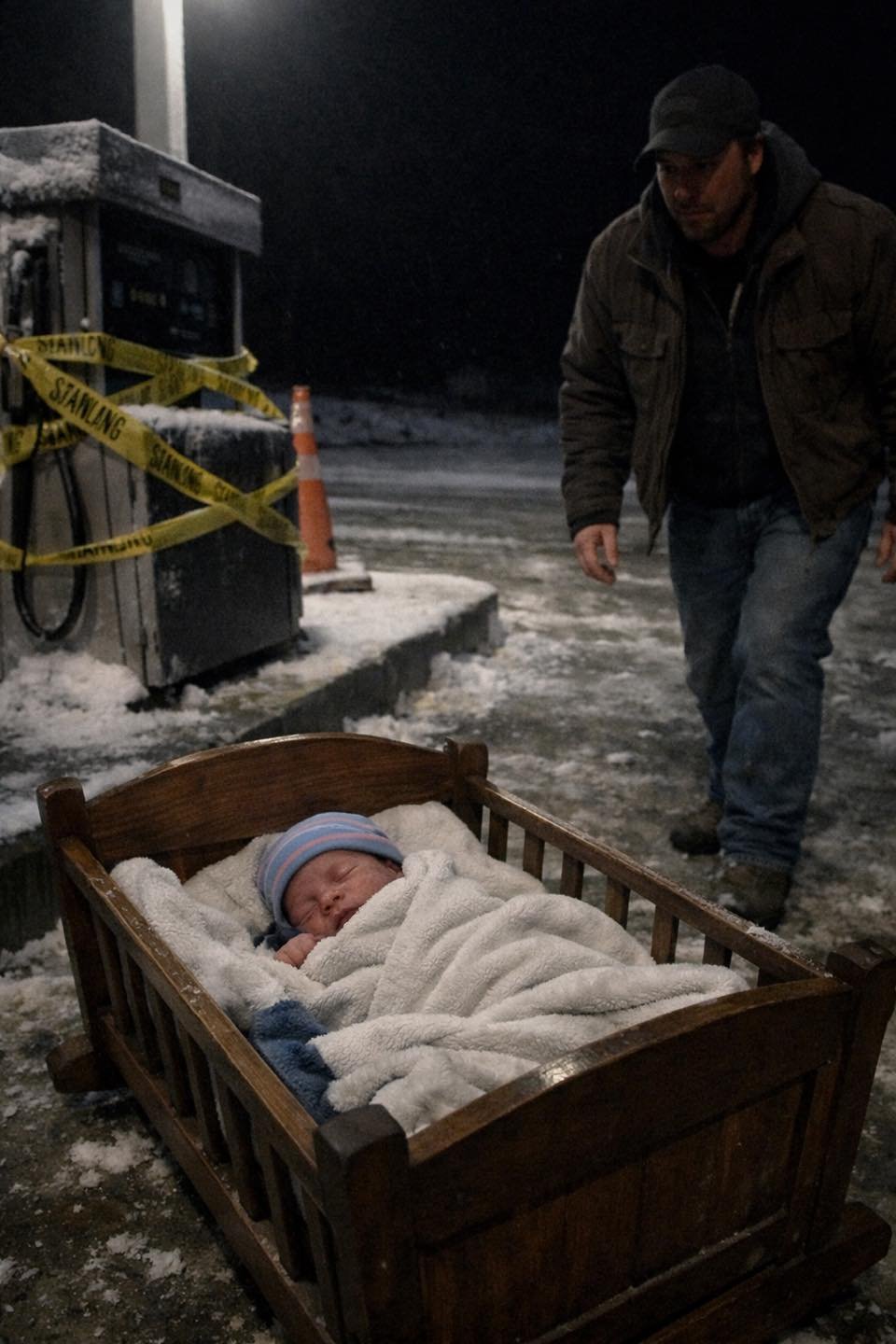
Behind the broken pump wrapped in yellow tape, partially shielded by the brick wall, sat an infant carrier.
It wasn’t tossed carelessly. It had been placed there. Deliberate. Protected from the direct wind, but not from the cold that seeped into everything. A pale blanket was tucked tightly around a small form inside. The baby’s face was flushed red from the freezing air, tiny fists trembling as she cried into a night that offered no answer. There was no note pinned to the blanket. No bag of supplies. No explanation written in ink to justify what had been done.
Just abandonment.
I stood motionless, my breath fogging in front of me, my mind racing through reasons to step back and dial 911. That was the lawful choice. The responsible one. The one any decent citizen would make without hesitation. But I had never been particularly skilled at being decent, and the law and I had crossed paths often enough to understand how easily good intentions can twist into paperwork and separation.
The baby’s cry shifted, weakening slightly, and something inside my chest tightened in a way I didn’t recognize. I crouched down slowly, knees cracking against the cold. When I reached out, my calloused finger brushing against her small hand, she reacted instantly. Her fingers wrapped around mine with a grip so unexpectedly strong it startled me. It wasn’t gentle. It wasn’t symbolic. It was survival.
“Alright,” I murmured, my voice rough from disuse. “Alright, I hear you.”
The wind howled louder, but I no longer felt it the same way. I lifted the carrier carefully, the plastic handle digging into my palm, and carried her back to the truck. The heater roared to life as soon as I turned the key, filling the cab with stale warmth that gradually pushed back the chill clinging to her skin. I watched as her cries softened into uneven breaths, her eyelids fluttering as exhaustion began to win.
I should have called the sheriff.
Instead, I put the truck in drive and turned west.
PART 2
At 2:00 A.M. in the Frozen Emptiness of Northern Wyoming, I crossed an invisible line that had nothing to do with state borders and everything to do with the kind of man I was willing to become. The road ahead was empty, the headlights carving twin tunnels through darkness, and for the first time in years I wasn’t thinking about what I was leaving behind. I was thinking about the small, fragile presence beside me, breathing in uneven rhythms as if the world had already taught her to expect disappointment.
I drove until dawn bled gray across the horizon. Somewhere near the Montana state line, I pulled into a rest area and fed her with formula bought from a twenty-four-hour grocery store clerk who barely looked up from her phone. When she asked for the baby’s name, the question hit me like a test I hadn’t studied for.
“Harper,” I said after a pause.
The name felt steady. Strong enough to survive winter.
Days turned into weeks with a speed that disoriented me. I rented a modest trailer outside a small Montana town called Red Hollow, a place where newcomers were tolerated as long as they worked hard and didn’t invite trouble. I found employment at a lumber mill, stacking boards and repairing machinery, trading muscle and silence for a paycheck that barely stretched but was enough. Nights were no longer spent in bars or on highways; they were spent pacing narrow rooms with a crying infant cradled awkwardly in my arms, learning the rhythm of someone else’s needs.
Harper demanded everything I had never offered anyone: patience, consistency, vulnerability. Fevers terrified me more than any fistfight I’d ever stumbled into. The first time she smiled—truly smiled, not gas from a bottle but recognition—I felt something inside me fracture and reform at the same time. It was as if a locked room in my chest had finally been forced open, revealing a capacity I had long assumed I didn’t possess.
Fear never disappeared completely. Every knock on the door made my pulse spike. Every unfamiliar car driving slowly past the trailer felt like impending judgment. I knew the legal complications of what I had done. I had no paperwork proving guardianship, no official adoption. Just a man and a child bound by a decision made in the cold. But months passed without inquiry. No missing persons posters surfaced with Harper’s face. No deputies arrived asking questions about a newborn abandoned in Wyoming.
The gas station became a memory, yet it remained vivid enough to revisit in restless dreams. I would see the yellow tape snapping in the wind, hear the echo of her cry, feel again the weight of the carrier in my hands. In those dreams, sometimes I walked away. Sometimes I left her there and returned to my truck alone. Those versions always ended the same way: with a silence heavier than guilt.
As Harper grew, so did the town’s quiet acceptance. People assumed I was a widower. I never corrected them. It was easier than explaining a truth that sounded criminal even when rooted in compassion. I learned to braid her hair with hands that had once known only blunt force. I attended school meetings and parent-teacher conferences, sitting in chairs too small for my frame, listening as teachers described her as bright, determined, stubborn in a way that suggested resilience rather than defiance.
Every year on the night of her birthday, I stayed awake until 2:00 A.M., remembering the exact hour our paths collided. I would step outside, breathe in the cold Montana air, and let the memory settle without overwhelming me. I never told her all the details, only that we found each other during a snowstorm in Wyoming. I wasn’t ready to confess how close I had come to choosing differently.
PART 3
At 2:00 A.M. in the Frozen Emptiness of Northern Wyoming, I stopped running without realizing that was what I was doing. Sixteen years later, Harper Whitlock stands taller than I ever imagined she would, her presence steady and self-assured, her questions sharper now that childhood has given way to something more searching. Tonight, on her sixteenth birthday, the house is quiet after friends have left, the remains of cake sitting untouched on the counter. She steps out onto the porch, wrapping herself in a blanket against the cool Montana night, and I follow.
“Dad,” she begins, her tone thoughtful rather than accusatory, “why were you there that night?”
The question is simple. The answer is not.
“I was trying to outrun myself,” I admit after a long pause, leaning against the railing beside her. “I thought if I put enough miles between me and my mistakes, they’d fade.”
“And I just… happened?”
I nod slowly. “You didn’t just happen. You interrupted.”
She studies me, eyes reflecting porch light and curiosity. “Did you ever think about calling the police?”
“Every mile,” I say truthfully. “But I knew what the system felt like. I grew up bouncing between homes that didn’t want me. I couldn’t let you start that way if I could help it.”
She exhales softly, absorbing that. The wind stirs the trees, but it’s no longer the lonely Wyoming wind; it carries the scent of pine and woodsmoke, the sound of a town that has become ours.
“Do you regret it?” she asks quietly.
The question pierces deeper than any accusation could.
I shake my head. “No. I regret who I was before you. I regret the years I wasted thinking I wasn’t worth staying for. But you…” I pause, struggling to compress sixteen years into a sentence. “You gave me something heavier than my past. You gave me a reason to carry it without collapsing.”
Her eyes shine, but she doesn’t cry. She steps forward and wraps her arms around me, taller now, stronger, no longer the fragile infant shivering behind a broken pump. I hold her carefully, aware of the weight and warmth that once fit into a single carrier and now fills my entire world.
Somewhere in northern Wyoming, that gas station may no longer exist. The pumps likely dismantled, the concrete cracked and reclaimed by weeds. The yellow tape long gone, fluttering into memory. But the decision made there endures, woven into every ordinary day that followed.
At 2:00 A.M. in the Frozen Emptiness of Northern Wyoming, I thought I was only stopping for fuel.
Instead, I found the one reason I would ever need to stay.
Website Disclaimer
The information provided on this website is for general informational and educational purposes only. While we strive to ensure that all content is accurate and up to date, we make no guarantees regarding the completeness, reliability, or accuracy of any information published.
The views and opinions expressed in articles belong to their respective authors and do not necessarily reflect the views of this website. Any action you take based on the information found on this website is strictly at your own risk. We will not be liable for any losses, damages, or inconveniences arising from the use of our content.
Some articles may contain opinions, third-party information, or external links. We do not endorse or guarantee the accuracy of content on external websites and are not responsible for their practices or policies.
All content on this website is provided in good faith and is intended for informational purposes only. Readers are encouraged to verify information independently and seek professional advice where appropriate.