By the fifth night, the nurses weren’t whispering anymore. They were watching me like I didn’t belong—like I was one more problem the hospital didn’t have time for.
It was 2:11 a.m. at Miami Valley Hospital in Dayton, Ohio. The hallway lights never fully dimmed. The air smelled like sanitizer and old coffee. Wheels squeaked somewhere behind a closed door. A monitor beeped steady in the distance, a metronome for everyone’s fear.
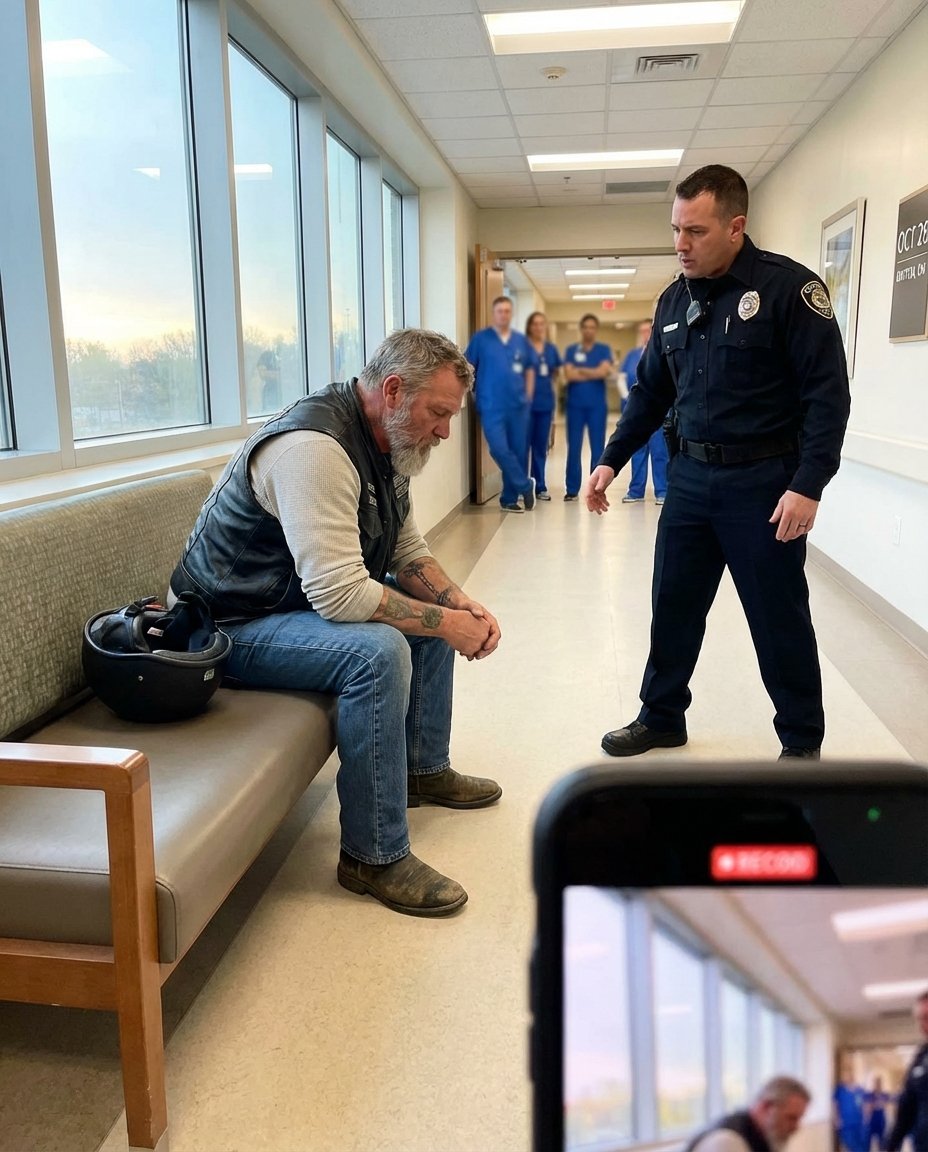
I lay on my side on a vinyl bench outside ICU, jacket folded under my head like a pillow that didn’t work. My boots stayed on. My leather vest stayed on. I didn’t take up much space. I tried not to.
Still, I could feel the stares.
A young nurse with tired eyes paused near the nurses’ station and murmured, “He’s back.”
Back.
Like I was a stray dog.
A security guard walked by slower than he needed to. His gaze flicked to my tattooed forearms, my gray beard, the worn biker patch on my vest. He didn’t say anything. Not yet.
Down the hallway, a family in a quiet huddle glanced at me and then away. The mother tightened her grip on her purse.
I heard someone say it, barely under their breath:
“Why is that biker sleeping here every night?”
I didn’t answer.
Because if I spoke, my voice might break in half.
And because every time I closed my eyes, I pictured the same thing—a door opening, a machine alarm, a doctor’s face that doesn’t soften.
Then the security guard stopped.
“Sir,” he said, firm. “You can’t stay out here.”
And at that exact moment, an ICU door swung open, and the sound that came from inside made every head turn.
“Sir,” the guard repeated, louder this time, as if volume could turn me into someone harmless. “Visitors aren’t allowed to sleep in the hallway.”
I pushed myself up slowly, not because I was afraid of him, but because I didn’t want to look like I was resisting. In a place like that, one wrong movement becomes a story.
“I’m not causing trouble,” I said.
“That’s not the point. Patients’ families are complaining. Staff is complaining. This is a hospital.”
I wanted to laugh at the word hospital like it meant anything gentle anymore.
A nurse stepped out of ICU with a clipboard. She looked past the guard, past me, toward the bench like it offended her.
“You’ve been here five nights,” she said. “You can’t camp out.”
Camp out.
Like I’d brought marshmallows.
I swallowed hard. “I’m not camping. I’m waiting.”
The nurse’s eyes narrowed. “Waiting for what?”
I didn’t answer right away.
Because the truth is, when people see a biker with a worn vest and a face carved by years on the road, they don’t imagine a man who wakes up at 3 a.m. to pack a lunch for his kid.
They imagine trouble.
They imagine loud engines and broken rules.
They don’t imagine a father who can’t breathe unless he’s close enough to a door.
The guard folded his arms. “We can escort you out, or you can leave on your own.”
Across the hall, another family watched, tense. A man in scrubs paused with his coffee and stared like I was about to explode.
“I’m not leaving,” I said, calm but final.
The guard’s eyes hardened. “Why not?”
I looked at the ICU door.
Because behind it, my son lay unconscious after a warehouse fire. Because the doctor used the phrase “severe smoke inhalation” like it was an item on a list. Because I’d seen firefighters walk out of flames laughing—until it was my boy who didn’t wake up.
But I didn’t say all that.
Not yet.
Instead, I reached into my vest pocket.
The guard tensed.
His hand moved toward his radio.
The nurse took a half-step back.
To them, it looked like a threat.
Like I was reaching for something else.
I pulled out my phone.
Typed a message with stiff fingers.
Sent it.
Then I slid the phone back into my vest.
“That necessary?” the guard asked.
“Yes,” I said.
“To who?”
I met his eyes.
“Someone who can explain this without you assuming the worst.”
That answer didn’t relax anyone.
It tightened the hallway.
Because now it wasn’t just a biker refusing to leave.
It was a biker calling someone.
And in a hospital at 2 a.m., that feels like a spark near gasoline.
Minutes dragged the way they do in ICU—slow enough to feel like cruelty.
The guard stood a few feet from me, radio clipped to his shoulder, waiting for me to make a mistake. The nurse had returned to the station but kept looking up, like she expected me to turn into a headline.
I sat back down on the bench, hands resting on my knees. Open. Visible. No sudden moves.
“Sir,” the guard said again, quieter now, “you’re making people uncomfortable.”
“I know,” I said. “I’m uncomfortable too.”
He didn’t smile. Neither did I.
Across the hallway, the vending machine hummed. A janitor pushed a mop bucket past us, eyes down. Two residents walked by whispering, and I caught one phrase:
“Probably drunk or something.”
I wasn’t drunk.
I hadn’t had a drink in years.
Not since the day my kid got his firefighter badge and asked me to promise I’d stay sharp if he ever needed me.
I stared at the ICU door and tried not to imagine him alone behind it.
Because he was.
They only let me in for short windows. Gloves. Mask. No touching his face. No kissing his forehead. No father stuff.
Just standing there watching machines do what my hands couldn’t.
I pulled my phone out again—not to call, just to check.
One unread message.
Then another.
My chest tightened.
The guard noticed. “Someone coming?”
“Yes,” I said.
“Who?”
I shook my head once. “Not here to cause trouble.”
He exhaled through his nose like he didn’t believe a word I said.
At 2:38 a.m., the elevator doors at the end of the hall opened.
A sound came first—boots on tile, brisk and certain—before I saw the people.
Two men in dark uniforms stepped out. Not bikers. Not cops.
Fire department dress jackets.
Behind them, another man in a hospital badge lanyard walked fast, face serious.
The guard straightened.
The nurse rose from her chair.
And for the first time all night, the hallway’s posture changed—like the building itself recognized authority moving toward us.
The man in the dress jacket scanned the hall and locked eyes with me.
He didn’t look surprised to see me on that bench.
He looked… almost angry.
Not at me.
At the situation.
He walked straight up to the guard and said, controlled but firm:
“Is this the man you’ve been trying to remove?”
The guard swallowed. “He’s been sleeping here. We have policies—”
The firefighter cut him off with one raised hand.
“His son is in ICU,” he said. “And if you make him leave tonight, you’ll answer to me.”
The hallway went dead quiet.
And I just sat there, hands still on my knees, feeling every stare finally shift away from suspicion—and toward something they didn’t know how to name.
The hallway didn’t explode into chaos.
It just… shifted.
Like a storm cloud pulling back an inch.
The battalion chief — Captain Ramirez — stood between me and the guard. His uniform was crisp even at nearly three in the morning. His eyes weren’t.
“This man’s son is one of mine,” he said, voice low but firm. “Lieutenant Daniel Carter. Engine 14.”
You could feel the words settle into the tile floor.
The nurse blinked. “The warehouse fire?”
“Yes,” Ramirez said. “Five days ago.”
The guard’s posture changed first. Not dramatically. Just enough to show he understood something he hadn’t before.
“Sir, we weren’t informed—”
“No,” Ramirez interrupted gently. “You weren’t.”
He turned to me.
“Mark,” he said, softer now. “You should’ve called me sooner.”
I shrugged.
“I didn’t want to make it bigger than it already is.”
He studied my face for a long second. I must’ve looked worse than I thought. Five nights without real sleep does that to a man.
Behind him, two other firefighters stood still — dress jackets buttoned, hands folded behind their backs. Not aggressive. Not loud.
Just present.
Presence changes the temperature of a room.
The nurse stepped closer. “We have policies about overnight visitors in the hallway.”
“I know,” I said.
“And families in ICU are under stress—”
“I know.”
My voice didn’t rise.
Didn’t need to.
Ramirez exhaled slowly. “He’s not here to disrupt anything. He’s here because his boy might wake up at any minute.”
Silence.
The kind that makes people reconsider themselves.
Across the hall, the family that had been watching earlier lowered their eyes.
The guard cleared his throat. “We’re just trying to keep things orderly.”
“I understand,” I said.
And I meant it.
Because hospitals aren’t built for men like me. They’re built for machines and schedules and quiet suffering.
But they’re also built for hope.
And sometimes hope sleeps on a vinyl bench.
Ramirez turned to the nurse. “Can we arrange something? A chair in the family room at least?”
The nurse hesitated. Then nodded once. “We can move him closer to the ICU doors. But he has to follow protocol.”
I nodded before she finished the sentence.
“I will.”
No victory.
No triumph.
Just adjustment.
They brought a simple reclining chair. Nothing fancy. No speeches attached.
I carried my jacket and helmet down the hall myself.
As I settled into the chair near the ICU doors, Ramirez placed a hand briefly on my shoulder.
“He’s fighting,” he said.
“I know.”
The firefighters stayed for ten minutes. Not talking. Just standing nearby.
Then they left the way they came — boots on tile, steady and respectful.
No spectacle.
But everyone in that hallway now knew exactly why I was there.
And no one looked at me like a problem anymore.
At 4:12 a.m., a machine alarm sounded inside ICU.
Not loud.
Just different.
Every muscle in my body tightened.
A nurse moved quickly past the glass doors.
Then another.
I stood up without thinking.
The chair scraped softly against the wall.
Seconds felt longer than the five nights before them.
The door opened.
A young resident stepped out, mask still hanging loose around his neck.
“Mr. Carter?”
My throat dried.
“Yes.”
He gave a small nod.
“He’s responding.”
Two words.
That was it.
But they felt like oxygen.
I followed him inside, gloved and masked again, heart pounding against my ribs like it wanted out.
Daniel lay pale but not as still as before.
His eyelids fluttered.
His fingers twitched.
I stepped closer.
Didn’t touch him right away.
Because I didn’t want to break the moment by believing in it too fast.
“Danny,” I said quietly.
His brow furrowed.
His lips moved.
And then — barely audible — he whispered:
“Dad?”
Five nights on a bench.
Five nights of whispers behind my back.
Five nights of being the man who didn’t belong.
And all of it shrank to that one word.
I leaned closer, careful of the tubes.
“I’m here,” I said. “I didn’t go anywhere.”
He drifted back under, but not deep.
Not unreachable.
When I stepped back into the hallway later, the nurse who had complained earlier gave me a look I couldn’t quite read.
Not pity.
Not guilt.
Just understanding.
The guard nodded once.
Small.
Respectful.
By sunrise, the first shift change began.
Staff passed by me without suspicion now.
Just a man sitting close to a door.
I didn’t celebrate.
Didn’t text the whole world.
I just pulled my vest tighter around my shoulders and watched the light creep through the narrow window at the end of the hall.
Hospitals see people at their most fragile.
And sometimes they see them wrong first.
By noon, Daniel was stable.
Still critical.
But stable.
When I finally stepped outside for air, the sun hit my face like something new.
Five days on a bench.
Worth it.
Because if he had opened his eyes and I wasn’t there—
That would’ve been worse than any hallway whisper.
If you want more stories about misunderstood bikers and the quiet ways they stand guard when it matters most, follow the page.
Website Disclaimer
The information provided on this website is for general informational and educational purposes only. While we strive to ensure that all content is accurate and up to date, we make no guarantees regarding the completeness, reliability, or accuracy of any information published.
The views and opinions expressed in articles belong to their respective authors and do not necessarily reflect the views of this website. Any action you take based on the information found on this website is strictly at your own risk. We will not be liable for any losses, damages, or inconveniences arising from the use of our content.
Some articles may contain opinions, third-party information, or external links. We do not endorse or guarantee the accuracy of content on external websites and are not responsible for their practices or policies.
All content on this website is provided in good faith and is intended for informational purposes only. Readers are encouraged to verify information independently and seek professional advice where appropriate.