If you have ever worked a morning shift long enough, especially in a small-town bakery where the ovens turn on before the sun does and the same four regulars arrive at the same four tables every single weekday, you begin to think you have seen every version of human trouble that can walk through a door before 7 a.m., and in thirty-two years behind the counter at Willow & Grain, I had watched marriages crack over burnt toast, teenage boys try to shoplift croissants with the subtlety of raccoons, and once, memorably, a man propose with a ring hidden inside a cinnamon roll, but nothing—absolutely nothing—prepared me for the sound of blood hitting polished maple.
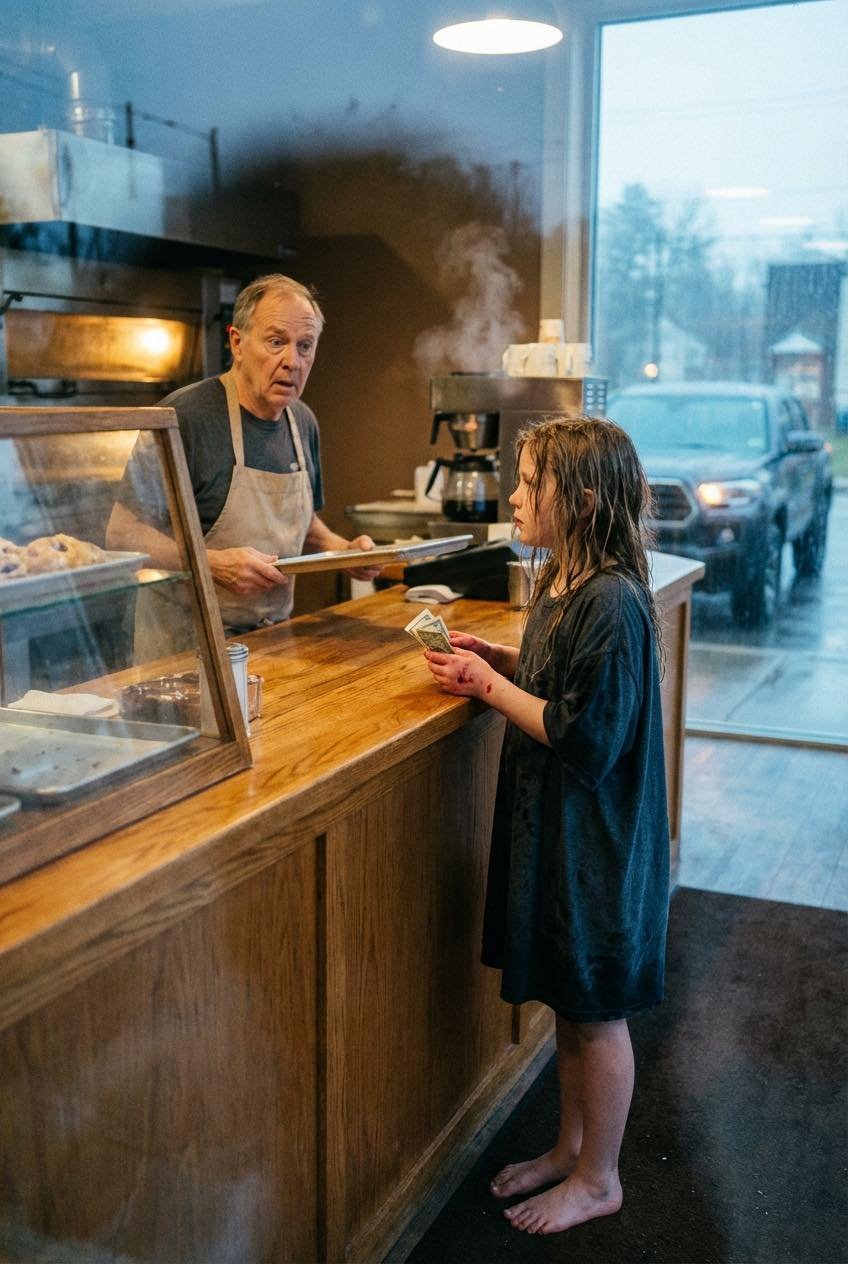
It was not dramatic at first. No scream. No crash. Just a soft, irregular tapping against the counter near the receipt printer, as though someone were drumming nervous fingers, except when I looked down I saw dark drops blooming against pale wood, spreading slowly, sticky and deliberate, and my brain refused to categorize what my eyes were seeing until I followed the thin red trail upward and found the child standing there.
She could not have been more than eight, maybe nine at most, though trauma compresses age in ways that make children look older and younger at the same time. Her hair—light brown, tangled, matted by rain—clung to her cheeks. She was barefoot. The soles of her feet were streaked gray from asphalt and gravel. A nightshirt hung from her shoulders, cotton stretched thin, hem ripped and heavy with water.
Her hands were completely red. Not smeared casually, not streaked from a scraped knee, but coated, as though she had tried to hold something back with her bare palms and failed.
“Bread,” she said, pushing a crumpled fist of dollar bills toward me. “Please. I can pay.”
Her voice fractured on the last word, like thin ice giving way under weight.
I remember thinking, absurdly, that it was too early for this. That the world was supposed to ease into chaos, not drop it at my register before the coffee even finished brewing.
“Sweetheart,” I said, my own voice unfamiliar to me, softer than I felt. “Are you hurt?”
Her eyes snapped sideways—toward the window, toward the street—and in that split second I saw something that did not belong in a child’s expression. Not embarrassment. Not guilt. Survival.
Outside, across Maple Avenue, a dark SUV sat angled against the curb, engine running, windshield wipers dragging in slow arcs across glass. Tinted windows. No visible driver.
The girl went rigid.
“He found me,” she whispered. “Please… don’t let him take me back.”
At the corner table by the pastry case, six men who had been discussing tire pressure and an upcoming charity ride fell completely silent. They were easy to miss most mornings if you weren’t looking for them, because they wore their past like something folded and stored rather than displayed, but if you paid attention, you noticed the posture, the way they scanned exits unconsciously, the way chairs were positioned with sightlines in mind.
They called themselves the Roadward Six, though the logo stitched onto their cycling jackets read simply VALOR RIDE. They were veterans, all of them, from different branches and different decades, bonded less by war stories and more by the quiet understanding that comes from having stood between danger and something fragile.
Ethan Caldwell, former Marine infantry, was the first to stand. He did not push his chair back abruptly; he rose in one controlled motion, coffee untouched. His eyes moved from the blood on the counter to the girl’s wrists to the SUV outside.
“That’s not from falling,” murmured Luis Herrera, who had served as a combat medic long before he opened a physical therapy practice on Main Street. He stepped closer, careful not to startle her. “Those are defensive cuts.”
Harold Boone, retired state trooper turned cycling enthusiast, shifted his chair slightly to block a direct line from the door to the counter. He did it so smoothly most people wouldn’t have noticed.
The girl flinched so violently she nearly slipped.
Ethan crouched slowly, lowering himself to her eye level without touching her. “You’re safe right now,” he said, and there was something in his tone that made the words feel less like a promise and more like a position he was prepared to defend.
Across the street, the SUV’s driver-side door opened.
The bakery door swung wide at exactly 6:47 a.m.
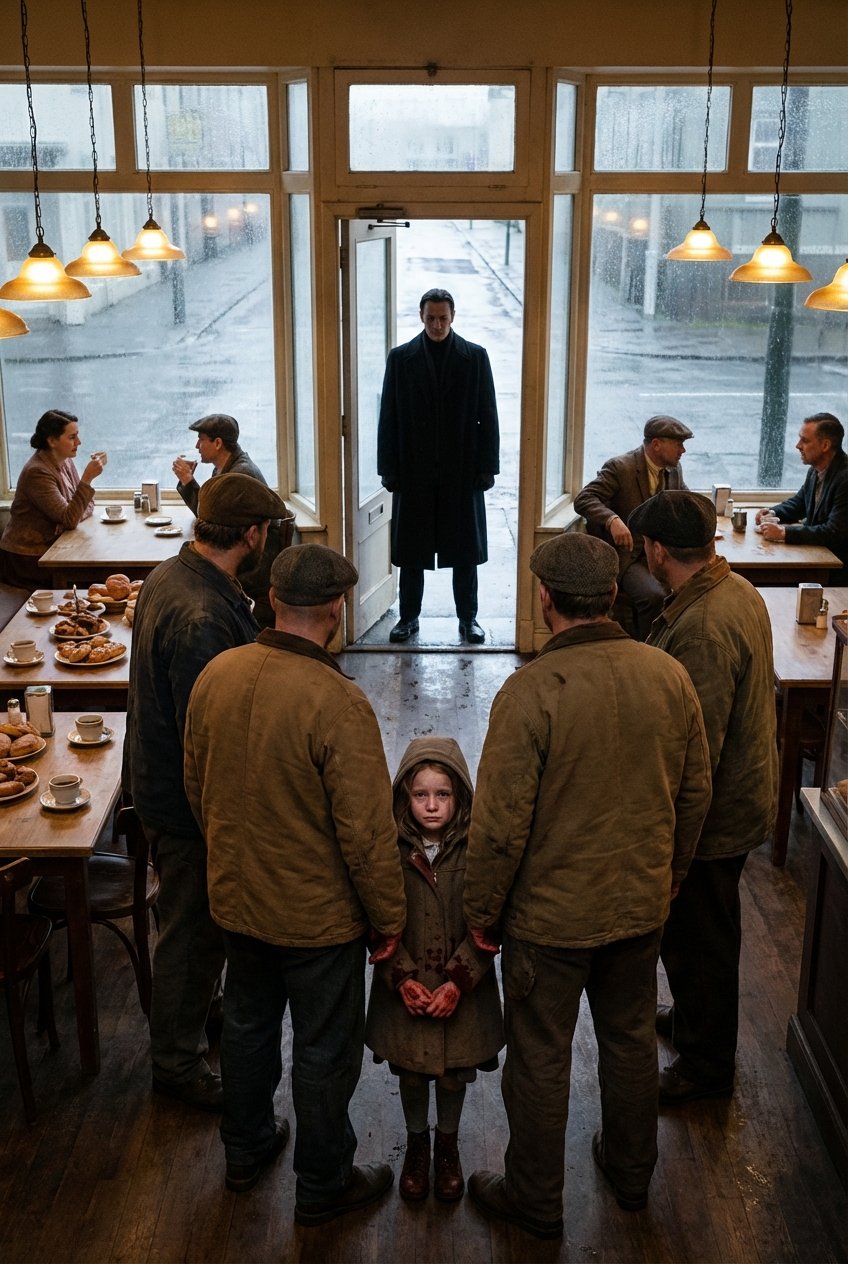
The man who entered did not rush. That was the first thing I registered. He stepped in with the calm of someone accustomed to walking into rooms he believed he owned. Tall. Clean jacket, suspiciously dry despite the rain. Jaw freshly shaved. His eyes found the girl instantly, and when they did, his mouth curved into something that pretended to be relief.
“There you are,” he said. “You had us worried sick.”
The girl screamed—not loud, but sharp and piercing, the kind of sound that does not come from imagination. She stumbled backward into Ethan’s legs.
The six men moved as if a silent command had been given. Chairs scraped. Bodies aligned. They formed a loose semicircle without touching one another, blocking the path between the door and the child.
“You need to leave,” Harold said evenly.
The man’s expression tightened. “This is a family issue.”
Luis glanced at the girl’s hands again. “Family doesn’t look like that,” he replied quietly.
I had already reached beneath the counter for the phone, but my fingers felt clumsy. Ethan didn’t raise his voice. He didn’t posture. He simply shifted his weight slightly forward, enough to signal that the next step the man took would not be unchallenged.
“Police are on their way,” Harold added, though at that moment they weren’t—yet.
The man’s gaze sharpened. “You don’t know what you’re interfering with.”
That was when the twist unfolded in a way none of us expected.
The girl—who we would later learn was named Lila Monroe—shook her head violently and clutched Ethan’s jacket. “He’s not my dad,” she cried. “He works for them.”
The room seemed to tilt.
“For who?” Luis asked gently.
But the man lunged forward before she could answer. Not dramatically. Just one quick, decisive step.
Ethan intercepted him in less than a second, one forearm raised, not striking but blocking with practiced efficiency. Luis moved simultaneously, positioning himself to pull Lila behind the pastry display. Harold’s hand dipped into his jacket—not for a weapon, but for his phone, thumb pressing the emergency call feature without breaking eye contact.
“You touch her,” Ethan said, voice low and controlled, “and you will regret it.”
Sirens wailed in the distance sooner than expected. Someone else in the bakery—one of the early-morning commuters who had been silent until now—had also called.
The man’s composure cracked for a fraction of a second. He stepped back. Then another. Then he turned and bolted, slipping on wet pavement as he dove into the SUV and sped away before the first patrol car rounded the corner.
Lila collapsed against the glass display case, sobbing so hard her small frame shook.
At the hospital, details emerged slowly, like photographs developing in dark water. Bruises in varying shades of yellow and purple. Lacerations consistent with shielding blows. Signs of chronic malnourishment.
When a child advocacy specialist sat beside her with soft-voiced patience, Lila spoke only once in a full sentence.
“They said if I told, they’d send me back to the basement. And if I ran, they’d take my brother instead.”
The room went still.
It was no longer about one violent adult. It was about something structured, something organized.
Harold made calls he had not made in years. Luis contacted colleagues who specialized in trauma care. Ethan reached out to a legal advocacy network that handled emergency protective custody cases.
Within forty-eight hours, the SUV was traced to a shell company. The man—whose real name turned out to be Victor Hale—was linked to an ongoing investigation into a small trafficking ring operating across three counties. Lila had not been running from a single abusive guardian. She had escaped something far darker.
And here is the part that unsettled even the veterans: the SUV had not been idling by coincidence. They had been watching the bakery for days. Lila had slipped out at dawn when a door had been left unlocked. She had chosen the first lit storefront she saw.
Willow & Grain had not been random. It had been refuge.
When authorities executed a warrant on the property Lila described, they found not only her younger brother but evidence of multiple children being moved through the location over the past year. The case exploded across regional headlines.
But inside the hospital room, Lila did not care about headlines. She cared that when she said, “Please don’t let him take me back,” six strangers did not hesitate.
Over the following weeks, the Roadward Six rotated shifts outside her room. Not because they were assigned to. Because leaving felt wrong.
When Lila finally left the hospital—placed with a foster family experienced in trauma recovery—she carried a small paper bag from Willow & Grain containing two cinnamon rolls and a handwritten note from me that read simply: You are believed.
Six months later, rain tapped softly against the bakery windows again, and the bell above the door chimed—not sharply this time, but gently.
Lila stepped inside wearing bright sneakers that squeaked slightly on the tile, a navy coat zipped to her chin, hair brushed and tied back. Beside her stood her foster mother, a woman named Andrea Cole whose grip was steady and warm. A younger boy hovered behind them, clutching a toy truck.
“No blood today,” Lila said with a shy smile.
Ethan, Luis, Harold, and the others sat at their usual table, coffee mugs raised in quiet salute.
She placed five crisp dollars on the counter. “One loaf of bread.”
I slid it back toward her. “On the house.”
Outside, traffic moved as it always had. But something in the air felt altered—not dramatic, not cinematic, just shifted slightly toward vigilance instead of avoidance.
The lesson in all of this, if there must be one, is not that veterans are heroes or that evil always announces itself loudly. It is that protection is often instinctive for those who have practiced it, but it should not belong only to the trained. A community cannot outsource its courage. It cannot assume someone else will stand first. Sometimes the only difference between captivity and freedom is whether the nearest adult decides to step forward or look away. Six men formed a wall that morning, but the true barrier was built from a simple refusal to accept the convenient explanation.
When a child says, “Please don’t let him take me back,” the right response is not hesitation. It is movement.
And sometimes that movement changes far more than one life.
Website Disclaimer
The information provided on this website is for general informational and educational purposes only. While we strive to ensure that all content is accurate and up to date, we make no guarantees regarding the completeness, reliability, or accuracy of any information published.
The views and opinions expressed in articles belong to their respective authors and do not necessarily reflect the views of this website. Any action you take based on the information found on this website is strictly at your own risk. We will not be liable for any losses, damages, or inconveniences arising from the use of our content.
Some articles may contain opinions, third-party information, or external links. We do not endorse or guarantee the accuracy of content on external websites and are not responsible for their practices or policies.
All content on this website is provided in good faith and is intended for informational purposes only. Readers are encouraged to verify information independently and seek professional advice where appropriate.