CHAPTER ONE
The Moment a Marriage Quietly Shattered
Hospitals are supposed to smell like reassurance, a sterile blend of disinfectant and artificial calm that tricks your nervous system into believing that no matter how fragile the human body is, someone in this building knows how to fix it, but as I walked through the long corridor of Ravenwood Memorial Hospital that afternoon, clutching a bouquet of pale white peonies I had driven across town to buy because my wife once mentioned, years ago, that they reminded her of safety, all I could smell was damp polish, old coffee, and something else I couldn’t quite name yet, something sour and wrong, like fear that had been left too long in a closed room.
My wife, Lydia Hale, was thirty-one weeks pregnant, admitted for what the doctors casually referred to as “preventive monitoring,” the kind of phrase designed to sound harmless while quietly rearranging your entire understanding of risk, and I had taken an early lunch break under the excuse of a client meeting that didn’t exist, because after five years of failed fertility treatments, miscarriages that were never discussed at dinner parties, and a town that only valued happiness if it came without visible effort, I wanted her to feel cherished in a way that couldn’t be mistaken or diminished.
Tucked into the inside pocket of my coat was a slim velvet case containing a silver bracelet engraved with a single word we had whispered to each other during the worst nights when hope felt irresponsible: Still.
Still here. Still trying. Still us.
Room 517 was at the far end of the maternity wing, where the lights hummed just a fraction louder and the walls were decorated with framed photographs of smiling newborns whose parents looked rested in a way I had never once felt, and when I reached the door, I noticed it wasn’t fully closed, which struck me as odd, because Lydia hated drafts and always complained about hallway noise drifting in.
I raised my hand to knock.
I didn’t.
Because laughter came through the crack in the door first, sharp and abrupt, stripped of warmth, the kind of laugh that doesn’t respond to humor but to power, and it made my fingers curl instinctively around the flower stems as my pulse spiked without explanation.
“Lower,” a woman’s voice said, brisk and amused. “You’re missing the corner again.”
I pushed the door open just enough to see.
And the world shifted in a way I still haven’t found language for.
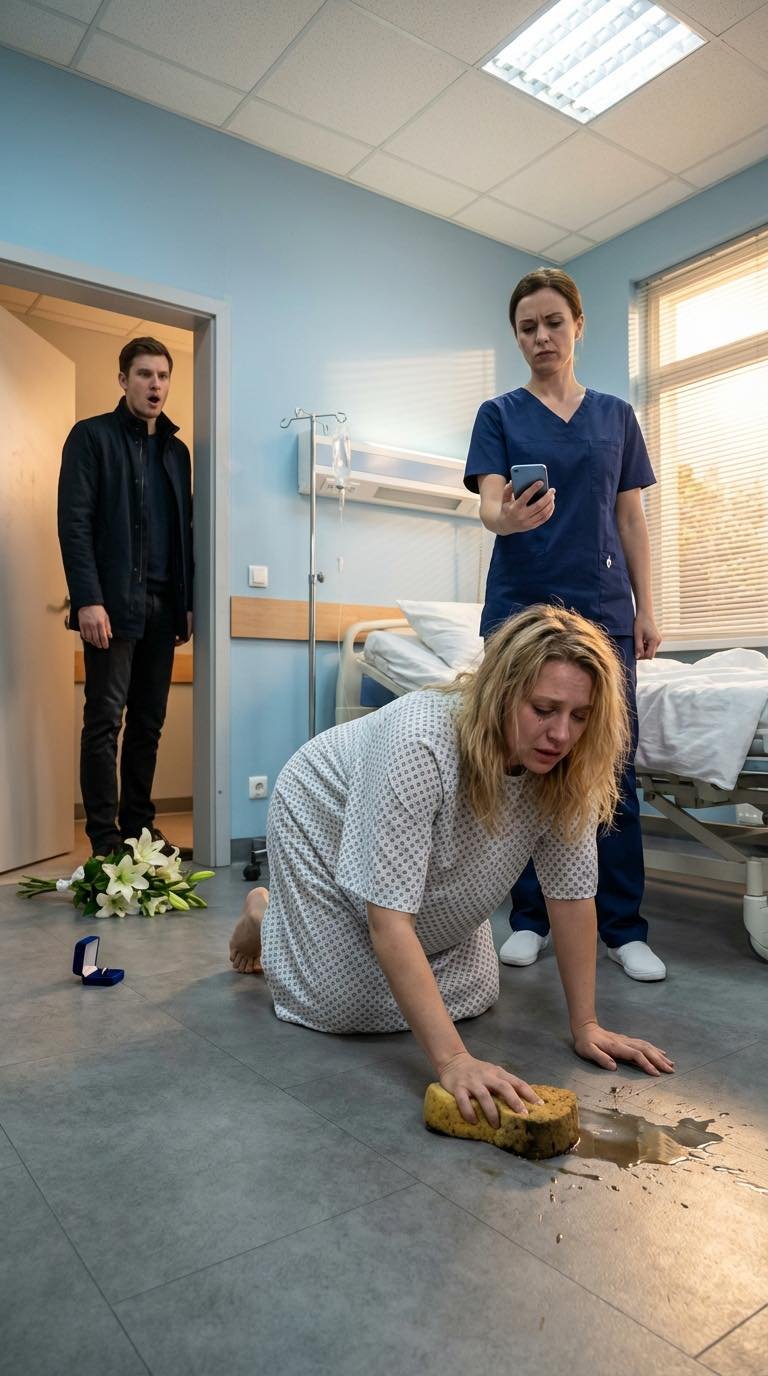
Lydia was on the floor.
Not collapsed. Not fainted.
Kneeling.
Her hospital gown was hitched awkwardly around her thighs, her swollen belly pulling the thin fabric taut as she leaned forward on trembling arms, a damp sponge clutched in her hand while she scrubbed the tile near the foot of the bed with a desperation that suggested she believed, on some level, that if she stopped moving, something much worse would happen.
Standing over her was Irene Caldwell, the woman we had hired three months earlier to “help around the house” and assist Lydia during the pregnancy, a recommendation from Lydia’s mother, a woman who had spoken of Irene with the kind of neutral politeness reserved for necessary evils, and now Irene was leaning casually against the IV stand, one foot crossed over the other, holding her phone at chest level, the camera unmistakably angled downward.
“Careful,” Irene said lightly. “If the nurse sees streaks, she’ll assume you’re not emotionally stable enough to handle postpartum recovery. And we both know how those notes follow you.”
Lydia’s voice, when she spoke, barely carried. “I feel dizzy. I just need a second.”
Irene sighed theatrically and nudged Lydia’s shoulder with the toe of her shoe, not a kick, not quite, but close enough to make the point unmistakable. “You don’t get seconds. You get instructions. Finish it.”
I don’t remember stepping into the room.
I remember the flowers falling.
I remember the sound of something plastic skittering across tile.
I remember my wife trying to turn toward me too quickly, losing her balance, her elbow cracking against the floor as she gasped in pain and humiliation at the same time.
And I remember the way Irene looked at me, not startled, not afraid, but almost… amused.
“Oh,” she said. “You’re early.”
That was the moment I understood that this was not an accident, not a misunderstanding, not something that could be explained away with stress or miscommunication, because nothing about Irene’s posture suggested she had been caught, only interrupted.
“Get away from her,” I said, and my voice didn’t sound like it belonged to a man who spent his days behind a desk calculating risk models and arguing deductibles.
Irene straightened slowly, slipping her phone into her pocket. “Mr. Hale,” she replied calmly. “Let’s not make this worse than it needs to be.”
“Worse?” I stepped between her and Lydia, helping my wife sit upright, my hands shaking as I realized how cold her skin felt. “You have sixty seconds to leave this room before I call hospital security and the police.”
Lydia grabbed my sleeve, panic flashing across her face. “No—please—don’t. It’s fine. I spilled water. I wanted to clean it. Irene was just—”
“Just filming you?” I snapped, unable to stop myself. “Just threatening you with social services? I heard everything.”
Irene smiled then, slow and knowing, and leaned in just enough for me to smell her perfume, sharp and synthetic. “You really think she’d let me do this if she didn’t have to?” she whispered. “Ask yourself why your perfect wife has been withdrawing cash every month. Ask yourself what she’s so desperate to keep buried.”
She stepped around us, crushing the fallen flowers beneath her heel as she walked out, pausing only once at the door to glance back at Lydia with a look that made my stomach drop.
“Rest up,” she said sweetly. “We have so much left to discuss.”
When the door shut, the silence felt louder than any scream.
I held Lydia as she shook, promising things I didn’t yet know how to deliver, while somewhere deep in my chest, a realization began to form, slow and awful and irreversible.
This humiliation wasn’t the secret.
It was the leash.
And whatever Irene had over my wife was powerful enough to make her believe that scrubbing a hospital floor on her knees was safer than telling me the truth.
PART 2 – The Secret That Was Never Supposed to Breathe Again
I didn’t confront Lydia that night.
Not because I wasn’t furious, or confused, or hollowed out by the image of her on the floor replaying behind my eyes every time I blinked, but because something about the way she clung to me in the hospital bed—her fingers digging into my sleeve like a drowning person grabbing the edge of a dock—told me that whatever truth she was carrying wasn’t the kind you could demand without consequences.
Truth like that doesn’t come out clean.
It rips.
The nurse came in twenty minutes later, cheerful and oblivious, commenting on Lydia’s blood pressure while pointedly not looking at the faint redness blooming on her elbow or the way her voice caught when she answered questions, and I nodded along, smiled when required, signed forms with hands that no longer felt like they belonged to me, all while Irene Caldwell’s parting words settled deeper into my chest like shrapnel.
Ask yourself why your perfect wife has been withdrawing cash every month.
I waited until Lydia fell asleep, her breathing uneven, one hand resting protectively over her belly as if she feared even unconsciousness might abandon the child growing inside her, and then I left the room, walking the length of the maternity wing in a fog, past the smiling baby photos that now felt obscene, down into the hospital lobby where the vending machines hummed and the night security guard nodded at me without interest.
In my car, under the flickering parking lot lights, I opened my banking app.
I hadn’t checked our joint account closely in months. We were comfortable, stable, the kind of couple whose arguments revolved around scheduling and groceries, not money, and when I scrolled back through the transaction history, the pattern revealed itself with brutal clarity.
Three hundred dollars.
Four hundred.
Sometimes five.
Always cash withdrawals.
Always on the fifteenth of the month.
Always beginning just after Lydia’s mother, Marianne Hale, had insisted we hire outside help “to ease the pregnancy strain.”
Marianne.
The name tasted bitter.
If Ravenwood was a town that ran on quiet hierarchies, Marianne sat near the top, her influence subtle but absolute, the kind that never announced itself but was always felt, woven through charity boards, hospital committees, zoning decisions, and the unspoken understanding that crossing her came with social consequences that were never traceable but always effective.
She had raised Lydia alone after Lydia’s father “left suddenly” when Lydia was eleven, a departure no one ever spoke about directly, just another story that had been smoothed over by time and politeness until its edges disappeared.
Or so I had thought.
The next morning, I didn’t go to work.
Instead, I drove to the house Lydia had grown up in, the narrow blue colonial on the edge of town that Marianne still occupied alone, its hedges trimmed with surgical precision, its windows always spotless, as if any hint of disorder might invite questions she refused to answer.
Marianne opened the door herself.
She smiled when she saw me, the practiced, public smile she wore like armor. “You should be at the hospital,” she said lightly. “Is Lydia alright?”
I stepped inside without answering, the familiar scent of lemon polish and old books wrapping around me as the door clicked shut behind us.
“What do you know about Irene Caldwell?” I asked.
The smile didn’t falter.
That was my first mistake—thinking a crack would appear.
Marianne gestured toward the living room. “She’s been invaluable. I recommended her because I trust her.”
“Why is my wife paying her in cash?” I pressed. “Every month.”
Marianne sighed, finally, as if indulging a child. “People from Irene’s background don’t always have… stable banking arrangements.”
I stared at her. “What background is that?”
Something shifted then, not in her expression but in the air, the way pressure changes before a storm, and Marianne’s gaze sharpened, calculating.
“You’re tired,” she said. “And emotional. Lydia has always been… sensitive. I imagine you’re projecting.”
I laughed, a short, broken sound. “She was on the floor of a hospital room yesterday, scrubbing tile while Irene filmed her.”
That did it.
Marianne’s smile vanished.
Not replaced with anger.
With resignation.
She walked past me toward the kitchen, poured herself a glass of water with hands that didn’t shake, and said, without turning around, “Irene doesn’t work for Lydia.”
The words landed with a dull thud.
“She works for me,” Marianne continued. “And now, unfortunately, for the consequences of a choice Lydia made long before she met you.”
My pulse thundered in my ears. “What choice?”
Marianne turned then, leaning against the counter, and for the first time since I had known her, she looked old.
“Twelve years ago,” she said quietly, “Lydia got pregnant.”
The room tilted.
“She was nineteen. Stupid. Reckless. In love with a man who disappeared the moment responsibility appeared. In a town like this, that kind of scandal doesn’t just ruin a girl’s future. It stains everyone connected to her.”
I swallowed. “She told me she’d never been pregnant before.”
“And that,” Marianne said, “is because I fixed it.”
My hands clenched into fists. “You forced her to have an abortion.”
Marianne’s eyes hardened. “No. I arranged an adoption. Quiet. Legal. Out of state. The child was never supposed to come back into our lives.”
The implication hit me like a punch.
“Supposed to,” I echoed.
Marianne exhaled slowly. “The adoptive parents died when the child was seven. The system failed. Records resurfaced. People started asking questions.”
“Irene,” I said hoarsely.
“Yes.”
The pieces snapped together with horrifying speed.
Irene Caldwell wasn’t a caregiver.
She was leverage.
“She found Lydia two years ago,” Marianne went on. “Threatened to contact you. To contact the press. To dredge up old medical records, adoption files, anything that would raise questions about timelines, pregnancies, why Lydia’s medical history had gaps.”
“Why now?” I demanded. “Why humiliate her?”
Marianne’s voice dropped. “Because Lydia tried to stop paying.”
The silence stretched, thick and suffocating.
“She’s pregnant again,” Marianne said softly. “And she wanted to believe she deserved a life without punishment.”
I thought of Lydia on the floor, apologizing, protecting everyone but herself.
“Where is the child?” I asked.
Marianne hesitated.
That hesitation told me everything.
“You don’t know,” I said.
“No,” she admitted. “And neither does Irene. That uncertainty is what keeps Lydia obedient.”
Something inside me broke then, cleanly, decisively.
“This ends,” I said.
Marianne looked at me with something like pity. “You don’t understand how Ravenwood works. Secrets are the currency here. Irene knows that. And now that you’ve seen her power firsthand, she knows you know.”
I stepped toward the door. “Then she made the mistake of underestimating how much I have to lose.”
That afternoon, back at the hospital, Lydia finally told me the rest, her confession coming in fragments between tears and apologies she didn’t owe me, and when she whispered, “I thought if I endured it quietly, the baby would be safe,” I realized Irene hadn’t just been extorting money.
She had been training Lydia to accept suffering as protection.
That night, as Lydia slept, I sat in the dim hospital room, scrolling through public records, adoption registries, and archived local news, following threads I wasn’t supposed to pull, until a name surfaced that made my breath hitch.
A name connected to a closed juvenile case.
A name tied to a charity Marianne had funded for years.
A name that suggested the child Lydia lost hadn’t vanished into anonymity.
He was closer than any of us had ever imagined.
And if Irene Caldwell realized that I was no longer afraid of the truth, she wouldn’t just escalate.
She would panic.
When the Past Refuses to Stay Buried
Irene Caldwell didn’t panic immediately.
People like her never do.
They test the edges first, probe for fear, for hesitation, for the smallest sign that the person across from them still believes in restraint, still hopes the situation can be resolved quietly, politely, without blood on the floor. Panic only comes when they realize the balance of power has shifted and there is no polite exit left.
I understood this instinctively as I watched her from the far end of the hospital corridor the following afternoon, her posture composed, her hair perfectly brushed, her arms folded around a clipboard as she spoke to a nurse with the calm authority of someone who had practiced sounding indispensable for years. She didn’t know yet that the ground beneath her had started to crack, but she sensed disturbance the way animals sense earthquakes, and that was why she had come back so soon after being dismissed the night before.
Lydia was awake when Irene entered the room.
I saw Lydia’s shoulders tense even before Irene spoke, the reflexive flinch of someone whose nervous system had been trained through repetition, not violence loud enough to leave bruises, but the quieter kind that rewires expectation. Irene smiled at her, soft and maternal, as if the night before had never happened, as if humiliation were a service rendered and not a weapon used.
“I brought your prenatal vitamins,” Irene said gently, setting the bottle on the tray table, her fingers lingering just long enough to remind Lydia of ownership. “You forgot them yesterday.”
Lydia didn’t reach for them.
“I don’t need you anymore,” she said, her voice shaking but audible.
Irene’s eyes flicked to me.
There it was. The recalculation. The first micro-adjustment.
“I’m afraid that isn’t entirely your decision,” Irene replied, still smiling, still kind, the tone one uses with children who don’t understand consequences.
“It is,” I said. “And if you return again, it will be in the presence of counsel.”
Irene tilted her head. “I don’t believe you know what you’re threatening.”
“I don’t believe you know what you’ve already done,” I answered.
For the first time, irritation cracked her composure. “Lydia,” she said, ignoring me completely, “your mother and I have an understanding. If you disrupt it, people get hurt.”
Lydia’s hand found mine.
“No,” Lydia said quietly. “They don’t.”
Irene studied her, truly studied her now, as if seeing a person instead of a pressure point for the first time. “You think courage erases history,” she said. “It doesn’t. It only makes the fall louder.”
She left without another word, heels clicking sharply down the hall, and I knew then that the clock had started.
That night, the first message arrived.
No sender name. No threats spelled out. Just a scanned document attached to an email with a subject line that read: Before You Decide Anything.
It was an adoption record.
Lydia’s adoption record.
Names redacted, dates partially obscured, but unmistakably real, complete with a handwritten note in the margin referencing a transfer facilitated through a private charitable foundation.
Marianne’s foundation.
Below it, a single line of text:
He deserves to know who abandoned him.
Lydia stared at the screen, her breath shallow, her hand shaking so violently I had to take the laptop from her before she dropped it. “She found him,” Lydia whispered. “Or she thinks she did.”
“She wants you to think she did,” I corrected. “That’s different.”
But doubt had already begun to seep in, insidious and corrosive.
Because Irene didn’t need certainty.
She only needed terror.
The next escalation came faster.
A voicemail, left on my phone while I was in the shower, her voice calm and unhurried, as if she were scheduling a dentist appointment instead of detonating a life.
“You should speak to your mother-in-law,” Irene said. “She knows the boy’s name. She always has. And if this turns ugly, it won’t be Lydia who pays the highest price.”
Marianne arrived at the hospital less than an hour later, eyes sharp, jaw set, carrying the weight of inevitability like a crown she had worn for so long she no longer felt it.
“She’s losing control,” Marianne said as soon as the door closed behind her. “That makes her dangerous.”
“You made her dangerous,” I replied. “You gave her access, leverage, silence.”
Marianne didn’t argue. “Yes. And I would do it again.”
Lydia stared at her mother, tears streaking silently down her face. “You let her torture me,” she said. “For years.”
Marianne’s voice softened, but not with regret. “I protected you.”
“No,” Lydia said, her voice rising for the first time. “You protected your reputation.”
That landed harder than any accusation I could have made.
Marianne’s composure fractured, just slightly, enough to reveal the truth beneath it. “You don’t understand what that town does to women who fall out of line,” she said. “I do. I lived it.”
“And you decided I should live it too,” Lydia whispered.
The truth finally spilled then, not because Marianne wanted it to, but because she had run out of places to store it.
She had known the adoptive parents personally. She had helped arrange the charity that later “lost” the trail. She had funded scholarships, youth programs, community initiatives that quietly intersected with the boy’s life without ever revealing the connection. She hadn’t known where he was all the time, but she had known enough.
Enough to feel safe.
Until Irene.
“She stumbled onto the records by accident,” Marianne admitted. “She realized what they were worth.”
“And the boy?” I asked. “Where is he?”
Marianne closed her eyes.
“He lives thirty miles from here.”
The room went still.
“He’s nineteen now,” she continued. “Different last name. Different life. He doesn’t know.”
Lydia let out a sound that was half-sob, half-laugh. “I was fifteen minutes away from my own child this whole time,” she said. “And you let someone use him as a weapon.”
Marianne straightened. “I will end this,” she said firmly. “I have resources Irene does not.”
“And if she releases everything?” I asked.
“Then the town will burn,” Marianne said. “But I will burn with it.”
For the first time, I believed her.
The final confrontation didn’t happen in a courtroom or a hospital or behind closed doors.
It happened in public.
Irene chose the setting herself, announcing an emergency meeting for the charitable foundation she managed, inviting donors, board members, local press, and community leaders under the pretense of a financial restructuring announcement.
Marianne attended.
So did we.
Irene stood at the podium, confident, radiant even, feeding on attention the way some people feed on air. “Transparency,” she began, “is the cornerstone of trust.”
She never saw it coming.
The reporter in the second row raised his hand before she could continue. “Are you referring to the funds redirected through your foundation to facilitate an undisclosed adoption nineteen years ago?” he asked. “Or the extortion payments tied to it?”
Irene froze.
The room erupted.
Documents appeared, projected onto the screen behind her, donation trails, altered records, recorded calls Irene hadn’t known were being archived. Marianne had not come unarmed.
Irene tried to speak.
No one listened.
By the time security escorted her out, her face had lost its polish, her smile finally shattered, replaced by something small and feral.
The aftermath was brutal.
Careers ended. Reputations collapsed. Lawsuits followed.
But the most important moment happened quietly, weeks later, in a small café outside of town, where Lydia sat across from a young man with her eyes, her hands clenched around a cup she didn’t drink.
He didn’t call her Mom.
Not yet.
He called her Lydia.
And that was enough.
THE LESSON
Some secrets survive because they are hidden well.
Others survive because too many people benefit from keeping them alive.
But truth has a way of choosing its moment, and when it comes, it doesn’t ask permission, doesn’t negotiate comfort, doesn’t care how carefully the lie was constructed or how long it was fed. It simply arrives, breaks what it must, and leaves behind a choice: continue the cycle, or end it, even if ending it costs you everything you thought you were protecting.
And sometimes, the bravest thing you can do is not endure quietly, but speak loudly enough that the silence can never grow back.
Website Disclaimer
The information provided on this website is for general informational and educational purposes only. While we strive to ensure that all content is accurate and up to date, we make no guarantees regarding the completeness, reliability, or accuracy of any information published.
The views and opinions expressed in articles belong to their respective authors and do not necessarily reflect the views of this website. Any action you take based on the information found on this website is strictly at your own risk. We will not be liable for any losses, damages, or inconveniences arising from the use of our content.
Some articles may contain opinions, third-party information, or external links. We do not endorse or guarantee the accuracy of content on external websites and are not responsible for their practices or policies.
All content on this website is provided in good faith and is intended for informational purposes only. Readers are encouraged to verify information independently and seek professional advice where appropriate.