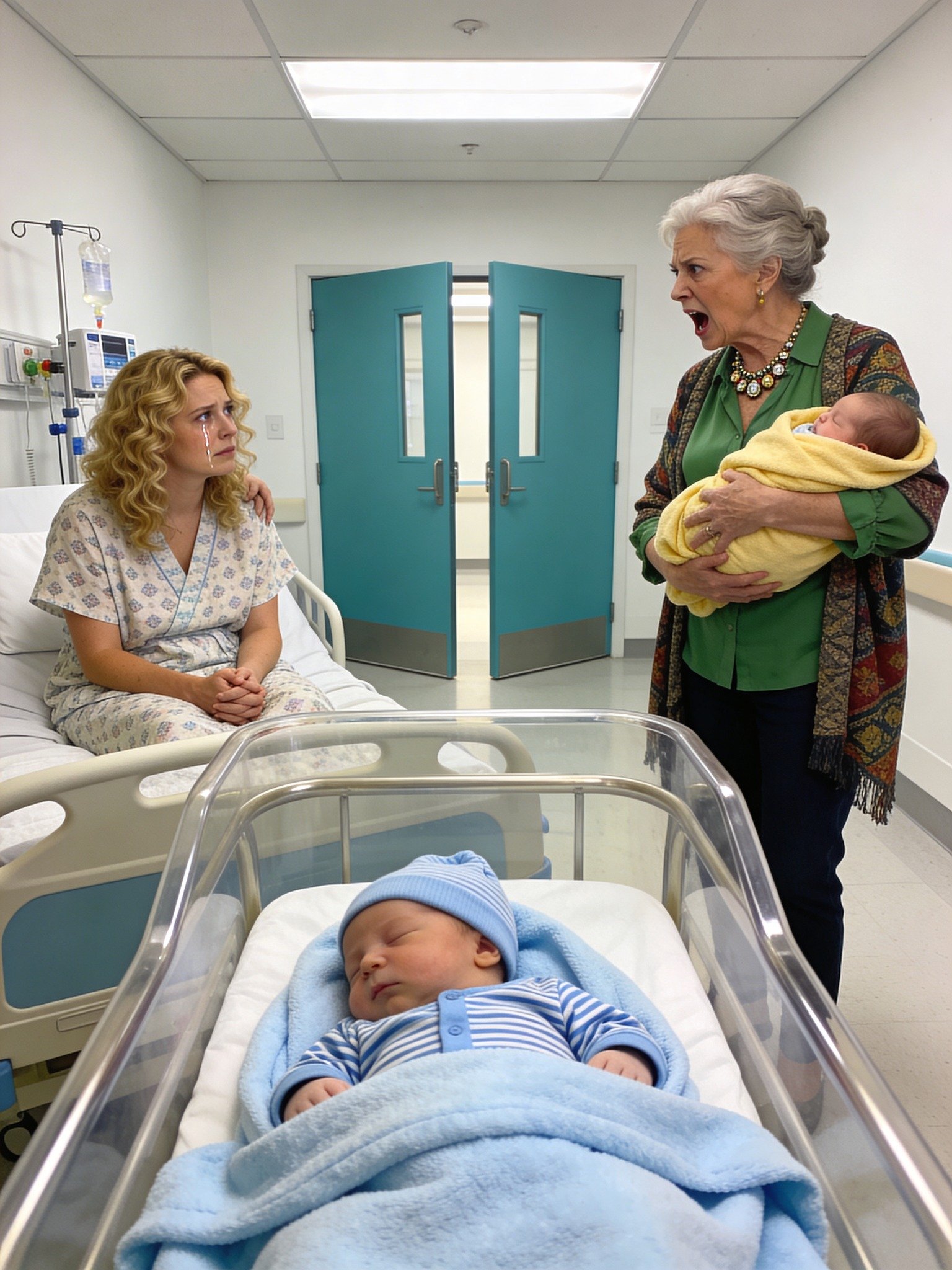
I never disclosed my true profession to my husband’s mother because experience had taught me that visibility often invites unnecessary judgment, resentment, and interference. Within her carefully curated worldview, I existed merely as the idle spouse benefiting from her son’s financial stability, a silent woman whose apparent lack of ambition validated every unspoken criticism she nurtured. Preserving that misconception required patience, restraint, and the deliberate erasure of any evidence that might challenge her assumptions about my identity.
Only hours after an exhausting emergency Caesarean procedure, while residual anesthesia clouded my senses and my newborn twins rested against my chest, she entered my private recovery suite without permission carrying a rigid expression and an unsettling sense of purpose. The door closed behind her with a force that reverberated painfully through my still fragile body, immediately transforming the atmosphere from serene exhaustion into tense anticipation.
“Sign these immediately,” she commanded, dropping a thick stack of documents onto the tray beside my hospital bed with theatrical impatience. “You have neither the discipline nor the capacity to raise two children properly, and delaying this decision will only complicate matters unnecessarily.”
The recovery suite at Riverstone Women’s Pavilion resembled an upscale executive suite rather than a clinical environment, an intentional choice reflecting privacy needs I rarely explained publicly. At my request, the nursing staff had discreetly removed elaborate floral arrangements delivered earlier by colleagues from the Department of Justice and several federal agencies with whom I maintained professional relationships. Maintaining a modest personal image within my husband’s family required careful management of optics, boundaries, and selective silence.
Beside me, my twins, Julian and Elise, slept peacefully, their synchronized breathing forming a fragile rhythm that momentarily softened every lingering trace of surgical agony. The procedure itself had been harrowing, filled with unexpected complications and urgent decisions, yet holding them dissolved every memory of pain into something infinitely more profound and protective.
Then the door swung open once more.
Constance Fairchild entered enveloped in expensive fragrance and unmistakable authority, her gaze sweeping across the suite with open disapproval and simmering indignation. Her eyes lingered briefly on the plush bedding, subdued lighting, and polished furnishings before narrowing with thinly concealed hostility.
“A private suite,” she remarked sharply, tapping the frame of my hospital bed with the pointed tip of her shoe. A sudden surge of pain radiated through my abdomen, forcing me to suppress an involuntary gasp. “My son works tirelessly while you indulge yourself in surroundings better suited for luxury vacations than medical recovery. The absence of shame in this arrangement continues to astonish me.”
Without waiting for a response, she pushed the documents closer toward me.
“Vivienne cannot conceive children,” she continued flatly, her tone devoid of hesitation or empathy. “She requires an heir to preserve the family lineage. You will provide her with one of the twins. The boy will be transferred to her guardianship. You may retain the girl.”
For several seconds, comprehension refused to align with reality, because the proposition itself defied both logic and humanity.
“You cannot be serious,” I whispered weakly, disbelief competing with rising fury. “They are my children, not negotiable assets subject to redistribution.”
“Stop behaving irrationally,” she snapped impatiently, stepping toward Julian’s bassinet with alarming determination. “Your emotional instability is precisely why decisive intervention has become necessary. Vivienne is waiting downstairs, and this arrangement benefits everyone involved.”
When her hand extended toward my son, instinct overpowered physical weakness entirely.
“Do not touch my child,” I warned firmly, forcing my body upright despite the searing pain erupting from my incision. “You have neither authority nor consent to approach him.”
She turned abruptly and struck me across the face with shocking force, the impact snapping my head sideways against the metal rail of the bed. A dull ringing filled my ears as warmth trickled from my split lip, while Julian’s startled cries shattered the fragile stillness of the room.
“Insolent girl,” she hissed, lifting my screaming son with possessive indignation. “I am his grandmother, and I will determine what circumstances serve his future best.”
With trembling fingers fueled by adrenaline rather than strength, I pressed the emergency security alert mounted beside my bed.
Alarms activated instantly.
Within moments, hospital security entered swiftly, led by Chief Security Officer Vincent Harrington, whose composed presence contrasted sharply with the escalating chaos unfolding before him. Constance’s demeanor shifted dramatically, outrage dissolving seamlessly into feigned distress.
“She is unstable,” Constance declared urgently, clutching Julian protectively while manufacturing visible panic. “She attempted to injure the infant during a psychotic episode. I intervened to prevent serious harm.”
Chief Harrington surveyed the scene methodically, his gaze registering my injuries, my compromised condition, and the elegantly dressed woman presenting herself as rescuer rather than aggressor. Then his eyes met mine.
Recognition followed instantly.
He froze mid step, his expression transforming from professional assessment into startled disbelief.
“Judge Bennett,” he murmured quietly.
The room fell silent.
Constance blinked repeatedly, confusion fracturing her carefully constructed narrative.
“Judge,” she repeated incredulously. “That is impossible. She does not work. My son assured me she operates some inconsequential home business.”
Chief Harrington straightened immediately, removing his cap with visible respect.
“Your Honor, are you injured,” he asked formally.
I steadied my voice despite throbbing pain and exhaustion.
“She assaulted me physically, attempted to remove my child from a secured medical wing, and issued a demonstrably false accusation intended to obstruct intervention.”
Harrington’s posture hardened decisively.
“Ma’am,” he addressed Constance calmly yet firmly, “you are currently being detained for assault and attempted unlawful removal of a minor within a protected medical facility.”
Her composure deteriorated rapidly.
“This is absurd,” she protested defensively. “My son told me she was unemployed.”
“For personal security reasons,” I replied evenly, wiping blood from my lip, “I maintain a deliberately low public profile. I preside over federal criminal proceedings. Today, I am also the victim of one.”
I held Harrington’s gaze steadily.
“Proceed with formal arrest. Charges will follow.”
As officers secured Constance’s wrists, my husband, Graham Fairchild, entered breathlessly, confusion and alarm etched visibly across his face.
“What is happening here,” he demanded anxiously.
“She attempted to take Julian,” I answered calmly. “She claims your approval.”
Graham hesitated briefly, an imperceptible pause revealing more than any denial could conceal.
“I did not explicitly approve,” he replied cautiously. “I simply believed discussion remained possible.”
“Discussion regarding surrendering our child,” I asked quietly.
“She is my mother.”
“And they are my children.”
My voice remained unwavering.
I informed him, with precise clarity, that any further interference would initiate immediate divorce proceedings accompanied by a custody dispute he would inevitably lose. I also reminded him that complicity, even through passive endorsement, carries consequences extending beyond personal disappointment into professional accountability.
For the first time, he perceived not a compliant spouse but a federal judge accustomed to delivering irreversible decisions without hesitation or sentimentality.
Six months later, I stood within my chambers adjusting judicial robes beneath subdued lighting that reflected neither triumph nor bitterness. A framed photograph of Julian and Elise rested upon my desk, their expressions vibrant, secure, and blissfully untouched by the turbulence preceding their earliest days.
My clerk informed me that Constance Fairchild had been convicted of assault, attempted kidnapping, and filing false reports, resulting in a seven year federal sentence. Graham voluntarily surrendered his legal credentials and received supervised visitation privileges contingent upon strict compliance.
I experienced no satisfaction.
Only resolution.
They mistook silence for weakness, privacy for insignificance, and restraint for vulnerability. Constance believed authority belonged exclusively to those who proclaimed it loudly, never considering that genuine power often resides quietly beneath deliberate understatement.
She forgot a fundamental truth.
Real power does not announce itself.
It acts.
I lifted the gavel gently, allowing its measured descent to punctuate finality.
“Court is adjourned.”
And this time, permanence accompanied the declaration.
Website Disclaimer
The information provided on this website is for general informational and educational purposes only. While we strive to ensure that all content is accurate and up to date, we make no guarantees regarding the completeness, reliability, or accuracy of any information published.
The views and opinions expressed in articles belong to their respective authors and do not necessarily reflect the views of this website. Any action you take based on the information found on this website is strictly at your own risk. We will not be liable for any losses, damages, or inconveniences arising from the use of our content.
Some articles may contain opinions, third-party information, or external links. We do not endorse or guarantee the accuracy of content on external websites and are not responsible for their practices or policies.
All content on this website is provided in good faith and is intended for informational purposes only. Readers are encouraged to verify information independently and seek professional advice where appropriate.