Part 1
My name is Thomas, and most days I can tell you the time by the way the hospital smells.
At 4:12 a.m., the corridors have that scrubbed, metallic bite like someone polished the world with alcohol wipes. At 6:40, the coffee carts begin to roll, and the air shifts toward burnt beans and tired hope. Around noon, it turns into cafeteria heat and faint antiseptic, like the building is sweating under its own responsibility.
I’m thirty-seven, a neurosurgeon, the kind of person who lives out of a locker and a suitcase and thinks in lists because lists don’t panic. I grew up with panic. I learned its dialect early. I was ten when I first told my mother, It’ll be fine, while she cried over a late rent notice with an overdraft fee stapled to it like an insult.
My father tried everything. Extra shifts. Side work. A secondhand truck that broke down at the worst times. He wasn’t weak. He was worn down. And my mother—my mother could stretch a can of soup into a meal that felt like love if you didn’t look too closely at the math.
That’s where my personality got built: in the space between fear and usefulness.
When people say money can’t buy happiness, I understand what they mean, but I also know money buys the absence of certain kinds of misery. It buys the ability to breathe when a tire blows. It buys the quiet of not checking your account before buying groceries. It buys your parents a chance to age without the soundtrack of bills.
My parents hit fifty years married two weeks ago.
Fifty years of making a life out of thin air, then making it again when it tore, then making it again when someone got sick or the car died or the roof leaked. I wanted to give them a win so tangible it could be touched.
So I bought them a house.
Not a big, flashy mansion with gates and marble that whispers wealth. I bought a seaside place that felt like a held breath becoming an exhale. It sat above the water like it was leaning closer to listen. The paint was a soft blue, slightly sun-faded. The deck was white, salt-stained, honest. Two palms out front stood like guards that didn’t take themselves too seriously.
It cost $425,000, which is a number that would have made my parents laugh and cry and deny it in the same minute.
I closed the deal in their names. I set up utilities. I prepaid taxes into a separate account for the next two decades because I didn’t want them to worry. I replaced the locks. I stocked the fridge with the exact things my father likes but never buys: good cheese, fresh berries, a carton of orange juice that wasn’t generic. I hid a note in the silverware drawer that simply said, Late mornings are allowed here. Loud laughter, too.
I didn’t tell my sister Julia.
That wasn’t an act of spite. It was instinct. Julia has always been a weather system that turns gifts into resources. If she knew, the house would become an idea she could build a story around, and my parents would get swallowed in it.
One week before their anniversary, I told Mom and Dad. Just them. So they could cry in private and not drown in attention. We drove down together. My father touched the banister like it was a violin he used to own. My mother opened cabinets and exhaled as if each empty shelf was proof she didn’t have to fill it with worry.
We sat on the deck that first evening and listened to gulls argue like petty roommates. I said, It’s yours. My father tried to respond and his voice broke.
The next morning I went back to the city because a little boy needed a decompression surgery and the hospital doesn’t pause for anniversaries. My parents stayed by the sea. I felt good about it. I felt stupidly happy. Like I’d finally done something that changed the shape of their lives.
Then, two days later, my father texted me: Some confusion about the house. Julia keeps saying “family home.” Can you come?
I didn’t see the text right away. I was scrubbed in, hands in a world where a millimeter matters. When I finally checked my phone between cases, there was a missed call from my mother and another text from Dad: She’s here. Kyle too. Can’t talk now.
Kyle is my brother-in-law, Julia’s husband. He’s the kind of man who refers to himself as an entrepreneur and treats other people’s boundaries like suggestions.
I texted back: Don’t sign anything. Don’t agree to anything. Love you.
Then I drove.
Four hours down the coast after a long case, still wearing the fatigue like a second skin. I rehearsed calm words. We’ll reset this. We’ll breathe. We’ll set rules. I imagined arriving and gently untangling things like you untangle an IV line: annoying but fixable.
What I didn’t imagine was the front door open wide, screen door banging in the wind like the house was trying to warn me.
I walked in carrying a cake and a bottle of sparkling cider.
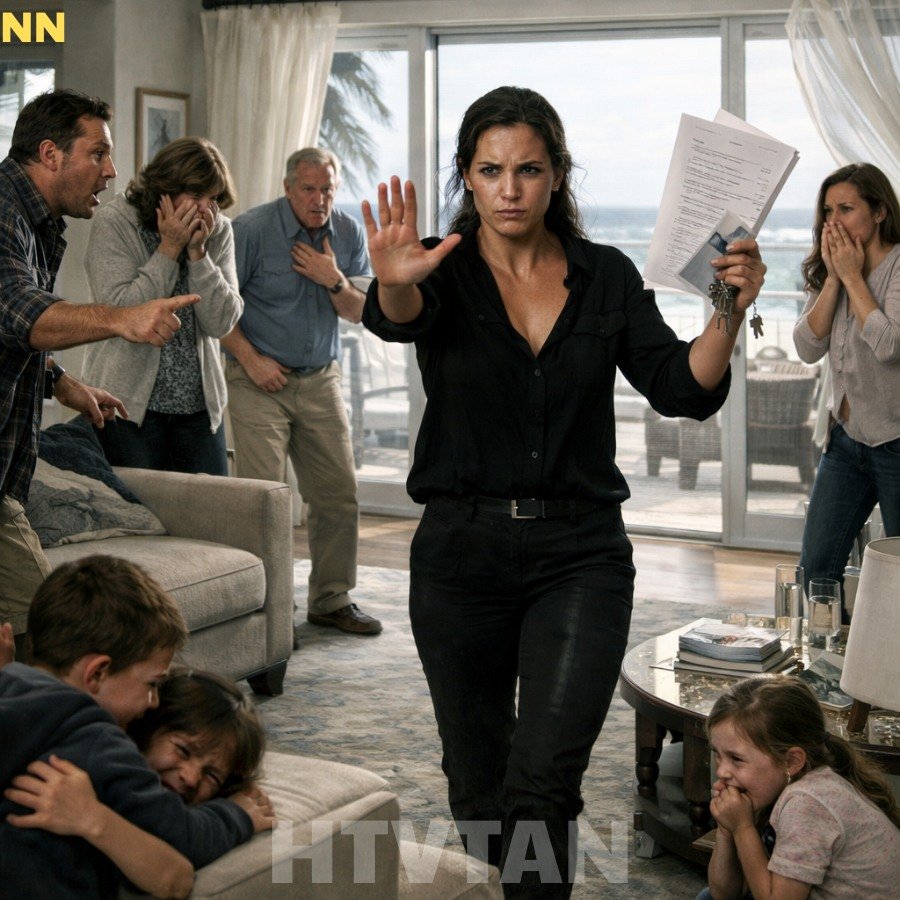
My mother stood in the kitchen clutching a dish towel like a white flag. Her eyes were red. My father sat in a chair with shoulders hunched, hands shaking, cardboard boxes stacked around him like a moving day he didn’t choose. The living room blared a child’s cartoon at full volume. Someone’s dog had shredded a throw pillow, stuffing scattered like snow.
And then Kyle stepped into the hallway, bare feet, beer in hand, football shirt stretched across his chest.
He planted himself in front of my father, jabbed a finger toward the door, and yelled, “This is my house. Get out.”
From the couch, Julia laughed, loose and confident. “Relax, Dad. We’re just getting settled.”
My palm tightened around the cake lid until the plastic dug into my skin.
Something in me went very, very quiet.
I set the cake on the counter, because my hands were suddenly too steady to be accidental, and I said, “Who told you this is your house?”
Kyle looked at me like I’d asked a stupid question. “Family money, family house. Don’t be weird.”
Julia added, sing-song, “We’re not asking, Tommy. We’re updating.”
My mother’s mouth trembled. “Thomas, can you just explain?”
Kyle pointed at my father again. “He can explain from the porch.”
Julia laughed again, and that laugh was the sound of my childhood repeating itself: Julia taking, my parents shrinking, me smoothing it over because keeping peace felt like love.
I looked at my father’s hands shaking. I looked at my mother standing like she didn’t know where to put her grief. I looked at my sister smirking in a house she hadn’t earned, and I felt a new sensation rise up.
Not rage.
Precision.
Part 2
Julia is two years younger than me, and when we were kids, she could charm a dog out of guarding a bone. She was the artist, then the free spirit, then the rough patch everyone swore would pass. My parents loved her in the way you love someone you’re always afraid will fall.
The problem is, fear makes you generous in the wrong ways.
The first time I bailed Julia out, it was a textbook bill. Then it was a semester. Then it was rent because Kyle’s startup was about to land. When that startup didn’t land, it was groceries and gas and a used minivan because the bank said no. There are payment app notes that read like diary entries: Julia electric bill. Kids’ braces. Rent again. Just this one last time.
It always felt temporary. It never was.
Somewhere along the line, my family learned I was the reliable part. If they leaned on me, I wouldn’t break. And if I did break, I’d do it quietly and apologize for the mess.
When I bought the seaside house, I planned it like a surgery: sterile, layered, protected. I put the property into a trust with my parents as lifetime beneficiaries with exclusive right of occupancy. I prepaid taxes. I reviewed the HOA rules. I created a paper wall because I didn’t want love to be vulnerable to a tantrum.
I didn’t anticipate my own sister would test that wall within forty-eight hours.
Later, my mother would tell me how it happened. Julia called on day two. Are you at a beach? Whose house? My mother lied badly. Oh, we’re visiting a friend. By dinner, Julia had triangulated the address from a blurry sunset photo my dad posted: View from our porch.
Julia arrived with Kyle, two kids, a dog, and the kind of entitlement you can smell from the driveway.
They came in loud, like the house belonged to their volume. They called it a family house. Kyle talked about the stairs being dangerous for my father. He said he’d manage things. He said it would be easier if they handled the hard parts. My parents, trained in guilt, folded like paper.
By Saturday, Julia had posted a selfie from my parents’ kitchen: Home sweet home. #manifesting
Kyle commented: Finally, a place where the kids can be kids.
And then Kyle did the thing that revealed the real plan: he listed the house online.
My father had texted me about confusion. Then nothing. Then the call I missed because I was scrubbed in. When I arrived and saw my mother crying, I knew the confusion was just the beginning.
Standing there in the living room with the cartoon still blasting, I didn’t argue in the hallway. I didn’t trade insults. I didn’t escalate emotionally, because people like Kyle use emotion as a trampoline.
I said, “Everyone to the living room.”
Not loud. Not angry. Just surgical. A tone that makes nurses move without thinking.
The kids paused their show. The dog stopped tearing. Kyle snorted but followed because men like him always believe the room belongs to them.
I stood by the mantle under a framed photo of my parents cutting a supermarket cake forty years ago. They looked so young in it, so proud of something small. That picture had always reminded me that they didn’t need much to be happy, just safety.
I pulled a folder from my bag and laid documents on the coffee table. Five pages, crisp, heavy with consequence.
“This is the deed,” I said, tapping the first page. “Recorded last week. The property is owned by the Sam and Ruth Living Trust.”
Kyle squinted at it like reading was an insult.
“In English,” I said evenly, “you don’t get a key, Kyle.”
Julia’s smile slid sugary. “Thomas, you can’t be serious. We’re helping.”
I tapped the second page. “Trust instrument. I’m successor trustee. My parents have exclusive right of occupancy for life. My job is to maintain the property for their comfort and remove anyone who interferes with that.”
Kyle laughed. “Bro, try and stop me.”
I slid the third page forward: a screenshot of the online listing, photos taken without permission, the description, the calendar, the payout account.
“The bank account ends in digits that match yours,” I said to Kyle. “I blurred it for the kids.”
Kyle’s grin faltered for half a second, then returned, louder. “So what? Your parents could use the cash.”
My mother made a small sound, like she wanted to disappear.
I placed the fourth page down: a forwarded group chat thread my dad had quietly sent me. Julia’s words were right there in gray: We’ll get him on board. He always caves if Mom cries. I’ll guilt him about med school loans.
Julia’s hand twitched toward the paper. I covered it.
Then I set down the fifth page: HOA rules, highlighted. “No short-term rentals,” I said. “Not allowed. Fines. Enforcement. Legal action.”
The room shifted. Julia blinked. Kyle’s jaw tightened.
“Here’s what’s going to happen,” I said. “You’re going to pack your things today. You’re going to delete the listing. You’re going to refund every booking. You’re going to apologize to Mom and Dad for frightening them in their own kitchen. And you’re going to leave any keys you have on this table.”
Julia laughed, high and brittle. “Or what, Tommy?”
“Or I perform my duty as trustee,” I said.
Kyle took a step toward me, puffing his chest like we were twelve and he wanted a playground win.
“I don’t like yelling,” I said calmly. “I like precision.”
I set my phone on the table, screen up. Drafted emails ready: HOA board with attachments, platform trust-and-safety report, county recorder, and a text thread with a locksmith named Victor.
Victor was parked two houses down. Because when my dad said confusion, I heard danger.
Kyle stared at the phone, then at me. “You wouldn’t.”
“I would,” I said. “And I already did.”
My mother’s voice trembled. “Thomas…”
I looked at her, and I waited, because my whole life she’d asked me to smooth things, to keep peace, to make it easier.
Instead she whispered, “Do what you need to do.”
It was the first time I’d heard her choose herself out loud.
Kyle’s face changed. He pointed toward the door again, the same stupid gesture that had lit the fuse in the kitchen.
“Old man out,” he said.
I stepped between him and my father.
“Point at my father again,” I said softly, “and the only door you’re going through is the one Victor locks from the outside.”
Silence fell. Even the cartoon noise seemed to thin.
Julia tried one last angle. “You’re cruel. You’re abandoning your family.”
I exhaled. “I’m done being your wallet,” I said. “That’s not abandonment. That’s a boundary.”
Kyle muttered, “We’ll see about that,” and lunged toward the folder, maybe to grab the deed, maybe to rip paper like paper can kill a trust.
I simply picked up the documents, tucked them back into my bag, and turned to my dad.
“Dad,” I said, “would you like to stay in your living room?”
My father swallowed. His voice came out rough but clear. “Yes.”
I nodded. “Then everyone who doesn’t live here,” I said, “go pack.”
No one moved.
The doorbell rang.
Victor, right on time.
Part 3
Chaos always takes longer to unwind than it takes to start. It’s a law of human mess.
Victor introduced himself politely, tool bag in hand, eyes darting once toward Kyle and then away like he’d seen this kind of entitlement before. He didn’t ask questions. He went straight to the door, unscrewed the deadbolt, replaced it with a keypad lock, and moved with the calm speed of someone who knows time matters.
Kyle followed him outside, whisper-yelling into a phone, making threats that sounded impressive only to himself. Julia stalked through the house collecting things with exaggerated sighs, as if she were the victim of an unfair eviction instead of an adult being stopped from stealing.
The kids moved like embarrassed shadows. Their eyes kept flicking toward my parents, then toward their mother, then toward me, trying to understand why adults sometimes turn love into a weapon. The dog barked so much it sounded hoarse.
Inside, I sat at the kitchen table with my mother. I put the kettle on and made tea with the kind of routine I use when a patient is unstable. Do one thing at a time. Create order. Calm the room.
My mother kept dabbing her eyes with a napkin. “I didn’t want to tell you,” she whispered. “I thought we could smooth it.”
“They came in fast,” I said, keeping my voice low. “They counted on you being too kind to stop them.”
My mother nodded. It was a small, guilty nod I recognized from every time she apologized for the weather.
In the living room, my father stared out at the water. His jaw was clenched, his hands still trembling, but not with fear now. With fury restrained by decades of being told to keep the peace.
“I thought I’d be stronger,” he said quietly when I came to stand beside him. “I should’ve told them to leave.”
“You called me,” I said. “That was strong.”
He swallowed like those words cost him. “I hate that I needed to,” he admitted.
“You didn’t fail,” I said. “They pushed.”
Outside, Kyle stomped around the driveway, trying to act like he was being wronged by the concept of ownership. Julia sat on a packed suitcase on the porch, face arranged into soft hurt whenever my mother looked up.
“We just wanted the kids to be around their grandparents more,” she said at one point.
I didn’t take the bait. I didn’t argue. Silence, used correctly, is its own scalpel.
When Julia realized I wasn’t going to negotiate, she switched to blood.
“You think money makes you the parent, Thomas?” she snapped. “It doesn’t. You buy things so you don’t have to be a person.”
It was a good line. It was also a lie.
“I bought a house for our parents,” I said. “I didn’t buy a permission slip for you to steal.”
She flinched at the word steal, like it was too blunt to be polite. Then she went cold.
“We’ll remember this,” she said.
“I hope you do,” I replied.
Kyle refused to hand over the key he’d somehow gotten—probably from bullying my father into giving it to him during the first day of invasion. He smirked. “Come and take it.”
Victor had already installed the keypad. I walked to the door, pressed a sequence, and reprogrammed the code. Then I turned to my father.
“Pick a code you’ll remember,” I said.
My dad blinked, then slowly punched in numbers with shaking fingers. Victor confirmed it, nodded, and stepped back.
Kyle watched like he’d just seen his leverage fall into the sea.
“You think you’re clever with your papers?” Kyle sneered. “I know a guy.”
“I know the county clerk,” I said evenly. “And your guy is going to tell you a trust beats a tantrum.”
Kyle stared at me, trying to decide if I was bluffing. I wasn’t.
When they finally carried boxes to their SUV, Julia paused on the porch as if the scene required a closing line.
“You could have just talked to me,” she said, voice wounded.
“I have been talking to you for ten years,” I said. “You just only hear yes.”
Her mouth tightened. “You’ll regret this when they need help and you’re not around.”
I looked at my mother pouring tea with hands still unsteady. I looked at my father’s hand finally resting still on the armrest.
“I am around,” I said. “For them.”
They drove away. The dog yapped at the window like it had an opinion about property law.
After the car disappeared, the house changed temperature. It was the same air, but not the same air. I could hear the ocean through the screen. I could hear my parents breathing, as if the house was relearning quiet.
I went room to room with a trash bag and picked up the evidence of takeover: juice boxes, a plastic tiara, mismatched socks, a broken crayon melted into the sofa cushion. I found a folded printout in the guest room drawer.
Kyle’s business plan.
He’d estimated monthly profit at five times the HOA fine. In the margin, Julia had written in her looping handwriting: Tom won’t say no if Mom cries.
I set the paper down like it was something sharp.
That evening, I cooked a simple dinner. Pasta, salad, garlic bread. Nothing fancy. We ate on the deck as the sun slid down and turned the water into copper.
My mother told a story about her first apartment, the one with a mouse she named Bernard because he only came out on Sundays. My father laughed. Not his polite laugh. His real one, the kind I only hear when he isn’t being careful for everyone else.
My phone buzzed constantly. Texts from Julia. From Kyle. From unknown numbers that were clearly friends or relatives drafted into their narrative.
You made Mom cry.
Cease and desist, Dr. Boy.
We already invited people next weekend. Don’t be selfish.
I put my phone face down and ate my salad.
That night I installed a porch camera and set the alarm system with a cheerful chime my mother wouldn’t hate. I put codes in a folder labeled happy things in big letters my father could read without his glasses. I left copies of the trust, deed, and HOA rules in a drawer I labeled boring armor.
Before I left the next morning, my mother stood in the doorway with her sweater pulled tight around her like she was trying to hold herself together.
“I’m sorry it came to this,” she said.
“I’m not,” I replied. “It needed to.”
Driving back to the city, exhaustion hit me like a wave. But underneath it was something steadier than fatigue.
A line had been drawn.
And for the first time, it felt like my family might actually respect it.
Part 4
The next week, Julia went loud.
She posted on social media in vague captions that were not vague at all. When money makes you cruel. Some people think they can buy love. Family isn’t paperwork.
She used photos of the house taken from angles that made it look like a dream she deserved. She posted a photo of my car in the driveway like it was evidence of my villainy. People who didn’t know us commented hearts and fire emojis and you deserve better.
My mother didn’t look at any of it. She told me she didn’t want her last chapters to be lived through a screen.
But the family group chat became a battlefield.
Julia wrote messages about how I’d “stolen a house from the grandchildren.” Kyle chimed in with dramatic lines about “elder abuse” that made my stomach turn, because he knew exactly what kind of accusation could poison a room.
Cousins I barely spoke to sent cautious texts.
Is it true you kicked them out?
Why would you do that?
Julia says you’re controlling Mom and Dad.
I didn’t engage publicly. I chose one person: my Aunt Lillian, my father’s sister, the woman who can cut through nonsense with one sentence.
I called her, explained it in boring, clear lines: the house belongs to my parents, and only my parents. There will be no rentals. No “family takeover.” No Kyle business plan.
Aunt Lillian listened, then said, “Finally.”
That was it. No lecture. No guilt. Just finally, like she’d been waiting for someone to stop enabling Julia’s storms.
I wrote Julia and Kyle one email. Polite. Firm. Boring. The tone of a bank.
All contact regarding the house goes through me. You do not have permission to enter the property. Any violation will result in action from the HOA and legal counsel.
I included copies of the trust summary, the HOA short-term rental clause, and a photo of the keypad lock.
I set an autoresponder for any future messages about the house: This matter is closed. Do not contact my parents directly regarding property use.
Two days later, a platform notification popped up on my phone.
New booking request: Sea Spray Cottage.
Kyle had relisted the house under a different account using a photo of the back deck. Not even subtle.
I forwarded the listing to the platform’s trust and safety with the deed and trust attached, along with screenshots of Kyle’s earlier payout account.
Ten minutes later, the listing vanished. Account banned.
I didn’t feel triumph. I felt like a janitor after a stadium game: just doing the work because if you don’t, the mess hardens.
Kyle tried again, this time through a friend’s account. Same result. Removed. Banned.
He tried a third time and finally realized the internet has rules too when you bring receipts.
Meanwhile, something quiet and beautiful happened.
My father called one morning and said, “The house smells like toast and salt.”
I smiled despite myself. “You’re making breakfast?”
“Your mother is,” he said, and I could hear softness in his voice. “I slept through the night.”
My mother sent a photo of her feet on the deck rail, ankles crossed, bright pink nail polish like when I was five and thought she was movie-star beautiful. In the background, my father sat with a newspaper, and his posture looked… unbraced.
They looked lighter.
Julia didn’t like that.
She mailed my parents a letter that began, As your primary caregiver, which was a sentence that had never been true. She asked them to “sign a simple family agreement” giving Julia “management rights” for the home “to reduce stress.”
My mother brought the letter to the table like it was something dirty. She didn’t cry. She didn’t apologize.
She said, “No.”
Then she called Julia and told her no, out loud, on speakerphone.
I listened from the other end of the couch, holding my breath like a child watching an adult finally step into a storm.
Julia’s voice snapped. “So you’re choosing him.”
My mother’s voice shook, but it held. “I’m choosing peace.”
Julia went quiet, then ugly. She accused my mother of favoritism. She accused my father of weakness. She accused me of manipulation. She said things that, if she’d said them ten years earlier, might have broken my mother.
But my mother had the sea now. She had a porch. She had the physical proof that her life didn’t have to revolve around Julia’s needs.
My father surprised all of us by speaking into the phone.
“Julia,” he said, low and steady. “You are not taking this from us.”
Julia sputtered. “Dad—”
“No,” he said. “I’m done.”
The line went dead.
My father stared at the phone like he didn’t recognize himself. Then he laughed once, short and shocked.
“Did I just do that?” he asked.
“You did,” I said, and my voice cracked a little because pride is a strange kind of grief too.
A week later, Julia called me from a blocked number. I answered because I still had that old reflex: maybe this time she’ll be different.
Her voice was soft at first. “Tommy.”
I closed my eyes. I hadn’t heard her call me that in years without it being loaded.
“We’re behind,” she whispered. “Kyle lost his contract. We might lose the apartment.”
There is a point where empathy becomes gasoline.
“Julia,” I said, “I will not discuss the house.”
“So money matters more than family,” she snapped, mask slipping back on.
“Boundaries are how I can be family and not a bank,” I said.
She hung up.
Afterward, I sat in my apartment with the quiet and realized something: saying no wasn’t what hurt me.
What hurt was how quickly Julia turned love into leverage.
But the house didn’t change. The porch stayed. The locks clicked. The ocean kept showing up every day whether Julia approved or not.
And my parents, slowly, began to live like people who weren’t waiting for the next crisis.
Part 5
Two weekends later, I drove down early. Coffee in a thermos. Hospital badge still clipped to my bag out of habit.
The water was flat and silver, like it was resting between breaths. I fixed a sticky hinge. I put tennis balls on the garage shelf at the right depth so my father could pull the car in without bumping the wall. I labeled the breakers because my dad loves labels. I tightened the gate latch. I adjusted the camera angle.
Small tasks. The kind that used to feel like how I proved love.
But now they felt different because they weren’t about rescuing someone from consequences. They were about building stability for people who’d earned it.
My mother made pancakes and burned the first batch and laughed. My father poured coffee and didn’t apologize for sitting down. We ate at the table and talked about ordinary things: groceries, the neighbor named Jan who left shells in a jar on the fence, a pelican that refused to be dignified.
No one said Julia for an hour.
It felt like a clean countertop.
After breakfast, my mother touched my hand. “I’m going to talk to your sister again,” she said. “Not to argue. To say no. Properly.”
“I’m not asking you to choose,” I said quickly, because I didn’t want this to become a competition where the winner is the one who suffers least.
My mother’s smile was small but steady. “It’s not choosing,” she said. “It’s stopping the pretending.”
My father cleared his throat. “I should have taught that better,” he said. “I taught you to work. I didn’t teach you to stop.”
“You taught me to stay,” I said. “I’m just learning the without being eaten part.”
He laughed low, grateful.
That afternoon, while my parents napped, I opened my laptop and reviewed the trust documents again, not because I doubted them, but because I wanted to see the structure that held. Paperwork isn’t romance, but it is protection. It is the difference between a gift and a liability.
I also called a local attorney and set up a standing relationship, just in case Julia and Kyle escalated into trespassing or harassment. I didn’t want to be caught reacting in crisis mode. I wanted to be ahead of it, like I am in surgery: anticipate bleeding before it becomes a flood.
When my parents woke up, we walked along the shore. My mother held my father’s elbow. Not because he couldn’t walk, but because she liked the contact. They moved slowly. They looked like people who finally had permission to take time.
That night, my father sat on the deck and stared at the water.
“Son,” he said, “I don’t know how to say this without sounding like I failed you both.”
“You didn’t fail us,” I said.
“We gave too much to her,” he admitted. “Your mother and I. We thought we were helping.”
“You were trying to love her into stability,” I said. “But you can’t love someone out of entitlement.”
He nodded slowly, like those words settled into his bones.
Back in the city, the family chatter continued. Julia recruited relatives. Kyle told stories. Someone sent my mother an article about “toxic siblings” with a message that said, Don’t let Thomas isolate you.
My mother deleted it.
“Let them talk,” she told me. “I can hear the ocean louder.”
Then the unexpected message came.
My niece Mia, sixteen, all band tees and big eyes, sent me a direct message: The house is pretty. Grandma looks happy there.
I stared at the screen, the simplest sentence cutting through weeks of noise.
I typed back: You’re welcome to visit with Grandma’s permission. No bookings. Just pancakes.
Mia replied with a laughing emoji, then: Okay.
A tiny truce, not with my sister, but with a child who didn’t choose the adult mess.
That truce mattered more than Julia’s approval ever could.
A month later, after a late case, I drove down again unannounced. I didn’t go in. I stood on the sidewalk and looked through the window.
My father was reading in his chair, glasses sliding down his nose. My mother had a blanket over her lap and a puzzle on the table. The porch light glowed warm. The ocean sound climbed under everything like a steady heartbeat.
I stood there and let the quiet explain the point of all of it.
Love isn’t covering someone’s bad behavior with your body.
Love isn’t congratulating chaos because the person causing it shares your blood.
Love is a house with good light and doors that lock.
Love is telling your parents, Rest.
And telling everyone else, No.
Part 6
Kyle didn’t stop trying. He just changed angles.
He emailed me from a new address and wrote like a man who thinks confidence is evidence. He threatened to “contest the trust.” He said he had “a legal team.” He claimed my parents were “senile” and being “coerced.”
That last one made something cold move through my chest.
My parents were not senile. They were tired. There’s a difference. And Kyle was counting on the world confusing exhaustion for incompetence.
I forwarded the email to the local attorney I’d retained. The attorney replied with a single sentence: This is bluster.
Still, we documented. We prepared. We stayed boring.
The attorney sent Kyle a cease-and-desist letter about defamation and harassment and false claims of incapacity. It wasn’t dramatic. It was clean and direct, like a warning sign posted on a fence.
Kyle posted about it online anyway, calling it proof I was “hiding something.” He made vague comments about “big money doctors” trying to silence a hardworking family man.
Julia shared the post.
It went nowhere, because people who don’t live in your life may click like, but they rarely show up when a lie needs proof.
Then Julia tried a softer move. She called my mother and cried. Real tears, maybe, or maybe practiced.
“I just want to be included,” she said. “Why am I being shut out?”
My mother didn’t soften. She said, “Inclusion doesn’t mean control.”
Julia sniffed and said, “You’re being influenced.”
My mother’s voice was steady. “I am being influenced by peace.”
I sat in my apartment listening on speakerphone, shocked again by my mother’s growth. It wasn’t loud or dramatic. It was quiet, which made it stronger.
Later, my father called me and said, “I told Kyle he can’t come here without asking.”
I paused. “You told him?”
My father sounded almost proud. “I did.”
“How did he take it?”
“He called me ungrateful,” my father said, and then he laughed. “Me. Ungrateful.”
I laughed too, and it felt like releasing pressure.
But Kyle had one more play.
He showed up anyway.
It was a Saturday. My parents were sitting on the deck. My mother heard tires on gravel and froze.
My father stood up, shoulders squaring like he remembered a version of himself that didn’t always step back.
Kyle’s SUV rolled into the driveway. Julia in the passenger seat. The kids in the back. The dog, too, because of course.
My mother called me immediately. Her voice was tight. “Thomas. They’re here.”
“Don’t open the door,” I said. “Stay inside. I’m calling the local attorney and the HOA.”
My father’s voice cut in, low. “No,” he said. “We’re handling it.”
I blinked. “Dad—”
“We’re handling it,” he repeated.
Through the phone, I heard the front gate creak. Kyle’s voice carried, loud and irritated. “Let us in! The kids just want to see the ocean!”
My mother’s breath sounded shallow.
Then my father’s voice rose, not yelling, but firm, a voice I hadn’t heard since I was small and he had to tell a landlord, No, you can’t just enter.
“Kyle,” my father said, “you are not welcome here without permission.”
Kyle laughed, a harsh bark. “Permission? This is family!”
“This is our home,” my father said. “Leave.”
Julia tried. “Dad, don’t be dramatic.”
“I am not being dramatic,” my father said. “I am being clear.”
Kyle’s voice sharpened. “You can’t do this. Tom thinks he owns you.”
My father’s reply was quiet and deadly. “Thomas doesn’t own me. He respected me enough to give me something without taking it back. You don’t.”
There was a pause. I could hear waves in the background, as if the ocean was listening too.
Kyle swore. Julia hissed something.
My father continued, steady: “If you do not leave, we will call the police for trespassing.”
“You wouldn’t,” Kyle said, but his voice wavered.
My mother spoke for the first time, and her voice shook but held: “We will.”
Kyle stalled, because bullies always stall when the target stands up.
Then, faintly, I heard Mia’s little brother ask, “Why can’t we go inside?”
The child’s confusion pierced me in a way Kyle’s threats never could.
Julia’s voice turned sweet, meant for the kids. “It’s okay, honey. Grandpa’s just being mean.”
My father snapped, “Do not call me mean in front of my grandchildren.”
Silence.
Then tires on gravel again. The SUV reversed. Kyle sped away like the house itself had insulted him.
My mother’s voice in my ear trembled. “Did we… did we just do that?”
“You did,” I said, and my throat tightened. “You did.”
After we hung up, I sat on my couch and realized something important: the house wasn’t just a gift of property.
It was a gift of power.
Not power over other people. Power back to my parents. The right to say no without collapsing.
That was the part Julia couldn’t stand.
Because when my parents stopped folding, Julia lost her favorite tool.
And the more she pushed, the more obvious it became who the problem had always been.
Part 7
The first real crack in Julia’s world didn’t come from me, or my parents, or any paperwork.
It came from the people Julia had been using as an audience.
Julia’s friend group—mostly parents from school and neighborhood acquaintances—had loved the beach-house storyline. It was shiny. It was aspirational. It made Julia look like someone whose chaos had finally turned into a win.
But when Kyle’s illegal listings kept getting removed, Julia started complaining. Loudly. Online. She posted about “platform corruption” and “haters” and “people in power sabotaging families.”
Then someone commented, cautiously: Wait, isn’t short-term rental banned in that neighborhood?
Julia responded with a long rant about how rules are meant to be challenged.
Another person asked, Why is the house in your parents’ names, not yours?
Julia’s replies got sharper. Then defensive. Then messy.
The audience that once clapped began to tilt their heads.
A week later, Mia called my mother and asked if she could come down to the house alone for a weekend.
My mother cried after that call, not because of sadness, but because it felt like a bridge being offered in the middle of a war.
“Do you want her to come?” I asked.
“Yes,” my mother said. “So badly.”
Mia arrived with a backpack and headphones, shoulders tense like she expected to be interrogated. When my parents hugged her, she stiffened at first, then melted into it like she’d been holding her breath for years.
That night, Mia sat at the kitchen table and blurted, “Mom says you’re stealing from us.”
My father didn’t flinch. He didn’t get angry. He didn’t defend me. He simply said, “Your uncle gave us a home. We are not stealing from you by living in it.”
Mia chewed her lip. “Dad says you’re controlling Grandpa.”
My mother slid a plate of pancakes toward her and said gently, “Does Grandpa look controlled?”
Mia glanced at my father, who was wearing a ridiculous apron that said Captain of Breakfast. She snorted despite herself.
“No,” she admitted.
My mother didn’t pile on. She didn’t speak badly about Julia. She just said, “Sometimes adults tell stories that make them feel better about their choices.”
Mia stared at her plate. “Mom and Dad fight a lot,” she whispered.
My mother reached across the table and touched her hand. “You can be safe here,” she said.
That weekend didn’t fix Mia’s life, but it gave her something precious: a place where she didn’t have to perform loyalty to chaos.
When Mia left, she hugged my parents hard and whispered to my mother, “Don’t let them take it.”
My mother held her and said, “We won’t.”
Julia found out Mia had visited and exploded.
She sent Mia angry texts. She accused my parents of poisoning her child against her. She accused me of buying Mia’s affection with pancakes and ocean views.
Mia didn’t respond.
That silence from her own daughter hit Julia harder than any legal letter ever could.
A month later, Julia showed up alone at my parents’ house in the city, not the beach house. She cornered my mother in the driveway and cried, real this time, shaking.
“I don’t know what I’m doing anymore,” she admitted.
My mother told me about it later, voice soft. “She looked… lost.”
“Did you let her in?” I asked.
“I did,” my mother said. “I listened. And then I told her the same thing again.”
“What?” I asked.
My mother’s voice was steady. “You can be our daughter without being our manager. You can visit without taking over. You can be family without using us.”
“And?” I asked.
My mother sighed. “She said Kyle would never accept that.”
There it was. The true engine of the mess. Kyle needed control because he confused control with safety. Julia had built her adult life around that confusion.
“Then she has a choice,” I said.
My mother didn’t answer, because saying it out loud would make it real: Julia might choose Kyle over peace, and my parents would have to live with that.
Winter rolled in again. My work got heavier. People think surgeons are invincible because we walk into chaos for a living. But family chaos is different. You can’t scrub in and out of it. You can’t clamp it and close it clean.
I kept visiting my parents when I could. Fixing things. Sharing meals. Sitting on the deck. Watching their shoulders slowly un-hunch.
One evening, my father surprised me. We were alone on the deck, wind pushing against the screen.
“You’re tired,” he said.
I shrugged. “Work.”
He shook his head. “Not just work. You’ve carried us,” he said, voice thick. “For too long.”
I swallowed. “I didn’t mind.”
My father’s eyes were wet. “You shouldn’t have had to,” he said. “I let you become the adult too early.”
The confession hit me hard, because I hadn’t realized how much I’d wanted to hear it.
“I didn’t resent you,” I said quickly.
“I know,” he whispered. “But I regret it anyway.”
We sat in silence, listening to waves. It wasn’t a dramatic healing moment. It was small. But small moments are what build a life.
That night, I drove back to the city with a strange feeling: for the first time, my parents weren’t just accepting my help.
They were seeing the cost of it.
And that meant they might finally start protecting me, too.
Part 8
The breaking point came in spring, the season that always arrives like a promise you aren’t sure you deserve.
Julia called me. Not blocked. Not dramatic. Just my sister’s number on my phone like it used to be.
I stared at it for a long moment, then answered.
“Tommy,” she said, and her voice sounded smaller than I remembered.
“What do you want, Julia?” I asked, because pretending we were fine would only feed the cycle.
She took a shaky breath. “Kyle left,” she said.
The words hung there, unbelievable in their simplicity.
“He left?” I repeated.
“He… packed a bag,” she said. “He said he was tired of being disrespected. He said he wasn’t going to be married to someone whose family ‘sides against him.’”
I exhaled slowly. Part of me felt relief. Part of me felt sadness. And part of me felt wary, because Julia’s crises often came with a hand out.
Julia’s voice cracked. “I didn’t know who else to call.”
I didn’t soften yet. “Why me?” I asked.
“Because you were right,” she whispered, and it sounded like it hurt to say. “About the house. About… everything.”
Silence.
Then she added, barely audible, “And because Mom won’t stop crying.”
My gut tightened. “Is she with them?”
“No,” Julia said quickly. “I’m at the apartment. The kids are asleep. Mom and Dad don’t know yet. I haven’t told them. I don’t want them to feel responsible.”
That last sentence sounded like growth, or at least awareness.
“What are you asking for?” I said.
Julia swallowed. “I don’t know,” she admitted. “I just… I’m scared.”
For a moment, I saw my sister not as an entitlement machine, but as a person who had built a life on avoidance and now couldn’t avoid the consequences. It didn’t erase what she did. But it made the picture more complicated.
“I’m not talking about the house,” I said.
“I know,” Julia said quickly. “I’m not asking for it. I swear.”
I let the silence stretch, because my boundaries needed room to exist.
Finally, I said, “Tell me what you need.”
Julia hesitated. “I need… help making a plan,” she said. “A real plan. For the kids. For money. For… life.”
I closed my eyes. This was the moment where my old self would have slid into rescuer mode without questions. But rescuing Julia had never fixed Julia. It had only postponed reality.
So I said, “I will help you with a plan if you agree to two things.”
Julia’s breath caught. “Okay.”
“One,” I said, “you do not involve Mom and Dad in fixing your marriage or your finances. They can support you emotionally, but you don’t take from them.”
Julia whispered, “Okay.”
“Two,” I said, “you get therapy. And you stop using guilt as a currency. If you try to manipulate me, I’m out.”
Julia was quiet for a long time. Then she said, “Okay,” and this time it sounded like she meant it.
Over the next few weeks, I helped Julia do boring, adult tasks: apply for a better job, meet with a financial counselor, figure out childcare logistics. I didn’t give her cash. I gave her structure. I didn’t pay her bills. I helped her create a budget.
It was harder than writing a check, because checks buy silence and structure forces honesty.
Julia slipped sometimes. She’d say, “You owe me,” then catch herself and apologize. She’d try to make my parents feel guilty, then stop when my mother said calmly, “We love you, but we are not fixing this.”
My parents’ boundary became the strongest support for mine.
Mia kept visiting the beach house. Sometimes with Julia’s permission, sometimes after Julia reluctantly agreed. The visits became less tense. Mia started smiling more. My father taught her how to grill. My mother taught her how to make pancakes without burning the first batch.
One day, Julia asked if she could come down too. Alone.
My parents looked at me, not for permission, but for emotional backup. I nodded. “If you want,” I said.
Julia arrived without Kyle, without noise, without a dog. She stepped onto the porch and froze like she’d forgotten how to stand in a place that wasn’t hers to control.
My mother hugged her. Julia cried into her shoulder like she was finally letting herself be the child again.
My father didn’t lecture. He didn’t punish. He simply said, “You scared us.”
Julia wiped her face. “I know,” she whispered. “I’m sorry.”
Then she turned to me. Her eyes were red, but clear.
“I’m sorry,” she said again, and this time she didn’t add a but.
I didn’t forgive her instantly. Forgiveness isn’t a switch. It’s a slow rebuilding. But I nodded, once.
“Okay,” I said. “We start there.”
That weekend, Julia sat at the kitchen table and helped my mother chop vegetables. She didn’t direct. She asked. She listened. She didn’t act like the house was a resource. She treated it like what it was: a sanctuary she almost destroyed.
On Sunday morning, Julia stood on the deck alone, staring at the water.
“I wanted this so badly,” she admitted when I stepped outside. “Not the house exactly. The feeling. Like everything was finally okay.”
“And you thought taking it would make it true,” I said.
She nodded, shame heavy in her face. “Kyle always said we were owed,” she whispered. “That the world was unfair. That we had to grab what we could.”
“And what do you think now?” I asked.
Julia swallowed. “I think… I confused grabbing with living,” she said.
It was the most honest thing she’d ever said to me.
By the time she left, she didn’t ask for a key. She didn’t hint at control. She hugged my parents and told them she loved them, then hugged me and whispered, “Thank you for not letting me ruin everything.”
After she drove away, my mother leaned into my father and said softly, “Maybe we can have both.”
My father squeezed her hand. “Maybe,” he said.
And for the first time, it felt possible.
Part 9
A year after the anniversary, the house had a rhythm.
My mother planted herbs in pots on the deck. Basil, rosemary, mint. My father fixed small things because fixing things made him feel capable, and capability had always been his language. They made friends with Jan next door and traded shells and stories. They took slow walks. They napped without guilt. They learned that peace isn’t something you earn after suffering enough; it’s something you choose.
The trust documents stayed in the boring armor drawer. The keypad code stayed the same. The porch camera captured mostly sunsets and the occasional raccoon.
Julia’s life didn’t magically become stable. She struggled. She worked. She apologized more than once. She had to face how much of her identity was tied to being rescued. Therapy was not a straight line. Some weeks she sounded strong. Other weeks she sounded like she wanted to slide back into old habits.
But my parents didn’t fold anymore.
When Julia hinted at moving into the beach house “temporarily,” my mother said, “No. You can visit. You cannot move in.”
Julia cried. Then she sighed. Then she said, “Okay,” and that okay was the sound of growth, painful but real.
Kyle tried to come back, too. Not to my parents. To Julia. He sent messages about forgiveness and family unity and how he’d “learned.” Julia showed me some of them, hands shaking.
“Do you think he’s changed?” she asked.
I chose my words carefully. “I think he’s uncomfortable,” I said. “And uncomfortable people often call that growth.”
Julia nodded slowly. She didn’t let him back in. Not yet. Maybe not ever.
Mia graduated high school that summer. My parents invited her to the beach house for a weekend before she left for college. We grilled burgers. My mother baked a cake. My father wore the Captain of Breakfast apron even though it wasn’t breakfast, just because Mia teased him and he liked the teasing.
Mia pulled me aside on the deck as the sun went down.
“You know,” she said, “I used to think you were the villain.”
I blinked. “Yeah?”
She shrugged, embarrassed. “Mom and Dad made it sound like you were… mean. Like you thought you were better than us.”
“And now?” I asked.
Mia looked out at the water. “Now I think you were the only one who acted like an adult,” she said. “And Grandma and Grandpa look… different here. Like they can breathe.”
My throat tightened. “That was the point,” I said.
Mia hesitated, then said, “I’m glad you walked in.”
The sentence landed like a full-circle moment I hadn’t realized I needed.
Because that’s what it had been. Walking in. Not just into a house, but into a pattern, and refusing to keep playing my role.
That night, after everyone went to bed, I sat alone on the deck with a glass of sparkling cider, the same kind I’d brought the day Kyle screamed.
The ocean rolled in and out like it was breathing for the whole planet. The porch light glowed warm behind me. Inside, my parents slept in a room that didn’t creak with anxiety.
I thought about the version of myself who used to believe love meant absorbing chaos until you disappeared. I thought about how often I’d handed out money like it was a bandage for a wound that needed stitches.
I understood something now with startling clarity:
A gift is not a gift if it becomes a leash.
And a boundary is not cruelty if it preserves dignity.
The next morning, my parents and I ate breakfast on the deck. My mother sipped coffee and said, “Do you know what I love most about this place?”
“What?” I asked.
She smiled. “No one is rushing,” she said. “No one is yelling.”
My father nodded. “And when someone tries,” he added, “we say no.”
He said it with quiet pride.
Later, when I drove back to the city, I passed the spot on the highway where I’d first gotten my dad’s text about confusion. I remembered the panic in my chest that day, the urgency, the fear that my gift had already been corrupted.
But it hadn’t been, not permanently.
Because I’d shown up.
Because I’d held the line.
Because my parents, after a lifetime of folding, had learned to stand.
Julia hadn’t gotten everything she wanted. Kyle certainly hadn’t. The house had not become a rental, a profit machine, a trophy for someone else’s entitlement.
Instead, it became what it was meant to be: a place where two people who had spent fifty years surviving could finally start living.
When people asked later if I regretted how hard I’d been, I told them the truth.
“I wasn’t hard,” I said. “I was clear.”
And clarity, I learned, is sometimes the kindest form of love.
Because now, when the wind pushes in from the bay, the windows sing. The locks click. The porch light stays on.
Inside, my parents breathe easy.
And that was always the only ending I wanted.
Part 10
For a while, the quiet held.
Not perfect quiet. Life never does that. But the kind of quiet that feels earned: my parents waking up when their bodies wanted to, my mother texting me photos of sunsets like she’d discovered the sky again, my father calling to ask if I knew the name of a bird he’d seen on the fence, as if he’d finally had time to notice birds.
Then, in late September, the quiet got tapped on the shoulder.
Jan from next door called my mother first. Jan had a voice like beach gravel—soft but impossible to ignore.
“Honey,” Jan said, “there’s a man down by the mailbox taking pictures of your front door.”
My mother’s hand shook just enough to spill her tea. She looked out through the blinds and saw Kyle’s truck.
He wasn’t coming up the driveway. He’d learned that part. He was hovering at the edges, collecting angles, pretending he had a right to observe.
My father stepped out onto the porch, shoulders squared, and Kyle lifted a hand like they were old buddies.
“I’m just documenting,” Kyle called up, voice loud on purpose. “In case we need to clarify some things.”
My mother’s stomach dropped. My father didn’t move.
“You are trespassing,” my father said.
“I’m on public property,” Kyle shouted back, waving his phone. “I’m allowed to stand on the street. You can’t stop me.”
My father’s jaw clenched. He turned and went inside.
My mother called me, voice tight. “Thomas. He’s here. He’s… taking pictures.”
I closed my eyes, felt the old adrenaline flare, and forced myself into calm.
“Don’t engage,” I said. “Don’t speak to him. If he comes onto the property, call the police. I’m calling the attorney.”
Kyle stayed twenty minutes. Took photos. Recorded a short video where he narrated like a man making a documentary about his own victimhood. Then he drove away.
That night, I received an envelope at my apartment.
Not a lawsuit. A letter, heavy with dramatic formatting and cheap legal language. Kyle had hired someone who called himself an advocate. The letter claimed the trust was coercive. It implied my parents weren’t competent to manage their own affairs. It requested “a family meeting” and suggested the house should be “restructured for the benefit of all descendants.”
Kyle wanted to turn my parents’ sanctuary into an inheritance machine he could tap early.
I sent the letter to the attorney. The attorney replied with two sentences: He has no standing. We respond once, firmly, then ignore.
The response was boring and brutal. It stated the trust was valid, properly recorded, and not subject to Kyle’s demands. It warned Kyle against harassment and defamatory claims of incapacity. It instructed him to cease contact with my parents and to communicate only through counsel.
Kyle didn’t take boring well.
Two weeks later, he filed a complaint with Adult Protective Services.
My mother called me in tears. “They left a card on the door,” she whispered. “They want to come inside and interview us.”
My heart dropped, sharp and cold.
There are few things more infuriating than someone weaponizing protection systems. Kyle was trying to use fear as leverage, hoping my parents would crumble under the shame of being investigated.
“Mom,” I said gently, “it’s okay. We cooperate. We tell the truth. We show the documents. This ends.”
My parents met with the caseworker the next day. I drove down, not to speak for them, but to be present. The caseworker was a tired woman with kind eyes and a clipboard that had seen too much.
She asked careful questions. Did they feel safe? Were they being pressured? Did they understand the trust? Did they want to live in the beach house?
My mother answered first, voice steady. “We feel safe here,” she said. “We chose this. No one forced us.”
My father added, “My son didn’t take anything from us. He gave us something. That’s the whole story.”
The caseworker reviewed the trust summary, the deed, the HOA rules. She watched my parents speak and saw what Kyle had hoped no one would notice: competence. Choice. Peace.
Before leaving, she said quietly, “I’m sorry this was done to you.”
My mother exhaled like she’d been holding her breath for years. “Thank you,” she said.
The investigation closed within a week.
Kyle, realizing that official channels wouldn’t bend, turned to the only place that always welcomed his version of events: the internet.
He posted a long rant about how “corrupt systems” protect rich doctors and ignore struggling fathers. He accused me of manipulation without naming me. He implied my parents were brainwashed. He tagged local pages. He tried to turn my family into content.
It got mild attention, mostly from strangers who love a villain they don’t have to live with.
Then something happened Kyle didn’t anticipate.
Neighbors noticed.
The HOA board received his posts. Jan sent screenshots. People in that small seaside community didn’t care about Kyle’s drama. They cared about peace, property rules, and not having strangers try to weaponize the neighborhood.
The HOA president called my father.
“We’re sorry you’re dealing with this,” the president said. “We’ve flagged his name. If he comes onto property again, we’ll act.”
Act meant fines. Trespass notices. Police calls. The neighborhood, once just background, became a shield.
Kyle’s antics reached a peak when he tried to show up at an HOA meeting to “present concerns” about the house.
He was removed by security before he could finish his second sentence.
Julia texted me that night: He’s making everything worse. I can’t control him.
My reply was simple: Then stop trying to control him. Protect the kids. Protect yourself.
A month later, Julia filed for divorce.
She didn’t announce it publicly. She didn’t post a caption about empowerment. She just did it, quietly, like someone who finally understood that loudness isn’t strength.
Kyle responded exactly the way everyone predicted. He blamed my family. He blamed the house. He blamed me.
But in court, blame doesn’t pay rent.
The divorce settlement wasn’t dramatic. It was sad and practical. The kids stayed primarily with Julia. Kyle got weekends. He had to find a job that wasn’t built on pretending. He had to face that no amount of shouting could turn other people’s property into his.
For the first time in years, my parents slept without fear that the next call would be an emergency.
My mother texted me one evening: I didn’t know peace could feel like this.
I stared at that message for a long time, the weight of it sinking in.
Then I typed back: You deserved it the whole time.
Part 11
My father had a scare in January.
He didn’t call it a scare at first, because my father is stubborn and allergic to worrying anyone. He called it “a weird feeling in my chest” and tried to shrug it off while my mother insisted something was wrong.
They were walking along the shore when my father stopped, pressed a hand to his chest, and frowned like his body had betrayed him mid-sentence.
My mother, who had spent fifty years surviving, didn’t hesitate. She sat him down on a bench and called 911.
When my phone rang at the hospital, I was in the middle of rounds. I saw my mother’s name and felt my stomach turn.
“Thomas,” she said, voice shaking, “we’re in an ambulance.”
I moved before my brain finished processing. I handed off my patients. I grabbed my coat. I drove, fast but controlled, to the nearest ER to the beach house.
My father had mild arrhythmia. Not a heart attack, not the worst case, but serious enough to remind us all that time is not unlimited just because we pretend it is.
Sitting beside his hospital bed, I watched his hands—those hands that had been trembling in fear the day Kyle tried to throw him out—rest now on the blanket, smaller than I remembered.
My father looked at me and tried to make a joke. “Guess I like the beach too much,” he said.
My throat tightened. “Don’t do that,” I murmured.
“Do what?” he asked.
“Try to make me feel better,” I said. “Let me feel it.”
My father blinked. Then his face softened.
“I’m scared,” he admitted quietly.
My chest ached. My father had faced layoffs, late rent, exhaustion, Kyle’s shouting, and still kept moving. Hearing him admit fear felt like witnessing a rare, raw truth.
“I’m here,” I said.
He nodded, eyes wet.
That night, my mother fell asleep in the hospital chair, head tilted awkwardly, mouth slightly open. She looked older than she had at the anniversary, and something in me cracked: I had been so focused on building them a place to rest that I forgot time keeps moving even when you buy a porch.
After my father was discharged, I stayed at the beach house for a week. I took vacation. Real vacation, the kind I usually avoided because the hospital always had something urgent and I always believed I was necessary.
In the mornings, my father walked slowly with a new awareness of his own heart. My mother made oatmeal with berries. We sat at the kitchen table and talked about ordinary things: the weather, the neighbor’s cat, a movie my mother wanted to watch.
One afternoon, my father said, “We should update the trust.”
I blinked. “It’s solid,” I said automatically.
“I know,” he replied. “Not because it’s weak. Because… we want to make sure you don’t carry everything forever.”
The sentence hit me like a kindness I didn’t know how to accept.
My parents wanted to protect me, not just be protected by me.
We met with an attorney and adjusted details. Nothing changed about their right to live there. Nothing changed about the house being their sanctuary. But we added clarity about future transitions, about caregiving decisions, about ensuring that Julia could never weaponize paperwork again. We created a plan that wouldn’t require emergency decisions made under stress.
When it was done, my father looked relieved. “Now you can stop being the firefighter,” he said.
I laughed softly. “I don’t know how,” I admitted.
My mother reached across the table and squeezed my hand. “Learn,” she said.
During that week, Julia visited once with the kids. She came alone, no Kyle. She looked tired but calmer, like someone who had finally stopped auditioning for sympathy.
She didn’t demand anything. She asked my father how he was feeling. She apologized to my mother again. She sat quietly on the deck while the kids played in the yard.
At one point, Julia found me in the kitchen while my mother washed dishes.
“I didn’t know Dad could scare me like that,” she whispered, voice raw.
I nodded. “It changes everything,” I said.
Julia swallowed hard. “I’m trying,” she said. “I really am.”
“I see it,” I replied, because I did. She was still flawed. Still prone to old instincts. But she was trying in a way that didn’t involve grabbing.
Before leaving, Julia hugged my father carefully, like she was afraid he’d break. My father hugged her back, firm.
“Be better,” he said quietly.
Julia nodded, eyes bright. “I will.”
After they left, my mother sat on the deck with her tea and said softly, “I wish we’d learned this sooner.”
“What?” I asked.
“How to say no,” she replied. “How to stop confusing sacrifice with love.”
My father added, “We thought if we gave enough, she’d finally become stable.”
“And?” I asked.
My father’s gaze went out to the water. “People don’t become stable because you save them,” he said. “They become stable because they stop being saved.”
That night, I couldn’t sleep. I sat on the deck alone, listening to waves and thinking about how many years I spent believing I was responsible for everyone’s survival. The house had been my attempt to give my parents a win.
But their real win wasn’t the wood floors or the sea breeze.
It was learning, at last, that their lives belonged to them.
And mine belonged to me.
Part 12
Two years later, the beach house looked even more like it had always belonged to my parents.
My mother’s herb pots had multiplied into a small garden. My father had built a simple bench near the deck rail, sturdy and unshowy, the kind of thing you build when you want to sit and watch the world without needing anything from it. Jan’s shell jar still appeared on the fence sometimes, refilled like a quiet friendship ritual.
Julia’s life stabilized in slow, unglamorous steps. She found steadier work. She downsized. She learned to live within her means. She went to therapy long enough that the apologies became less performative and more real.
Kyle, on the other hand, drifted. He tried to reinvent himself in the ways men like him do: new business pitches, new social circles, new narratives where he was misunderstood. But without Julia’s family to push against, his storms had less fuel.
Mia went to college. She came back the summer after her freshman year and asked to stay at the beach house for a week with my mother.
Just the two of them.
My mother cried when she asked, the kind of quiet crying that means the heart is finally unclenching. Mia and my mother spent mornings walking, afternoons reading, evenings cooking. Mia told my mother things she’d never told anyone else, and my mother listened without trying to fix, because she’d learned that listening can be its own kind of shelter.
On my parents’ fifty-third anniversary, they invited everyone down for a picnic. Not everyone. Not Kyle. And not any relatives who still treated the house like a prize.
But Julia came with the kids. Jan came with homemade cookies. Aunt Lillian came and immediately criticized the potato salad with affection.
My father stood on the deck and raised a glass of sparkling cider.
“I never thought we’d have a place like this,” he said, voice thick. “Not because we didn’t want it. Because we didn’t think we deserved it.”
My mother reached for his hand. “We do,” she said simply.
My father looked at me. “Thomas built the porch,” he said, “but your mother and I learned how to keep it.”
People laughed softly. My mother’s eyes were wet.
Julia stood a little apart at first, watching. When my father motioned her closer, she stepped onto the deck carefully, like she still didn’t fully trust herself not to ruin things.
My father put an arm around her shoulders. “No more grabbing,” he said quietly.
Julia nodded, swallowing hard. “No more,” she whispered.
The kids ran around the yard, loud but harmless, the kind of loudness that belongs in a home. My mother watched them and smiled without flinching. She didn’t look like a woman bracing for disaster anymore. She looked like a woman enjoying her own life.
Later, as the sun slid down, Julia approached me by the kitchen doorway.
“I want you to know something,” she said.
I waited.
“I used to think you did this to punish me,” she admitted. “The trust, the locks, the rules. I thought you were humiliating me.”
“And now?” I asked.
Julia stared out at the water. “Now I think you saved them,” she said. “And… you saved me from becoming worse.”
I didn’t respond immediately. That kind of honesty deserves space.
Julia added, voice shaking, “I hated you for saying no. Because no meant I had to finally meet myself.”
I exhaled slowly. “I didn’t want to be your enemy,” I said.
“I know,” she whispered. “I made you one.”
There it was. Not a perfect repair. But real.
When the guests left, my parents and I stayed on the deck. The house glowed behind us, porch light warm, windows singing softly when the wind pushed in from the bay.
My father leaned back on his bench and said, “You know what the best part is?”
“What?” I asked.
He smiled. “No one is afraid,” he said.
My mother nodded, eyes on the horizon. “And if someone tries to bring fear here,” she said, “we know what to do.”
“Say no,” my father said.
My mother squeezed his hand. “And mean it.”
I looked at them, older now, still imperfect, but finally resting. I thought about the day I walked into this house and found my mother crying and my father trembling. I thought about Kyle’s finger pointing at the door, his voice claiming ownership like volume could rewrite reality.
And I thought about what happened after: documents, locks, neighbors, boundaries, therapy, the slow hard work of change.
If someone asked me later what the real gift was, I would tell them it wasn’t the money.
It was the moment my parents stopped shrinking.
It was the moment my sister stopped laughing.
It was the moment my family learned that love is not the absence of conflict. Love is the refusal to let someone else’s chaos be the price of belonging.
As I drove back to the city that night, the ocean disappeared behind me, but the feeling stayed: steady, clean, earned.
The house stood above the water, stubborn and bright.
A porch light that didn’t belong to entitlement.
A home that finally belonged to the people who had spent fifty years surviving.
Now, they were living.
THE END!
Website Disclaimer
The information provided on this website is for general informational and educational purposes only. While we strive to ensure that all content is accurate and up to date, we make no guarantees regarding the completeness, reliability, or accuracy of any information published.
The views and opinions expressed in articles belong to their respective authors and do not necessarily reflect the views of this website. Any action you take based on the information found on this website is strictly at your own risk. We will not be liable for any losses, damages, or inconveniences arising from the use of our content.
Some articles may contain opinions, third-party information, or external links. We do not endorse or guarantee the accuracy of content on external websites and are not responsible for their practices or policies.
All content on this website is provided in good faith and is intended for informational purposes only. Readers are encouraged to verify information independently and seek professional advice where appropriate.