Part 1
The text came in while I was still in scrubs, standing at the kitchen island with my shoes kicked off and a cold, untouched cup of coffee in front of me.
We planned the family reunion at your beach house. 47 people. 4 days. Stock the fridge by Friday.
It wasn’t a question. It wasn’t even an attempt at pretending it was a conversation. It was an order, delivered with the casual confidence of someone who’s been allowed to treat your generosity like a utility bill that pays itself.
Across the room, Milo was half-asleep on the couch, curled around her Switch like it was a stuffed animal. She had one sock on, one sock off, and a loose braid she’d put in herself before bed. She was eleven and still looked surprised by mornings, as if waking up was a new invention someone had sprung on her without warning.
I stared at Paige’s message so long the screen dimmed. Then it brightened again under my thumb, like my phone was politely reminding me that my life had been interrupted and I should respond promptly.
I hadn’t been asked. Not once.
No “Hey, are you guys using the house that weekend?” No “Would it be okay if we…” No “We’re thinking about a reunion and we’d love to have it there if you’re comfortable.”
Just: Stock the fridge.
I typed one word.
No.
The typing bubbles appeared on Paige’s side, disappeared, came back, vanished again, like she was enjoying the build-up. Then her reply popped up.
Lol. We’re coming anyway. What are you gonna do—call the HOA?
I set my phone face down like it was hot.
“Everything okay?” Milo asked, rubbing her eyes with her fists.
“Yeah, kiddo,” I lied the way I’d lied in a hundred small ways to keep the world from landing on her too hard. “Just family stuff.”
She nodded like she’d heard that line a thousand times, because she had.
I’m Bella Carter. Forty-two. Neurosurgeon. Jacksonville, Florida. The person my colleagues call when something has gone wrong and time is running out. The person who can stand over an open skull for six hours and keep her hands steady. The person who, somehow, still went limp whenever my family pushed.
Ethan came in from the garage carrying a bag of laundry like it was a dead weight. He took one look at my face and raised an eyebrow.
“Paige?” he guessed.
I didn’t answer, which was answer enough.
Milo wasn’t Ethan’s biological child. She wasn’t mine either, not by blood. The first time I met her she was three, standing behind Ethan’s knee at a backyard barbecue, peeking around him like he was a shield. Her biological mother had already vanished into whatever darkness she’d been running from. Ethan had been raising Milo alone for years, doing his best with a job that didn’t come with paternity leave or patience.
I married Ethan when Milo was five. I adopted her that same year because the word step always made her flinch, like it implied she might be temporary.
When I signed those papers, the judge smiled at me and said, “Congratulations, Dr. Carter.”
Like becoming Milo’s mother was something I’d earned through education. Like the letters after my name had made me worthy of her.
My family had never seemed sure what to do with Milo. They didn’t mistreat her in obvious, dramatic ways. They didn’t shout slurs or slam doors in her face. It was quieter than that. Death by a thousand small edits.
At Christmas, Mark’s kids and Paige’s kids had stockings with embroidered names. Milo’s stocking was a plain red one my mom “found” at the last minute. In family photos, someone would “forget” to call Milo over until after the picture had already been taken. At my dad’s seventieth birthday party, my mom introduced the grandkids to her church friends as “Mark’s three, Paige’s two, and this is… Milo.”
She said it like Milo was a stray cat someone had followed home.
I let it go for years because I told myself it was generational. Because my parents came from a world where blood meant everything and feelings were an optional luxury. Because my family had never had money and I had more than any of us ever imagined, and I thought my job, my salary, my beach house, were all my way of paying back the universe for giving me an exit ramp.
When my career took off, I helped.
I paid off my parents’ credit card debt with one transfer that made my mother cry on the phone like I’d saved her life. I covered their property taxes when the county raised them again. I put a thousand dollars a month into a joint account in my mom’s name because my parents had a way of turning every grocery store trip into a crisis.
I co-signed Mark’s truck. I gave Paige twenty grand for a down payment when her husband’s business went under. I replaced my parents’ air conditioner in July because my dad called me wheezing into the phone like heatstroke was already happening. When hurricanes barreled toward the coast, I bought them generators and plywood and hotel rooms like I was prepping a small army.
And five years ago, when my salary crossed into that strange territory where it stopped feeling like money and started feeling like a scoreboard, I bought the beach house.
Three bedrooms. Two bunk rooms. A wraparound deck and an ocean view that turned pink at sunrise like the sky was blushing.
Nothing insane by neurosurgeon standards, but to my family it might as well have been a castle.
“This is all of ours,” my mom said the first time she stood on the deck, hand pressed to her chest like she was witnessing a miracle. “Not yours. Ours.”
That should’ve been my warning. Instead, I smiled and handed her a glass of iced tea.
They started calling it the family house.
They texted Ethan like he was the booking manager.
We want the house the second week of June.
Not: Is it free? Not: Would that work for you? Just: We want it.
They left sand in the showers and sticky beer rings on the tables. They broke a TV and acted baffled about how it happened. Once, Paige’s kids colored on the wall in the bunk room with permanent marker and my mom said, “Well, the house is for memories.”
I swallowed it. I told myself this was what success was for.
Then last Fourth of July happened.
I had one weekend off-call, rare enough that it felt like winning something. I rented a pontoon boat and two jet skis because I wanted the weekend to be special. I moved a brain tumor resection onto a colleague’s schedule and owed him a favor that would probably last a decade.
The morning of the boat trip, I got stuck on a call with a resident about a post-op complication. By the time I reached the dock, everyone was already climbing aboard.
Kids in neon life jackets. Coolers thumping onto the deck. A Bluetooth speaker blasting country music so loud the gulls lifted off in protest.
Everyone except Milo.
She sat on the end of the pier with her towel folded tight in her lap, sketchbook hugged to her chest. Her face was still, but I knew that stillness. Milo’s stillness was what happened when she’d decided the world was too loud and she was going to make herself smaller.
“Hey,” I said, crouching beside her. “You not getting on?”
She shrugged without looking at me. “They said there isn’t room.”
I looked at the boat. There was room. Too much room.
Paige caught my eye and called out, “We’re at capacity, Bella. Coast Guard rules. Eighteen max.”
I counted fourteen. Maybe fifteen. Even if I’d missed someone, it wasn’t eighteen.
“There’s room for one more,” I said, stepping closer. “Milo can sit up front with me.”
Paige’s husband cut in before Paige did. “We already divided the weight by seat. It’s not safe to change last minute.”
My dad lifted his beer like he was toasting the ocean. “You two can take the jet ski later. Girls’ time. Let the cousins have their day.”
The cousins.
Like Milo wasn’t one.
Behind me, Milo said softly, “It’s okay. I get seasick anyway.”
She didn’t. She loved the water.
One of Paige’s kids muttered, “She’s not even a real cousin,” like it was nothing. Like she was commenting on the weather.
Everyone heard it.
No one corrected her.
My hands clenched so tight my knuckles ached. The sensation was familiar, the same tight focus I had in the operating room when something slipped and I had half a second to fix it. I should have thrown someone off that boat and put Milo in their place. I should have ended it all right there.
Instead, I swallowed it again.
“Text me if you want me,” I told Milo. “We’ll go for ice cream later.”
“Okay,” she said. Her voice didn’t shake. That was the worst part.
The boat pulled away. Laughter rose. Music got louder. Milo stared at the water until the boat became a blur.
That night, while fireworks cracked over the beach, Milo handed me a drawing.
The boat. The fireworks. Stick figures crowded together on deck.
And off to the side, on the pier, a smaller stick figure shaded darker than all the others.
“That’s me,” Milo said.
I tried to laugh it off. “You’re an artist. You can add yourself in later.”
She shrugged. “It’s fine. Sometimes side characters are more interesting.”
Side character.
The words lodged in my chest like a piece of glass.
And when Paige’s reunion text arrived in May, with 47 people and four days and stock the fridge by Friday, something in me finally stopped swallowing.
Something in me clicked.
Part 2
After Paige’s laughing emojis, I didn’t respond. I didn’t argue. I didn’t negotiate. I didn’t send a paragraph explaining boundaries and feelings the way therapy blogs suggest.
I went quiet, and in my family, quiet is treated like weakness. Quiet is interpreted as consent. Quiet is the pause where they push harder.
That week, Paige built an entire reality without me.
She created a Facebook event: Family Beach Bash, with my house as the cover photo, stolen from an old Christmas post Ethan had made back when we still believed sharing our lives online was harmless.
Under location, it said: Bella’s beach house, our family place.
Guest list: my parents, both siblings, all their kids, my parents’ church friends, two of Paige’s coworkers and their kids, a couple of Mark’s buddies, someone named “Tina +1,” like this was a concert.
Under my name was a yellow tag: Host.
Ethan wasn’t listed. Milo wasn’t listed. Like we were staff at a hotel that had accidentally booked itself.
Then I found the comment thread about sleeping arrangements.
Don’t worry about Milo, Paige wrote. She’s sensitive. Probably better if she stays with Ethan’s parents. She hates the beach anyway.
My mom reacted with a heart.
Someone asked: Is she not coming at all?
Paige replied: We’ll invite her for a day trip of course, but the overnight bunk thing is for the real cousins.
Real cousins.
I took a screenshot. My finger was steady when I did it, steadier than it had been in the OR that morning when a resident’s hands had trembled over a suction tube.
I called my mom.
“Hey,” I said, keeping my voice neutral the way I did with distraught families in the ICU. “I saw the reunion thing. You didn’t ask about dates.”
“Oh, honey,” she said, like I was being silly. “We knew you’d say yes. You never use the place in August.”
“We were planning to,” I lied. I didn’t need the truth to win. I needed the disrespect to be undeniable. “And forty-seven people is over capacity. The HOA—”
“Don’t start with your rules,” she snapped. “You’re always so strict. It’s family.”
“Mom,” I said carefully. “I also saw the comments about Milo.”
Silence, thick enough I could hear my own breathing.
“Those were jokes,” she said finally. “You know how Paige is. Don’t take everything so personally. Milo is… different. She doesn’t like noise.”
“You mean you don’t want to adjust anything for her.”
“Now you’re putting words in my mouth,” my mom said, voice sharpening. “Either let us use the house or don’t. But don’t make us the bad guys.”
“You made yourselves the bad guys,” I said, and hung up before I could soften it.
That night, Ethan found me sitting at the kitchen table with my laptop open, HOA guidelines on one tab and Paige’s Facebook event on another.
“You’re spiraling,” he said gently, setting a mug of tea beside me.
“I’m planning,” I corrected.
He leaned on the counter. “What do you want to do?”
I opened the screenshot and turned the screen toward him.
He read it once. Then again, slower. His jaw tightened.
He looked up. “Oh.”
“Yeah,” I said.
For a moment, neither of us spoke. Milo’s laugh floated in from her room where she was watching some ridiculous YouTuber build a mansion out of Minecraft blocks. Her laugh was bright, but it always had a cautious edge, like she was listening for someone to tell her she was too loud.
Ethan’s voice dropped. “You’re not going to let them do this.”
“No,” I said, and the word tasted different now. Not like a rebellion. Like a decision.
The day before Friday, I took half an hour between surgeries and made phone calls like I was scheduling a medical consult.
First: the property management company for the community.
“Hi,” I said. “This is Dr. Bella Carter, unit 12B. I need to update my access list for the gate.”
The woman on the line perked up instantly. People always perk up when you say Dr., like the title itself is a coupon.
“Of course, Dr. Carter. What are we adjusting?”
“Remove all existing recurring guest passes,” I said. “Especially anything under the last names Carter, Lewis, or Hill.”
Clicking sounds. A pause.
“All removed,” she said. “Your guest list is now empty.”
“Good,” I said. “And I’d like a guard at the gate Friday and Saturday, noon to eight. No one enters my property unless their name is on a list I’ll email. No exceptions.”
“Understood,” she said, like she was suddenly very awake.
Next: the smart lock app for the house.
I deleted the codes I’d set up over the years. My mom’s code. Mark’s “emergency” code. The generic contractor code. Gone.
New code: only Ethan, Milo, and me.
Then I opened my banking app and stared at the family card I’d created three years earlier “for emergencies.” The balance was under two grand, and the transaction list was a tour of entitlement.
Costco. Walmart. A fireworks outlet in a town I’d never been to.
I transferred the remaining balance back to my account and froze the card.
Are you sure? the app asked.
Yes.
Lastly, I called the local security company that monitored the house alarm.
“I have a large group planning to enter my property without consent,” I told the man on the phone. “I’ve arranged gate control, but I’d like someone stationed near my driveway entrance as a deterrent.”
He didn’t sound surprised. “We see that more than break-ins,” he said, amused. “We’ll have someone there by 11:30. You expecting trouble?”
“Just entitlement,” I said.
He laughed. “Same thing, half the time.”
By Friday morning, it was done.
Milo came downstairs in a Spider-Man T-shirt and asked, cautiously, “Are we still going to the beach this weekend?”
“We are,” I said. “Just us. And maybe Leah and the twins if they want to join.”
Leah was my cousin, the only one who texted me just to ask how Milo was doing, not what I could do for her.
Milo studied my face, searching for something. Then she nodded, like a quiet agreement. “Okay.”
We drove down with the windows cracked, sea air sneaking in as we crossed the bridge. Ethan kept glancing at me in the rearview mirror like he was watching for cracks.
“You good?” he asked once Milo had her headphones on.
“I think I’m done,” I said. “Done being their wallet. Done begging them to see our kid.”
Ethan reached over and squeezed my hand. “Then let’s be done.”
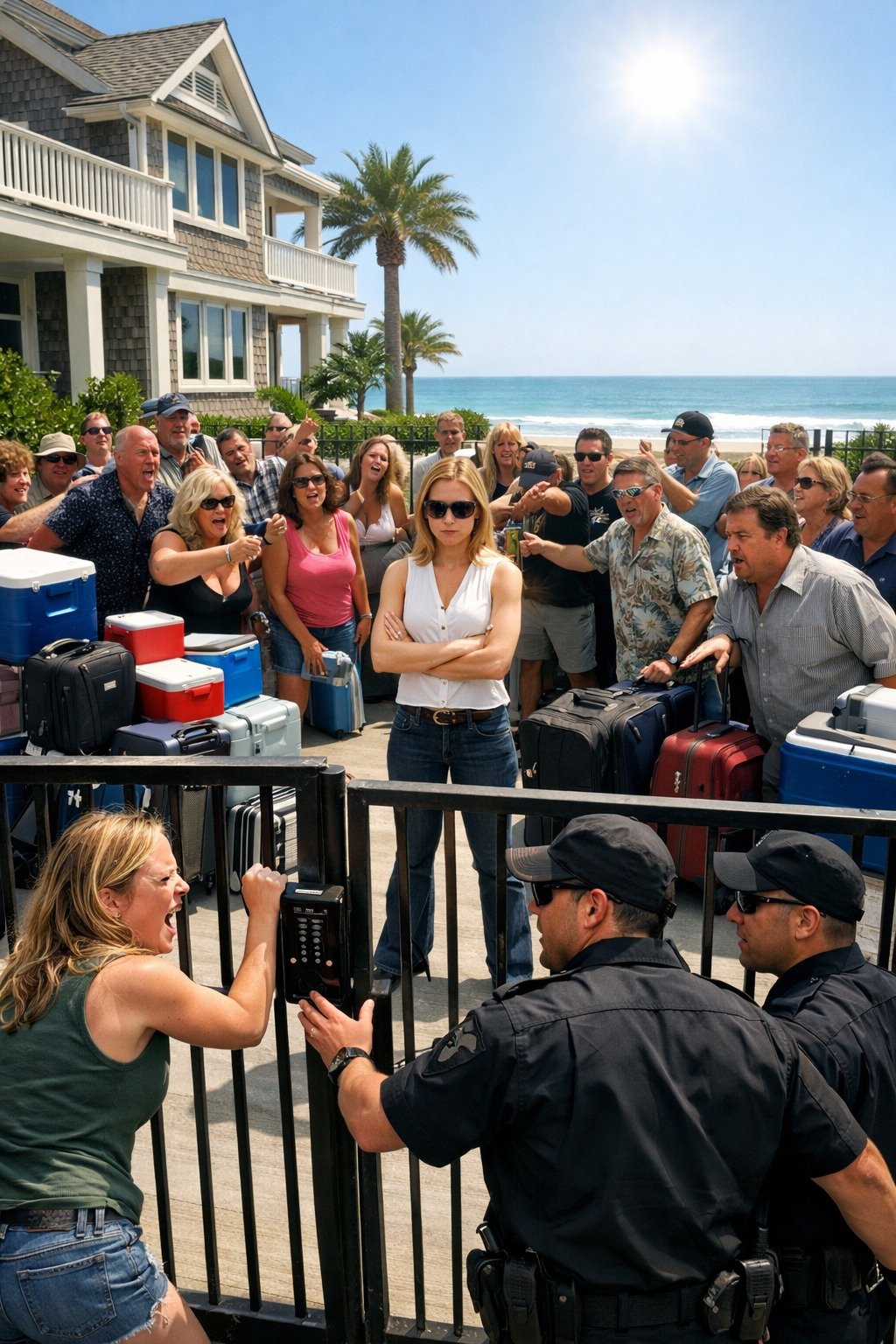
We were already unpacked, barefoot, and breathing easier when the first SUV rolled up to the gate.
I saw it through the security app on my phone: my parents’ white SUV, Paige’s minivan behind them, trucks and sedans stacked like a parade of assumption.
Coolers strapped to roofs. Inflatable paddleboards. Kids’ faces pressed to windows.
Paige called immediately. I let it ring.
Then the gatehouse number popped up.
“Dr. Carter,” the guard said. “We have a group here insisting they have permission. They’re upset.”
“I’m sure they are,” I said. “Their names aren’t on the list. They do not have permission.”
“Understood,” he said. “One of them is demanding to speak to you.”
“Put her on speaker,” I said, voice calm enough it surprised even me. “But my answer isn’t changing.”
There was a shuffle, then Paige’s voice, tight and furious, came through like a hiss.
“Are you kidding me right now? The guy says we’re not on the list. It’s our reunion, Bella.”
“No,” I said. “It’s your reunion at my house that you planned without asking.”
“Stop being dramatic,” she snapped. “We drove all this way. The kids are excited. Open the gate and we’ll talk about whatever you’re mad about inside.”
“No,” I repeated. “Turn around.”
In the background I heard my mom, panicked and shrill. “What is she saying? Is she opening it?”
Paige lowered her voice, as if whispering would make her sound reasonable. “You’re really going to pull this because of a stupid Facebook comment. Milo isn’t even a beach kid. She hates sand. You’re doing this to punish us.”
I looked out at the deck where Milo was building a fort out of beach towels and chairs, humming to herself, blissfully unaware of the battle happening over her existence.
“You told forty-seven people you were spending four days in a house you don’t own,” I said. “You booked time off. You bought food. You did all that without checking with me. And then you planned to exclude my daughter from her own home.”
“We said she could come for the day,” Paige shot back. “You’re twisting this. You’re making everything about her.”
“She lives here,” I said, and heard my own voice tighten. “You treat her like an afterthought. I’m not hosting a family that doesn’t host my kid.”
My dad’s voice cut in, loud and rough. “We raised you,” he barked. “We wiped your backside and this is how you repay us? Leaving us out there like dogs?”
“I’m not leaving you anywhere,” I said, and my hands started to shake even as my voice stayed steady. “I’m setting a boundary.”
“You think you’re better than us with your big brain job and your fancy house,” he spat.
“I don’t think I’m better,” I said. “But I am done.”
For a second there was nothing but the faint hush of waves behind me and, on the other end, a child crying in one of the cars.
Then my mother’s sob broke through the speaker like a siren.
“You’re tearing this family apart,” she wailed. “Over money, over that girl. Blood is blood, Bella.”
“You did that,” I said quietly, and I hung up.
I sat on the outdoor couch, phone in my hand, while the camera feed showed my family swarming the gatehouse like angry bees.
Ten minutes, I told myself.
Ten minutes and then they would have to make a choice.
Part 3
The first thing my body did when I hung up on my parents was prepare for impact.
Not physical impact. Emotional. The kind that lives in your jaw and shoulders and makes your stomach feel like it’s full of nails. I’d spent years training myself to stay calm under pressure, but my pressure was usually a bleeding artery or a swelling brain. This was something messier: a family that believed love could be invoiced.
“Mom?” Milo called from the deck. “Can I put the hammock up?”
“The one Grandma said was a fire hazard,” Ethan muttered, half-smiling.
I swallowed a laugh that came out sharp and startled. “Yeah, kiddo,” I said. “Put it wherever you want.”
Milo’s shoulders relaxed like she’d been waiting for permission her whole life. She threaded the hammock straps around two posts, tongue poking out in concentration.
My phone rang again. This time it was the gatehouse.
“Dr. Carter,” the guard said, sounding polite in that exhausted way people sound when they’ve realized they’re dealing with a circus. “They’re refusing to leave. One of them tried to push the gate open.”
“That’s not how gates work,” I said, and heard my own voice go dry.
“No, ma’am,” he agreed. “Also, they’re telling me they have a legal right because it’s a family house.”
I laughed once, humorless. “It’s in my name. They have no right.”
“Understood,” he said. “Do you want me to call local PD now?”
“Yes,” I said. “If they won’t turn around, call.”
A pause. “They’re asking if you’re inside. They’re saying they’ll just walk in from the beach access point.”
My heart lurched. “They can’t,” I said quickly. “The beach access is gated too, right?”
“It is,” he confirmed. “But, ma’am, people get… creative.”
“Call PD,” I repeated. “And tell them I want a trespass warning issued. I’m not playing.”
“Copy that,” he said. “Also, for what it’s worth, you’re handling this better than most.”
He didn’t see my hands trembling so badly I nearly dropped the phone.
Ethan came to stand beside me, his presence steady like a wall. “You want me to take Milo inside?” he asked softly.
I watched Milo’s small figure test the hammock, swinging gently. She looked peaceful, for once not bracing for someone to tell her she didn’t belong.
“No,” I said. “Not yet.”
Because that was the point. Because this was her house too, and I wasn’t going to teach her that safety meant hiding.
Five minutes later, the camera feed showed a patrol car pulling up behind my parents’ SUV. The officer got out slowly, one hand resting near his belt, posture calm but alert.
Paige stormed toward him like she’d been rehearsing the outrage in her car.
Even through the grainy video, I could see her gestures: palms up, head shaking, the big performance of Wronged Sister.
My mom stood behind her, hands fluttering near her face. My dad’s arms were crossed tight, jaw working like he was chewing on anger.
Behind them, kids milled around between cars, bored and confused. One of Mark’s boys kicked at the gravel. Paige’s youngest tugged on her shirt.
The officer spoke for a moment with the guard, then turned to my family.
Paige pointed toward the ocean, toward the road, toward the sky, like the entire universe should be subpoenaed to witness her injustice.
I watched it like I was observing a different species.
My phone vibrated with a new message. A text from Mark.
Bella, what the hell is going on? We’re at the gate. Kids are freaking out. Just open it and we can talk.
I didn’t answer.
Ethan squeezed my shoulder. “They’re going to try to make you feel like this is a tantrum,” he murmured. “Don’t let them.”
On the screen, the officer held up a hand, stopping Paige mid-rant. He spoke again, firmer this time. Paige’s face tightened. She looked over her shoulder, toward my parents, then back to the officer as if demanding he change the law to fit her narrative.
My dad stepped forward, pointing now, his finger stabbing the air. The officer didn’t flinch. He said something that made my dad’s shoulders drop half an inch, like a deflated tire.
Then the officer pulled out a notepad.
The guard turned slightly, angling his body as if to block the gate no matter what. Paige’s minivan rocked as someone inside slammed a door.
My mom’s head dipped. She wiped her face.
Paige suddenly whipped around and marched back to her minivan, yanking the door open hard enough it bounced. Her kids scrambled in like they knew an explosion was coming.
My parents climbed into their SUV slowly. My dad paused, glancing toward the camera mounted on the gatehouse. Even from here, I could feel his stare as if he knew I was watching.
He raised one hand and flipped the bird at the camera.
I let out a breath that was half-laugh, half-sob.
The officer wrote something down, then walked toward the line of cars. He spoke to each driver briefly, like he was handing out instructions. One by one, the vehicles turned around in the narrow space, executing awkward three-point turns.
It took time. The convoy that had arrived like a celebration left like a retreat.
Paige’s minivan went first, tires spitting gravel. Mark’s truck followed slower, hesitant, like he still believed I might relent at the last second.
My parents’ SUV was last. My dad drove with stiff shoulders, my mom’s face turned toward the window like she couldn’t bear to look forward.
When the last car cleared the gate, the guard pressed the button and the gate slid shut.
The camera feed steadied on an empty road.
I dropped my phone into my lap and stared at the ocean. The waves didn’t care. The waves were just waves.
“Mom?” Milo’s voice broke through.
I turned. Milo stood on the deck, fingers twisting the hem of her shirt.
“You okay?” she asked.
The question was so Milo: checking on me when she was the one who’d been treated like a footnote for years.
I patted the cushion beside me. She climbed up and tucked herself against my side, light as a bird.
“I’m okay,” I said, and this time it wasn’t entirely a lie. “I’m… relieved.”
“Were they here?” she asked quietly.
Ethan’s breath hitched, but I kept my voice steady. “They were at the gate.”
“Did they want to come in?”
“Yes.”
“Did you let them?”
“No.”
Milo didn’t flinch. She didn’t gasp. She didn’t ask why.
She stared out at the ocean for a moment, then said, “Because they’re mean?”
The simplicity of it knocked the air out of my lungs.
“Because they’ve been mean,” I corrected, kissing the top of her head. “And because you deserve better than people who treat you like you’re optional.”
Milo was quiet for a long time. Then she said, almost like she was testing the words, “So we’re allowed to say no to family.”
“We’re allowed to say no to anyone,” Ethan said firmly, joining us on the couch.
Milo nodded slowly, absorbing it like a rule she’d never been taught.
That night, Leah arrived with her twins, arms full of grocery bags and a fierce, tired smile.
“They’re calling me a traitor,” she said as soon as we hugged. “My mom said I’m choosing sides.”
“And?” I asked.
Leah glanced at Milo, who was showing one of the twins her sketchbook.
“Yeah,” Leah said simply. “I am.”
We roasted hot dogs and marshmallows and made a lopsided sandcastle that collapsed twice. Milo laughed more than I’d heard her laugh in months. She taught the twins a card game that involved a lot of strategy and a little bit of ruthless joy.
For two days, we lived like the beach house was what it was supposed to be: a home, not a trophy.
Then Sunday came, and with it, my phone exploding with the aftermath.
Voicemails from my mom, crying. Texts from my dad, venomous. Paige’s group chat rant, already recruiting cousins and aunties into her version of events.
Bella locked us out of our own house over her trauma child.
Trauma child.
I read it once. Then again.
And something in me, the part that had been trained to fix and soothe and smooth everything over, finally stood up straight.
I wasn’t going to argue about my daughter’s worth with people who had already decided it was negotiable.
I turned my phone off.
On Monday morning, I turned it back on and started making a different set of calls.
Part 4
The first call I made after the weekend wasn’t to my mother, or my father, or Paige, or Mark.
It was to my financial advisor.
“I want to separate everything,” I told her. “Anything tied to my parents, my siblings, any shared accounts or cards. I want it clean.”
There was a pause on the line. “Are you safe?” she asked gently.
“Yes,” I said. “I’m just… finished.”
She didn’t pry. She just asked for details and started listing steps like she was reading from a playbook.
The second call was to an attorney.
Not because I wanted to sue anyone. Because I wanted to stop living like the only way to keep my family from hurting me was to keep giving them tools.
Paige’s “we’re coming anyway” wasn’t just rude. It was a threat. And the moment the police had gotten involved, the situation had shifted into something I refused to treat like normal family drama.
The attorney’s name was Janice Mercado. She sounded like she’d eaten entitlement for breakfast her whole career.
“Do you have documentation?” she asked.
I emailed her the screenshots: the Facebook event, the “real cousins” comment, Paige’s texts, my mom’s messages afterward claiming they were at a Motel 6 “because of me,” as if I’d physically locked them out of their own home instead of my property.
Janice made a low sound of appreciation. “This is a gift,” she said. “Not emotionally. Legally.”
“What can I do?” I asked.
“We can send a formal notice,” she said. “Trespass notice. Cease and desist. Make it clear in writing that they do not have permission to access your property, that any attempt will be considered trespassing, and that they are not to harass you through social media or group communications.”
“That feels extreme,” I admitted, because the word extreme had been used on me my whole life whenever I tried to set a boundary.
“It feels appropriate,” Janice corrected. “Because you already tried reasonable. Reasonable is what got you here.”
That afternoon, Ethan and I sat at the kitchen table while Milo did homework at the other end, chewing her pencil like she was trying to taste the math.
Ethan slid Paige’s group chat message toward me. “You want to tell her?” he asked, nodding toward Milo.
I looked at Milo. She was writing carefully, brow furrowed, doing that thing she did where she leaned so close to the paper her braid fell over her shoulder like a curtain.
“I don’t want to dump adult problems on her,” I said.
“She already knows,” Ethan said quietly. “Kids always know when they’re being left out. She just doesn’t have language for it unless we give it to her.”
He was right, and I hated that he was right.
After dinner, I asked Milo to sit with me on the couch. Ethan stayed nearby, not hovering, just present.
“Milo,” I began, “I want to talk about what happened at the gate.”
Milo’s hands folded in her lap. She didn’t look scared, exactly. More like she was preparing.
“I didn’t let Grandma and everyone in,” I said. “Because they planned to come without asking, and because they’ve said and done things that aren’t kind to you.”
Milo’s eyes stayed on mine, steady. “Like the boat,” she said.
I felt my throat tighten. “Yes. Like the boat. And like the ‘real cousins’ comment.”
Milo blinked once. “I saw that,” she admitted, voice small. “On Aunt Paige’s phone once. I didn’t tell you. I thought… if I tell you, you’ll be mad at me for looking.”
I reached for her hand. “I’m not mad at you.”
“I don’t want you to lose your family because of me,” she whispered.
The words hit hard because they were the exact fear my family had been feeding, whether they realized it or not: that Milo was a complication. A cost. A problem I’d chosen that was now making me difficult.
Ethan sat down beside her, taking her other hand. “Milo, you are our family,” he said. “You didn’t make anyone treat you badly. They did that by themselves.”
Milo swallowed. “But they don’t like me.”
I took a slow breath. “Some of them don’t know how to love someone unless they see themselves in them,” I said carefully. “That’s their limitation, not yours.”
Milo stared at our hands linked together. “So… are we not seeing them anymore?”
The question was bigger than her. Bigger than me, too, in a way. Because the old version of me would have immediately said, Of course we will, don’t worry, I’ll fix it.
But fixing it had always meant making Milo smaller.
“We’re going to take a break,” I said. “And we’re going to have rules. If they want to be in our lives, they have to treat you with respect. No jokes about you not being real. No excluding you. No pretending you’re optional.”
Milo’s shoulders loosened, like she’d been holding her breath for years.
“Okay,” she said, and then, so quietly I almost missed it: “Thank you.”
That night, my mother called. I let it go to voicemail. Her voice was raw, dramatic.
“You humiliated us, Bella,” she cried. “People from church were with us. They saw everything. We told them the gate was broken so you wouldn’t look bad. You should be thanking us.”
I deleted the voicemail without responding.
Paige messaged me thirty-seven times in two days. Long paragraphs, short insults, a screenshot of her kids crying, a threat to “tell everyone what kind of person you really are,” as if I hadn’t already watched her do that in real time.
Mark stayed quiet publicly, but sent me one private message late Tuesday night.
You could’ve warned us. We took time off work. Dad’s furious. Paige is losing it. You didn’t have to call the cops.
I stared at his message until my eyes burned.
I typed back:
I didn’t call the cops. I called security. Security called the cops when they refused to leave. I’ve been warning all of you for years. You just didn’t believe me because I always gave in.
Mark didn’t respond.
The next day, Janice emailed me a draft of the notice. It was crisp, formal, and painfully clear.
It stated that my beach property was privately owned, access was by permission only, and that permission had been revoked. It stated that any attempt to enter would result in law enforcement involvement. It instructed them to stop harassing me through any means, including social media.
Seeing my family’s names typed into a legal document made my stomach twist.
Ethan read it and nodded. “Send it.”
My finger hovered over the email button.
Then I thought of Milo on that pier, drawing herself as a shaded stick figure off to the side.
I hit send.
The silence that followed wasn’t peaceful. It was the kind of silence that comes right before someone decides they’re going to prove you wrong.
And Paige, I knew, hated being told no more than she hated being told she was cruel.
Three days later, the security company called me.
“Dr. Carter,” the manager said, “we had someone drive by the property this afternoon. A woman. She didn’t enter, but she stopped near your driveway and took photos.”
“Paige,” I said, not even needing to ask.
“We got her on camera,” he said. “Do you want us to report it?”
I looked at Milo at the dining table, happily arguing with Leah’s twins over a board game, her face lit up like she’d finally been written into the scene.
“Yes,” I said. “Document everything.”
Because if Paige wanted a war, she was going to learn something I’d spent my entire career mastering.
I didn’t panic. I prepared.
Part 5
Paige’s retaliation didn’t arrive as a dramatic, movie-style confrontation.
It arrived in whispers and smear campaigns, like mold spreading through walls.
An aunt I barely spoke to posted a vague Facebook status about “people who forget where they came from” and “blood being thicker than fancy titles.” My mother’s church friend, a woman named Carol who once complimented my haircut and asked if I could “look at her MRI sometime,” commented with praying hands and wrote, “Some children are ungrateful.”
Paige made a public post with a photo of the beach house from five years ago, back when I’d still let everyone take pictures like it was a backdrop. The caption read:
When you help build a family dream and then get locked out by the person who thinks she owns everything. Some people really do choose strangers over blood.
Underneath, she tagged me.
Ethan saw it first. His face went flat in that dangerous way it did when someone insulted Milo.
“I can respond,” he offered.
“No,” I said, because Paige wanted a public fight. Paige wanted me to look like the angry doctor who’d gone too far. “We don’t feed her.”
That didn’t mean we did nothing.
Janice sent Paige and my parents a second message: a formal warning about defamation and harassment. She included screenshots, time stamps, and a reminder that anything posted publicly could be used as evidence.
Paige didn’t back down. She doubled down.
Two weeks later, on a Thursday afternoon while I was in surgery, Ethan’s phone buzzed with an alert from the beach house security system.
Motion detected: back deck.
He called me in the hallway between cases, his voice tight. “Bella. Someone’s at the house.”
My chest went cold. “Who?”
“I don’t know. The camera’s lagging.”
I ducked into an empty call room and pulled up the live feed on my own phone. For a moment, all I saw was sky and a corner of the railing, the camera shaking slightly in the wind.
Then a figure moved into view.
Paige.
She wore big sunglasses and a wide-brimmed hat like she was incognito, which would’ve been funny if it weren’t terrifying. She stood on the sand below the deck, looking up, hands on hips, like she was evaluating a house she planned to buy.
Then she walked toward the side gate that led from the beach access path to the backyard.
The lock didn’t budge.
She tried again, harder. Then she yanked, rattling it like she could intimidate metal into obeying.
Her phone came out. She held it up and filmed the lock, narrating silently, probably for another post.
Then she did something that made my blood spike.
She looked directly at the camera mounted under the eaves and waved.
A slow, smug wave.
Like she knew she’d gotten what she wanted: proof that she could still reach me.
Ethan’s voice came through my phone, low. “I’m calling the security company.”
“Call the police,” I said. “Now.”
By the time the patrol car arrived, Paige was already walking away, but the officer stopped her on the path. I couldn’t hear the conversation, but I watched her body language shift from smug to indignant to forced composure.
She gestured toward the house, toward the ocean, toward herself, the same choreography she’d used at the gate.
The officer spoke, then asked for her ID.
Paige’s head jerked. She shook it like no, like how dare you.
The officer didn’t move.
Finally, Paige handed it over.
The officer wrote something down and, a few minutes later, handed her a paper.
A trespass warning.
Paige snatched it and stalked away, shoulders rigid.
Ethan exhaled so hard I could hear it. “She’s escalating,” he said.
“She’s flailing,” I corrected, though my hands were shaking. “She doesn’t know what to do without control.”
That evening, Janice filed for a restraining order. Not because I wanted to punish Paige, but because I wanted the rules enforced by something bigger than my own resolve.
When the court date came, Paige showed up with my mother, both dressed like they were attending a funeral. My father sat behind them, arms crossed, staring at me like I’d betrayed an ancient oath.
The judge, an older woman with sharp eyes, listened quietly as Janice presented evidence: texts, screenshots, the Facebook event, the police report from the gate, the beach house camera footage.
Paige’s lawyer tried to paint it as “a family misunderstanding.”
The judge’s eyebrow rose. “A misunderstanding doesn’t involve repeated trespass warnings,” she said dryly.
Then she asked Paige directly, “Ms. Hill, why did you go to the property after you were told not to?”
Paige’s mouth tightened. “Because it’s family,” she said, like it was a magic phrase. “That house is the family house.”
The judge looked at her. “Is your name on the deed?”
“No,” Paige snapped.
“Then it is not your house,” the judge said. “Dr. Carter is not obligated to grant you access. The order is granted. Do not return to the property. Do not contact her except through legal counsel.”
My mother made a small sound, wounded.
My father muttered something under his breath that I didn’t catch, but the tone was poison.
Outside the courthouse, my mom tried to approach me, eyes wet. “Bella, please,” she whispered. “This is too much.”
I looked at her, really looked. At the wrinkles around her mouth, the tired slump of her shoulders. At the woman who’d raised me with love and scarcity and fear, and who now couldn’t understand why love wasn’t supposed to hurt.
“It’s only too much because you’re used to me taking too much,” I said quietly.
Her face crumpled. “We didn’t mean—”
“You did,” I said, not cruel, just honest. “Even when you didn’t say it out loud.”
My mom’s gaze flicked toward Milo, who stood beside Ethan, clutching her sketchbook like armor. Milo didn’t look scared. She looked tired.
My mom’s lips trembled. “She’s a child.”
“So was I,” I said, and then I turned away.
That summer, we went back to the beach house with Leah and the twins. We started a new tradition: Milo got to pick one “ridiculous” thing to do every trip.
One weekend it was renting a giant inflatable swan and insisting we name it Captain Feathers. Another weekend it was a scavenger hunt for “treasure” she made up on the spot, burying shells and coins and making the twins swear an oath of secrecy.
She laughed louder each time, like her body was learning it was safe.
At the end of August, school started again. Milo’s art teacher emailed me.
Milo submitted a piece for the district showcase, the teacher wrote. It’s… extraordinary. I wanted you to see it.
When I opened the attached photo, I stared.
Milo had drawn a house by the ocean, detailed down to the grain of the deck boards. In the windows were silhouettes of people. Three figures in the center, close together. On the porch, a fourth figure, slightly behind them, shaded darker.
I swallowed, heart catching.
Then I noticed something else.
The darker figure wasn’t off to the side.
It was inside the scene.
Not a side character.
A person who belonged.
I printed the picture and framed it. I hung it in the hallway where Milo would see it every day.
And then, in October, my phone rang during morning rounds.
The caller ID made my stomach tighten.
Dad.
I let it ring. Then again. Then a third time.
Finally, a text came through, short and strange.
Bella. It’s an emergency.
My hands went cold, not from fear of him, but from the word emergency, which in my family usually meant money.
Then the next message arrived, and the world shifted.
I’m at the hospital. It’s your mom.
Part 6
I left rounds without finishing my coffee. I didn’t wait for the attending’s raised eyebrow or the resident’s questions. I just told the charge nurse, “Family emergency,” and walked fast enough that my badge slapped against my chest.
Ethan met me in the parking lot, Milo at his side. Milo’s face was pale, eyes wide.
“What happened?” Ethan asked, voice tight.
“I don’t know,” I said. “Dad says Mom’s at the hospital.”
Milo climbed into the backseat, clutching her sketchbook like she might need it to breathe. “Are we going to see Grandma?” she asked softly.
The question was layered. It wasn’t just Are we going. It was Are we allowed. Will they want me there. Will I make it worse.
“We’re going to the hospital,” I said. “And we’re going to be together.”
We found my parents in the ER waiting area. My dad looked smaller than I remembered, like the past few months had shaved something off him. His face was red, eyes bloodshot. Mark stood nearby, arms folded, jaw tight. Paige was there too, pacing like a caged animal.
The second Paige saw me, she froze, hatred flashing across her face so openly it was almost a relief. No more pretending.
My dad stepped forward. “Finally,” he barked.
Ethan moved slightly in front of Milo without thinking. Not blocking her, just bracing.
“What happened?” I asked, ignoring my dad’s tone.
Mark answered, voice rough. “Mom collapsed at church. They think it’s a stroke.”
Everything in me snapped into a different mode. The surgical mode. The triage mode. The part of me that could hold horror in one hand and still do math with the other.
“Where is she?” I asked.
“In imaging,” Mark said. “They’re doing a CT.”
I turned toward the nurses’ station, already scanning for familiar faces. “What’s her name?” a nurse asked briskly.
“Linda Carter,” I said. “Date of birth—” I rattled it off without thinking, because of course I knew. My mother’s birthday was carved into my memory like my own.
A nurse recognized me. “Dr. Carter,” she said, startled. “You’re family?”
“Yes,” I said. “What do we have?”
She lowered her voice. “Right-sided weakness, slurred speech at onset. CT is pending.”
My mind ran through possibilities, through pathways in the brain like roads on a map.
Paige stepped in close, eyes blazing. “You don’t get to play hero now,” she hissed. “You humiliated her and now you’re here acting like you care.”
I looked at Paige, really looked. At the fury that kept her upright. At the desperate need to win.
“I do care,” I said. “And I’m not here to fight you.”
“You’re the reason she’s stressed,” Paige snapped. “You’re the reason this happened.”
My dad’s voice rose. “You broke your mother’s heart.”
Mark’s eyes flicked to Milo and away again, like he couldn’t decide what to do with her presence.
Milo stood very still, shoulders tucked in.
I took a slow breath. “This is not the time,” I said, voice level. “If you want to scream at me, do it later. Right now, we focus on Mom.”
Paige scoffed, but she stepped back. My dad muttered again, but his energy was uneven, fear leaking through.
A doctor approached then, a neurologist I knew professionally, Dr. Ramirez. Her expression was serious.
“Bella,” she said quietly. “Can we talk?”
I followed her into a small consult room. She closed the door.
“CT shows a bleed,” she said. “Small hemorrhage. Likely hypertensive. We’re stabilizing. She’s awake, but confused.”
My heart clenched. “Surgery?”
“Not yet,” Ramirez said. “We’re monitoring. But I need you to be family right now, not colleague. Go sit with her when we move her upstairs.”
I nodded, swallowing hard.
When my mom was wheeled into a room, her face looked wrong. Not because she was older or sick, but because she looked vulnerable in a way I’d never seen. Her eyes fluttered open when she heard my voice.
“Bella?” she whispered, and even through the slur, I heard relief.
“I’m here,” I said, taking her hand. Her skin felt papery, cool.
Her eyes shifted past me and landed on Milo. For a moment, confusion creased her brow. Then recognition softened something in her face.
“Milo,” she whispered.
Milo stepped forward cautiously. “Hi, Grandma,” she said, voice polite, guarded.
My mom blinked slowly. “You grew,” she murmured, like time had skipped.
Milo nodded. “A little.”
My mom’s gaze held Milo’s longer than it ever had at Christmas or birthdays. Something in her expression trembled, like she was trying to reach for a thought and it kept slipping.
Then she squeezed my hand weakly. “I’m sorry,” she whispered.
My throat tightened. “Rest,” I said, blinking fast.
“No,” my mom said, struggling, frustration flaring. “Listen.” She swallowed, breath shaky. “I… I did wrong.”
The words hung in the air like a fragile ornament.
Behind me, I felt Paige stiffen. I felt my dad shift, uncomfortable.
My mom’s eyes remained on Milo. “You… belong,” she said, voice thick, as if the sentence cost her. “You’re… ours.”
Milo froze. Her eyes widened, and in them I saw something raw: hope fighting not to trust.
Milo swallowed. “Okay,” she whispered, like she didn’t know what else to say.
My mom closed her eyes, exhausted, like she’d run a marathon just to speak that truth.
Outside the room, Paige cornered me in the hallway.
“She’s confused,” Paige snapped. “She doesn’t know what she’s saying.”
“Maybe she knows exactly what she’s saying,” I replied quietly.
Paige’s eyes narrowed. “You think this changes anything?”
I looked at her, and for the first time, I felt something like pity underneath the anger. Paige had built her identity on being the one who could take and still be loved for it. If my mother changed, Paige’s whole structure collapsed.
“I don’t know,” I said honestly. “But I’m not going back.”
Over the next week, my mother improved. Her speech cleared. The weakness faded. Fear hung around her like smoke, but she was alive.
During those days, I watched my father hover at her bedside like he didn’t know who he was without her. I watched Mark bring flowers and sit stiffly, guilt etched into his posture. I watched Paige complain about the hospital food and the parking fees and how inconvenient it all was, as if the universe owed her a smoother crisis.
And I watched Milo.
Milo sat in the corner of the room with her sketchbook, drawing quietly while my mother slept. She didn’t demand attention. She didn’t push. She was simply there.
On the last day before my mom was discharged, she asked to speak to me alone.
My dad and Paige and Mark stepped into the hallway reluctantly. Ethan took Milo to get a snack.
My mom looked at me, eyes clearer than they’d been in months. “I thought you’d come back,” she said softly. “After… after the beach.”
“I didn’t,” I said.
Her mouth trembled. “I know.”
Silence stretched.
Then she said, “I was ashamed.”
I blinked. “Of what?”
“Of needing you,” she admitted, voice small. “Your father and I… we got used to your help. And when you said no, it felt like you were saying we weren’t worth it anymore. So we… we made you wrong. Because it was easier.”
I didn’t respond, because the truth had too many sharp edges.
My mom’s eyes filled. “And Milo,” she whispered. “I don’t know why we were… like that. She’s sweet. She tries so hard.”
“She shouldn’t have to try hard to be loved,” I said quietly.
My mom nodded slowly, tears slipping down. “I know.”
She took a shaky breath. “Will you… will you let us try again?”
The question landed heavy. My old self wanted to say yes immediately, to erase discomfort. My new self took a slow breath.
“You can try,” I said. “But there are rules. Real rules. And if you hurt her again, we’re done.”
My mom nodded, swallowing. “Okay.”
When Ethan and Milo returned, my mom reached out her hand.
“Milo,” she said, voice gentle. “Can I… see your drawings?”
Milo hesitated, looking at me. I nodded once.
Milo stepped closer and opened her sketchbook, turning it toward my mother. My mom’s face softened as she looked. “You’re talented,” she whispered.
Milo’s lips pressed together. “Thanks.”
It wasn’t a hug. It wasn’t a miracle reconciliation.
But it was the first time my mother had looked at Milo like she was seeing her.
Paige watched from the doorway, eyes hard.
And I knew, with the calm certainty of a diagnosis, that Paige wasn’t going to accept this shift quietly.
Part 7
Paige didn’t wait long to strike.
Two weeks after my mom came home, Paige showed up at my parents’ house with a casserole and a smile that didn’t touch her eyes. My mom told me about it on the phone, voice cautious.
“She’s trying,” my mom said, like she was convincing herself.
“She’s performing,” I said, and I hated that the cynicism felt like wisdom.
Then Paige called me for the first time in months.
I stared at the caller ID until it stopped ringing. She called again. On the third attempt, I answered, because part of boundary-setting is refusing to be controlled by fear.
“What,” I said, not a question.
Paige exhaled dramatically. “Wow,” she said. “Still cold. Good to know you didn’t suddenly become human after Mom almost died.”
I kept my voice even. “What do you want?”
There was a beat, like she was irritated I didn’t take the bait.
“Mom wants Thanksgiving,” Paige said. “All of us. Like a real family. No lawyers. No threats. Just… normal.”
Normal. A word Paige loved because it meant everyone else should behave the way she wanted.
“Where,” I asked.
“At Mom and Dad’s,” Paige said. “Obviously.”
“Will Milo be welcome?” I asked.
Paige made a sound like a sigh and a laugh had a baby. “Bella. She’s always welcome.”
I thought of the boat. The stocking. The ‘real cousins’ comment.
“She’s welcome like a pet is welcome,” I said quietly. “Present, but not included.”
Paige’s voice sharpened. “You really can’t let this go.”
“I won’t let my kid be treated like she’s less,” I said.
“She’s not your kid by blood,” Paige snapped, and the truth of her finally slid into the open like a knife.
Silence stretched.
Then I said, “Thank you for saying it out loud.”
Paige’s breath hitched, as if she realized she’d exposed herself.
“You’re twisting—”
“No,” I said. “You meant it. And because you meant it, you don’t get to be in our lives unless you can change.”
Paige’s voice rose. “Mom needs us together!”
“Mom needs peace,” I corrected. “Not a performance.”
Paige went quiet for a second, then her tone shifted into something smooth and transactional. “Fine,” she said. “But you know what else Mom needs? Money.”
My stomach tightened.
“Dad’s hours got cut,” Paige continued. “Medical bills are piling up. They’re scared. I thought maybe… after everything… you’d step up.”
There it was. The real call.
I took a slow breath. “I’m not your family bank anymore,” I said.
Paige’s voice cracked with anger. “So you’re just going to let them drown?”
“I’ll help Mom and Dad with a budget,” I said. “I’ll pay for a financial counselor. I’ll make sure they have food. But I’m not handing you money. And I’m not giving you access to my accounts.”
Paige laughed, bitter. “You really think you can control everything.”
“I’m controlling what belongs to me,” I said. “That’s called being an adult.”
Paige’s voice turned venomous. “You’re going to regret this. One day you’ll need us.”
I thought of Milo’s drawing, the darker figure finally inside the scene. I thought of Ethan’s steady hand on my shoulder. I thought of Leah choosing us without hesitation.
“I already have family,” I said quietly. “And they don’t threaten me.”
I hung up.
Thanksgiving came, and we didn’t go to my parents’ house.
Instead, we hosted Leah, the twins, and two of Milo’s friends from school who didn’t have anywhere comfortable to go. One was a shy girl named Anika whose parents were mid-divorce. The other was a boy named Trevor who lived with his grandmother and always ate like he wasn’t sure there would be more later.
We cooked too much food. We played board games. Milo taught the twins a new card strategy that made them scream-laugh in outrage.
After dinner, Milo disappeared into her room and came back holding something wrapped in tissue paper.
She handed it to my mother on a video call.
My mom looked surprised. “What’s this?”
Milo’s voice was quiet but steady. “I made you something.”
My mom unwrapped it carefully. Inside was a small drawing: a woman sitting in a chair, holding a cup of tea, sunlight through a window. The lines were gentle. The expression was soft.
My mom’s eyes filled instantly.
“Oh, Milo,” she whispered. “It’s beautiful.”
Milo nodded. “I thought… you might like a calm picture.”
My mom laughed through tears. “I love it.”
Paige wasn’t on the call. My mom didn’t mention her. My dad didn’t say much at all.
But afterward, my mother texted me:
Thank you for not taking Milo away from me completely. I’m trying. I know it doesn’t fix the past. But I’m trying.
I stared at the message for a long time.
Then I replied:
Trying means listening. It means changing. Keep going.
In January, Mark came to see me alone.
He showed up at my office after hours, hands shoved in his pockets like a teenager. He looked older than he had in years, tired in a way that wasn’t just work.
“I owe you an apology,” he said abruptly.
I didn’t respond, because I’d learned not to rush people into comfort.
Mark exhaled. “I didn’t see it,” he admitted. “Not really. I mean, I saw… little things. But I told myself it wasn’t a big deal. And then Paige said that stuff, and I realized… we’ve been letting her do it our whole lives.”
I watched him, my brother, the kid I’d once walked to school holding his hand.
“I should’ve said something on that boat,” he said, voice rough. “I should’ve shut it down. Milo… she didn’t deserve any of it.”
“No,” I said softly.
Mark swallowed hard. “I want to do better.”
“You can,” I said. “But it’s not words. It’s actions.”
Mark nodded. “I know.”
He hesitated. “Can I… can I talk to Milo sometime? Like, actually talk? Not just… wave at her at holidays?”
I thought of Milo’s cautious eyes, her careful heart.
“Yes,” I said. “But you follow her lead. You don’t push. You show up consistently.”
Mark nodded, eyes shiny. “Okay.”
When he left, I didn’t feel triumph.
I felt something quieter. Something like the beginning of a new shape.
Paige, meanwhile, started telling anyone who would listen that Mom had “turned against her.” That I’d brainwashed Mark. That Ethan was controlling me. That Milo was the reason everything was broken.
But for the first time, the story Paige told wasn’t the only story in the family.
And Milo wasn’t just a shaded figure off to the side anymore.
People were finally starting to look at where she stood.
Part 8
Spring brought a strange kind of peace, the kind that feels suspicious at first because you’re used to chaos.
My mother went to physical therapy. My father stopped drinking beer at noon. Mark started calling once a week, not to ask for anything, just to talk. Sometimes he asked Milo about her drawings. Sometimes he asked Ethan about work. Sometimes he sat in silence on speakerphone and listened while Milo explained a fantasy book plot with the seriousness of a courtroom argument.
Paige stayed absent, except for occasional sharp messages to my mother that my mom didn’t forward to me anymore.
My mother and I met for lunch twice. The first time, she cried the whole meal. The second time, she brought a small photo album.
“I found these,” she said, sliding it across the table.
Inside were pictures from Milo’s early years. Milo at six, missing a front tooth, sitting on my father’s lap at a Christmas gathering. Milo holding a sparkler, hair frizzed by humidity. Milo standing beside Paige’s kids, all of them squinting into the sun.
I stared. “You had these?”
My mom’s face tightened. “I did,” she admitted. “I don’t know why I never… I don’t know.”
“Because you didn’t want to admit she was already part of us,” I said quietly.
My mom nodded, tears spilling again. “Yes.”
I didn’t forgive her instantly. Forgiveness isn’t a switch.
But I took the album home and showed Milo.
Milo flipped through slowly. Her finger traced the edges of the photos like she was making sure they were real.
“I’m there,” she whispered.
“You’ve always been there,” I said.
Milo’s eyes lifted to mine. “Then why did it feel like I wasn’t?”
Because people can keep you in the frame and still push you out of the story, I thought.
But what I said was, “Because some people didn’t know how to love you properly. And that’s not your fault.”
Milo nodded, quiet. Then she said, “Can we go to the beach house on my birthday this year?”
Her birthday had always been complicated, because it came with old losses and questions she didn’t always say out loud. But this year, she wanted the ocean. She wanted space.
“Yes,” I said. “We’ll go.”
We invited Leah and the twins. We invited Mark and his oldest son, who had been quietly kind to Milo at family gatherings even when others weren’t.
We did not invite Paige.
We did not invite my father, not yet. He’d apologized to me once, gruffly, but he’d never apologized to Milo, and I refused to pretend that didn’t matter.
On Milo’s birthday morning, we woke up to dolphins in the distance, small arcs breaking the surface like someone was drawing punctuation marks on the water.
Milo stood on the deck in her hoodie, wind tugging at her braid, and she smiled in a way that looked unguarded.
Leah’s twins arrived with cupcakes and too much energy. Mark arrived awkwardly, carrying a gift bag like he wasn’t sure he deserved to be there.
He pulled Milo aside at one point, clearing his throat. “Hey,” he said. “I just… I wanted to tell you something.”
Milo blinked up at him.
Mark’s voice shook. “I’m sorry,” he said. “For all the times I didn’t speak up. For the boat. For the stupid stuff people said. You’re family. And I should’ve acted like it.”
Milo stared at him. Her face didn’t change much, but her eyes softened a fraction.
“Okay,” she said, simple.
Mark looked like he wanted more, wanted immediate forgiveness and warmth. But he swallowed it and nodded.
“Happy birthday,” he said. “I’m glad you’re here.”
Later, Milo opened his gift: a set of professional drawing pens and a sketchbook with thick paper.
Milo’s fingers brushed the pens like they were fragile. “These are… nice,” she said, almost stunned.
Mark cleared his throat. “I asked Leah what you’d like. She told me. I hope it’s… right.”
Milo looked at him. “Thanks,” she said, and it was quiet, but it was real.
That night, after cake and laughter and a bonfire on the beach, Milo handed me a drawing.
It was the beach house again. But this time, every person was drawn with detail: Leah laughing, the twins running, Mark sitting with a thoughtful expression, Ethan beside him, and me with my arm around Milo.
In the center of the porch was Milo herself, not shaded darker, not off to the side. Just there.
At the bottom, she’d written, in careful letters:
Main character energy.
I laughed, and the sound came out half broken.
“What?” Milo asked, smiling.
“Nothing,” I said, pulling her into a hug. “Everything.”
In the months that followed, I made practical changes too. The kind you don’t notice in stories but that matter in real life.
I updated my will. I set up a trust for Milo. I put the beach house in a structure that made it impossible for anyone to claim it as “family property” if something happened to me.
I stopped the monthly deposit into my mother’s joint account. Not because I wanted to punish her, but because the system had to change. Instead, I paid specific bills directly: the electric, the water, the pharmacy co-pays. No cash, no slush fund, no vague “emergency” pool that Paige could siphon from.
My mom accepted it, quietly, a little ashamed. My dad grumbled, but he didn’t fight me the way he would’ve before. The stroke had scared him into seeing how fragile control actually was.
Paige tried once more, in late summer, to contact me through a new phone number.
I recognized her tone immediately.
You can’t keep Mom from me forever. And if you think Milo’s going to take everything when you’re gone, you’re out of your mind.
I didn’t respond. I forwarded it to Janice.
Then I took Milo to the beach house anyway.
Because the best revenge wasn’t silence.
It was building a life so full and solid that Paige’s bitterness had nowhere to land.
Part 9
Two years later, Milo stood on a stage in a school auditorium holding a plaque that looked almost too heavy for her.
District Arts Showcase: First Place.
Her drawing was projected behind her on a screen: a cityscape she’d invented, all towering bridges and floating gardens, intricate enough that you could stare at it for an hour and still find new details.
In the corner of the drawing, tucked into a window, was a small figure at a desk, sketching.
Not hidden. Not shoved aside.
Just living.
When Milo stepped off the stage, she made a beeline for Ethan and me, cheeks pink, eyes bright.
“I didn’t trip,” she whispered, like that had been her biggest fear.
“You absolutely did not trip,” Ethan said, grinning.
I pulled her into a hug, careful not to crush the plaque. “I’m proud of you,” I said, voice thick.
Milo hugged back, then stepped away quickly, because she still wasn’t the kind of kid who lingered too long in big emotion. She needed space even from happiness.
Leah was there, clapping like she was at a rock concert. Mark was there too, standing a little awkwardly but smiling in a real way, one of his sons cheering beside him.
My mother was there, sitting in the second row, a cane resting against her chair. She dabbed at her eyes with a tissue, then caught Milo’s gaze and pressed a hand to her chest.
Milo gave her a small nod.
It wasn’t a perfect family reunion. It wasn’t a movie ending where everyone apologizes and the credits roll over warm music.
Paige wasn’t there.
Paige hadn’t been in our lives for two years, not really. She’d tried a few times to force her way back in, through guilt, through threats, through my mother. But my mother, to my surprise, had finally held a line.
You can’t talk about Milo that way, my mom had told her once, according to Mark. Not anymore. If you want to be part of this family, you don’t get to cut her out.
Paige had called her a traitor and stormed out.
My father had watched, silent, then later muttered to Mark, “She always did think the world owed her.”
That was as close to self-awareness as he’d ever gotten.
After the art show, we went to the beach house, because Milo asked. It was becoming our tradition: big moments marked by the ocean, like we were anchoring memories somewhere no one could rewrite them.
On the first night, Milo sat on the deck with her sketchbook and the plaque beside her like a companion. The air smelled like salt and sunscreen and the faint smoke of someone else’s grill down the street.
Ethan and I sat nearby, quiet.
Milo flipped to a blank page. She stared at it for a long time.
“What are you drawing?” I asked.
Milo shrugged. “I don’t know yet.”
She tapped her pencil against the paper, thoughtful. Then she said, without looking up, “Do you think Aunt Paige ever thinks she’s wrong?”
The question didn’t come with anger. It came with curiosity, like Milo was examining a character’s motivation in a story.
I considered carefully. “I think Paige thinks being wrong means losing,” I said. “And she’s terrified of losing.”
Milo nodded slowly. “So she’d rather be alone than change.”
“Some people would,” Ethan said softly.
Milo’s pencil moved then, lines appearing. Not a cityscape this time. Something simpler.
A gate.
On one side of it, a crowd of small figures, blurred together. On the other side, a house by the ocean.
Inside the yard were a few people, drawn clearly. Milo drew herself, Ethan, me. Leah. The twins. Mark. My mom, sitting in a chair with a cup of tea.
Milo shaded the inside of the gate with light pencil strokes, like sunlight.
Then she wrote one sentence at the bottom, small and firm:
No is a full sentence.
She handed the sketchbook to me without speaking.
I stared at it, feeling something unwind in my chest that I hadn’t realized was still knotted.
“You remember,” I said quietly.
Milo’s mouth twitched, half a smile. “I remember a lot.”
I swallowed. “I’m sorry I didn’t protect you sooner.”
Milo looked at me, eyes steady and older than eleven, older than thirteen, older than she should’ve had to be.
“You did,” she said simply. “You just… started later.”
The honesty of it made me laugh through tears.
We sat together in the ocean air, listening to waves fold into the shore like breath.
In the morning, my phone buzzed with a message from an unknown number.
For a second, dread flared.
Then I opened it.
It was a photo.
A cake on a table. A banner that read Happy Birthday Linda.
My mother had written underneath:
Small celebration. Dad grilled. Mark came. I told everyone about Milo’s award. I framed her drawing. I hope that’s okay.
I stared at the message, then at the ocean beyond the deck, endless and indifferent and beautiful.
I typed back:
It’s more than okay. Tell her I’ll call later.
Then I turned to Milo, who was already outside, barefoot, hair wild, holding her sketchbook like a map.
“What do you want to do today?” I asked.
Milo didn’t hesitate. “I want to go find shells,” she said. “The really weird ones.”
Ethan stretched, yawning. “Weird shell expedition. Got it.”
Milo started down the steps, then turned back, looking at us with a sudden seriousness.
“You know,” she said, “if this was a story…”
“It is a story,” Ethan said, smiling.
Milo rolled her eyes. “If it was a story, people would say the beach house is the main thing.”
I waited, because Milo always had a point if you gave her time.
Milo’s gaze moved over the deck, the ocean, the hammock swaying in the breeze.
“But it’s not,” she said, voice quiet but sure. “The main thing is that you picked me.”
My throat tightened. “Always,” I said.
Milo nodded once, like that settled it, and ran toward the sand, leaving footprints that the waves would erase.
I watched her go, feeling the strange, fierce peace of a life rebuilt on purpose.
Years ago, my sister had texted me like I was a concierge at a resort she believed she owned.
Stock the fridge by Friday.
She’d laughed and said she was coming anyway. What are you gonna do, call the HOA?
I hadn’t called the HOA.
I’d called my own strength.
I’d changed the code.
I’d hired security.
I’d said no.
And in the years that followed, I learned the truth I should have known all along:
A family isn’t the people who demand your house.
A family is the people who make room for your child.
Even when the room is your whole life.
THE END!
Website Disclaimer
The information provided on this website is for general informational and educational purposes only. While we strive to ensure that all content is accurate and up to date, we make no guarantees regarding the completeness, reliability, or accuracy of any information published.
The views and opinions expressed in articles belong to their respective authors and do not necessarily reflect the views of this website. Any action you take based on the information found on this website is strictly at your own risk. We will not be liable for any losses, damages, or inconveniences arising from the use of our content.
Some articles may contain opinions, third-party information, or external links. We do not endorse or guarantee the accuracy of content on external websites and are not responsible for their practices or policies.
All content on this website is provided in good faith and is intended for informational purposes only. Readers are encouraged to verify information independently and seek professional advice where appropriate.