I was at airport security, belt in my hands, boarding pass on the tray. Then an airport officer stepped up: “Ma’am, come with us.” He showed me a report-my name, serious accusations. My greedy parents had filed it… just to make me miss my flight. Because that morning was the probate hearing: Grandpa’s Will-My Inheritance. I stayed calm and said only: “Pull the emergency call log. Right now.” The officer checked his screen, paused, and his tone changed – but as soon AS HE READ THE CALLER’S NAME…
Part 1
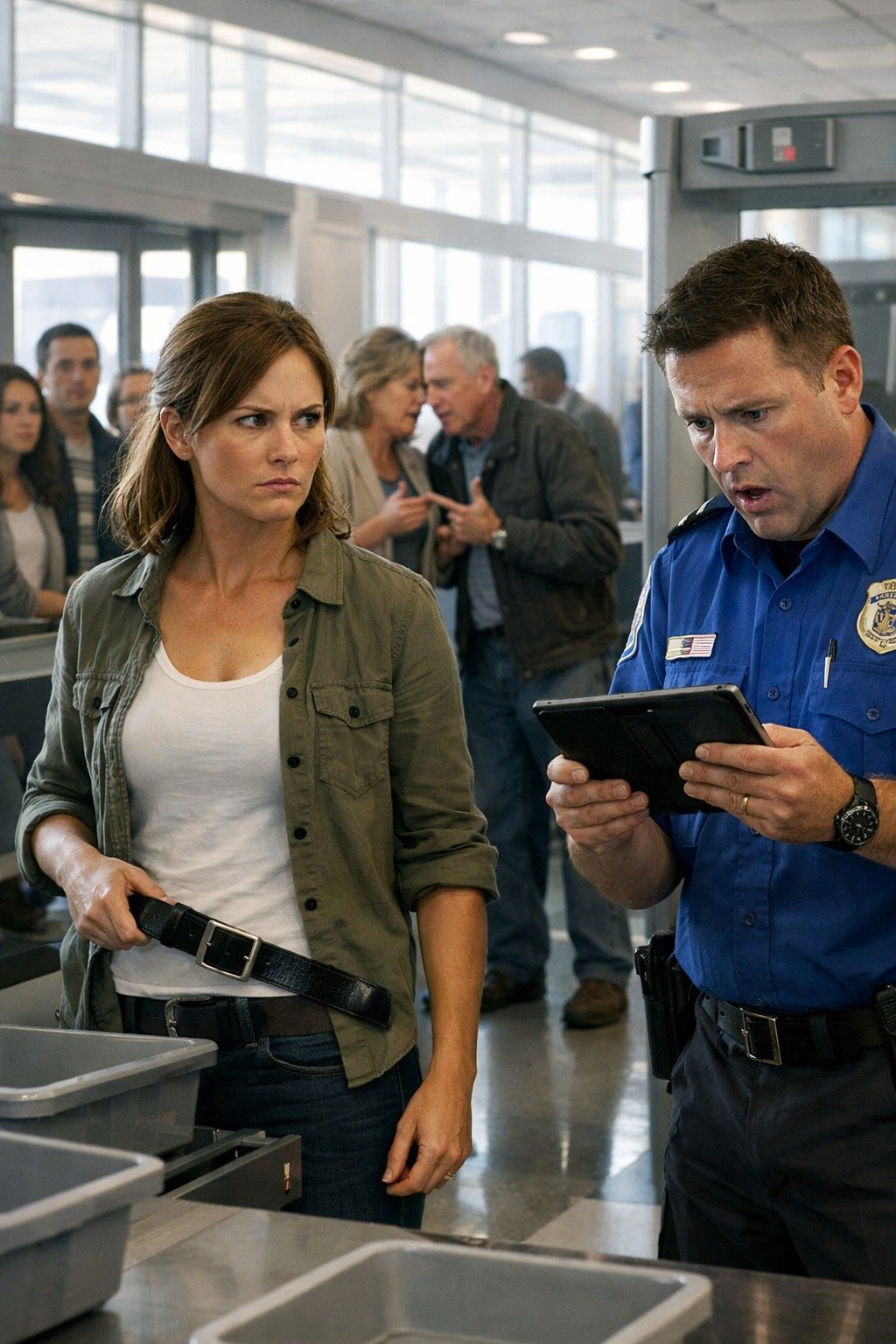
My belt was looped over my wrist like a leash and my boarding pass lay flat in the gray tray, so light it felt like a dare. Shoes off. Laptop out. Liquids in their little plastic bag. The TSA line moved in that slow, irritated shuffle where nobody makes eye contact but everybody judges.
I kept looking up at the clock above the checkpoint, willing it to move faster.
This wasn’t a vacation. This was a sprint.
My grandfather’s probate hearing was scheduled that morning in Rio Arriba County. The kind of hearing that takes grief and turns it into paperwork—names next to property, signatures next to money, the court deciding what gets passed on and what gets fought over. Since Grandpa’s funeral, my parents had been circling that day like it belonged to them.
We’ll handle it, they’d said.
You’ll just complicate everything, they’d said.
They wanted me absent. They wanted the judge to see an empty chair when my name was called, so they could explain it away with concern and soft voices and the story they’d already rehearsed: Nina’s emotional. Nina’s unstable. Nina can’t be trusted with serious matters.
The tray slid forward. I stepped toward the metal detector.
That’s when a uniformed airport police officer moved into my path.
Not TSA. Not a supervisor in a blue shirt. Airport police—dark uniform, badge, calm face that didn’t belong to a normal travel day. His partner angled in beside him, a half-step behind, the way trained people position themselves when they don’t want you bolting.
“Ma’am,” he said, voice low but firm. “Come with us.”
For half a second, my brain refused the sentence. Me? I glanced over my shoulder like he’d mistaken me for someone else. He didn’t blink. His partner’s eyes stayed on my hands.
My stomach tightened, but my voice came out steady. “What is this about?”
“We need to ask you some questions,” he said. “Right now.”
The TSA line behind me got quiet in that special airport way—people pretending not to watch while their curiosity leans forward. I felt eyes, the itch of phones, strangers deciding which version of me they’d tell later.
I looked at my tray—belt, wallet, boarding pass—my hands suddenly empty in the most vulnerable way.
“I have a flight,” I said carefully.
“You need to come with us,” he repeated.
His partner softened her tone without softening her stance. “Just bring your ID if you have it.”
Slow hands. No sudden moves. I reached into my carry-on and pulled my driver’s license, holding it between two fingers like a peace offering. The officer took it, studied it, then nodded toward a glass-walled room off to the side.
A desk. A chair bolted to the floor. The kind of room designed to make you feel guilty even if your conscience is clean.
He sat across from me and asked, “Is your name Nina Holloway?”
“Yes,” I said.
He opened a tablet and scrolled, the screen glow reflecting faintly on his face. “I’m going to read what we received. Then you can respond.”
I didn’t interrupt. I didn’t plead. I didn’t get emotional. I’d learned something about authority the hard way: the fastest way to lose is to hand them your panic and hope they’ll treat it gently.
He cleared his throat. “We got a report this morning. Caller states you’re traveling today and may be a threat.”
Threat.
The room tilted. Not dramatically—just enough to make the air feel thinner.
“A threat to who?” I asked.
He glanced down. “To the public. Caller states you made statements about making them pay and that you might attempt to cause an incident at the airport.”
My skin went cold, not because the accusation made sense, but because I knew exactly who would use that language.
My father loved vague words that sounded serious and couldn’t be disproven in one sentence. Unstable. Dangerous. Threat. Words that give institutions permission to slow you down.
“Who made the report?” I asked.
He hesitated just long enough to tell me the name mattered. “I’m not going to discuss that yet.”
His partner watched me like she’d been warned I might explode. Like she’d been briefed to expect tears or yelling or hysteria.
I didn’t give her any of it.
“I’m traveling to a probate hearing,” I said. “For my grandfather’s estate. If I miss it, my parents get what they want.”
The officer’s eyes flicked up. “Probate?”
“Yes.” My voice stayed level. “They’ve been trying to keep me out since the funeral.”
He scrolled again. “The caller claims you recently made concerning emergency calls and that you’ve been reported before.”
My pulse shifted—slow and heavy—because that was the tell. My parents weren’t just trying to delay me. They were trying to build a record that could follow me into court.
Unstable daughter. Questionable behavior. Safety risk.
If they could plant that now, they could walk into probate later and sound reasonable while the judge looked at me like a problem.
I leaned forward slightly, hands visible on my knees. “Officer, pull the emergency call log tied to this report. Right now. The original call information and the recording.”
His partner started, “Ma’am, that’s not always—”
“It will be there,” I said, cutting her off without raising my voice. “Whoever did this is counting on you not checking.”
The officer studied me for a beat. Then he tapped the screen and opened a different panel.
I watched his face as he read.
Neutral. Neutral. Then his thumb stopped moving.
His tone changed—not dramatic, just more careful. He angled the tablet away from me and glanced at his partner.
“What?” she asked quietly.
He didn’t answer her immediately. He stared at the same line again like he wanted it to be something else, then looked up at me.
“Ms. Holloway,” he said slowly. “You said your parents want you to miss a probate hearing.”
“Yes.”
He swallowed once. “Because the call log lists the reporting party by name. And it lists your father, Grant Holloway, as the caller.”
The moment he said my father’s name out loud, the room sharpened around the edges. Not embarrassment. Something worse: the sound of a system realizing it had been used.
His partner leaned in and read the line for herself. Her mouth tightened. “Grant Holloway. Relationship listed as father.”
The officer’s name tag finally registered in my peripheral vision: Delaney. His partner’s: Singh.
Delaney asked, “Any restraining orders? Pending charges? Prior incidents at the airport?”
“No,” I answered. “None.”
Singh tilted her head. “He also said you might be carrying documents and might destroy them if confronted.”
My stomach went cold for a different reason. That wasn’t just delay. That was an attempt to justify searching my bag and taking anything related to probate.
“I’m carrying one thing,” I said. “A copy of my grandfather’s emergency call log from the night he died.”
Singh’s eyes sharpened. “Why would probate hinge on an emergency call log?”
I met Delaney’s gaze. “Because my parents told the court my grandfather was confused and coerced when he changed his will. That call log proves who was with him and who wasn’t.”
Delaney stared at me for a beat, then opened the audio record. A button marked play lit up on his tablet.
He hesitated—because once he pressed it, he’d be listening to evidence of someone trying to weaponize police.
Then he pressed play.
My father’s voice filled the room, too calm, too confident, pretending to be worried. “This is Grant Holloway. I’m calling because my daughter is flying today and I’m afraid she’s going to do something. She’s been unstable. She said she’d make people pay. I’m scared for the public.”
Delaney paused the audio and looked at Singh. Singh’s expression was flat now, professional in the way that means she’s already decided.
“He included probate,” Singh murmured.
Delaney exhaled through his nose. “Yeah.”
I didn’t gloat. I didn’t say I told you so. I just kept my voice calm. “He’s trying to create a record.”
Delaney nodded once. “We’re going to document this as retaliatory and connected to a civil matter. We’ll run a quick check to confirm nothing else is attached to your name.”
“Do it,” I said.
Singh slid a form across the desk. “Voluntary statement. Short facts only.”
I wrote: I was stopped at security based on a report made by my father, Grant Holloway. I deny making threats. I believe the report was filed to interfere with my travel to a probate hearing in Rio Arriba County. I request preservation of the call audio and logs.
Delaney scanned it, then said something that made my chest go tight again.
“It wasn’t the first call today,” he said. “It was the third.”
Singh read over his shoulder. “Two earlier calls were dropped before dispatch answered.”
My mouth went dry. Twice he’d called and hung up, then called again—rehearsing the lie until someone took it seriously.
“That matters,” Delaney said, voice controlled. “It suggests intent.”
He stepped out and spoke to a TSA supervisor in a low voice. I caught fragments: probate, father, retaliatory, no criminal indicators.
When he came back in, he slid a small printed slip across the desk. “Incident number. Keep this.”
I tucked it into the back of my phone case like it was armor.
Delaney stood. “We’re going to let you continue to your gate.”
Relief hit my chest, quick and sharp, but I didn’t let it show. Not yet. My parents never stopped at one attempt.
Singh matched my pace as they walked me back toward the checkpoint, two uniforms visible beside me like a shield and a warning.
“Thank you,” I said.
Delaney nodded once. “Get to your hearing.”
I retrieved my tray, buckled my belt, and walked away from the checkpoint without running.
Calm isn’t weakness, I reminded myself.
Calm is control.
Part 2
My gate had changed, because of course it had.
I moved fast through the terminal—past perfume kiosks, past a family arguing over a stroller, past the glossy airport ads promising luxury to people who were already late. I kept my eyes on overhead signs and my mind on one thing: get on the plane.
Halfway there, my phone buzzed.
An email from the airline: Your itinerary has been updated.
My stomach tightened. Then another buzz.
Your flight has been cancelled.
I stopped so abruptly a man behind me bumped my shoulder and muttered an apology that didn’t match his annoyed face. I stared at the cancellation email and felt my throat go dry as I read the reason line.
Cancelled per customer request.
Not weather. Not maintenance. Not staffing.
Customer request.
My parents didn’t steal with crowbars. They stole with access.
I didn’t call the airline hotline. Hotlines eat time. I went straight to the nearest service desk, set my ID on the counter, and kept my voice level.
“My flight was canceled minutes before boarding,” I said. “I did not request that.”
The agent looked tired until he saw the timestamp. Then his eyes sharpened. He typed, clicked, frowned at the screen.
“I’m seeing the cancellation,” he said slowly. “It was requested by someone who answered your security question.”
My pulse dropped into my hands.
“I didn’t give anyone my security answers,” I said.
He glanced up, uncertain. “Do you have an authorized traveler on your profile?”
“No,” I said. “Absolutely not.”
He clicked again. “They called in. They had your confirmation code.”
Of course they did. My father used to “help” me book flights when I was younger, back when I still believed his involvement meant care instead of control. Confirmation codes live in old emails. Security questions are usually the kind of thing parents think they own: your first pet, your childhood street, your mother’s maiden name.
All the answers to prove you’re you, handed to the people most likely to pretend they’re you.
“Can you see the number that called?” I asked.
He hesitated. “We don’t always—”
“Please,” I said gently, firm enough to cut through. “This is interference with a court hearing. I was just stopped by airport police because of a false report filed by my father. I have an incident number.”
His expression shifted at the word police.
I pulled the slip from my phone case and slid it across the counter. He read it, then looked back at his screen with a different seriousness.
“I can see the caller ID,” he said. “It’s logged in the notes. Caller identified himself as Grant Holloway.”
There it was again—my father’s name typed neatly in a field that made it look official.
“Did he say why he canceled?” I asked.
The agent scrolled. “He said you’re not well and you’re not safe to travel alone. He asked us to stop you from getting on the plane.”
Same language. Different institution.
Threat at the airport. Not safe to travel. Unstable.
My father was building a version of me that could be waved around like a warning sign.
“I need you to reverse it,” I said. “And I need those notes printed.”
He nodded, fingers moving faster now. “Reversing depends on availability.”
“I’ll pay for a new ticket,” I said. “I just need to get there.”
He clicked, the screen refreshed.
Then he said, “There’s one seat still open.”
“Print it,” I said.
He printed the new boarding pass and slid it over, then printed the internal notes—one thin sheet with a timestamp, the caller ID, and my father’s name.
“Keep this,” he said quietly. “If he tries again, tell them to flag your profile for in-person verification only.”
“I will,” I said.
I didn’t linger. I walked fast toward the gate with my new boarding pass in one hand and my father’s paper trail in the other.
Boarding had already started. The scanner beeped when I handed my pass over.
Green.
I stepped onto the jet bridge and didn’t look back.
Once I was in my seat, I finally allowed myself one private second of shaking—just in my fingers. Then I forced them still. I opened my folder and checked that the packet I’d been carrying all morning was still there: the CAD printout and dispatch summary from the night Grandpa died.
The paper looked ordinary. That was the point. Ordinary paper is harder to argue with than emotional stories.
My phone buzzed.
A text from my mother: We know you’re trying to stir things up. Turn around. You’ll regret it.
I didn’t respond.
Another buzz.
A court notification I hadn’t subscribed to: Notice of hearing update.
My stomach tightened as I opened it.
The hearing time had been moved earlier by two hours.
Two hours.
They weren’t trying to keep me off the plane anymore. They were trying to make sure that even if I landed, I’d land too late.
The plane pushed back. As the engines rolled up, I stared at the notice and did the only thing left inside my control.
I called the probate clerk’s office.
It rang twice. A woman answered, brisk and tired. “Rio Arriba County Probate.”
“My name is Nina Holloway,” I said, voice steady. “I’m a beneficiary in today’s hearing. I just received a notice the hearing was moved earlier. I’m in transit due to interference, and I need to confirm whether the court will allow remote appearance or continue until I arrive.”
Keys tapped. A pause. Then her tone shifted slightly—less routine.
“Miss Holloway,” she said carefully, “the time change was requested this morning as an emergency accommodation.”
“By who?” I asked.
Another pause. “By counsel for Grant and Linda Holloway.”
My chest went cold.
“Has the court granted anything yet?” I asked.
The clerk hesitated. “Your parents’ attorney filed a motion to proceed without you based on a claim you were detained by airport police for threat-related behavior.”
I stared out the window as the runway blurred into motion.
They were writing me out in real time.
I bought the in-flight Wi-Fi before the seatbelt sign even turned off, then called the clerk back.
“I need an address for emergency exhibits,” I said. “Your motion contains a factual misrepresentation being used to deprive me of my right to appear. I have documentation that contradicts it.”
“We don’t accept filings by email,” she said automatically.
“I’m not asking you to file it,” I replied. “I’m asking where I can send supporting documents for the judge to review, because the motion is false.”
A beat. Then: “Are you represented?”
“Yes. Elliot Lane.”
Keys tapped again. “Mr. Lane is in the building.”
“Please note this,” I said, controlled. “I was stopped at airport security because my father filed a report. Airport police identified him via call log and audio. I was cleared. And my flight was canceled by my father calling the airline and claiming I’m not safe to travel.”
The clerk went quiet for a moment, then gave me an address for a secure exhibit inbox.
I built an email like a brick wall—no emotion, no adjectives. Attached the incident slip. Attached the airline notes. Attached screenshots of my mother’s threats. Five sentences. Timeline. Request.
Then I called Elliot Lane.
He answered on the first ring, voice low like he was already standing in a courthouse hallway. “Nina. Where are you?”
“On the plane,” I said. “They moved the hearing earlier and filed a motion claiming I was detained for threats.”
“I saw it,” he said, and his voice sharpened. “No police report attached. Just their declaration.”
“Because there isn’t one,” I said.
“I know,” he replied. “Send me the emergency call log too. Now.”
I pulled the packet from my folder, flattened it on the tray table, and photographed each page. Then I emailed it to the clerk’s secure inbox and copied Lane.
Two minutes later, the clerk replied: The judge has reviewed your exhibits and is considering the motion at the start of the hearing. Please remain available by phone.
My phone buzzed again—Lane.
“Your father just told the judge you were removed in handcuffs,” he said softly. “And the judge just asked the clerk to read your incident number into the record.”
I closed my eyes once, steadying my breath.
Let the record speak, I thought.
Let them drown in their own lies.
Part 3
I stayed on the phone while the courtroom came to order. I couldn’t hear everything, but I could hear enough to recognize when the air changed—murmurs settling, chairs stilling, that quiet that falls when a judge stops being patient.
Then I heard the judge’s voice clearly, older and flat.
“Counsel,” he said, “I’m looking at a supplemental exhibit containing an airport incident number. I’m also looking at airline notes identifying the caller as Grant Holloway.”
A beat of silence. Then my father’s voice rose too quickly, too defensive, like a man trying to outtalk paper. “That’s what she wants you to believe, Your Honor. She’s manipulative.”
The judge didn’t take the bait. “Mr. Holloway,” he said evenly, “you are in a court of record. Choose your words carefully.”
Lane whispered into the phone, “He’s irritated.”
“Good,” I murmured, not for spite, but because irritation is the first crack in arrogance.
The judge continued. “I have an airport police slip indicating the party was stopped, identified, and cleared. No arrest. No handcuffs. No detention for threats.”
My father tried again, “Your Honor, she—”
“You do not get to diagnose your daughter as a strategy,” the judge snapped, still not loud, just final.
Then the judge said the sentence my parents had spent weeks trying to prevent: “Ms. Holloway, are you present by phone?”
Lane angled the phone closer. My mouth went dry.
“Yes, Your Honor,” I said. “I’m on an aircraft in transit due to the interference described in my exhibits. I’m available to be heard.”
A pause. Then: “You are heard,” the judge said.
My chest tightened—not victory, not relief, something closer to dignity finally being recognized in a room that mattered.
The judge addressed the courtroom. “Given the credible evidence of interference, I am denying the motion to proceed without Ms. Holloway. I am also denying any request for temporary appointment as personal representative today. I will not reward obstruction.”
Lane exhaled quietly. “Thank you,” he whispered.
But the judge wasn’t finished. “Counsel,” he continued, “I am continuing this hearing to tomorrow morning at nine to allow Ms. Holloway to appear in person. Additionally, I am directing production of communications related to the airport report and airline cancellation. Failure to comply may result in sanctions. I am also referring the conduct described to the appropriate authorities for review.”
Referral. Sanctions.
Consequences had entered the record.
When the call ended, I sat back in my seat and stared at the folder on my tray table. My parents had tried to stop me with uniforms and cancellations and motions. Instead, the court had slowed down and written their names into official ink.
I landed after dark, exhausted in that deep way that comes from fighting a battle nobody can see.
Lane met me outside baggage claim under harsh lights where everything looks more real and less forgiving. He didn’t hug me. He didn’t ask if I was okay.
He handed me a slim binder. “These are the documents everyone’s been fighting over,” he said.
Inside were my exhibits—the airline notes with my father’s name typed neatly, the airport incident slip, screenshots of my mother’s threat about guardianship. And behind all of that, protected in a clear sleeve like evidence, was the emergency call log from the night Grandpa died.
Lane kept walking beside me toward the parking garage. “Your parents are claiming your grandfather wasn’t lucid when he updated the will,” he said. “They’re also claiming you pressured him.”
I didn’t give a speech. I just opened the sleeve and looked at the line that had been burning a hole through my brain since I first read it.
Caller reports male subject attempting to obtain signature. Patient states, “Do not let him take papers.”
I shut the binder. Lane watched my face change. “You didn’t tell me that part,” he said quietly.
“I didn’t want it said out loud on a phone,” I replied.
He nodded once, like he understood the instinct.
At the hotel, I barely slept—not because I was scared of the judge, but because I knew my parents would show up smiling.
They always smiled when they thought the system belonged to them.
In the morning, we walked into probate early enough to smell coffee before we heard voices. My mother was already there—perfect hair, soft cardigan, hands clasped like prayer. The Concerned Parent costume.
My father stood in an expensive suit, speaking in low tones to their attorney. When he saw me walk in beside Lane, his smile didn’t drop.
It sharpened.
We didn’t greet them. We didn’t give the hallway a show. Lane guided me into the courtroom and into the front row aisle seat—visible to the bench, not hiding, not shrinking.
When the judge entered, the room rose.
He didn’t start with the will.
He started with my parents.
“I reviewed the supplemental exhibits,” he said, voice flat. “And I reviewed the motion to proceed without Ms. Holloway based on an alleged detention for threat-related behavior.”
My father’s attorney stood quickly. “Your Honor—”
The judge held up one hand. “No. I have questions. I want answers without theater.”
The courtroom went so quiet I could hear a pen click behind me.
The judge looked directly at my father. “Mr. Holloway. Did you contact airport police and report your daughter as a threat?”
My father’s smile tried to hold.
“Your Honor, I was worried,” he said. “She’s unstable. She said things—”
“Did you make the call?” the judge asked, sharper. “Yes or no.”
My father inhaled like he wanted to perform innocence.
Then he realized the judge wasn’t a stage.
“Yes,” he admitted.
My mother’s eyes snapped to him, furious, because that admission shifted everything. A lie whispered is one thing. A lie sworn is another.
The judge nodded once. “All right. Then we’re going to address motive.”
Lane stood. “Your Honor, we have the CAD report and the dispatch narrative, and we’ve requested the audio.”
The judge looked at me. Not pity. Not sympathy. Attention.
“Ms. Holloway,” he said, “is the log in your possession?”
“Yes, Your Honor.”
“Approach.”
My legs felt steady when I stood, because this wasn’t a plea. This was proof. I handed the sleeve to the clerk. The clerk carried it to the judge.
The judge read silently for a long moment. Then he paused, reread one sentence, and I watched my mother’s hands tighten like she could feel the words from across the room.
The judge looked up.
“Mr. and Mrs. Holloway,” he said, “you allege the decedent was confused and coerced when he changed his estate plan.”
My father lifted his chin. “Yes. He wasn’t himself.”
The judge held up the page slightly. “Then explain why the dispatch narrative states he was coherent enough to request a witness, refuse contact with you, and report you attempting to obtain a signature.”
My father’s mouth opened, then closed.
The judge turned to the clerk. “If the audio is available, I want it played.”
Lane’s voice stayed calm. “It is, Your Honor.”
The speakers crackled. The room leaned forward without moving.
And then my grandfather’s voice filled the courtroom—rough, but clear.
“This is Harold Holloway,” Grandpa said. “My son is here. He’s trying to make me sign papers. I told him no. He won’t leave.”
My mother made a small sound, like the truth physically hurt.
Grandpa continued, “He brought someone. A man I don’t know. They said it’s for the will. I don’t want to sign anything. I already did what I wanted to do.”
The judge shifted slightly on the bench, focus sharpening.
Then another voice entered the recording—my father’s voice, close and controlled, the tone he used at family dinners when he wanted to sound reasonable while applying pressure.
“Dad, stop making this dramatic,” my father said. “You’re not well. You don’t even remember what you signed.”
Grandpa replied immediately, no hesitation. “I remember exactly what I signed. And I remember why.”
That line hit the room like a door slamming.
The recording ended. Silence followed—the kind where nobody rushes to fill it because the truth already did.
The judge didn’t yell. He didn’t have to.
“We just heard capacity,” he said flatly, when my father’s attorney tried to object. “Sit down.”
Then he looked at my father. “Mr. Holloway, you attempted to obtain a signature from your father the night he called emergency services. You then filed a false narrative to obstruct this proceeding. This court does not tolerate manufactured delays.”
My father’s suit didn’t look expensive anymore.
It looked like a costume.
Part 4
The judge struck their motion. He denied the emergency accommodations. He scheduled sanctions. Then he did the thing that mattered most to me in that moment: he turned the hearing back to what it was supposed to be.
My grandfather’s plan.
Lane presented the executed will and trust documents. Clean, notarized, witnessed, dated long before my parents started treating Grandpa’s grief like an opportunity.
My father’s attorney tried one last time—capacity, influence, confusion.
The judge shut it down with a simple sentence. “We listened to the decedent himself. That is not confusion. That is clarity under pressure.”
Lane walked through the structure: a pour-over will, a revocable trust, a property titled outside probate. The judge asked who was named trustee.
“My firm,” Lane answered. “Along with a corporate fiduciary as co-trustee.”
My father’s eyes snapped up—because now he understood the real punishment.
He wasn’t just cut out.
He was cut off from control.
Lane read the schedule of assets. The numbers didn’t sound real when spoken out loud—almost a million in brokerage, certificates of deposit, life insurance, the house protected by title. My mother’s breath hitched. My father’s face tightened. A cousin behind them whispered, “That’s insane,” like the money belonged to whoever wanted it most.
Then Lane read the distribution terms.
My name.
Not as a headline. Not as a fight. As a final instruction.
My mother leaned forward, voice shaking with rage disguised as disbelief. “That can’t be right.”
The judge didn’t look at her. He looked at the documents. “It is right,” he said.
“Is there any distribution to Grant and Linda Holloway?” he asked.
Lane turned a page. “A limited bequest. Ten thousand dollars each, contingent on non-interference and cooperation with administration.”
My father whispered, “Ten thousand?” like the words were an insult.
“And if there is interference?” the judge asked.
“The bequest is revoked,” Lane said. “And the trustee may recover costs and fees related to obstruction.”
The judge nodded once, slow. “Based on the exhibits and testimony, I find the estate plan valid and enforceable.”
My father stood abruptly. “This is theft! She manipulated him—”
The bailiff stepped forward.
The judge leaned in. “Sit down. If you continue, you will be held in contempt.”
My father sat.
And in that moment, I realized something that shifted the air in my chest: I didn’t win because I fought harder.
My grandfather won because he anticipated them.
He built a plan, documented it, and the record did what family never did for me.
It protected me.
In the hallway afterward, my mother hissed my name like it was a curse. My father stepped closer, the smile gone, replaced by humiliation and anger.
“You’re not leaving this courthouse with that money,” he said quietly.
Lane moved slightly between us, not touching him, just occupying space. “Threats after an order to show cause are unwise.”
A deputy approached with a paper. “Mr. Holloway? The judge asked me to serve you.”
My father’s expression flickered—fear, then calculation.
The top line read: Notice of Investigation: False Reporting.
My father took it like it burned. Signed for receipt like the ink could bite.
Lane murmured, “Don’t speak to them.”
Then my phone buzzed.
Lane’s phone buzzed too.
A calm, clipped voice came through when Lane put it on speaker. “Mr. Lane. This is Special Agent Pacheco with State Investigations. I’m on site regarding the false reporting referral. I’d like to speak with Ms. Hale and make contact with Mr. Grant Holloway.”
Ms. Hale.
That was my legal name now. The name on the trust documents. My married name had changed, my life had shifted, but my parents still tried to trap me in a version of myself they could control.
Pacheco rounded the corner a moment later in a dark jacket with an ID badge clipped at his waist. He scanned faces like a man who already knew the answer.
He stopped in front of my father. “Mr. Holloway, I need your phone.”
My father flared. “You don’t get to take my property.”
“I’m requesting voluntary access,” Pacheco said evenly. “If you refuse, I will document that and apply for a warrant. That will not be comfortable for you.”
My mother tried syrupy concern. “Agent, there’s been a misunderstanding. We’re a good family—”
Pacheco didn’t look at her. “Ma’am, I’m speaking to Mr. Holloway.”
My father did what arrogant people always do when the room stops believing them.
He decided to prove he was right.
He unlocked his phone and shoved it toward Pacheco like a challenge. “Here. You’ll find nothing.”
Pacheco took it and opened the call history without rushing. He tapped, read, tapped again.
Then he looked up.
“Delta customer service,” he said, and angled the screen toward my father. “Call placed at 8:41 a.m. Duration twelve minutes. That’s the same window your daughter’s itinerary was canceled per customer request.”
My father blinked too hard. “I call airlines all the time.”
Pacheco tapped again. “Airport police non-emergency. Dispatch. Two dropped calls before the connected call.”
My mother went pale.
Pacheco opened a text thread. His eyes scanned. He didn’t need to read it all to change the temperature.
“Your daughter sent you the confirmation code?” he asked my father.
Alyssa—my cousin who always played messenger for my parents—lurched forward. “No, that’s—”
“Don’t,” Pacheco said quietly, and Alyssa’s mouth snapped shut.
Then Pacheco found a note draft and read a single line out loud, because one line was enough to break the illusion.
“Mention probate hearing to justify urgency.”
The hallway went silent in a new way—people recognizing the difference between a family dispute and a documented scheme.
Pacheco handed the phone back. “Preservation notice. Do not delete. Do not reset. Do not lose this phone. If you do, that becomes obstruction.”
He turned to me. “Ms. Hale, are you willing to give a short statement now?”
“Yes,” I said.
My statement took seven minutes: dates, times, what happened at security, the airline desk, the motion, the audio, the threats. No adjectives. No speeches. Just a timeline.
When I finished, Pacheco nodded once. “That’s exactly what we need.”
My father stared at me like he was trying to memorize the moment to rewrite later.
But he couldn’t rewrite the call logs.
And he couldn’t rewrite my grandfather’s voice.
Part 5
Three weeks later, the judge held the sanctions hearing.
My parents showed up different—less swagger, more caution. Their attorney spoke carefully, like each sentence might get clipped and stapled to a referral. Lane spoke with the confidence of a man backed by audio, timestamps, and a judge who hated being used.
The judge didn’t raise his voice. He didn’t perform outrage. He didn’t need to.
He issued sanctions for false statements submitted to the court. He ordered my parents to pay attorney fees related to the obstruction. He confirmed the court’s referral regarding false reporting.
Then he enforced the trust clause my grandfather had written like a trap for exactly this behavior.
“Given the conduct established in the record,” the judge said, “the contingent bequests to Grant and Linda Holloway are revoked.”
Ten thousand each, gone.
Not because I begged for it. Not because the judge took pity on me. Because my grandfather anticipated their tactics and wrote consequences into the plan.
I sat still as the words landed, not celebrating, not gloating. The money didn’t feel like winning. It felt like an answer to a question I’d been afraid to ask since the funeral.
Did Grandpa see them clearly?
Yes.
He’d seen them so clearly he’d prepared for them.
The trust administration proceeded without family interference. Lane’s firm and the corporate fiduciary took control. Accounts were transferred exactly as the documents stated. The house stayed protected by title. Everything my parents tried to pry open with lies stayed sealed by record.
My father threatened appeals for about a month. He sent texts through relatives. He hinted at lawsuits the way some men hint at violence—hoping fear will do the work before action is required.
None of it mattered.
They weren’t fighting me anymore. They were fighting orders, recordings, logs, and institutions that don’t care who brings potato salad to Christmas.
The investigation into false reporting moved quietly, then not so quietly when my father missed a deadline to produce certain records and Pacheco obtained a warrant for digital copies anyway. When someone’s power is built on controlling access, the moment access gets pried open, everything spills.
Pacheco never promised me a satisfying ending. He just kept saying the same thing in different words: “We follow the evidence.”
That was the first time in my life an authority figure’s process felt like safety instead of threat.
One afternoon, after the final transfer documents were signed, I drove out to Brierwood Lane alone.
My grandfather’s house sat exactly as it always had—same porch, same stubborn wind chimes, same oak tree in the yard like an old guard. I changed the locks again even though I didn’t have to, not because I was paranoid, but because I’d learned a painful truth:
Some people don’t stop trying. They just stop being creative when they’re watched.
Inside, the air smelled like old books and lemon cleaner. I walked room to room slowly, letting the quiet settle. In the kitchen, I sat at Grandpa’s table and opened the safe folder one last time.
The call log.
The dispatch narrative.
The audio transcript Lane’s office had ordered after the hearing.
It wasn’t dramatic on paper. It was sterile. Official. It didn’t care who cried at the funeral or who told the better story in a hallway.
That was why it mattered.
I closed the folder and put it in the small safe I’d installed in the hallway closet, behind a stack of boring legal binders. Not because I wanted to relive any of it. Because I understood now what Grandpa had understood:
The only language manipulators can’t rewrite is the record.
By the time autumn arrived, my parents had stopped calling. Not because they’d found peace. Because they’d found limits. They’d learned the court wouldn’t carry their lies for them, and law enforcement didn’t like being turned into a family weapon.
I didn’t forgive them. Forgiveness is personal, and mine didn’t belong to them anymore.
But I did something I hadn’t expected.
I turned Brierwood Lane into a place Grandpa would recognize.
I kept the garden going. I fixed the fence. I repaired the porch step that always creaked and made him grin every time someone complained about it. And with Lane’s help, I set up a small scholarship fund in Grandpa’s name through the trust—modest, practical, aimed at local students going into nursing, emergency dispatch, and public service.
Because one dispatcher’s notes had helped protect my life.
I wanted the next dispatcher, the next nurse, the next person who answers a call at two in the morning, to feel supported by something steadier than family politics.
On the first anniversary of Grandpa’s death, I drove to the cemetery with a single bouquet of wildflowers and sat beside his headstone until the sun dipped low.
“I made it,” I told the stone, feeling a little silly and not caring.
Not just to the hearing.
To the truth.
I didn’t get a perfect ending. I didn’t get parents who apologized in a way that meant something. I didn’t get a family that suddenly became safe.
What I got was clearer.
A judge who refused to be used.
A record that told the truth even when people lied.
And a grandfather who, in his final days, had protected me with the most powerful thing he could leave behind:
Proof.
Part 6
The first thing I learned after probate court was that winning on paper doesn’t stop people who live off control.
It just changes their tactics.
The day after the sanctions hearing, Elliot Lane met me at Brierwood Lane with a locksmith and a corporate fiduciary rep who introduced herself as “Margo” and shook my hand like we were closing on a house, not sealing a family rupture. Elliot walked through the plan in the same calm voice he used in court: trust accounts would be transferred, the co-trustee would handle distributions, and every communication from my parents would go through counsel.
“Why can’t I just… take the keys and be done?” I asked him, even though I already knew the answer.
Elliot’s eyes flicked toward the driveway. “Because they don’t see this as money,” he said. “They see it as authority. And authority doesn’t let go quietly.”
He wasn’t wrong.
By noon, my phone had filled with messages from relatives I hadn’t heard from in years. Some were syrupy. Some were angry. Almost all of them used the same language like it came from a shared script.
Family is family.
You only get one set of parents.
You should be the bigger person.
Not one of them asked what it felt like to be stopped by airport police because my father wanted to erase me from court. Not one of them asked what it felt like to hear my grandfather beg dispatch to keep my father from taking papers.
They didn’t want the truth. They wanted quiet.
When I didn’t respond, the pressure shifted to public performance.
My mother posted a photo from Grandpa’s funeral on social media—her hand on the casket, her face turned upward like prayer. The caption was short and carefully vague: Some people will do anything for money. Pray for our family.
My father’s friends piled into the comments with the kind of outrage that thrives on missing context. I was called greedy. I was called cruel. I was called unstable again, because that word was their favorite tool. If they could stick it to me long enough, maybe it would become reality to people who didn’t know better.
Elliot forwarded the post to Agent Pacheco the same afternoon.
“It’s not a crime to be awful,” Elliot said over the phone, “but it’s relevant to the pattern.”
The investigation moved with a steadiness that felt unfamiliar after living under my parents’ chaos. Pacheco didn’t chase drama. He chased timelines.
A week later, he asked to meet me at a small state office building with fluorescent lights and chairs designed to make you sit up straight. He greeted me with the same calm he’d had in the courthouse hallway.
“I’m going to ask you for the simplest version of the story,” he said. “Not what you felt. Not what you think they meant. Just what happened.”
I gave him the timeline again. Airport stop. Airline cancellation. Hearing moved earlier. Motion filed claiming handcuffs. Court exhibits. Call log. Audio. Sanctions. Preservation notice.
When I finished, he nodded once. “You did exactly what you should’ve done,” he said. “You documented and you stayed consistent.”
“Does it matter?” I asked. “Or is this just… a file that gets closed because it’s family?”
Pacheco leaned back slightly. “It matters,” he said. “The airport call is false reporting with a clear civil motive. The airline cancellation involved impersonation and unauthorized access. The court motion included a factual claim that was demonstrably false. That’s not a family dispute. That’s misuse of systems.”
Then he slid a printed page across the table. “This is what we pulled from the airline,” he said. “And this is what we pulled from dispatch.”
I stared down at the page and felt the cold clarity return.
There it was. My father’s number. His calls. Dropped, dropped, connected. The same pattern Delaney had noticed.
“Rehearsing,” I murmured.
“Testing,” Pacheco corrected gently. “He was testing which door would open.”
I looked at him. “What happens now?”
Pacheco’s expression didn’t change. “Now we request more records. We interview the officers. We interview the airline agent. We interview your father. And we see what he says when he isn’t performing for family.”
On the drive back to Brierwood Lane, I took the long route through town. Rio Arriba County looked the same as it always had—quiet roads, small storefronts, the kind of place where everybody knows your business but pretends they don’t. I passed the diner Grandpa used to love, the hardware store where he’d taught me to choose lumber by tapping it like it could talk back.
And I realized something that landed hard in my chest:
I hadn’t just inherited money.
I’d inherited visibility.
My parents had spent years using small-town perception like a weapon. They knew who to charm, who to intimidate, who to guilt. They knew how to make themselves look like the reasonable adults while quietly pulling strings.
Now the strings were attached to records instead of whispers.
When I pulled into the driveway, I noticed a car parked across the street, engine off, windows dark. It wasn’t unusual on its own. But I’d learned to pay attention to patterns.
I walked inside and checked the locks again. Then I went to the small safe in the hallway closet and pulled out Grandpa’s letter of instruction—an envelope Elliot had mentioned but I hadn’t opened yet because some parts of grief you avoid until you’re strong enough.
The envelope was addressed to Marin.
My legal name.
My real name, the one my parents kept trying to talk over.
My hands didn’t shake when I opened it. That surprised me. I’d expected tears. I’d expected pain. Instead, I felt steady, like my grandfather’s words were a hand on my shoulder.
Marin,
If you are reading this, it means you didn’t let them scare you out of the room.
I closed my eyes for a second.
Grandpa continued, his handwriting firm and familiar. He wrote about watching my parents for years, about the way they treated love like a transaction. He wrote about my father’s “projects” that never finished, the loans that never ended, the way he always needed more. He wrote about the night he called dispatch, not as a dramatic confession, but as a simple statement of fact: he didn’t feel safe in his own home.
Then the line that made my throat tighten:
I want you to have what I built because you are the only one who never asked me to turn my life into your leverage.
The letter ended with instructions—practical ones. A safe deposit box key taped to the bottom of the page. A list of account numbers. A note about the trust clause: the ten-thousand-dollar bequest, contingent on non-interference.
I didn’t smile. I didn’t celebrate.
I just sat at the kitchen table, the same table where Grandpa used to drink coffee and tell me to stop letting people rush me, and I let the truth settle:
He knew.
He saw them clearly.
And he made sure I wouldn’t be alone in a room full of their lies ever again.
Part 7
The safe deposit box was at a small bank in town that smelled like carpet cleaner and caution. The teller looked at me a little too long when I handed over my ID, then glanced at the name on the trust authorization.
“Ms. Hale,” she said, like she was testing whether the name belonged to me.
“It does,” I replied.
She nodded once and led me to a back room where the boxes lived behind steel, the way secrets always do. She slid the drawer out and left me alone with a small key and a quiet that felt heavier than it should’ve.
Inside the box was a thin folder, a flash drive, and a second envelope.
The envelope said: If they try to rewrite me.
I sat down at the little metal table and opened it carefully.
The first thing inside was a notarized statement from Grandpa’s longtime neighbor, Mrs. Ortega, dated weeks before he died. It described my father’s visits, the raised voices, the strange man who came with him “carrying a briefcase and papers,” and Grandpa’s visible distress afterward. Attached was a copy of a text chain between Mrs. Ortega and Grandpa, where Grandpa wrote, I don’t want Grant here. He’s pushing papers again.
The second thing was a handwritten note from Grandpa that made my stomach drop:
Grant tried to get me to sign an amendment leaving him control. I refused. He told me he’d “handle Marin.”
Handle me.
My chest tightened with a mix of anger and something like grief for a version of myself that had once believed my parents’ worst sin was being selfish, not dangerous.
I opened the flash drive last. There was a single folder labeled Audio.
Inside were recordings Grandpa had made on his phone—short clips, time-stamped. My father’s voice arguing. My mother telling Grandpa he was “confused.” My father saying, flat and cold, If you don’t sign, we’ll make sure Marin doesn’t get anything anyway.
I sat there for a long time staring at the file names, because I could already hear them in my head even before I pressed play. Grandpa hadn’t just left me money. He’d left me armor.
On the drive back to Brierwood Lane, I called Elliot.
“I found recordings,” I said.
He didn’t ask for emotion. He asked for facts. “How many?”
“Several,” I replied. “And a neighbor statement.”
His tone sharpened in a quiet way. “Do not share those with anyone except me and the investigator,” he said. “Not relatives. Not friends. Not social media.”
“I know,” I said. “I’m not giving them a chance to claim I doctored anything.”
“Good,” Elliot said. “That’s exactly right.”
That evening, as the sun dropped behind the oak tree in the yard, a knock hit the front door.
Not a polite tap. A firm knock that assumed the right to be answered.
My heart didn’t race. It slowed.
I looked through the peephole.
My mother stood on the porch, cardigan buttoned, hair perfect, face arranged in that concerned expression she used like a mask. Behind her, my father waited at the edge of the steps, hands in his pockets, posture casual like this was a normal visit.
Like he hadn’t tried to label me a threat to keep me off a plane.
I didn’t open the door.
My mother knocked again. “Marin,” she called softly, using my legal name like it was proof of intimacy. “We need to talk.”
I stepped back from the door and called Elliot immediately.
“My parents are here,” I said.
Elliot’s voice went flat. “Do not engage,” he replied. “If they refuse to leave, call the sheriff.”
My mother’s voice rose slightly. “We know you’re in there. Don’t be like this.”
I didn’t answer.
My father stepped forward, voice sharper. “Open the door. You can’t hide from this.”
Hide. Like the airport wasn’t an attempt to hide me from court. Like the motion wasn’t an attempt to hide me from inheritance.
I called the sheriff.
When the deputy arrived, my father tried to perform wounded dignity. “Officer, we’re just here to check on our daughter,” he said. “She’s been unstable. We’re worried.”
The deputy’s expression didn’t change. “Sir, I have an active note on this address due to a probate referral and a false reporting investigation,” he said calmly. “I’m going to ask you to leave.”
My mother’s eyes widened. “That’s not necessary—”
“It is,” the deputy replied. “Leave the property.”
My father’s jaw tightened. “This is my father’s house—”
“It’s not,” the deputy cut in, and his tone finally carried a hint of irritation. “It is trust property under Ms. Hale’s administration. You were ordered by the probate court not to interfere. Now leave.”
My father’s gaze snapped to the deputy like he wanted to argue, then shifted to the road where a second patrol vehicle had pulled up.
He smiled thinly, the way he did when he lost but wanted you to believe it was temporary. “This isn’t over,” he said quietly, not to the deputy, but to the door.
I watched through the peephole as they walked back to their car.
And in that moment, I understood the difference between boundaries and hope.
Hope is believing someone might change.
Boundaries are what you build when they don’t.
Part 8
Two months later, Agent Pacheco called me with an update.
“Your father is being charged,” he said, voice calm. “False reporting. Attempted interference with judicial proceedings. And unauthorized access related to the airline cancellation.”
I sat down at Grandpa’s kitchen table again because my legs suddenly didn’t trust themselves.
“What about my mother?” I asked.
Pacheco paused briefly. “She’s not clean,” he said. “But her involvement is harder to prove beyond what we have from her texts. We’re interviewing her.”
I exhaled slowly. “Will it go to trial?”
“It might,” he said. “But I want you to be prepared for another possibility.”
“A plea,” I guessed.
“Yes,” he confirmed. “People like your father often choose control. If he thinks a plea lets him control the narrative, he’ll take it.”
He was right.
My father pled not guilty at first, loudly, through his attorney, insisting he’d been a concerned parent and the system was punishing him for “trying to protect the public.” Then, when the discovery packet included the dispatch audio, the airline records, the airport call attempts, and the flash drive evidence Grandpa had left—evidence Elliot provided through proper channels—my father’s posture changed.
He stopped performing.
He started negotiating.
The plea came in late winter. Reduced charges in exchange for admitting the false report, paying restitution for costs incurred, and accepting probation with a strict no-contact order regarding me and any trust property. The judge in the criminal matter didn’t indulge speeches.
“You used public systems as a personal weapon,” the judge said. “That is unacceptable. This sentence reflects both deterrence and accountability.”
My father stood stiffly, face tight, as if consequences were happening to him unfairly instead of because of him.
My mother never spoke in that courtroom. She sat behind him, hands folded, eyes glossy. When the no-contact order was read, her mouth trembled like she wanted to protest.
She didn’t.
Outside, in the cold, Elliot walked beside me toward my car.
“You okay?” he asked, the closest he’d come to softness in months.
“I’m… clear,” I said. “Not okay. Clear.”
He nodded. “That’s usually how it feels.”
The trust administration finalized in early spring. The house stayed protected. The accounts were transferred. The scholarship fund paperwork went through, small but real, tied to local programs that trained dispatchers, EMTs, nurses, and public defenders. People who dealt in records and reality, not family myths.
The first time I met with the community college to sign the scholarship agreement, the coordinator—a woman with kind eyes—said, “Your grandfather must have been proud.”
I swallowed and nodded. “He was careful,” I said. “That’s how he showed love.”
That summer, I got one letter from my mother.
It arrived in a plain envelope with careful handwriting. Inside were three sentences.
I am sorry I tried to make you disappear.
I told myself it was for peace.
I see now it was for control.
There was no request to reconcile. No demand for forgiveness. Just an admission that didn’t try to bargain.
I stared at it for a long time. Then I placed it in the safe with Grandpa’s letter, not as a trophy, but as a record.
Because even apologies can be rewritten later if you let them.
I didn’t respond.
Not because I wanted to punish her.
Because contact was the rope my family always used to pull me back into their orbit.
And I had learned to stop handing them rope.
Part 9
The year after the probate fight ended, the town stopped talking about it the way towns always do—slowly, like gossip loses interest when it can’t keep feeding itself. My father’s friends found new targets. My mother’s prayer posts became vague again. People moved on because people always move on when the story isn’t theirs.
I didn’t move on in a dramatic way. I moved on in small decisions.
I stopped checking my phone the second a notification arrived.
I stopped explaining myself to relatives who hadn’t been in the courtroom.
I stopped shrinking my truth to make other people comfortable.
I took a weekend class on basic home repair because Grandpa would’ve laughed at how many things I used to outsource out of stress. I planted tomatoes and ruined half of them because I overwatered. I fixed the fence twice because wind doesn’t care about effort.
On the one-year anniversary of Grandpa’s death, the scholarship committee held a small ceremony at the community college. It wasn’t fancy. A table. Coffee. Cookies. A few students in clean shirts who looked like they were trying not to cry in front of strangers.
A young woman named Janelle received the first award. She was studying emergency dispatch.
“I want to be the calm voice,” she said, standing at the microphone with hands shaking slightly. “The one who writes the record so people can’t rewrite what happened to them.”
I felt my throat tighten because I could hear Grandpa’s dispatch call in my head again, not as trauma, but as proof.
Afterward, Janelle approached me. “Thank you,” she said. “I heard your story.”
I didn’t correct her. I didn’t tell her it wasn’t just mine. It belonged to a judge who refused obstruction, an officer who checked the log, a dispatcher who typed what she heard, and a grandfather who chose documentation over denial.
“I’m glad you’re here,” I told her.
That night, I sat on the porch at Brierwood Lane and watched the yard go dark. The wind chimes Grandpa loved tapped softly like they were speaking in code. I thought about the version of myself who had once believed adulthood meant tolerating whatever family handed you.
I used to think loyalty meant enduring.
Now I knew loyalty could mean refusing.
Refusing to be lied about.
Refusing to be erased.
Refusing to be controlled.
My phone buzzed.
A number I didn’t recognize.
I let it ring.
A minute later, a voicemail appeared. I didn’t listen right away. I waited until I was inside with the doors locked, the way you do when you’ve learned that fear isn’t always irrational.
The voicemail was my father.
His voice sounded older, smaller, but still sharp with entitlement.
“Marin,” he said. “You think you’re safe because you’ve got papers. But papers don’t protect you from what you did to this family. You’ll regret this.”
I deleted it.
Then I forwarded the voicemail record to Elliot and to the officer assigned to enforce the no-contact order.
It wasn’t vindictive. It was procedure.
It was the language my father couldn’t charm.
Part 10
Two years after the airport stop, I flew again—this time by choice, not necessity.
I went to a conference in Albuquerque on elder law and financial abuse prevention. Elliot had suggested it quietly, the way he suggested most things: no pressure, just a door opening.
“You’d be valuable in that room,” he said. “And you’d understand why the record matters.”
The conference hall wasn’t glamorous. It was rows of chairs and water pitchers and people in name tags talking about the unglamorous mechanics of protection: capacity evaluations, guardianship abuse, coercion patterns, document integrity, digital trails.
I sat in the back for the first panel and listened to a public defender explain how often families weaponize police reports to paint someone as unstable. A retired judge spoke about obstruction tactics in probate—emergency schedule changes, character smears, manufactured delays.
I felt a strange calm settle over me.
My story wasn’t rare.
It was just documented.
During a break, a woman approached me with a soft smile. “You’re Marin Hale,” she said. “I read about the Rio Arriba matter. The dispatch audio.”
I tensed reflexively, then relaxed when her tone stayed respectful. She introduced herself as a court clerk from another county.
“I just want you to know,” she said, “we tell trainees about your case. About checking the underlying records. About not rewarding obstruction.”
My throat tightened. “Thank you,” I managed.
“Your grandfather did something brave,” she added. “He called when he was afraid. A lot of people don’t. And you did something brave by showing up anyway.”
On the flight home, I stared out the window at desert turning into mountains and thought about the day at security—the glass room, Delaney’s tablet, the word threat hovering over my name like smoke.
Back then, I’d thought the airport stop was the worst part.
Now I understood it was the turning point.
Because it forced me to do what my parents never wanted: involve systems that don’t run on family loyalty. Systems that run on logs, recordings, and accountability.
When I got home, I walked through Brierwood Lane and let the quiet greet me. The house didn’t feel haunted anymore. It felt anchored.
I opened the small safe in the closet and looked at the stack inside: Grandpa’s letter. The call log. The neighbor statement. The scholarship documents. My mother’s apology letter. A printed copy of the no-contact order.
A history of how I stopped being erasable.
I closed the safe and turned toward the kitchen table.
For a long time, I’d thought inheritance meant money.
Now I knew what Grandpa really left me.
He left me proof.
And proof did what love sometimes failed to do.
It protected the truth long enough for the truth to win.
THE END!
Website Disclaimer
The information provided on this website is for general informational and educational purposes only. While we strive to ensure that all content is accurate and up to date, we make no guarantees regarding the completeness, reliability, or accuracy of any information published.
The views and opinions expressed in articles belong to their respective authors and do not necessarily reflect the views of this website. Any action you take based on the information found on this website is strictly at your own risk. We will not be liable for any losses, damages, or inconveniences arising from the use of our content.
Some articles may contain opinions, third-party information, or external links. We do not endorse or guarantee the accuracy of content on external websites and are not responsible for their practices or policies.
All content on this website is provided in good faith and is intended for informational purposes only. Readers are encouraged to verify information independently and seek professional advice where appropriate.