My ten-year-old called me out of nowhere, his voice shaking. “Mom… please. Come home. Hurry.” I burst through the front door, my heart nearly stopped—my child and my husband were lying on the floor, motionless, unconscious. When the officers arrived, one of them pulled me aside and spoke in a low, careful voice, “Ma’am… please stay calm. We’ve found something…”
“Mom… Dad gave me juice. It tastes… wrong.”
Those were the last words I heard from Leo, my ten-year-old son, before the phone hit the floor with a dull thud, leaving me with nothing but the sound of relentless rain over the speakerphone.
I drove through the storm like a madwoman, running every red light. Mark—my husband—didn’t know how to use the juicer. He couldn’t even make toast without burning it. Why was he making juice at this hour? And why did Leo’s voice sound thick and slurred, like he was heavily drugged?
The house was completely dark, a black void in the middle of the glowing suburban street. The front door was deadbolted from the inside—something we never did, a safety rule we never broke. I smashed the glass panel with a planter and crawled inside, my hands bleeding.
The smell hit me first. It wasn’t the scent of home. It was the sickly-sweet odor of bitter almonds mixed with harsh chemicals.
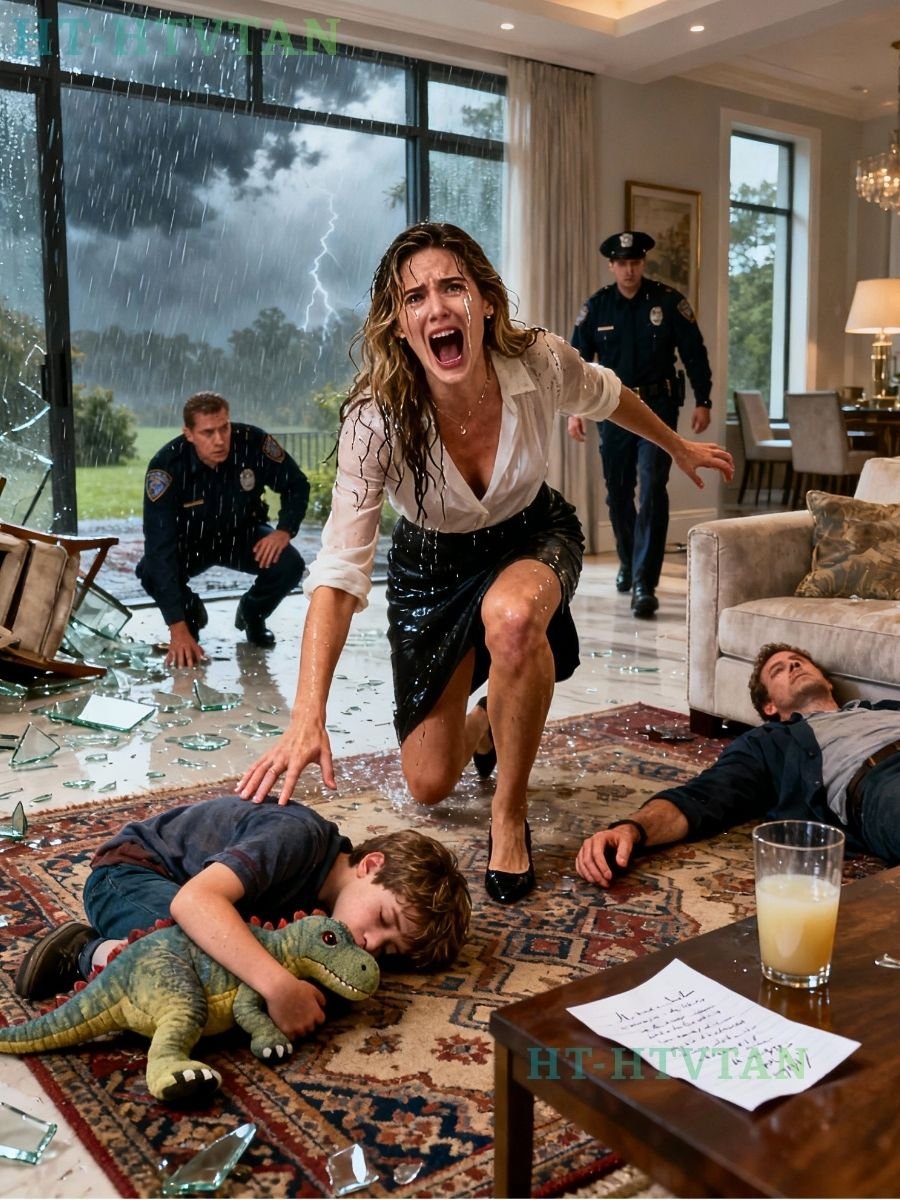
I found them on the Persian rug in the living room. Mark was lying on his back, arm thrown over his eyes like he was taking a Sunday nap. Leo was curled up next to him, clutching his plush dinosaur, Rex. They looked peaceful. Terrifyingly, unnaturally peaceful. Like wax figures.
“Wake up! Mark! Leo!” I screamed, diving down to start chest compressions on my son. His lips were already turning blue.
Police and paramedics swarmed the house in a chaos of flashing red and blue lights. They dragged me away from my husband’s cold body and my son’s fading pulse.
“Ma’am, step away from the scene,” Detective Miller barked, his eyes cold and calculating. There was no sympathy in his gaze for a grieving wife and mother. Only suspicion.
He held up a clear plastic evidence bag. Inside was a piece of crumpled notebook paper.
“We found this next to your husband’s hand,” Miller said quietly. “It’s a suicide note.”
I shivered in my soaked clothes. Had Mark tried to kill himself and taken our son with him?
“No,” Miller shook his head, turning the bag over so I could see the signature at the bottom. “It’s not signed by Mark.”
The familiar handwriting stared back at me, freezing the blood in my veins: Elena.
It was my name.
I shivered in my soaked clothes. Had Mark tried to kill himself and take our son with him?
𝙰𝚜 𝙵𝚊𝚌𝚎𝚋𝚘𝚘𝚔 𝚍𝚘𝚎𝚜𝚗’𝚝 𝚊𝚕𝚕𝚘𝚠 𝚞𝚜 𝚝𝚘 𝚠𝚛𝚒𝚝𝚎 𝚖𝚘𝚛𝚎, 𝚢𝚘𝚞 𝚌𝚊𝚗 𝚛𝚎𝚊𝚍 𝚖𝚘𝚛𝚎 𝚞𝚗𝚍𝚎𝚛 𝚝𝚑𝚎 𝚌𝚘𝚖𝚖𝚎𝚗𝚝 𝚜𝚎𝚌𝚝𝚒𝚘𝚗. 𝙸𝚏 𝚢𝚘𝚞 𝚍𝚘𝚗’𝚝 𝚜𝚎𝚎 𝚝𝚑𝚎 𝚕𝚒𝚗𝚔, 𝚢𝚘𝚞 𝚌𝚊𝚗 𝚊𝚍𝚓𝚞𝚜𝚝 𝚝𝚑𝚎 𝙼𝚘𝚜𝚝 𝚁𝚎𝚕𝚎𝚟𝚊𝚗𝚝 𝙲𝚘𝚖𝚖𝚎𝚗𝚝𝚜 𝙾𝚙𝚝𝚒𝚘𝚗 𝚝𝚘 𝙰𝚕𝚕 𝙲𝚘𝚖𝚖𝚎𝚗𝚝𝚜. 👇
—
The waiting room of the ICU was a purgatory of beige walls and buzzing fluorescent lights. I sat in a plastic chair, wrapped in a scratchy gray blanket a nurse had given me. My clothes were still damp, smelling of rain and that awful, sweet chemical scent from the house.
Detective Miller sat opposite me. He hadn’t let me out of his sight. He held a notebook, his pen poised like a weapon.
“I didn’t write this,” I said for the tenth time, my voice hoarse. I pointed at the photocopy of the note he had placed on the low table between us.
The handwriting was terrifyingly familiar. It looped and slanted just like mine. It looked like my grocery lists. It looked like the birthday cards I wrote.
I can’t take the debt anymore. The shame is too much. I’m taking the boys with me so they don’t have to suffer. I’m sorry. – Elena.
“It looks like your handwriting, Elena,” Miller said calmly. “We’ll have an expert analyze it, of course. But to the naked eye…”
“I have excellent penmanship,” I snapped. “So does my husband. He… he used to practice calligraphy. He forged it. He must have.”
“Why would he do that?” Miller asked. “Why would a man poison his own son and himself just to frame you?”
“I don’t know!” I stood up, pacing the small room. “You said ‘debt’. The note mentions debt. I don’t have debt. I have perfect credit. We have savings. I check our accounts every month.”
Miller sighed. He opened a folder. “We ran a preliminary financial check, Elena. Your credit score is 450. You have three personal loans taken out in the last four months totaling two hundred thousand dollars. You have maxed out five credit cards. The mortgage hasn’t been paid in three months.”
My legs gave out. I sat back down hard.
“That’s impossible,” I whispered. “I pay the bills. I…”
I stopped.
Three months ago. Mark had insisted on taking over the finances. He said I was working too hard. He said he wanted to contribute more since his “consulting business” was slowing down. He said he changed the passwords to “increase security.”
—
Part 1: The Silent Alarm
The rain was hammering against my windshield, a relentless, rhythmic assault that turned the world outside into a smeared impressionist painting of gray and charcoal. It was a Tuesday evening in November, the kind of night that felt like it started at 4:00 PM. The wipers slapped back and forth, fighting a losing battle against the deluge, their rhythmic thwack-hiss acting as a metronome to my exhaustion.
I was bone-tired. My double shift at St. Jude’s Hospital had run over by an hour due to a multi-car pileup on the interstate. I had spent the last twelve hours triaging trauma, stitching lacerations, and holding the hands of scared strangers. Every muscle in my body felt like it was made of lead, and my eyes burned from the harsh fluorescent lighting of the ER.
I sat at the red light on 4th and Main, tapping my fingers on the steering wheel to the beat of a low-volume pop song I didn’t recognize. My mind was on autopilot, cycling through the mental checklist that governs every working mother’s life. Did Mark pick up the dry cleaning? Do we have milk? Leo needs his inhaler refilled by Friday. Should I cook, or should we just order pizza?
Pizza, I decided. Definitely pizza. I didn’t have the energy to chop vegetables, and Mark had been complaining about money lately, but a twenty-dollar pizza wouldn’t break the bank.
My phone buzzed on the dashboard mount, vibrating violently against the hard plastic. The screen lit up with a photo of a grinning ten-year-old boy holding a soccer ball, his front tooth missing.
Leo.
I smiled, shaking off the fatigue. Leo usually called around this time to ask if he could play video games before dinner or to tell me a new fact about space he’d learned in school. He was obsessed with the Apollo missions lately.
I tapped the speakerphone button. “Hey, buddy,” I said, pitching my voice up to sound cheerful, masking the weariness. “I’m about twenty minutes out. The traffic is terrible. Do you want pepperoni or cheese tonight?”
Silence.
It wasn’t the empty silence of a dropped call or a bad connection. It was a heavy, wet silence. I could hear breathing—shallow, ragged, and alarmingly close to the microphone.
“Leo?” I asked, my smile faltering. “Honey, are you there?”
“Mom…”
The voice was a whisper, barely audible over the drumming of the rain on the roof. It didn’t sound like my energetic, articulate ten-year-old. It sounded thick, slurred, like his tongue was too big for his mouth. It sounded like a drunk stranger.
“Leo? What’s wrong? Is it your asthma? Do you need your puffer?”
“Sleepy…” he mumbled. The word dragged out, dissolving into a soft, rattling wheeze. “Dad gave me… juice. It tastes… wrong.”
A cold spike of adrenaline shot through my chest, instantly clearing the fog of exhaustion. My heart hammered against my ribs.
“What juice, Leo? Where is Daddy?”
“He’s… sleeping on the rug,” Leo whispered. His voice was fading, drifting away like smoke. “Mom… please. Come home. Hurry.”
“I’m coming, baby. Stay on the phone with me. Leo? Leo, talk to me!”
There was a soft thud, the distinct sound of a phone slipping from a lax hand onto a carpeted floor. Then, nothing but the faint hiss of static and the distant sound of the rain.
“Leo! Leo, answer me!”
The line went dead.
I didn’t scream. I didn’t cry. A switch flipped in my brain—the nurse’s switch. The part of me that handled trauma codes and triage took over, suppressing the panic and replacing it with cold, hard efficiency.
I slammed my foot on the gas pedal. The Honda surged forward, running the red light. Horns blared around me, angry and insistent, but they sounded like they were underwater.
Dad gave me juice. It tastes wrong.
The sentence looped in my mind. Mark didn’t make juice. Mark didn’t know how to work the complex cold-press juicer I bought three years ago. Mark barely knew how to make toast without burning it. And Leo loved juice; he wouldn’t complain about the taste unless it was… tainted.
My hands shook so violently I had to grip the steering wheel until my knuckles turned white to keep the car steady. The speedometer climbed. 60. 70. I wove through traffic, hydroplaning slightly on the slick asphalt, correcting with a jerk of the wheel.
My mind raced through the possibilities, each worse than the last. Carbon monoxide leak? No, Leo said the juice tasted wrong. Food poisoning? An allergic reaction?
But why was Mark sleeping on the rug? Why hadn’t he answered Leo?
I turned into our subdivision, the tires screeching on the wet pavement. The suburban houses were glowing with warm yellow light, families sitting down to dinner, TVs flickering in living rooms. It was a picture of safety. It was a lie.
I screeched into our driveway, jumping the curb slightly.
Our house was completely dark.
No porch light. No landscape lighting. No blue glow of the television from the den. It was a black box, a void sitting in the middle of the manicured lawn.
I threw the car into park and didn’t even bother to turn it off. I ran through the rain, fumbling for my keys. I jammed the key into the lock, twisting hard.
It wouldn’t turn.
I jiggled it. I pulled the door handle. It was locked. Not just the handle lock—the deadbolt.
We never used the deadbolt when we were home. Never. It was a rule. In case of fire, we wanted to be able to get out fast.
“Mark! Leo!” I screamed, pounding on the wood with my fist. “Open the door!”
Silence. Only the rain answered me.
I ran to the living room window, pressing my face against the cold glass. The curtains were drawn tight. I couldn’t see anything.
I ran back to the door. I threw my shoulder against it. It held firm.
Something was wrong. Something was terribly, fatally wrong. The darkness of the house felt heavy, as if it were pushing out against the walls, trying to keep me out.
I looked around for a rock, a brick, anything. I grabbed a heavy ceramic planter from the porch—my prize hydrangeas—dumped the dirt onto the wet concrete, and swung the pot with all my strength against the glass panel of the door.
CRASH.
The sound of shattering glass was deafening. I reached through the jagged hole, a shard slicing into my forearm, and unlocked the deadbolt from the inside.
I threw the door open and stepped into the silence.
Part 2: The Stillness
The air inside hit me first.
It didn’t smell like home. It didn’t smell like the lemon furniture polish I used, or the lingering scent of morning coffee, or the earthy smell of Leo’s soccer cleats.
It smelled sweet. Sickly sweet. Like bitter almonds mixed with the acrid stench of exhaust fumes.
“Leo! Mark!”
I ran into the living room, my wet sneakers squeaking on the hardwood.
The room was illuminated only by the streetlights filtering through the cracks in the curtains. Shadows stretched across the floor like long, dark fingers.
I found them on the Persian rug.
Mark was lying on his back, his arm thrown over his eyes as if he were taking a nap on a Sunday afternoon. He was wearing his favorite gray loungewear pants and a t-shirt.
Leo was curled up next to him, his small body tucked into the curve of his father’s side. He was holding his favorite plush dinosaur, ‘Rex,’ clutching it to his chest with one hand, while his phone lay just out of reach of the other.
They looked peaceful. Terrifyingly, unnaturally peaceful. Like statues carved from wax.
“No, no, no,” I chanted, dropping to my knees. The glass shards from the door crunched under my pants, biting into my skin, but I didn’t feel it.
I grabbed Mark’s wrist. His skin was clammy, cold. No pulse. Or maybe… maybe a ghost of one? I couldn’t tell. My own heart was beating too loud in my ears.
I crawled over him to get to Leo. I grabbed my son’s shoulders and shook him.
“Leo! Wake up! Baby, wake up!”
His head lolled back. His lips were tinged with blue. A small line of white foam had dried at the corner of his mouth.
I pressed two fingers to his carotid artery, holding my breath.
Silence.
Wait. There. A flutter. Faint. Thready. Like a butterfly trapped in a jar, beating its wings against the glass.
“He’s alive,” I gasped, the air rushing back into my lungs. “Siri! Call 911!”
My phone, lying on the rug where I dropped it, lit up. “Calling Emergency Services.”
I positioned myself over Leo’s small chest. I interlocked my fingers. Push hard. Push fast. The training took over.
“One, two, three, four…”
I began chest compressions. My own son. I had done this on strangers a hundred times. I had broken ribs to save lives. I had brought people back from the edge. But looking down at Leo’s pale face, his freckles standing out against the gray skin, I felt my training warring with a primal, animalistic panic.
“Come on, Leo. Come on. Don’t you leave me.”
“911, what is your emergency?” the dispatcher’s voice sounded tinny on speakerphone.
“My son and husband are unconscious! Possible overdose or poisoning! My son has a pulse, barely! Send everyone!”
“Paramedics are en route, Ma’am. Are you safe? Is there gas?”
“I don’t know!” I screamed, pumping Leo’s chest. “Just get here!”
I looked at Mark. I reached over with one hand while pumping with the other, checking his neck again. Nothing.
“Mark! Mark, wake up!” I kicked his leg. Nothing.
Minutes stretched into eternity. My arms burned. My sweat mixed with the rain dripping from my hair, falling onto Leo’s face like tears he couldn’t cry.
Then, sirens. Blue and red lights flashed through the broken door, painting the walls in a chaotic disco of emergency.
Men and women in uniforms swarmed the house.
“Ma’am, step back!”
“He has a pulse! He’s bradycardic!” I yelled as a paramedic pulled me away by the shoulders. “He mentioned juice! Check for toxins! Cyanide! It smells like almonds!”
“We got him, Ma’am. Let us work.”
They swarmed Leo. They intubated him right there on the rug. They stuck needles into his small arms.
Another team worked on Mark. “No pulse. Starting CPR. Push 1mg Epi.”
I was shoved toward the door. “Ma’am, we need to clear the area. There’s a chemical smell. It might be dangerous.”
“I’m not leaving them!”
“You have to!” A police officer, a large man with a grim face, grabbed my arm and hauled me out onto the wet lawn.
I stood in the rain, shivering, watching my life being dismantled. Neighbors were coming out onto their porches, whispering, pointing.
They wheeled Mark out first. The medic was straddling the stretcher, still doing compressions.
Then Leo. He was hooked up to a portable ventilator. His chest rose and fell mechanically.
“Is he alive?” I screamed at the medic passing by.
“Critical,” was all he said.
They loaded them into separate ambulances. The doors slammed shut.
I tried to run to the ambulance carrying Leo, but the police officer blocked me.
“Ma’am… please stay calm,” he said. His badge read Detective Miller. “You can’t go with them yet. We need to secure the scene.”
“Secure the scene? It’s my house! My family is dying!”
Detective Miller looked at me. His eyes weren’t full of sympathy. They were calculating. Cold. Suspicious.
He held up a clear plastic evidence bag. Inside was a piece of lined notebook paper.
“We found something near your husband’s hand,” Miller said quietly.
I squinted through the rain. It was a letter. Handwritten.
“What is that?” I asked, my teeth chattering.
“It’s a suicide note,” Miller said.
I felt a wave of confusion. “Mark… Mark tried to kill himself?”
Miller paused. He looked at the note, then back at me.
“No, Ma’am. It’s not signed by Mark.”
He turned the bag over so I could see the signature at the bottom.
Elena.
“It’s signed by you,” Miller said.
Part 3: The Frame Job
The waiting room of the ICU was a purgatory of beige walls and buzzing fluorescent lights. I sat in a plastic chair, wrapped in a scratchy gray blanket a nurse had given me. My clothes were still damp, smelling of rain and that awful, sweet chemical scent from the house.
Detective Miller sat opposite me. He hadn’t let me out of his sight. He held a notebook, his pen poised like a weapon.
“I didn’t write this,” I said for the tenth time, my voice hoarse. I pointed at the photocopy of the note he had placed on the low table between us.
The handwriting was terrifyingly familiar. It looped and slanted just like mine. It looked like my grocery lists. It looked like the birthday cards I wrote.
I can’t take the debt anymore. The shame is too much. I’m taking the boys with me so they don’t have to suffer. I’m sorry. – Elena.
“It looks like your handwriting, Elena,” Miller said calmly. “We’ll have an expert analyze it, of course. But to the naked eye…”
“I have excellent penmanship,” I snapped. “So does my husband. He… he used to practice calligraphy. He forged it. He must have.”
“Why would he do that?” Miller asked. “Why would a man poison his own son and himself just to frame you?”
“I don’t know!” I stood up, pacing the small room. “You said ‘debt’. The note mentions debt. I don’t have debt. I have perfect credit. We have savings. I check our accounts every month.”
Miller sighed. He opened a folder. “We ran a preliminary financial check, Elena. Your credit score is 450. You have three personal loans taken out in the last four months totaling two hundred thousand dollars. You have maxed out five credit cards. The mortgage hasn’t been paid in three months.”
My legs gave out. I sat back down hard.
“That’s impossible,” I whispered. “I pay the bills. I…”
I stopped.
Three months ago. Mark had insisted on taking over the finances. He said I was working too hard. He said he wanted to contribute more since his “consulting business” was slowing down. He said he changed the passwords to “increase security.”
“My husband,” I whispered. The realization hit me like a physical blow. “He did this. He stole the money. He realized he couldn’t pay it back. So he decided to erase us.”
“And kill himself?” Miller asked skeptically. “Why take the poison himself?”
“He didn’t take enough,” I said, my mind racing, connecting the dots. “You said they were found together. Maybe he staged it. Maybe he took a non-lethal dose to make it look like a murder-suicide pact. If I come home and find them… maybe he hoped the gas would get me too. Or maybe he wanted me to go to prison.”
“Life insurance,” Miller noted, writing something down. “If you kill them and yourself, the policy is void in some cases. But if you survive and go to prison… and he survives as the victim…”
“He gets the money,” I finished. “He has a policy on me. A million dollars. And a policy on Leo.”
I felt sick. I wanted to vomit. The man I slept next to. The man I made pancakes with. The man who kissed me goodbye this morning.
“Your husband is in critical condition, Elena,” Miller said. “He’s in a coma. The doctors say it’s touch and go. He ingested a massive amount of sedatives and some kind of cyanide compound.”
“Almost,” I said bitterly. “He almost died. That’s the keyword, isn’t it? He calculated the dose. He’s a chemist, Detective. Did you know that? He works for a pharmaceutical company.”
Miller’s eyebrows went up. “He is? His file said ‘Consultant’.”
“He develops drug delivery systems,” I said. “He knows exactly how much to take to look dead but stay alive. He knows the half-life of toxins.”
A nurse burst into the waiting room, looking flustered.
“Detective? We have a situation. Code Blue in Room 304.”
Room 304. Mark’s room.
For a split second, a dark, primal part of me hoped he would die. I hoped his heart would stop and he would rot in hell for what he did to Leo.
But then the logic kicked in.
If Mark died, he couldn’t confess. If he died, the only narrative left was the suicide note signed by me. If he died, I would go to prison for life for murdering my family.
“Save him!” I yelled, running after the nurse. “Don’t let that bastard die! He has to talk!”
Part 4: The Witness
Hours later. The sun was rising, casting a pale, weak light through the hospital windows.
Mark had stabilized. He was on a ventilator, unconscious but alive. The doctors said he might have brain damage. Or he might be faking. I didn’t care.
I cared about Room 308.
Leo.
He had woken up.
Detective Miller stood by the bed. A child psychologist was there. I stood by Leo’s head, holding his small, cold hand. He looked so fragile, tubes running into his nose, an IV in his arm.
“Leo,” Miller asked gently. “I know you’re tired, buddy. But we need to ask you about last night. Do you remember?”
Leo blinked slow, heavy blinks. He looked at me, fear swimming in his eyes.
“Mommy came home,” he whispered. “I called.”
“You did, baby. You were so brave,” I kissed his forehead.
“Leo,” Miller continued. “Do you remember who gave you the juice?”
Leo’s eyes darted to the door, as if he expected his father to walk in.
“Daddy made it,” Leo rasped. His voice was rough from the intubation tube they had just removed. “He… he was in the kitchen. He had the mortar and pestle.”
“The stone bowl?” Miller asked.
“Yeah. He was crushing pills. White ones.”
Miller took notes. “Did he say what they were?”
“He told me…” Leo took a shaky breath. “He told me it was ‘magic vitamin powder.’ He said we were going on a trip. He said we were going to the moon.”
I choked back a sob. The Moon. Leo was obsessed with space. Mark knew exactly how to manipulate him. He used our son’s innocence as a weapon.
“Did Mommy touch the juice?” Miller asked. This was the most important question of my life.
“No,” Leo shook his head weakly. “Mommy was at work. Daddy said… Daddy said, ‘Don’t tell Mom, or we can’t go to the moon. It’s a secret mission for the boys.’”
Miller stopped writing. He looked at me. The suspicion in his eyes was fading, replaced by a dawning horror.
“And,” Leo whispered, shifting slightly. “I… I hid the wrapper.”
“The wrapper?” Miller asked.
“From the bottle. The one Daddy poured the pills from. He threw it in the trash, but I took it out. Because… because it had the skull on it.”
“The skull?”
“The poison symbol,” Leo said. “Like in my science book. I wanted to ask him why vitamins had a skull. But I got sleepy too fast.”
Leo reached under the thin hospital pillow with a trembling hand.
He pulled out a crumpled, silver foil packet.
Miller put on a latex glove and took it gently. He smoothed it out.
It wasn’t a vitamin bottle label. It was a blister pack label for a high-grade, restricted sedative used in pharmaceutical research. And stuck to the back of it, a small residue of a white crystalline substance.
“That’s from his lab,” I whispered. “He brought it home.”
Miller looked at the wrapper. He looked at the child. He looked at me.
He turned to his partner standing by the door.
“The husband is in recovery?”
“Yes, Detective.”
Miller unholstered his handcuffs from his belt. The metallic click sounded like the most beautiful music I had ever heard.
“Not anymore,” Miller said grimly. “Now he’s in custody.”
Part 5: The Confrontation
Two days later, Mark was extubated. He was awake. He was claiming amnesia. He said he remembered nothing of the night.
I stood in the doorway of his room. Two uniformed officers stood guard.
Mark looked up. He looked pale, weak. When he saw me, he tried to arrange his face into a mask of confusion and sorrow.
“Elena?” he croaked. “What happened? Where is Leo?”
“Cut the act, Mark,” I said. My voice was flat. Dead.
I walked to the foot of the bed. I didn’t touch him. I didn’t want to catch whatever disease of the soul he had.
“Leo told them,” I said. “He gave them the wrapper. They found your fingerprints on the mortar and pestle. They found the offshore accounts. They found the tickets to Rio booked in your mistress’s name.”
Mark’s face changed. The confusion vanished instantly. The sorrow evaporated.
In their place was a blank, bored expression. It was the face of a stranger. It was the face of a man who had looked at his family and seen only obstacles.
“He survived,” Mark muttered. It wasn’t a question. It was a complaint.
“Yes,” I said. “He survived. Because he called me.”
Mark laughed. It was a cold, empty sound, like dry leaves skittering on concrete. “I took his phone away. He must have found the old one in the drawer. Resourceful kid.”
“Why?” I asked. It was the only question that mattered. “We were happy. We had a life.”
“You were happy, Elena,” Mark said, staring at the ceiling. “I was drowning. The suburbs. The routine. Your double shifts. The endless mediocrity of it all.”
“So you decided to kill us?”
“I met someone,” he said casually, as if discussing the weather. “She lives in Rio. She has money, but not enough. I needed the insurance payout to start over. A clean slate. I tried to leave, but the debt was too heavy. This was the only way out.”
I stared at him. “You tried to kill our ten-year-old son for a plane ticket to Brazil?”
Mark shrugged. “He wasn’t supposed to wake up. He has a strong constitution. Like you. Annoyingly hard to kill.”
I felt a strange calm wash over me. The grief I expected didn’t come. The betrayal didn’t sting anymore. Because the man I loved—the gentle father, the loving husband—had never existed. I had been married to a mirror, reflecting what I wanted to see, while a monster lived behind the glass.
“You’re right,” I said, stepping closer. “I am hard to kill. And I’m going to spend the rest of my life making sure you die in a cage.”
Mark smirked. “I’ll plead insanity. Stress-induced psychosis.”
“Leo will testify,” I said. “He remembers everything. The ‘Moon Mission’. The juice. The lies. You didn’t just try to kill him; you tricked him. No jury will show you mercy. You’re not insane, Mark. You’re just evil.”
I turned my back on him.
“Elena!” he called out, a hint of panic finally entering his voice. “Call my lawyer! You owe me that! I’m your husband!”
I kept walking.
I walked out of his room and into the hallway where my own lawyer was waiting.
“We can file for divorce, full custody, and protective orders immediately,” the lawyer said. “The police have seized his assets, what’s left of them.”
“Do it,” I said. “And cancel his life insurance. I don’t want a penny if he dies. I want him to live a long, long life with absolutely nothing.”
Part 6: The Locksmith
Six Months Later.
The house looked the same from the outside, but it was different on the inside.
The locksmith gathered his tools. “Alright, Ma’am. You’re all set. Voice activation, fingerprint entry on all exterior doors, shattered-glass sensors on every window, and a direct line to the precinct. This place is Fort Knox.”
“Perfect,” I said, signing the invoice. “Thank you.”
Leo ran into the room, his cleats clattering on the hardwood. He was wearing his soccer uniform. He looked healthy, his cheeks flushed with color. The shadows under his eyes had faded, though the psychological scars were still there.
He ran to the kitchen counter and grabbed a juice box.
I watched him. He didn’t just stick the straw in. He checked the seal. He squeezed the box to make sure it hadn’t been tampered with. He sniffed the straw.
Only then did he drink.
It broke my heart every time I saw it, but it also made me proud. He was vigilant. He was a survivor.
“Mom, phone!” he pointed to the counter.
My phone was ringing. It was the hospital scheduler. Just work.
I picked it up. I looked at Leo, who was now kicking his soccer ball gently against the sofa.
“I’m here, buddy,” I said, though he hadn’t asked. “I’m always here.”
I realized that the scariest call of my life was the one that saved us. If Leo hadn’t called, if I had been five minutes later, the carbon monoxide Mark had released from the garage vents before taking his own “dose” would have finished the job.
That phone call woke me up. Not just from my commute, but from the sleepwalking life I was living with a monster. It taught me that safety isn’t a location. It isn’t a house in the suburbs with a white picket fence. Safety is awareness. Safety is action.
I walked over to Leo and ruffled his hair.
“Ready for practice?” I asked.
“Yeah. Are you watching today?”
“I’m watching every day,” I promised.
We walked out the front door. I paused on the porch.
I touched the new necklace I wore. It was a small, silver crescent moon.
Mark had used the moon as a lie to lure his son to death. He had tried to send Leo to the darkness. But I wore it as a reminder of the truth. We didn’t go to the moon. We stayed here, on Earth, where the fight is. Where the rain is. Where the life is.
And we won.
I tapped the keypad on the door. The deadbolt slid home with a heavy, reassuring thud.
We got in the car and drove away, leaving the fortress behind us, safe in the knowledge that the only monsters left were the ones locked away in prison cells.
The End.
Website Disclaimer
The information provided on this website is for general informational and educational purposes only. While we strive to ensure that all content is accurate and up to date, we make no guarantees regarding the completeness, reliability, or accuracy of any information published.
The views and opinions expressed in articles belong to their respective authors and do not necessarily reflect the views of this website. Any action you take based on the information found on this website is strictly at your own risk. We will not be liable for any losses, damages, or inconveniences arising from the use of our content.
Some articles may contain opinions, third-party information, or external links. We do not endorse or guarantee the accuracy of content on external websites and are not responsible for their practices or policies.
All content on this website is provided in good faith and is intended for informational purposes only. Readers are encouraged to verify information independently and seek professional advice where appropriate.