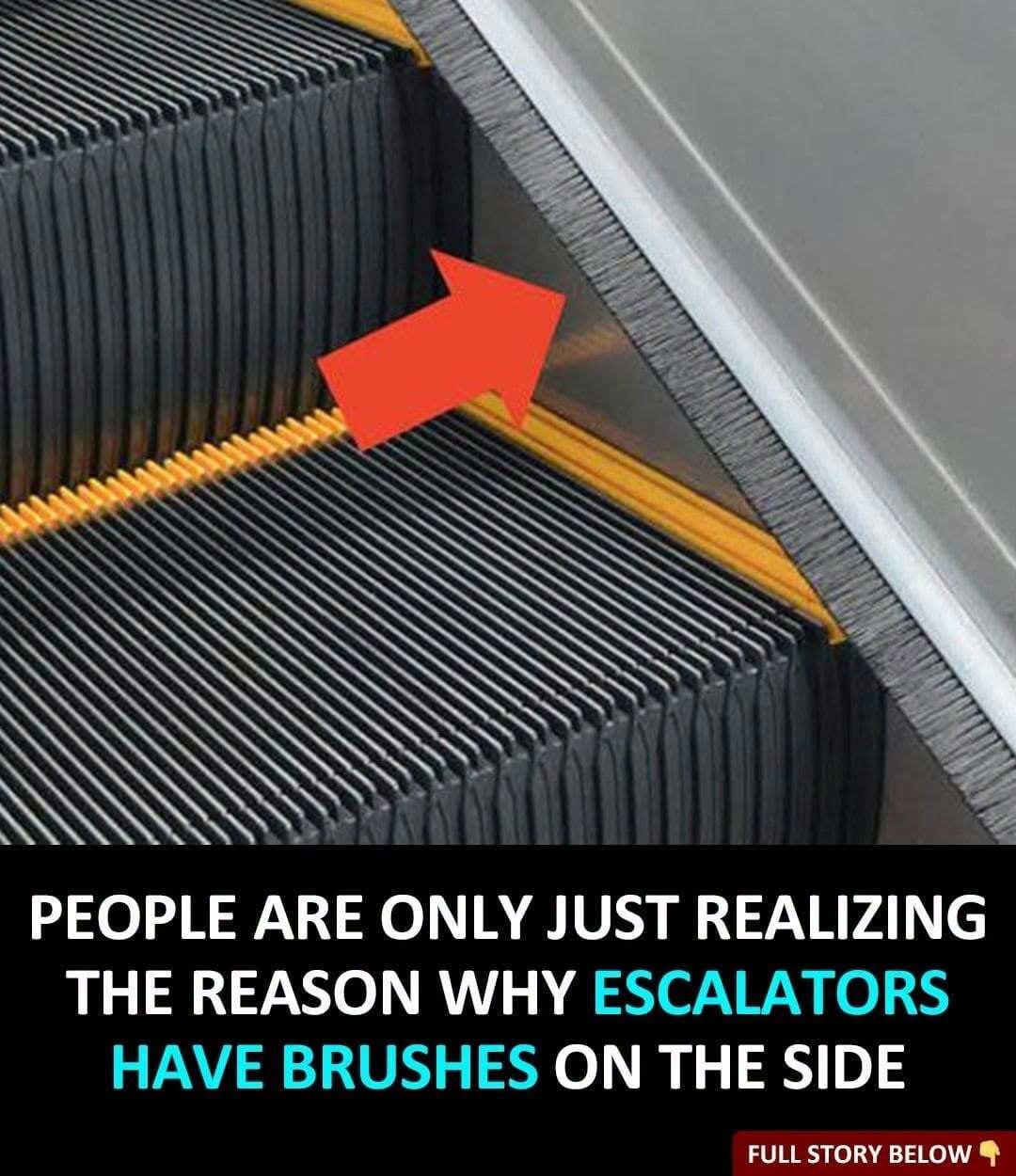
Millions of people ride escalators every day without giving much thought to the small brushes running along their sides. Many assume these bristles are designed to clean shoes or remove dirt, but their more important role is connected to passenger safety.
These brushes are positioned along the edges where the moving steps meet the stationary side panels. Because escalators are so familiar, this detail often goes unnoticed. Yet their placement is intentional and serves as a subtle reminder about where passengers should stand.
The brushes help encourage riders to keep their feet, clothing, bags, and other belongings away from the edges. When a shoe or piece of clothing touches the bristles, the sensation can prompt the passenger to move slightly toward the center of the step.
This matters because escalators contain small clearances between moving and stationary components. Although these areas are carefully engineered and protected, loose clothing, shoelaces, bags, or other objects can potentially create an entrapment hazard if they get too close.
The brushes are therefore more of a behavioral safety feature than a physical barrier. They do not completely prevent objects from reaching dangerous areas. Instead, they provide a noticeable tactile warning that encourages passengers to maintain a safer position.
A common misconception is that the brushes exist mainly to clean passengers’ shoes. They might remove a little dust accidentally, but cleaning is not their primary purpose. They also are not designed to protect the internal machinery from debris.
Their purpose becomes especially important for children, who may stand near the edges while looking around or playing. Keeping passengers centered can help reduce unnecessary contact with the sides and moving components.
The next time you ride an escalator, notice the brushes along the edges. Stand near the center, hold the handrail when appropriate, and keep loose clothing and belongings away from the sides. This small design feature may look ordinary, but it is part of a larger system of precautions intended to make everyday escalator travel safer.
Website Disclaimer
The information provided on this website is for general informational and educational purposes only. While we strive to ensure that all content is accurate and up to date, we make no guarantees regarding the completeness, reliability, or accuracy of any information published.
The views and opinions expressed in articles belong to their respective authors and do not necessarily reflect the views of this website. Any action you take based on the information found on this website is strictly at your own risk. We will not be liable for any losses, damages, or inconveniences arising from the use of our content.
Some articles may contain opinions, third-party information, or external links. We do not endorse or guarantee the accuracy of content on external websites and are not responsible for their practices or policies.
All content on this website is provided in good faith and is intended for informational purposes only. Readers are encouraged to verify information independently and seek professional advice where appropriate.