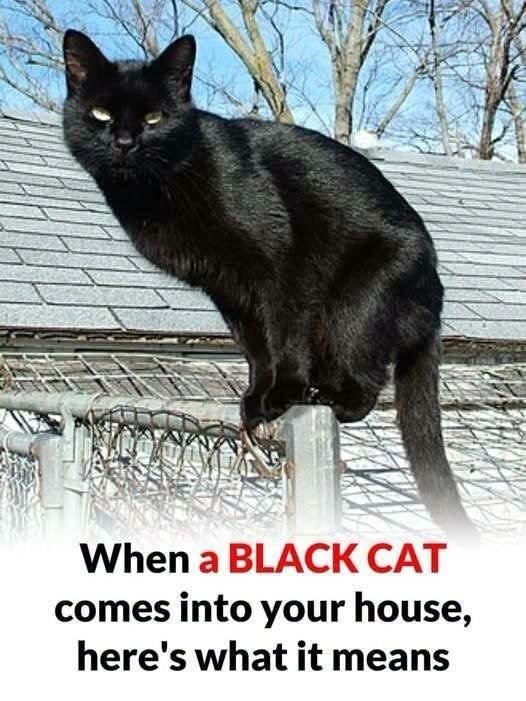
Black cats have been viewed differently across cultures and history, shifting from sacred symbols to feared omens and now to more neutral or positive interpretations.
In ancient Egypt, cats were highly respected and associated with the goddess Bastet, who protected homes, women, and fertility. Black cats were considered especially fortunate, and their presence in a home was often seen as a blessing and a sign of divine protection.
During medieval Europe, beliefs changed drastically. Black cats became linked to witchcraft and superstition. Many people believed witches could transform into black cats or use them as spiritual companions, which led to fear and negative associations.
These ideas spread to early American settlers, where black cats were often seen as bad luck. In traditional U.S. superstition, a black cat crossing your path or entering your home could be interpreted as a warning of misfortune, illness, or hidden danger.
This belief became especially strong around Halloween, where black cats are commonly shown alongside witches and dark imagery. Over time, this also contributed to black cats being less likely to be adopted from shelters due to lingering stigma.
In modern times, interpretations have shifted. Many people now see a black cat entering a home as a symbol of change, intuition, or personal growth rather than danger or bad luck. It is often viewed as a sign of transition or awareness.
In spiritual interpretations, black cats are sometimes considered protective figures. They are believed by some to absorb negative energy or act as silent guardians, bringing emotional balance and shielding a household from harm.
From a psychological perspective, the meaning depends more on the observer than the animal itself. A black cat may represent independence, boundaries, or transformation, with its significance shaped by personal beliefs rather than superstition.
Website Disclaimer
The information provided on this website is for general informational and educational purposes only. While we strive to ensure that all content is accurate and up to date, we make no guarantees regarding the completeness, reliability, or accuracy of any information published.
The views and opinions expressed in articles belong to their respective authors and do not necessarily reflect the views of this website. Any action you take based on the information found on this website is strictly at your own risk. We will not be liable for any losses, damages, or inconveniences arising from the use of our content.
Some articles may contain opinions, third-party information, or external links. We do not endorse or guarantee the accuracy of content on external websites and are not responsible for their practices or policies.
All content on this website is provided in good faith and is intended for informational purposes only. Readers are encouraged to verify information independently and seek professional advice where appropriate.