No one talks about this part.
They show you the announcement photos and the color-coded nursery reveals, but no one tells you what it actually feels like when all four babies start screaming at once and you haven’t slept more than two hours in six days.
I love them. God, I love them more than anything.
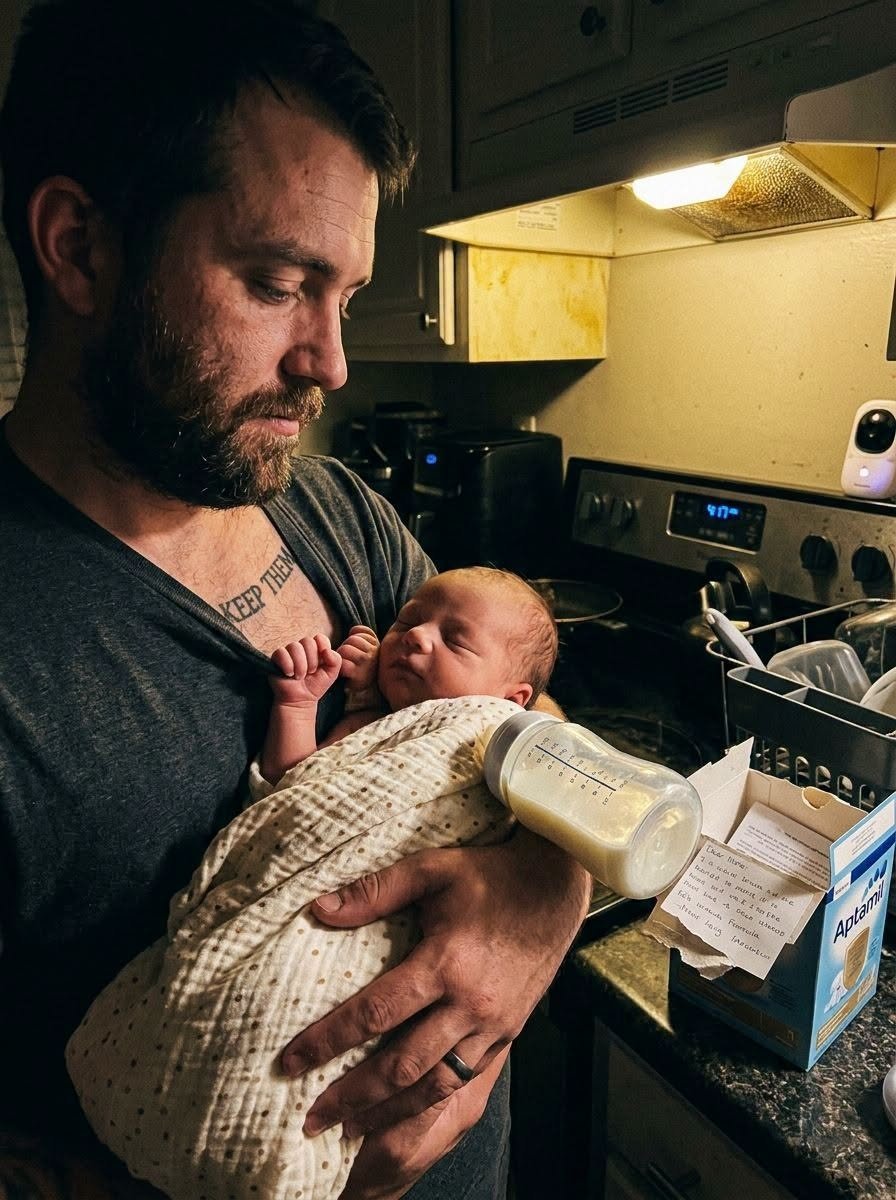
But there’s this moment – every night around 3:15 a.m. – when I sit on the kitchen floor with one in my arms, the other three crying from down the hall, and I wonder if we made a terrible mistake.
We weren’t ready for four. Emotionally, financially… we barely held it together with one before this.
And my wife, who used to be so steady, now goes rigid every time the bottle sterilizer starts its cycle.
We don’t
What She Looks Like Now
finish sentences anymore. That’s what I was going to say.
We don’t finish sentences. We don’t finish meals. We don’t finish arguments because we’re both too tired to remember what we were angry about. Donna will start saying something and just stop, staring at the middle distance, and I’ll watch her face do this thing where she’s clearly still in there, still thinking, but the words just dissolve before they get out.
She was a project manager before the babies. Ran a team of fourteen people. Had a whiteboard in the home office with color-coded timelines and a system for everything. Now she leaves full mugs of coffee on top of the refrigerator. Four of them up there right now. I stopped moving them.
The bottle sterilizer thing started about three weeks in. It’s a loud machine. Makes this pressurized hiss when it finishes, then a long beep. The first time it went off in the middle of the night, Donna was standing at the counter and she just locked up. Hands flat on the counter, shoulders pulled in, eyes closed. Like she was bracing for something.
I asked if she was okay.
She said yes.
She wasn’t.
The Number Nobody Warns You About
There’s something specific about four that nobody tells you when you’re doing IVF and the doctor says “strong chances of multiples” in that carefully neutral voice.
Two is hard. Three is harder. Four is a different category of thing. Four is not a family, it’s a logistics operation, and if you don’t have the staffing, the infrastructure, the money, you are running that operation on fumes and prayer and whatever goodwill your neighbors still have left.
We have Milo, Ruth, Caleb, and June. All born October 14th. Milo and Caleb are fraternal, Ruth and June are identical. They came at 34 weeks, which meant twelve days in the NICU, which meant Donna and I spent nearly two weeks driving back and forth to the hospital, sleeping in shifts in the family lounge on a pull-out couch that smelled like industrial soap, watching four isolettes and trying to figure out which feeling was love and which one was pure animal terror.
They’re all home now. They’re all healthy. I know how lucky that is.
I know.
But knowing you’re lucky doesn’t stop the 3:15 a.m. floor-sitting. It just makes you feel guilty about it on top of everything else.
My mother came for the first three weeks. Donna’s parents drove up from Harrisburg and stayed ten days. Donna’s sister Karen took a week of PTO. And then all of them left, one by one, back to their lives, and it was just us. Two people. Four babies. An apartment that was right-sized for one child and is now, genuinely, not big enough for what we’re doing in it.
We can’t afford a bigger place. Not right now. The IVF alone put us $38,000 in debt.
The Conversation We Kept Not Having
It started as a joke. Or I told myself it was a joke.
About five weeks in, around 2 a.m., I was trying to get Caleb back down and Donna came in looking like she’d been awake for a week straight, because she had been, and she said, “What if we just had three?”
I laughed. She didn’t.
I kept feeding Caleb. She went back to bed.
We didn’t talk about it for four more days. Then she brought it up again, not as a joke this time, sitting at the kitchen table with June asleep on her chest and the other three down for what we hoped would be forty-five minutes. She said it quietly. “I’ve been reading about it. Families with multiples sometimes. There are agencies.”
I didn’t say anything.
She said, “I’m not saying we’re doing it. I’m saying I looked it up.”
The thing is, I’d looked it up too. Two nights before. At 4 a.m., on my phone, in the bathroom with the fan running so I couldn’t hear the crying as well. I’d read three different articles. I’d read a Reddit thread where a woman talked about placing one of her triplets with a family member and the comment section absolutely destroyed her, called her a monster, and she just kept responding, calmly, that her other two children were alive and thriving and she didn’t regret it.
I hadn’t told Donna I’d read any of that.
So we sat there at the kitchen table with June on her chest, and I said, “Which one?”
And Donna started crying.
The Part That Broke Me
Not because of the question. Because of what happened next.
She said, “I keep thinking Milo.”
And then she put her hand over her mouth like she could push the words back in.
Milo is the one who looks like her. Dark hair, her exact nose, her way of scrunching his face before he cries, this little pre-cry warning scrunch that Donna does too, I’ve seen her do it a hundred times, she doesn’t know she does it. He’s also the hardest. Colic, maybe, or just his temperament, but he cries more than the others, sleeps less, takes longer to settle. He’s the one I’m usually holding at 3:15.
She said Milo because Milo is the one costing her the most. And she hates herself for knowing that.
I sat down next to her. June was still asleep between us, this tiny perfect thing, completely unaware that her parents were falling apart. I didn’t say anything wise. I didn’t have anything wise. I said, “Okay.”
Not okay like yes. Okay like I hear you. Okay like I’m not running from this.
She cried for a long time. I held her while she did and June stayed asleep somehow, which felt like the universe throwing us one small mercy.
When she stopped she said, “I don’t actually want to give him away. I want to want to. I want someone to tell me it’s okay to want to. But I don’t.”
I said, “I know.”
She said, “I’m scared of who I’m becoming.”
That one sat in my chest for a while. Still does.
What We Did Instead
We called the pediatrician the next morning. Not about adoption. About Donna.
The doctor asked a series of questions, the kind with obvious right answers that aren’t actually the point. She listened. She said postpartum depression in parents of multiples is severely underdiagnosed, that the sheer physical load of it masks the psychological symptoms, that what Donna was describing, the rigidity, the dissociation at the counter, the intrusive thoughts about giving a child away, those weren’t signs of a bad mother. They were signs of a person who had hit a wall and needed help.
She referred Donna to someone. A therapist named Dr. Priya Mehta, who specializes in perinatal mental health and who had, according to the pediatrician, worked with several families in similar situations. Donna went the following Tuesday. She came home quieter than when she left, but different quiet. Not the scary kind.
We also called Karen back. Donna’s sister. Asked if she could come every other weekend, not for a week, just a weekend, just so we could sleep. Karen said yes without hesitating. She drove up the following Saturday morning with a bag full of groceries and kicked us both out of the apartment for three hours.
We went to a diner two blocks away and sat in a booth and didn’t talk about the babies for forty-five minutes. We just ate eggs. Donna had a real cup of coffee, hot, sitting down, from a mug that wasn’t on top of the refrigerator.
She cried a little. The good kind, if there’s a good kind.
Where We Are Now
Milo is eleven weeks old today. He slept a four-hour stretch two nights ago, which in this house is cause for something close to celebration. Donna was the one who woke me up to tell me, whispering in the dark, and she was grinning.
We’re not giving anyone up. We were never actually going to. But I don’t think less of the version of us that considered it, that sat at the kitchen table at 2 a.m. and said the quiet part out loud. That version was just two people trying to survive something enormous and being honest about it in the dark.
Donna still flinches at the sterilizer sometimes. Dr. Mehta says that’s fine, that the body keeps its own schedule, that it’ll pass.
There are still four mugs on top of the refrigerator. I keep meaning to move them. I won’t.
Last night I was on the floor again. 3:15, almost exactly. Milo in my arms, the other three finally quiet for once. He was looking up at me with that scrunched-up pre-cry face, the one that’s all Donna, and he didn’t cry. Just looked. I don’t know what he was doing. Deciding something, maybe.
I held him until he fell asleep. Then I sat there a little longer.
Nobody tells you about the floor. But the floor is where a lot of the real stuff happens.
If this one hit close to home, pass it to someone who needs to know they’re not the only ones sitting on that floor.
For more compelling true stories, learn about the message a father sent after 18 years of silence or read about a daughter’s memory of being pulled from a car.
Website Disclaimer
The information provided on this website is for general informational and educational purposes only. While we strive to ensure that all content is accurate and up to date, we make no guarantees regarding the completeness, reliability, or accuracy of any information published.
The views and opinions expressed in articles belong to their respective authors and do not necessarily reflect the views of this website. Any action you take based on the information found on this website is strictly at your own risk. We will not be liable for any losses, damages, or inconveniences arising from the use of our content.
Some articles may contain opinions, third-party information, or external links. We do not endorse or guarantee the accuracy of content on external websites and are not responsible for their practices or policies.
All content on this website is provided in good faith and is intended for informational purposes only. Readers are encouraged to verify information independently and seek professional advice where appropriate.