Two Orphans Inherited Their Grandmother’s Lonely Mountain House and Discovered the Secret That Saved Them
Lily Carter had learned to sleep without closing both eyes.
At thirteen, she knew the difference between footsteps that belonged to a tired janitor and footsteps that belonged to a police officer. She knew which convenience stores threw away sandwiches after ten o’clock, which church basements served soup on Wednesdays, and which alleys in downtown Asheville stayed warmest when the wind came down from the Blue Ridge Mountains like a knife.
Her little brother, Noah, was eight and still believed some things could be wished into being.
A house.
A bed.
A kitchen with cereal in the cabinet.
A grandmother who would open the door, wrap them in a quilt, and say, “You’re safe now.”
But wishes, Lily knew, were dangerous. They made people slow. They made people wait for rescue. And rescue was something that happened in movies, not behind a closed auto-repair shop where she and Noah slept beneath flattened cardboard and a stolen grocery cart tarp.
“Lily?” Noah whispered.
She opened one eye. “What?”
“I can’t feel my toes.”
She sat up fast, pulling the thin blanket off herself and tucking it around him. The November cold had settled into the cracked pavement. Their breath showed white in the dark.
“Move them,” she said. “Wiggle them.”
“I am.”
“Harder.”
He made a face, concentrating. His sneakers had holes near the toes. One shoelace had snapped two days ago, and Lily had tied the shoe with a piece of twine she’d found behind a hardware store.
“We’ll go to the mission in the morning,” she said.
“They said we can’t come back until next week.”
“I’ll figure it out.”
Noah looked at her with the kind of trust that hurt. “You always say that.”
“And I always do.”
That was almost true.
Their mother had disappeared six months earlier, though disappearing made it sound gentle, like fog lifting off a river. In truth, Rachel Carter had left them outside a laundromat with two backpacks and a promise to come back after “handling something.” She never returned.
Their father had been gone longer than Noah could remember. Jail, then pills, then a rumor from Tennessee that he’d died behind a motel. Lily had never checked if it was true. Some facts did not help.
For a while, they had stayed with people who called themselves friends of their mother. Then those people got tired of two hungry kids. Social workers came once. Lily ran. She’d heard stories about siblings being split up, and she would rather freeze beside Noah than let strangers send him somewhere she could not follow.
So they survived.
They moved. They hid. They counted coins. Lily stole when she had to and hated herself every time. Noah asked fewer questions as the weeks passed.
That morning, just after sunrise, while they were picking through a grocery store dumpster for bruised fruit, a man in a brown coat called Lily by name.
She froze with one hand around a dented apple.
“Lily Carter?”
Noah ducked behind her.
The man stood near the loading dock, holding a leather folder against his chest. He was thin, silver-haired, and wore polished shoes too clean for the alley.
Lily tightened her grip on the apple. “Who wants to know?”
“My name is Harold Benton. I’m an attorney from Coldwater County.”
“Don’t know it.”
“It’s about your grandmother.”
Lily’s stomach pulled tight.
Noah stepped out from behind her. “Grandma Mae?”
The attorney’s eyes softened. “Yes. Mae Carter.”
Lily had not seen Grandma Mae in almost two years. Their mother had always said the old woman lived too far away, too poor, too stubborn, too full of opinions. Mae lived somewhere in the mountains near a town called Pine Hollow, in a house Rachel described as “one hard wind away from kindling.”
When Lily was little, Grandma Mae used to mail birthday cards with five dollars tucked inside and Bible verses written in blue ink. Lily remembered her hands smelling like flour, woodsmoke, and peppermint.
“What about her?” Lily asked.
Mr. Benton took off his hat. “I’m sorry. She passed away three weeks ago.”
Noah made a small sound.
Lily looked at the apple in her hand. There was a brown soft place near the stem. She stared at it because if she looked at Noah, she might cry, and she could not afford crying in front of strangers.
“She left something for you,” the attorney said.
“We don’t want debt,” Lily said quickly. “If she owed money, we don’t have anything.”
“No. She left you her house.”
Lily laughed once, bitter and sharp. “Her falling-down mountain shack?”
“It is legally yours now. Yours and Noah’s. There are some taxes due, but nothing immediate. I have the deed, the keys, and instructions from your grandmother.”
Noah looked up at Lily. “We have a house?”
Lily did not answer.
Because a house sounded like a trap.
People did not find homeless children behind grocery stores and hand them keys. Life did not turn around because an old woman died in the mountains. There was always a catch. Always.
Mr. Benton seemed to read her face. “I know this is a lot. Your grandmother came to my office two months before she died. She told me to find you no matter what. She was worried.”
Lily swallowed. “Why didn’t she find us herself?”
“She was sick, Lily.”
Noah wiped his nose on his sleeve. “Did she hurt?”
The attorney crouched slightly, so his eyes were level with Noah’s. “Not at the end.”
That was probably a lie, but it was a kind one.
Mr. Benton drove them to a diner first. Lily almost refused, but Noah’s hunger won. He ate pancakes like someone might take the plate away. Lily forced herself to go slowly, watching the attorney between bites.
He gave them papers. A copy of Mae Carter’s will. A deed. A photograph of a small house tucked among dark pines. A brass key tied with red string.
“There is also a letter,” he said.
Lily took the envelope. Her name and Noah’s were written across the front in Grandma Mae’s careful handwriting.
She did not open it.
“Coldwater County is about ninety minutes from here,” Mr. Benton said. “I can take you today.”
“What happens if we say no?” Lily asked.
“Then the property stays in your names. But the house is empty. Winter is coming. Empty houses decay quickly.”
Lily looked at Noah. Syrup shone at the corner of his mouth. His eyes were alive in a way she had not seen in months.
A roof.
Walls.
A door that locked.
It did not have to be forever, she told herself. Just a few nights. Just long enough to breathe.
“We’ll go,” she said.
The drive into the mountains felt like leaving one world and climbing into another.
Asheville’s traffic faded behind them. The road narrowed, curling through forests of oak and pine. Clouds hung low over the ridges. Every few miles, they passed rusted mailboxes, sagging barns, and fields silver with frost.
Noah pressed his face to the window. “Do bears live here?”
“Yes,” Mr. Benton said.
Noah’s eyes widened.
“But they usually mind their business.”
“Usually?”
Lily almost smiled.
Pine Hollow was smaller than Lily expected. A gas station. A post office. A church with white siding. A diner called Betty’s Kitchen. A hardware store with rocking chairs out front and a hand-painted sign that said, WELCOME HUNTERS.
People looked as the attorney’s car passed.
Lily sank lower in the seat.
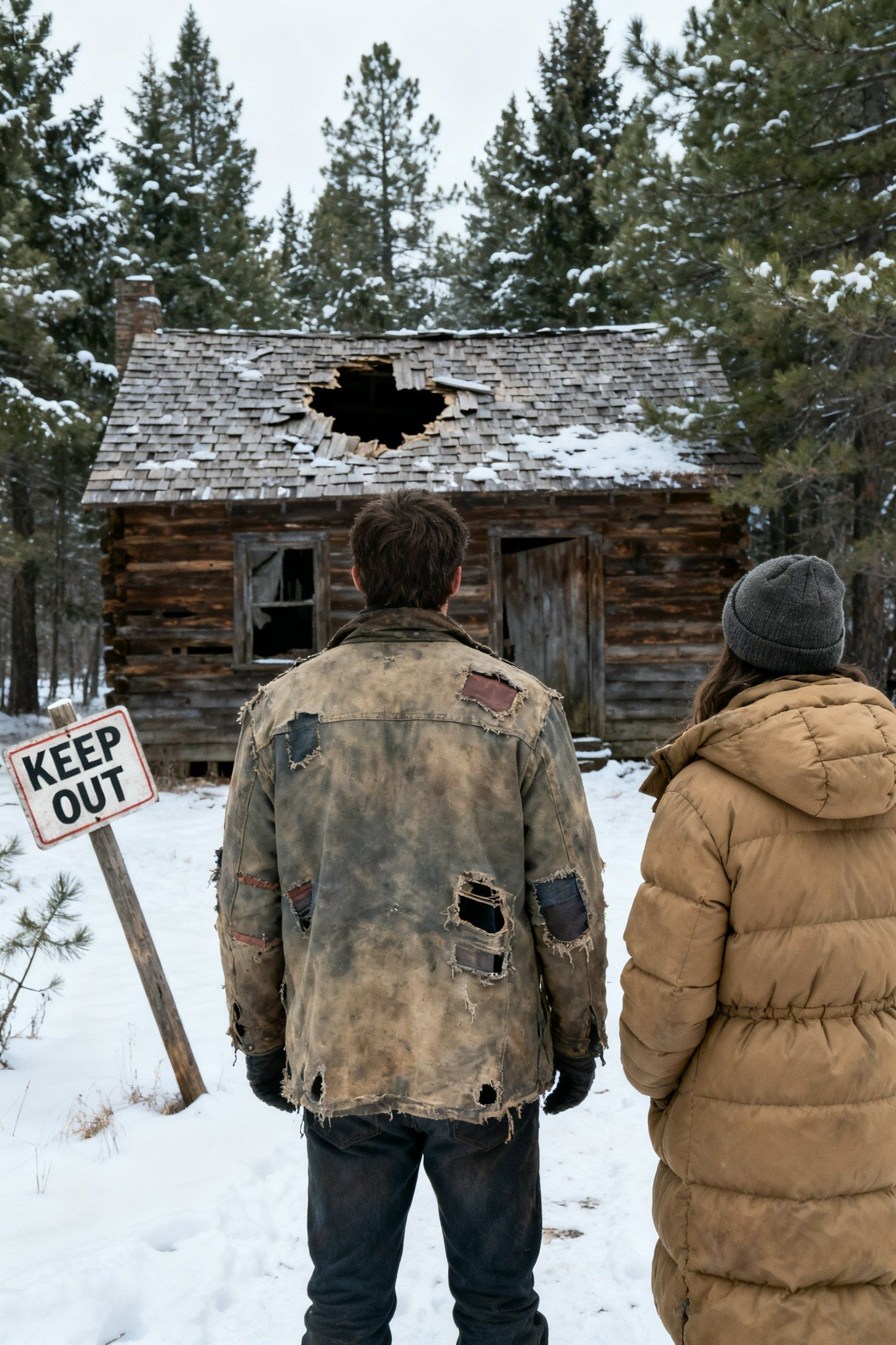
The house stood three miles beyond town, up a gravel road that twisted through thick woods. It appeared suddenly around a bend: a one-story cabin with a steep tin roof, gray wooden siding, and a stone chimney patched in three different colors of mortar.
It did not look like much.
The porch sagged. The shutters were faded blue. Weeds crowded the front steps. A rusted rain barrel sat beneath the gutter. Behind the house, the mountains rose dark and endless.
But smoke marks stained the chimney, proof that it had once held warmth. Lace curtains hung in the windows. A wind chime made of spoons tinkled weakly from the porch beam.
Noah whispered, “It’s real.”
Mr. Benton parked. “Your grandmother lived here for forty-one years.”
Lily stepped out. The cold air smelled like wet leaves, dirt, and wood. Somewhere far off, a crow called.
The front door stuck before opening. Inside, the house was dim and chilly. Dust floated in strips of gray light. The living room held a flowered couch, a braided rug, a rocking chair, and shelves crowded with old books, mason jars, candles, and framed photographs.
Lily saw one picture of herself at six, missing two front teeth, sitting on Grandma Mae’s lap. Noah was a baby in their mother’s arms. Rachel looked pretty then, before life hollowed her out.
Noah touched the picture. “I don’t remember that.”
“I do,” Lily said.
The kitchen was tiny but clean. A woodstove stood in the corner. The cupboards held cans of beans, peaches, soup, cornmeal, and jars of green beans Grandma Mae must have preserved herself. There was no television. No internet. No heat except the stove and fireplace. The bathroom had a claw-foot tub and pipes that groaned when Mr. Benton tested the faucet.
“The water comes from a spring,” he said. “Electricity works, but it can go out during storms. There’s chopped wood stacked behind the shed.”
Lily opened a cabinet and saw plates with yellow flowers painted around the edges. Her throat tightened again. Poor did not mean empty. Poor did not mean unloved.
Mr. Benton handed her another key. “This opens the shed. There’s a little money in an account for essentials, not much. I’ll help you contact the county office about your situation.”
“No,” Lily said too fast.
He paused.
“We’re not going into foster care.”
“Lily—”
“No.”
Noah looked between them.
Mr. Benton sighed. “You’re thirteen. Noah is eight. The law has opinions about children living alone.”
“Then don’t tell them.”
“I already have obligations.”
“You said Grandma wanted us here.”
“She did. But she also wanted you safe.”
“We weren’t safe in the city.”
The attorney studied her. Something in her face must have told him arguing would only make her run.
“I’ll give you a few days,” he said quietly. “I have to make some calls, but I’ll do what I can to keep you together. There may be a way, if a responsible adult checks in regularly.”
“We don’t need one.”
“Yes,” he said gently, “you do.”
Lily hated him for being right.
Before leaving, he set a grocery bag on the table. Bread, peanut butter, milk, eggs, oranges, hot cocoa, and a bag of marshmallows. Noah looked at it like Christmas had arrived early.
When the car disappeared down the gravel road, silence settled around the house.
Not city silence, which was full of engines, sirens, voices, and danger.
Mountain silence.
Deep. Watching.
Noah turned in a circle. “This is ours?”
Lily held the brass key so tightly it left marks in her palm. “For now.”
They cleaned first because Lily did not know what else to do. She swept dust from the floor while Noah shook blankets on the porch. They found sheets in a cedar chest, canned soup in the pantry, and matches in a tin beside the stove.
Lily struggled with the fire until smoke puffed into the kitchen and made Noah cough. After three tries, flames caught. Heat slowly filled the room.
That night, they ate tomato soup and toast at Grandma Mae’s kitchen table.
Noah dipped his bread and smiled. “This is the best soup ever.”
“It came from a can.”
“Still.”
After dinner, Lily finally opened the letter.
The paper smelled faintly of lavender.
My dearest Lily and Noah,
If you are reading this, then I have gone where old bones stop aching. Do not be sad for me too long. I had a good life, even when it was hard.
This house is not fancy. It leaks in the west corner when rain comes sideways. The stove needs patience. The porch step lies. Don’t trust it.
But it is yours.
I know things have been bad. I know more than your mother thinks I know. I tried to reach you. I should have tried harder, and I am sorry.
Listen carefully now.
This house has kept more than one secret. Some secrets are burdens. Some are blessings. You must learn the difference.
If trouble comes, remember: the heart of the house is not where people look. Follow what keeps time. Trust the bluebird. And never sell to a man who smiles too much.
I love you more than these old mountains.
Grandma Mae
Noah leaned over the table. “What does that mean?”
Lily read the strange lines again.
The heart of the house is not where people look.
Follow what keeps time.
Trust the bluebird.
Never sell to a man who smiles too much.
“It means Grandma liked riddles,” Lily said.
“Do you think there’s treasure?”
“No.”
But she folded the letter carefully and put it in her pocket.
Outside, wind pushed through the trees. The spoon chime trembled on the porch.
For the first time in months, Lily and Noah slept in beds.
Grandma Mae’s room still held her dresses in the closet and slippers beneath the bed. Lily could not bring herself to sleep there. She took the small room at the back, with faded wallpaper and a quilt covered in red stars. Noah slept across the hall in a room with a metal bedframe and a shelf of old toy trucks.
In the middle of the night, Lily woke to a sound.
Tap.
Tap.
Tap.
She sat up.
The house was dark except for moonlight on the floor. At first, she thought it was a branch hitting the window. Then it came again.
Tap.
Pause.
Tap-tap.
From inside the wall.
Lily held her breath.
Old houses made noises, she told herself. Pipes. Mice. Wood shrinking in the cold.
Then Noah screamed.
She was out of bed before she fully woke, grabbing the fireplace poker she had left beside her door. She ran across the hall.
Noah stood on his bed, pointing at the wall.
“There was someone,” he cried. “There was someone whispering.”
Lily swung the poker toward the corner. “Who’s there?”
Nothing answered.
The room smelled cold and dusty. The window was locked. The closet empty.
“What did you hear?” she asked.
Noah’s face was pale. “A voice. It said my name.”
“That was a dream.”
“It wasn’t.”
Lily wanted to tell him not to be silly, but the tapping began again.
This time, they both heard it.
Tap.
Tap.
Tap.
From behind the wall near Noah’s shelf.
Noah clutched her arm.
Lily moved closer, poker raised. “Mice,” she whispered.
Mice did not tap in patterns.
She pressed her ear against the wall.
For a moment, nothing.
Then a faint metallic click sounded beneath the floor.
The old toy truck on Noah’s shelf rolled forward by itself and fell to the floor.
Noah shrieked again.
Lily almost did too.
They slept the rest of the night in the living room with every lamp on.
The next morning, Lily told herself fear looked different in daylight. Daylight made shadows ordinary. It turned monsters back into furniture.
Noah was not convinced.
“We should call Mr. Benton.”
“And say what? Grandma’s house is haunted?”
“Maybe it is.”
“It’s old.”
“It said my name.”
“You dreamed that part.”
But Lily kept looking at the wall.
After breakfast, they searched Noah’s room. They found mouse droppings behind the dresser, which made Lily feel better for about ten seconds. Then Noah noticed something carved into the bottom of the shelf that held the toy trucks.
A small bluebird.
The carving was simple: a little bird with open wings, painted once in blue, though most of the color had faded.
Noah touched it. “Trust the bluebird.”
Lily’s skin prickled.
She removed the trucks from the shelf and tugged at the wood. Nothing happened. She pushed the bluebird carving. Still nothing.
“Maybe it’s just decoration,” she said.
But that afternoon, they found bluebirds everywhere.
One was stitched into a kitchen towel. One was painted on the side of a flour tin. One appeared on the spine of an old hymnal. Another was carved into the rocking chair’s armrest.
Grandma Mae had loved bluebirds. That was all.
Probably.
Near sunset, a pickup truck came up the gravel road.
Lily saw it from the kitchen window and pulled Noah behind her. The truck was black and shiny, too new for the road. A man stepped out wearing jeans, a wool coat, and a cowboy hat that looked unused. He was broad-shouldered, clean-shaven, and smiling before he even reached the porch.
Too much, Lily thought.
The letter in her pocket seemed to grow warm.
The man knocked.
Lily did not open the door. “Who are you?”
“Name’s Russell Vance,” he called. “I own land nearby. Heard Mae’s grandkids were staying up here.”
“What do you want?”
He chuckled. “Just being neighborly.”
Lily looked through the curtain. His smile stayed fixed on his face, but his eyes moved over the windows, the roof, the chimney, measuring.
“We don’t need anything,” she said.
“Sure you do. Everybody needs something.” He held up a white paper bag. “Brought biscuits from Betty’s.”
Noah whispered, “Biscuits?”
Lily shook her head.
Vance leaned closer to the door. “This house is a lot for two kids. Hard winters up here. Pipes freeze. Trees fall. Road washes out. Your grandma should’ve sold years ago.”
“We’re not selling.”
His smile widened.
Never sell to a man who smiles too much.
“Now, I didn’t ask,” he said. “But since you mention it, I made Mae fair offers. More than fair. Land like this can be useful.”
“For what?”
“Development. Cabins. Vacation rentals. People from Charlotte pay good money to pretend they like the woods.”
“No.”
“You haven’t heard a number.”
“No.”
The smile flickered.
“Well,” he said, setting the bag on the porch, “you think on it. Kids need cash more than they need rotten boards.”
He walked back to his truck, but before getting in, he turned and looked at the house again.
Not like a man seeing rotten boards.
Like a man searching for something.
That night, Lily locked the door and pushed a chair under the knob.
Noah ate one biscuit despite her warning, then admitted it was delicious and apologized.
The tapping returned at 11:17.
Lily knew the time because the living room clock stopped ticking.
It was an old wall clock shaped like a schoolhouse, with a brass pendulum swinging behind glass. It had ticked loudly all day. Then suddenly, silence.
Tap.
Tap.
Tap.
Noah sat upright on the couch. “Lily.”
“I hear it.”
The tapping came from the hallway now.
Lily took the flashlight and poker. Noah followed, holding the quilt around his shoulders.
The sound led them past the bedrooms, toward the narrow hall beside Grandma Mae’s room. At the end stood a tall cabinet filled with quilts, winter coats, and jars of buttons.
The clock in the living room gave one deep, rusty chime.
Then another.
Eleven times.
It had not chimed before.
“Follow what keeps time,” Noah whispered.
Lily turned back toward the living room.
The clock’s pendulum had stopped at an angle, pointing not straight down but slightly left.
Toward the fireplace.
The fireplace mantel held framed photos, a jar of matches, two candlesticks, and a small ceramic bluebird.
Lily picked it up.
Something rattled inside.
She turned it over. A cork plugged the bottom. She pulled it free and shook out a tiny iron key.
Noah’s mouth fell open. “Treasure.”
“Probably a cabinet key.”
But Lily’s hand trembled.
They tried the key on everything they could find: kitchen drawers, the cedar chest, Grandma Mae’s desk, the shed lock, the pantry cupboard. Nothing.
Then Noah said, “What about the clock?”
The clock case had a small keyhole near the bottom.
The iron key fit.
When Lily turned it, the back of the clock clicked open.
Inside was no machinery. No gears. No weights.
Just a narrow hollow space cut into the wall behind it.
And inside that space lay a rolled piece of cloth tied with blue thread.
Lily pulled it out and unrolled it on the kitchen table.
It was a map.
Not a store-bought map, but hand-drawn in black ink on old linen. It showed the house, the shed, the spring, the ridge behind the property, and several marked places in the woods. At the center of the house, beneath the living room, was a small bluebird symbol.
Beside it, Grandma Mae had written:
Not under the floor.
Under the memory.
“What’s memory?” Noah asked.
Lily stared at the map. “I don’t know.”
The next two days were a storm of discoveries and problems.
Mr. Benton returned with paperwork and concern. He brought winter coats donated by his church and news Lily did not want.
“I spoke with child services,” he said carefully.
Lily’s face hardened.
“Hear me out. There’s a woman in town, Grace Miller. Retired school principal. She knew your grandmother. She’s willing to serve as temporary guardian if the court approves. You could stay here, attend school, and not be separated.”
“No,” Lily said automatically.
Mr. Benton’s mouth tightened. “Lily, this is the best chance.”
“Who is she?”
“She lives ten minutes away.”
“Then why don’t we live with her?”
“Because she believes Mae wanted you in this house.”
Lily did not trust adults who appeared conveniently after years of absence. But Grace Miller came by that afternoon in a mud-splattered Subaru, wearing boots, a purple scarf, and an expression that could silence a classroom without raising her voice.
She carried groceries in one hand and a toolbox in the other.
“You must be Lily,” she said. “You’ve got Mae’s chin.”
Lily crossed her arms. “I don’t remember you.”
“You were four. You put a biscuit in my purse because you thought I looked hungry.”
Noah giggled.
Grace looked at him. “And you must be Noah. Your grandmother talked about you both every Sunday after church.”
“She did?” Noah asked.
“Every Sunday.”
Grace did not smile too much. Lily liked that despite herself.
The woman checked the pantry, the stove, the windows, and the porch step, which she declared “a lawsuit waiting for a victim.” She showed Lily how to bank the fire at night and where the emergency lanterns were stored. She did not ask too many questions about the months in Asheville.
Before leaving, she looked at the map on the table.
Lily moved to cover it, but Grace had already seen.
Her face changed.
“You found one of Mae’s puzzles.”
“One of them?” Lily asked.
Grace removed her glasses. “Your grandmother believed in hiding important things where greedy people wouldn’t think to look.”
“What important things?”
Grace hesitated.
Then headlights appeared outside.
Russell Vance’s truck rolled into the yard.
Grace’s expression hardened. “Lock the back door.”
Vance knocked once and entered without waiting.
Lily grabbed the poker.
Grace stepped in front of the children. “Russell.”
“Grace.” His smile returned, slick as oil. “Didn’t know you were babysitting.”
“Then you’re poorly informed.”
He laughed. “Kids settling in?”
“What do you want?” Lily demanded.
“Same thing I wanted before. To help.” He looked past her at the table. His eyes caught the edge of the linen map before Lily snatched it up.
His smile vanished.
“What’s that?”
“Homework,” Grace said.
“School hasn’t started for them.”
“Then consider it extra credit.”
Vance took one step into the room. “Mae had no right filling kids’ heads with nonsense.”
Grace’s voice turned cold. “Leave.”
“This property should have been mine.”
“It isn’t.”
“Not yet.”
The room went still.
Noah moved closer to Lily.
Vance seemed to remember himself. The smile came back, but thinner. “I mean, once they understand what it’s worth, they’ll make the smart choice.”
He placed a business card on the table.
“Offer stands. For now.”
After he left, Grace locked the door.
“What does he want?” Lily asked.
Grace took a long breath. “Land. Money. And maybe something he thinks Mae hid.”
“What did she hide?”
“I don’t know.”
Lily knew Grace was lying.
Not fully. But enough.
That night, Lily dreamed of Grandma Mae standing in the hallway, holding a bluebird in her hands.
“Under the memory,” Grandma whispered.
Lily woke before dawn.
The house was quiet. Noah slept on the couch. The fire glowed low.
Under the memory.
She walked through the living room, shining the flashlight over photographs on the mantel. Memories. Family pictures. Grandma Mae at a county fair. Rachel as a teenager. Lily as a child. Noah as a baby.
One photo showed Grandma Mae and a man Lily did not recognize standing in front of the house. The man was tall, with kind eyes and a soldier’s posture. On the back, in faded ink, was written:
Mae and Thomas, 1978. The heart came home.
The heart.
Lily’s pulse quickened.
She searched the room for anything shaped like a heart. A heart-shaped candy tin in the kitchen. A carved heart on the porch rail. A red heart ornament in a box of Christmas decorations.
Nothing.
Then Noah woke and found her sitting among photographs.
“What are you doing?”
“Trying to understand Grandma.”
He rubbed his eyes. “Maybe memory means the photo.”
“What photo?”
“The one you keep looking at.”
Lily turned it over again.
The heart came home.
She removed the photo from its frame.
Behind it was another piece of paper.
A receipt.
Pine Hollow Bank, 1978.
Safe deposit box rental.
There was a number circled: 42.
At the bottom, Grandma Mae had written in tiny letters:
When the mountain takes what men bury, the house remembers.
Lily wanted to scream.
“Why couldn’t she just write normal instructions?” she said.
Noah shrugged. “Maybe she wanted only us to find it.”
They showed Grace when she arrived.
Grace sat down heavily at the kitchen table. “Thomas Carter was your grandfather.”
Lily blinked. “Our grandfather died before I was born.”
“Yes.”
“What does he have to do with this?”
Grace folded her hands. “Thomas worked for a mining company in the seventies. There used to be old mica and feldspar operations all through these mountains. Most shut down. Some men got rich. Most got sick or broke.”
“Was he a miner?”
“Surveyor. He knew land records, mineral rights, old tunnels. He found something he wasn’t supposed to find.”
“What?”
Grace looked toward the window, as if the trees might be listening.
“Proof that the company had been dumping chemical waste into the creek above town. People were getting sick. Livestock died. Wells turned bad. Thomas gathered documents, maps, photographs. Before he could take them to Raleigh, there was an accident.”
Lily’s mouth went dry. “What kind of accident?”
“His truck went off Ridge Road during a storm. That’s what the report said.”
“You don’t believe it?”
“Mae didn’t.”
Noah whispered, “Was he murdered?”
Grace’s eyes softened. “No one could prove anything.”
“And Vance?”
“Russell Vance’s father owned part of the company. Russell inherited land, money, and a talent for making problems disappear.”
Lily looked at the map. “So Grandma hid proof?”
“Mae spent years fighting them. But records vanished. Witnesses moved away. People got scared. She never stopped looking for what Thomas hid before he died.”
“Why would she leave it to us?”
“Because maybe she finally found it.”
The room seemed smaller.
Lily had thought the secret might be money. Jewelry. Something simple that could buy shoes and groceries.
Instead, they had inherited a dead man’s danger.
“We should give the map to the police,” Lily said.
Grace shook her head slowly. “The sheriff plays poker with Vance every Friday.”
“Then the state police.”
“Maybe. But first we need to know what we have.”
“No,” Lily said. “No, I’m not doing some dangerous mystery thing. Noah’s eight.”
“I know.”
“We just needed a house.”
Grace reached across the table. “Sometimes a house gives you what you need by asking something from you first.”
Lily pulled her hand away. “That sounds like something adults say before kids get hurt.”
Grace did not argue.
But that afternoon, trouble came anyway.
Lily and Noah returned from gathering firewood to find the front door open.
Inside, drawers had been pulled out. Books scattered. The mattress in Grandma Mae’s room sliced open. Kitchen jars smashed across the floor.
Noah began to cry.
Lily stood in the wreckage, shaking.
On the wall above the mantel, someone had written in black marker:
SELL THE HOUSE.
Grace called the sheriff. A deputy arrived forty minutes later, looked around for seven minutes, and suggested “teenagers or drifters.”
“Drifters don’t write real estate advice,” Grace snapped.
The deputy shrugged. “You got proof Vance did this?”
Lily said nothing.
Proof.
Everyone wanted proof.
That night, Grace insisted the children stay at her house. Lily refused until Noah stepped on a piece of glass and bled through his sock. Then she gave in.
Grace’s house was warm, neat, and smelled like lemon polish. She made chicken and dumplings. Noah fell asleep in a recliner with a bandaged foot.
Lily sat at the kitchen table, staring at Grandma Mae’s map.
“You can be afraid,” Grace said.
“I’m not afraid.”
“Fine. You can be furious.”
Lily’s eyes burned. “We had one thing.”
“You still do.”
“They got inside.”
“And they didn’t find what they wanted.”
Lily looked at her.
Grace pointed to the map. “Because you have it.”
Lily slept badly, dreaming of black marker on walls.
In the morning, she made a decision.
Not because she was brave. Brave was a word people used after danger ended. In the middle of danger, people were just trapped.
She would solve Grandma Mae’s puzzle because Vance wanted her scared, and Lily had spent too much of her life being chased.
No more.
They returned to the house with Grace and Mr. Benton. The attorney looked grim when he saw the damage.
“This changes things,” he said. “I can petition the court faster. Get temporary protection—”
“Can you stop Vance?” Lily asked.
“Legally, if we have evidence.”
“Then we find evidence.”
The map’s bluebird symbol marked the center of the house, beneath the living room. But Grandma’s note said not under the floor. Under the memory.
They searched every photograph, every frame, every old letter. In Grandma Mae’s desk, Lily found birthday cards she and Noah had sent years ago, school drawings, a lock of baby hair, newspaper clippings about creek contamination from the 1970s, and a folder labeled TOM.
Inside was a photograph of Thomas Carter beside a mine entrance.
A bluebird had been drawn in the corner.
On the back:
He kept time where the dark breathes.
Noah shivered. “I hate her riddles now.”
“Me too,” Lily said.
Mr. Benton studied the photo. “That looks like the old Blackpine Mine.”
Grace nodded. “Closed before you were born.”
“Where is it?” Lily asked.
“Up the ridge.” Grace’s face darkened. “And absolutely not somewhere children should go.”
But that evening, while Grace argued with Mr. Benton in the kitchen about legal options, Noah brought Lily an old cigar box he had found beneath loose boards in the closet.
Inside were more bluebird carvings, a rusted compass, and a pocket watch.
The watch was silver, scratched, and stopped at 11:17.
The same time the tapping had begun.
Follow what keeps time.
Lily opened the back of the watch. Inside, tucked behind the mechanism, was a tiny folded paper.
It showed a tunnel.
At the end of the tunnel was a square marked 42.
Safe deposit box 42.
Mine tunnel 42.
The next morning, Lily woke before Grace.
She did not mean to take Noah.
She wrote a note saying she was going to check the ridge and would be back soon. She packed water, crackers, the flashlight, the compass, the pocket watch, and Grandma Mae’s map.
Then Noah appeared in the hallway wearing his coat.
“I’m coming.”
“No, you’re not.”
“Yes, I am.”
“You have stitches.”
“One stitch.”
“It still counts.”
“If you leave me, I’ll follow and get lost.”
Lily stared at him.
He stared back.
Sometimes love was a hostage situation.
“Fine,” she said. “But you do exactly what I say.”
They left as dawn opened pale over the mountains.
The trail behind Grandma Mae’s house climbed steeply through rhododendron and pine. Frost silvered the leaves. Their breath came hard. Noah limped but did not complain.
After forty minutes, they reached a rusted fence half-swallowed by vines.
NO TRESPASSING.
DANGER: OLD MINE.
Beyond it, the land dipped toward a black opening in the hillside.
The Blackpine Mine.
Cold air breathed from the entrance.
Noah whispered, “The dark breathes.”
Lily wanted to turn back.
Then she saw fresh tire tracks in the mud.
Someone else had been there recently.
“Maybe we should get Grace,” Noah said.
Lily knew he was right.
But from inside the mine came a faint sound.
Tap.
Tap.
Tap.
Noah grabbed her hand.
The tapping echoed from the dark, the same pattern they had heard in the walls.
Lily shone the flashlight into the entrance. The beam caught wet stone, rotting beams, and old rails disappearing inward.
“We go in ten feet,” she said. “Just to look.”
Ten feet became twenty.
Twenty became fifty.
The mine swallowed daylight quickly. Water dripped from above. Their footsteps crunched on gravel. The air smelled metallic and old.
The map showed three branches. They took the left tunnel, counting steps. At a split, they found a bluebird carved into a support beam.
Grandma Mae had been here.
Or Thomas had.
The tapping grew louder.
At the end of the tunnel stood a wall of collapsed rock. Beside it was a rusted metal cabinet bolted into the stone. Painted on the front, barely visible beneath grime, was the number 42.
Lily’s heart hammered.
The safe deposit key did not fit.
The tiny iron key did not fit.
Then Noah held up the pocket watch. “Maybe this.”
The winding stem of the watch had a hollow end shaped like a square.
It fit into the cabinet lock.
The door opened with a groan.
Inside was a metal box wrapped in oilcloth.
Lily pulled it out. It was heavy. Inside were yellowed documents, photographs, maps, and small glass vials sealed with wax. There were letters signed by company executives. Receipts for chemical shipments. A ledger listing payments to county officials. Photographs of barrels buried near the creek.
And a cassette tape labeled:
THOMAS CARTER — IF I DON’T MAKE IT HOME
Noah whispered, “This is proof.”
A voice behind them said, “Yes, it is.”
Lily spun.
Russell Vance stood in the tunnel with a flashlight in one hand and a pistol in the other.
Noah stopped breathing.
Vance’s smile was gone now. Without it, his face looked older and meaner.
“You Carters,” he said. “Always digging.”
Lily stepped in front of Noah. “How did you find us?”
“You’re children. Children leave doors open, notes on tables, tracks in frost.” He pointed the gun at the box. “Set it down.”
Lily’s hands tightened around it.
Vance sighed. “Don’t be stupid. That box has caused enough trouble.”
“Your family poisoned the creek.”Family
“My father did business in a different time.”
“And killed our grandfather?”
His jaw worked. “Your grandfather should’ve minded his own land.”
Noah made a small, frightened sound.
Vance gestured with the gun. “Box. Now.”
Lily slowly lowered it to the ground.
“Kick it over.”
She kicked it. The box slid across the dirt.
Vance crouched to pick it up.
That was when the mountain groaned.
At first, Lily thought it was thunder. Then dust rained from the ceiling. A wooden beam cracked overhead.
Vance looked up.
The mine shifted again.
“Move,” he snapped.
A section of rock fell behind him, blocking part of the tunnel. He stumbled, dropping the flashlight. The gun went off.
The sound exploded through the mine.
Noah screamed.
Lily grabbed him and ran deeper into the side passage marked on Grandma Mae’s map.
Behind them, Vance shouted, “Come back!”
The tunnel narrowed. Lily dragged Noah around a bend just as more rocks crashed down. Dust filled the air. The flashlight beam shook wildly in her hand.
Then the floor disappeared.
Lily fell hard, sliding down a slope of loose gravel. She hit the bottom on her side, pain bursting through her ribs. Noah landed beside her, sobbing.
The flashlight flickered but stayed on.
They were in a lower chamber.
Above, the passage they had fallen from was too steep to climb.
“Lily,” Noah cried. “We’re trapped.”
She forced herself to sit. “Are you hurt?”
“My foot. My arm. I don’t know.”
“Can you move?”
He nodded, crying.
Lily shone the flashlight around.
The chamber was not natural. Wooden crates lined one wall. Old barrels stood in rows, rusted and leaking dark stains into the dirt. A sour chemical smell burned her nose.
The buried waste.
The secret inside the mountain.
Then she saw something else.
A skeleton of old timbers forming a narrow exit tunnel.
And on one beam, carved in blue paint, was a bird.
Lily laughed once, half sob and half miracle.
“Trust the bluebird.”
They followed the markings.
The tunnel was low, forcing Lily to crawl. Noah whimpered with every movement but kept going. Behind them, somewhere in the mine, Vance shouted and coughed.
Then his voice changed.
“Help! Hey! Help me!”
Lily stopped.
Noah looked at her. “Lily?”
Vance shouted again, weaker. “I’m stuck!”
Lily’s face hardened. “Keep moving.”
“He’ll die.”
“He tried to kill us.”
“He’s still a person.”
Lily hated him for saying it. Hated Grandma Mae, the mountain, the whole world that made an eight-year-old boy choose mercy in the dark.
She crawled back far enough to see Vance through a gap in fallen rock. His leg was pinned beneath a beam. Blood darkened his jeans. The metal box lay just beyond his reach.
When he saw Lily, panic stripped his face bare.
“Help me,” he begged. “Please.”
Lily picked up the box.
Vance’s eyes followed it. Even trapped, he wanted it.
“You’ll go to prison,” she said.
“If I live.”
For one terrible second, she considered leaving him. She imagined walking away and letting the mountain keep its secrets and its monsters.
Then she heard Grandma Mae’s words in her head.
Some secrets are burdens. Some are blessings. You must learn the difference.
Lily wedged a loose board under the beam and pushed with all her strength. “Noah, pull that rock away.”
Together, they freed Vance’s leg enough for him to drag himself backward. He screamed through clenched teeth.
The moment he was loose, Lily grabbed the gun from where it had fallen near the rocks and threw it into a deep crack.
“Move,” she said. “You crawl in front of us.”
Vance, pale and shaking, obeyed.
The bluebird tunnel led upward for what felt like forever. Lily’s knees bled. Her ribs burned. Noah cried silently now, which frightened her more than sobbing.
At last, cold daylight appeared ahead.
They crawled out through a hidden opening behind a curtain of laurel halfway down the ridge, nearly a mile from the mine entrance.
Grace Miller was there.
So were Mr. Benton, two state troopers, and half the Pine Hollow volunteer fire department.
Grace ran to them and dropped to her knees in the mud, pulling both children into her arms.
“I found your note,” she said, voice breaking. “Don’t you ever do that again.”
Lily tried to answer, but everything tilted.
The last thing she saw before fainting was Russell Vance being handcuffed to a stretcher.
The story spread faster than wildfire.
At first, Pine Hollow whispered. Then Asheville reporters came. Then Raleigh. Then national news trucks parked outside Betty’s Kitchen and asked locals what they knew about the Carter children and the poisoned creek scandal buried for nearly fifty years.
The cassette tape made everything worse for the Vance family and better for the truth.Family
Thomas Carter’s voice crackled through old speakers in the state investigation office.
“My name is Thomas Eli Carter. If you’re hearing this, I didn’t run off the road by accident. I found the dump site. I found the payoffs. Mae, forgive me for hiding this burden near our home. I thought I’d have time to bring it into the light myself.”
There was more.
Names. Dates. Locations. A warning that men from the company had threatened him. A message to Mae telling her he loved her. A final line that made Lily cry when she heard it:
“The house remembers what evil men try to bury.”
The documents confirmed illegal dumping, bribery, fraud, intimidation, and a cover-up that had lasted decades. Russell Vance had spent years trying to buy Mae’s land because the hidden access tunnel and buried waste site were beneath the Carter property. If developers bought the land later and disturbed it, the old crimes might surface.
Mae had known enough to resist, but not enough to prove it.
Until the end.
Investigators reopened Thomas Carter’s death. Russell Vance faced charges for breaking into the house, threatening minors, evidence tampering, and crimes connected to the cover-up. Older men who had once seemed untouchable suddenly stopped appearing at church, diners, and town meetings.
The state sealed off the mine and began environmental cleanup. Families who had lived along the creek came forward with stories of sickness, dead cattle, miscarriages, cancers, and ruined wells. Lawsuits followed.
Lily did not understand all of it.
She understood this: Grandma Mae had not left them a treasure chest of gold.
She had left them truth.
And truth, once opened, was heavier than gold.
But the house changed too.
Donations arrived from people who had seen the news. Grace refused most of them until Mr. Benton set up a proper trust for Lily and Noah. The first money went to fixing the roof, replacing broken windows, repairing the porch, and installing a real heating system that made Noah dance barefoot across the floor.
A local carpenter found the hidden tapping mechanism in the walls. Thomas had built it decades earlier, a strange system of pipes and wires connected to the old clock. When the clock stopped at 11:17, the time of his final recording, temperature changes in the wall triggered small metal taps along the hidden spaces. It had not been a ghost.
Mostly.
Noah still insisted Grandma Mae had whispered his name.
Lily never argued too hard.
In December, the court approved Grace Miller as their legal guardian. She did not move into the mountain house, but she came every morning and evening. Lily and Noah enrolled in Pine Hollow School. Noah was behind in math but ahead in reading. Lily pretended not to care about school until her English teacher praised her first essay and she carried the paper folded in her pocket for three days.
Their mother, Rachel, was found in Knoxville in January.
Lily had imagined that moment many times. Sometimes Rachel would be sorry. Sometimes she would be clean, healthy, and full of explanations. Sometimes Lily would run into her arms.
Reality was smaller.
Rachel looked tired. Older than she should have. She cried when she saw them, promised she had meant to come back, promised she was getting help, promised a hundred things Lily no longer knew how to receive.
Noah hugged her.
Lily did not.
Not at first.
Grace told Lily forgiveness was not a door she had to open just because someone knocked. Mr. Benton arranged supervised visits. Rachel entered treatment. Some days she did well. Some days she vanished for a week. Lily learned that loving someone did not mean handing them the keys to your safety.
Spring came slowly to the mountain.
Snow melted from the shaded hollows. The creek ran clear after state crews began removing contaminated soil upstream. Bluebirds returned to the fence posts and sang like they had personally survived winter.
On the first warm Saturday in April, Lily and Noah painted the shutters.
Blue, of course.
Grace worked in the garden, wearing Mae’s old straw hat. Mr. Benton repaired the mailbox. Noah chased a chicken that had wandered over from a neighbor’s yard. Lily stood on the porch with paint on her hands and watched sunlight spill across the ridge.
The house no longer looked forgotten.
It looked stubborn.
Like Mae.
Like Thomas.
Maybe like them.
Inside, Grandma Mae’s letter was framed beside the old schoolhouse clock. The clock still did not keep perfect time, but Lily refused to replace it. Every now and then, it ticked too loudly or chimed when it should not. Noah claimed it was saying hello.
The ceramic bluebird sat on the mantel.
The metal box, now empty of evidence, rested beneath it. Lily had asked to keep it after the investigators finished. It reminded her that secrets could rot in darkness, but they could also become keys.
One evening, after dinner, Noah found Lily sitting in Grandma Mae’s rocking chair with a notebook in her lap.
“What are you writing?” he asked.
“Stuff I don’t want to forget.”
“Like what?”
She looked around the room.
The patched walls. The warm stove. The repaired windows. The photograph of Grandma Mae smiling in the garden. The picture of Thomas Carter in his work shirt. The new photo Grace had taken of Lily and Noah on the porch, both squinting into the sun.
“Like how we got here,” Lily said.
Noah climbed onto the couch. “Can you write that I helped solve everything?”
“You helped solve some things.”
“I found the watch.”
“You found the watch.”
“And I told you not to leave Mr. Vance.”
Lily’s pencil stopped.
“Yes,” she said quietly. “You did.”
“Was I right?”
She looked at her brother, at his too-thin face finally filling out, at the scar near his eyebrow from a bad night in Asheville, at the hope returning to him one ordinary day at a time.
“Yes,” she said. “You were right.”
Noah smiled and leaned his head against the couch cushion. “Grandma would be proud.”
Lily looked toward the mantel.
For once, thinking of Grandma Mae did not hurt like a fresh bruise. It hurt like a healing place. Tender, but proof that something had survived.
Outside, the spoon chime rang softly in the evening wind.
Lily picked up her pencil again.
The house had been poor. Forgotten. Nearly stolen. Full of riddles, dust, and danger.
But it had given them walls when they had none.
It had given them a past when the world tried to erase it.
It had given them the truth when lies came smiling up the road.
Most of all, it had given them a future.
And for the first time in a long time, Lily Carter did not sleep with one eye open.
She slept beneath Grandma Mae’s red-star quilt, while the old clock ticked in the living room and bluebirds nested under the eaves of the mountain house that remembered.
THE END
Website Disclaimer
The information provided on this website is for general informational and educational purposes only. While we strive to ensure that all content is accurate and up to date, we make no guarantees regarding the completeness, reliability, or accuracy of any information published.
The views and opinions expressed in articles belong to their respective authors and do not necessarily reflect the views of this website. Any action you take based on the information found on this website is strictly at your own risk. We will not be liable for any losses, damages, or inconveniences arising from the use of our content.
Some articles may contain opinions, third-party information, or external links. We do not endorse or guarantee the accuracy of content on external websites and are not responsible for their practices or policies.
All content on this website is provided in good faith and is intended for informational purposes only. Readers are encouraged to verify information independently and seek professional advice where appropriate.