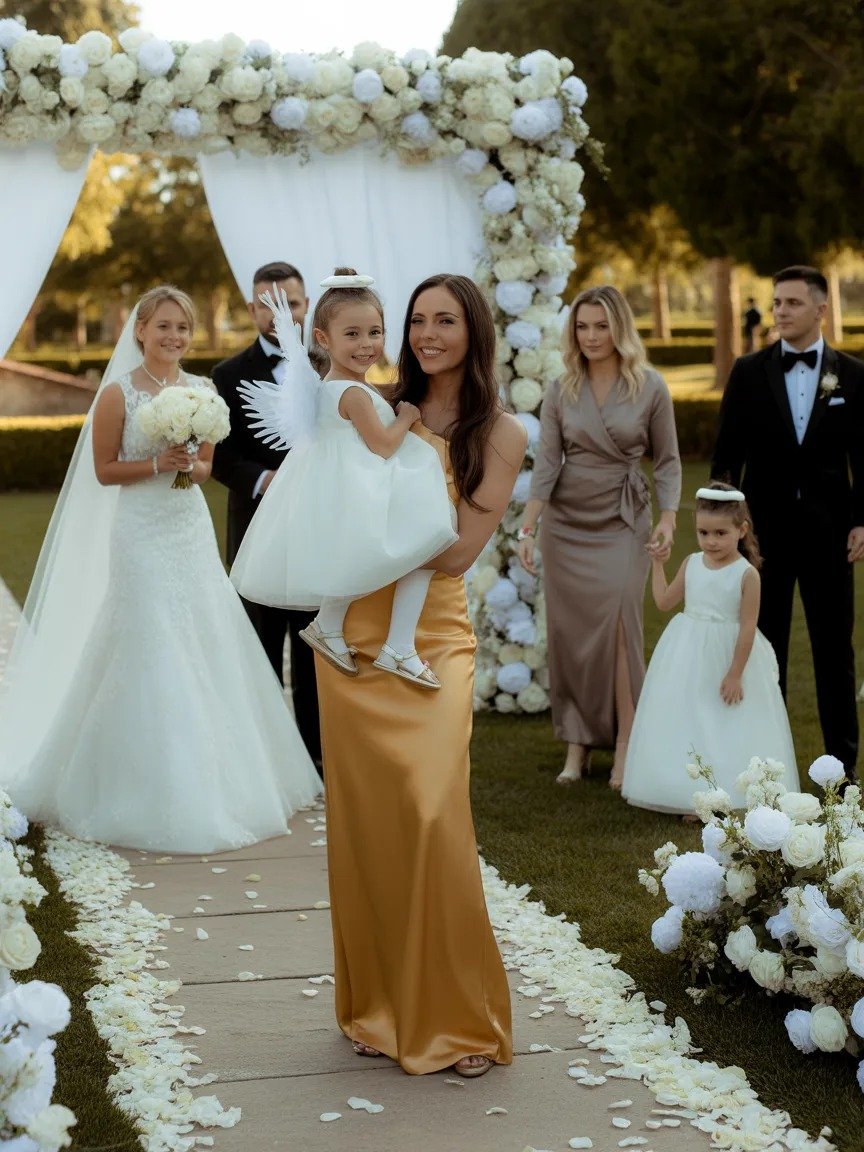
The scuff mark on the baseboard was Emma’s doing. She had practiced her flower girl walk so many times, down our narrow hallway and back, that the paint at the far end had worn away to a faint gray smear where she pivoted. Four months of practice.
She had the pace memorized, the measured step, the chin-up posture she had developed after watching a YouTube video of a flower girl at some stranger’s wedding and deciding that was the correct form. On the morning of my brother’s rehearsal dinner, she stood in front of the bathroom mirror holding one hair clip in each palm — tiny white enamel daisies in one hand, miniature silver stars in the other — with the solemn gravity of someone making a consequential decision. “The daisies,” she finally announced.
“Perfect choice,” I said, and pinned them into her hair. She absorbed this the way children absorb certainty when it comes from someone they trust completely. Without question.
Without doubt. She had a job. She had practiced.
She was ready. My husband Derek had ironed his shirt the night before without being asked, aligned Emma’s patent leather shoes by the front door, and found a congratulatory card for my brother Ryan and his fiancée Madison entirely on his own initiative. When I stood in the kitchen frozen by last-minute anxiety, second-guessing whether I needed a hostess gift for an event I had spent weeks helping to coordinate, he put his hand on my back.
“You’ve poured enough of yourself into this,” he said. “Let’s just get in the car.”
The drive to the Hargrove Inn took forty minutes — a white-columned estate at the edge of a private lake, the kind of property that makes you want to whisper the moment your tires hit the gravel. Emma had her face pressed to the cold window the entire way, watching the highway dissolve into country roads.
“Is Uncle Ryan going to notice my daisy barrettes?” she asked. “He won’t be able to look at anything else,” I told her. She leaned back in her booster seat looking satisfied, and I felt that particular warmth that only comes from watching your child anticipate something untainted.
She knew nothing of family politics, nothing of whispers or calculated silences. She only knew she had a role and she had earned it. My phone vibrated as Derek pulled into the parking area.
It was my mother. Come around to the garden entrance instead of the front doors. I need to talk to you before you come inside.
Don’t bring Emma yet. Have Derek wait with her. I read it twice, my pulse skipping.
“My mom wants to talk to me. Outside. Alone,” I said.
Derek looked at me with the expression he reserves for equations missing a crucial variable. I turned around and gave Emma a bright, brittle smile. “I’m going to run and give Grandma a quick hug.
You stay here with Daddy and show him how the daisies look in the sunlight, okay? He hasn’t gotten a proper look yet.”
She accepted the mission immediately. I pushed open my door and walked around the perimeter of the estate, following a crushed-stone path through rose bushes that had just started to bloom, the scent thick and almost suffocating.
My mother was waiting near a wrought-iron bench. She wore a tailored navy dress, her hair sprayed into place, her hands clasped rigidly at her waist — the posture she always assumed when delivering news she had already made peace with. “What’s going on?” I said.
She exhaled. “I wanted to catch you out here so this didn’t blindside you at the table. Madison’s sister has a daughter, Brooke.
She’s five. A few weeks ago, Madison asked if Brooke could be the flower girl instead. She wanted the bridal party to feel cohesive, and—”
“Mom.” The word came out hollow.
“Emma has been practicing for four months.”
“I know, honey.”
“She is currently in a car seat wearing the dress we drove to three different cities to find. She has her hair clips in. She has talked about nothing else since January.”
“I know.
And Ryan should have called you the second the plan changed. But Madison felt awkward about it, and it kept getting pushed down the list, and she’s only six, Sarah. Children are resilient.”
Something cold and specific moved through me.
“She’s a six-year-old who wore a path into my baseboard walking that hallway so she wouldn’t embarrass her uncle. She wanted to be perfect for him.”
My mother’s expression didn’t shift into guilt. It shifted into resolution — the face of someone who has already accepted a betrayal and is now tapping her foot, waiting for the injured party to accept it too.
“It is Madison’s wedding,” she said, her tone hardening. “It is her day, and she wants the people walking down the aisle to feel like her family.”
Her family. As if my daughter — Ryan’s own blood niece — was a stranger renting a seat.
“And what exactly are we, then?” I asked. She dropped into the specific patronizing register she reserved for when I was being difficult. “I need you to be gracious about this.
Ryan is stressed. Madison is overwhelmed. The last thing anyone needs tonight is you making this into something larger than it needs to be.”
I stood very still on the crushed stone.
The roses smelled cloying and too sweet. Inside, a string quartet had started playing. “Okay,” I said.
“Okay?” She reached toward my arm. I stepped back. “Give me a minute.”
She hesitated, debating a word she ultimately decided not to offer, and disappeared through the garden door.
I stood alone on the path with the golden light playing on the lake surface and understood, with complete clarity, what I had to do next. I had to walk back to that car and break my daughter’s heart. Derek was crouched near our bumper when I returned, pointing something out in the gravel to Emma.
She was mirroring his posture exactly, her tulle skirt pooled around her knees. He took one look at my face and stood immediately. “Hey, Em,” he said, keeping his voice completely level.
“Can you do something for me? Can you count how many smooth white rocks you can find right here? I bet there aren’t even ten.”
She accepted the challenge with immediate intensity, eyes scanning the dirt.
Derek closed the distance to me in two strides. “They replaced her,” I managed. “Madison’s niece is doing it.
They decided weeks ago and just didn’t want to deal with telling us.”
Derek went entirely still. The silence around him shifted into something with weight. “How do you want to play this?” he asked.
I looked past him at Emma, who was lining up her findings on the toe of her shoe. “I have to tell her,” I said. “And then I honestly don’t know if I can sit in that room tonight and pretend any of this is fine.”
“You don’t have to figure out the whole night right now,” he said.
“Seven!” Emma called out, holding up a dusty pebble. “Great find,” Derek called back, his voice remarkably steady. I lowered myself to the gravel and ignored the bite against my bare knees.
She held out her eighth stone for my inspection. “That one has sparkles,” she noted. I took both of her small dusty hands in mine.
She felt the shift in the air immediately. “Hey, bug. I have some news.
It’s a little bit of a bummer, but we’re going to be completely fine, okay?”
She studied my face with the ancient, unsettling perceptiveness children sometimes have. “Okay.”
“The flower girl job changed a little bit. There’s another little girl from Madison’s family who is going to carry the basket today.”
Emma went still.
Her eyes moved carefully across my face. “Did I do the walking wrong?” she whispered. The burn behind my eyes was almost physical.
“No, baby. You did it perfectly. This has nothing to do with how you walked.
The bride wanted someone from her own house to carry it. It was not your fault.”
She looked down at her shoes. The daisies caught the light.
“So I don’t get to carry it?”
“Not today.”
“Can I still go inside?”
“Of course.”
“Can I still wear my dress?”
“I wouldn’t take it off you for the world.”
She gave a small, jerky nod — that particular resilience of a child who hasn’t yet learned to perform grief for an audience. “Okay,” she said. “Will there be snacks?”
“So many snacks.”
She let go of my hands, turned to Derek, and said, “I found nine but I think there’s one hiding under the tire.”
Derek looked at me over the crown of her head.
His eyes were doing everything that needed doing. The dining room was a cavern of cream linens and low candles. Ryan was laughing near the bar, his arm around Madison, radiant and oblivious to our entrance.
Madison noticed us. She was holding a champagne flute and when her eyes found my dress, something crossed her face — not remorse. The specific irritation of a woman who thought a nuisance had been resolved.
Then a small blur of white and pink darted through the crowd. A five-year-old in a pristine gown, swinging a wicker basket. Emma stopped.
She didn’t cry. She didn’t point. She just looked at that basket, and I watched the abstract thing she had been told become real and concrete on her face.
She reached up blindly and wrapped her fingers around mine. Dinner was a blur of clinking glass. Emma ate her chicken, stole half of Derek’s bread, and told the elderly couple beside us a detailed story about a backyard frog.
She was holding herself together better than I was. When the main course was cleared I slipped away to the restroom, turned the faucet on full blast, and gripped the sink. I didn’t cry.
I just stood there with ice water running over my wrists, needing a single square foot of space where I didn’t have to smile. I bought that dress. I watched her spin in front of the mirror.
I knelt in that hallway for four months. And my brother hadn’t had the spine to dial a telephone. Walking back through the lobby, my phone buzzed.
I assumed it was Derek. It was my father. My father did not text.
He viewed phones as glorified landlines. I had once watched him spend eight minutes finding the letter K. The message read: Come find me outside on the east porch.
Now, please. The east porch was quiet and cool, the sky bleeding its last colors behind the tree line. My father stood at the railing with his back to me, looking out at the lake.
He turned when he heard my footsteps. “Your mother briefed me,” he said. “During the bruschetta.”
“She ambushed me in the garden.”
“She told me like she was updating me on a catering substitution.” His jaw tightened.
“Ryan knew. He’s known for three weeks. He texted your mother this afternoon and asked her to intercept you.” He paused.
“I read the message off her phone. His exact words were: ‘Sarah will make it a whole dramatic thing, and I cannot deal with her right now on top of the wedding stress.’”
The lake water lapped against the dock in the dark. “He called me a thing,” I said.
“His own sister.”
My father put both hands on the railing. When he spoke, it was with the measured cadence of someone who has been biting their tongue for a very long time and has finally tasted blood. “Your brother has been the beneficiary of every doubt this family had to offer for thirty-one years.
Every ball he dropped, someone scrambled to catch it. Every rocky path, we paved it. And I have been one of the primary architects of his comfort.” He looked out at the water.
“You tell yourself you’re protecting your child. But this afternoon he reduced you to a nuisance to be managed by his mother. And your little girl is sitting in there wearing a dress she earned through months of dedication while a stranger holds her basket.”
He turned to face me.
“And you sat through the appetizers in silence. Because it is Ryan’s special night. Because that is the script you have memorized.”
“Dad—”
“I have two things to tell you,” he said.
“And I am telling you out here because I want you to have the truth before we walk back into that room.”
He reached into his jacket pocket. “Your grandmother’s estate cleared probate six weeks ago. There was a remaining asset.
The land in Vermont. The property with the cabin.”
The memory hit me hard — the rotting dock, the cold clear lake, the back fields where Ryan and I used to chase fireflies and trap them in Mason jars. “She left the deed to me.
My original intention was to divide it evenly between you and your brother.” He paused. “I changed the documentation last Tuesday. The land is entirely yours.
Sole ownership.”
“Dad, you can’t—”
“This was decided before tonight,” he said firmly. “This is not about a flower basket. This is about a pattern of cowardice I have enabled, which I am now officially dismantling.
The land is yours, Sarah.”
I stood on the wooden deck and felt the weight I had carried my whole life suddenly shift, like gravity had recalibrated. I didn’t feel victorious. I felt a deep, quiet grief for the brother I used to catch fireflies with.
“There is one more thing.” He reached into his other pocket and withdrew a small dark green velvet pouch. He extended it toward me. I loosened the drawstring and tipped the contents into my palm.
A delicate gold chain. A tarnished oval locket. My grandmother’s locket.
The one she had worn every day of her life. She had shown me the inside once, when I was a teenager — a tiny folded square of parchment with a verse from the Psalms in her own handwriting. “Your mother gave that to Madison,” my father said quietly.
“Three months ago. She presented it as a welcome-to-the-family gift. She told people it was what your grandmother would have wanted.”
I stared at the gold in my palm.
“I approached Madison in the lobby earlier this evening,” he continued. “I explained that the gift had been given in error, that the heirloom had a rightful heir, and that your mother did not have the authority to surrender it. To her credit, Madison returned it immediately.”
I closed my fingers around the locket.
A sob came up from somewhere I hadn’t known was open. “I know,” my father whispered. He stepped forward and put his hand on my shoulder.
Not a comforting pat. A declaration of presence. “I know.”
We stood in the dark for a long time while the crickets started up.
“I am going back in there,” my father said finally, adjusting his lapels, “and I am making a statement.”
Panic moved through me. “Dad, you don’t have to—”
“I am aware I don’t have to,” he said. “But I am going to.
And I want my daughter standing beside me.”
I thought about the scuff mark on the baseboard. I thought about thirty minutes of deliberating over daisy clips. I thought about my daughter swallowing her hurt to talk about a frog to strangers because her uncle was too much of a coward to make a phone call.
I put the velvet pouch in my pocket. “Okay,” I said. “Let’s go.”
He didn’t tap a glass.
He didn’t clear his throat. He simply walked to the head of the banquet table where Ryan and Madison sat, and stood there radiating such complete, deliberate stillness that the conversations nearest him faltered. The silence spread outward like a ripple.
Within fifteen seconds, the room had gone quiet. Ryan looked up. When he saw our father’s face, the ease drained out of his expression.
“I have a few things I’d like to say,” my father began, his voice conversational but carrying to every corner. “I am choosing to say them here because this family has a long habit of burying difficult conversations in the shadows where they can be conveniently managed. I am done with that approach.”
Beside Ryan, Madison set her champagne glass down with exquisite slowness.
“My daughter drove forty minutes tonight to celebrate this marriage. My granddaughter arrived in a dress she has been counting down to wearing for four months. Upon arrival, they were intercepted in the parking lot and told her role had been revoked.
No one offered Sarah the basic dignity of a phone call. No one gave her the chance to prepare her six-year-old child for that disappointment. Why?
Because my son sent a text to his mother this afternoon asking her to handle it for him, because an honest conversation felt inconvenient.”
The silence had a physical quality now. Thirty people trying very hard not to look at Ryan. “I love my son,” my father said, and his voice cracked for the first time.
“I want this weekend to be a milestone he remembers with joy. But I am saying this in front of his future in-laws, in front of people who will shape how he understands himself, because the truth needs light. The way my daughter and granddaughter were treated tonight was wrong.
Emma is Ryan’s niece. She is our family. She was owed a phone call.”
Ryan’s jaw was rigid.
His face had gone a dark, bruised red. Madison kept her eyes on her plate. “I am not asking for the music to stop,” my father said.
“I am not demanding changes to tomorrow’s program. I am simply speaking the truth out loud, because I have spent too many years waiting for a convenient moment to be honest, and I am exhausted by it.”
He looked at Ryan one last time. “I love you.
That is exactly why I am doing this.”
He stepped back. For three full seconds the room held its breath. Then, slowly, like water filling a space, the murmur of conversation resumed.
My mother appeared at his elbow immediately, her face white. “Robert. That was spectacularly inappropriate.”
“I imagine it felt that way,” he said, and stepped around her.
He returned to where I was standing. He looked older, suddenly, but also lighter — the particular look of someone who has set down something very heavy they have been carrying for a very long time. “Thank you,” I managed.
“Decades overdue,” he said. Derek appeared from the edge of the room with Emma on his hip, her arms looped around his neck. She surveyed her grandfather with great seriousness.
“Grandpa made a speech,” she observed. “He did,” Derek agreed. My father held out his arms.
She went to him without hesitation, and he held her the way he used to hold me — one large hand cradling the back of her head. She patted his shoulder blade, a gesture that was somehow both infantile and deeply maternal. “I really like your hair clips,” he said quietly.
“They’re daisies,” she told him. “I noticed. Your great-grandmother grew them in the side yard.”
Emma pulled back slightly, her face grave.
“I have a flower basket waiting for me at home. I have been practicing.”
“I heard you were a complete professional.”
Just before dessert, Ryan appeared at our table. No audience, no performance.
Just a raw, hollow admission. “I should have called you,” he said. “The day the plan changed, I should have picked up the phone.
I was a coward, Sarah. I’m sorry.”
I looked at him. My brother.
The boy I used to chase fireflies with in Vermont. “Yes,” I said quietly. “You should have.”
He looked at Emma, who was methodically demolishing a lemon tart.
“Is she okay?”
“She’s six. She’s handling betrayal with more grace than most of the adults in this room.”
He winced. He asked if Emma might be able to walk at the beginning of the ceremony the following day, just at the very start, as part of the bridal party entrance.
“You clear it with Madison first,” I said. “And if she hesitates for even a second, do not say a word of it to Emma. I will not let you pull the rug out from under her twice.”
He nodded and retreated.
We didn’t stay for the dancing. Derek buckled a sleeping Emma into her car seat while I found my father in the foyer. He pulled me into a fierce, rib-crushing hug — entirely unlike his usual measured reserve.
“I’ll call you this week,” he said against my hair. “I’ll pick up,” I said. The drive home was dark and quiet, oak trees rushing past the windows.
Emma was asleep within eleven minutes. I sat in the passenger seat with the velvet pouch on my lap, my thumb tracing the outline of the locket through the fabric. “Hell of a night,” Derek said.
“Hell of a night.”
“Your dad did something monumental in there.”
“He did.”
“You going to be okay?”
I looked out at the passing dark. I thought about the silence in that dining room, the way truth sounded when it was finally said out loud in front of witnesses. I thought about the Vermont land and firefly summers.
I thought about the fracture that had finally cracked open, letting the poison drain out. “Eventually,” I said. “I think so.”
I didn’t open the velvet pouch for fourteen days.
It was an ordinary Tuesday morning, sunlight spreading across the kitchen island. Emma was working through a bowl of cereal. I took the necklace out of the bag and fastened the clasp around my neck without ceremony.
The cool metal settled against my collarbone. Emma’s spoon stopped. She pointed at my chest.
“Shiny?”
“It belonged to your great-grandmother,” I told her. She nodded with enormous respect and went back to her cereal. Ryan did manage to salvage something.
On the afternoon of the wedding, Madison’s coordinator brought Emma to the front of the vestibule and handed her a single massive white peony bound in silk ribbon. She was to lead the bridal party down the aisle. It wasn’t the wicker basket.
It didn’t undo four months of scuff marks on my baseboard. But Emma gripped that peony stem like she was carrying the Olympic torch, and she walked that aisle with the terrifying, deliberate precision of someone who had been preparing for exactly this. When she reached the altar and spotted us in the third row, her face broke into the most blinding, triumphant smile I have ever seen.
My father clapped until his palms were red. Ryan and I speak now. He called three weeks after the honeymoon, and the conversation stretched longer than anything we’d shared in a decade.
It was awkward in places and honest in others, and he didn’t hang up. We are not the idealistic children chasing fireflies in Vermont. But we might be something real — two adults attempting to navigate the wreckage without our mother’s invisible hands directing traffic.
My mother remains herself. She goes to her grave believing the garden ambush was an act of peacekeeping. I have stopped spending energy trying to revise that belief.
We tolerate a careful version of Sunday dinners — a fragile ecosystem that functions as long as no one leans too hard against the walls. But my father calls every Thursday at six-fifteen. He asks to be put on speakerphone so he can talk to Emma about a violently red cardinal that has taken up residence in the oak tree in his backyard.
Emma has named the bird Gerald. Last week a manila envelope arrived containing a photocopied page from an ornithology textbook on cardinal migration habits, with my father’s handwriting in the margins underlining what he considered the important parts. Emma keeps the crinkled page on her nightstand.
I wear the locket almost every day. On mornings when the light hits it right, Emma asks to see inside. I unlatch the tiny gold clasp and show her the ancient yellowed parchment, my grandmother’s script in faded ink.
She runs her sticky thumb over the loops of cursive and asks me to read it aloud. I do. I know she doesn’t understand the weight of the words yet.
But she closes her eyes while I speak, listening to the rhythm of my voice like it is the only certain thing in the world. And in the quiet light of our kitchen, that is more than enough.
Website Disclaimer
The information provided on this website is for general informational and educational purposes only. While we strive to ensure that all content is accurate and up to date, we make no guarantees regarding the completeness, reliability, or accuracy of any information published.
The views and opinions expressed in articles belong to their respective authors and do not necessarily reflect the views of this website. Any action you take based on the information found on this website is strictly at your own risk. We will not be liable for any losses, damages, or inconveniences arising from the use of our content.
Some articles may contain opinions, third-party information, or external links. We do not endorse or guarantee the accuracy of content on external websites and are not responsible for their practices or policies.
All content on this website is provided in good faith and is intended for informational purposes only. Readers are encouraged to verify information independently and seek professional advice where appropriate.