The date on the photograph was October 17, 2004.
I knew that date.
I had seen it once before, twenty-two years earlier, written on the bottom of an envelope my brother had left behind in our mother’s old house.
October 17.
The day after he disappeared.
I stared at the photograph in June’s hand.
It showed my brother standing beside an old blue pickup truck at a gas station. He looked exhausted, thinner than I remembered, with one hand resting on the hood and the other holding a phone to his ear.
Behind him was a sign.
Miller’s Truck Stop.
I remembered it because I had driven past that place hundreds of times.
“Where did you get this?” I asked.
June looked at her sisters.
“Mom kept it.”
The word hit me harder than anything else.
Their mother.
The woman I had spent twenty-two years grieving alongside three daughters who barely remembered her.
I had always known she was sick before she died. I had never known how much she had been carrying before that.
June lowered the photograph.
“We found a box in Grandma’s attic three months ago,” she said. “We weren’t looking for this. We were looking for old family pictures.”
Ava stepped toward me.
“There were letters inside.”
“From your father?”
“All of them.”
My hands tightened around the arms of my chair.
“Why didn’t you tell me?”
Claire answered softly.
“Because we weren’t sure you knew.”
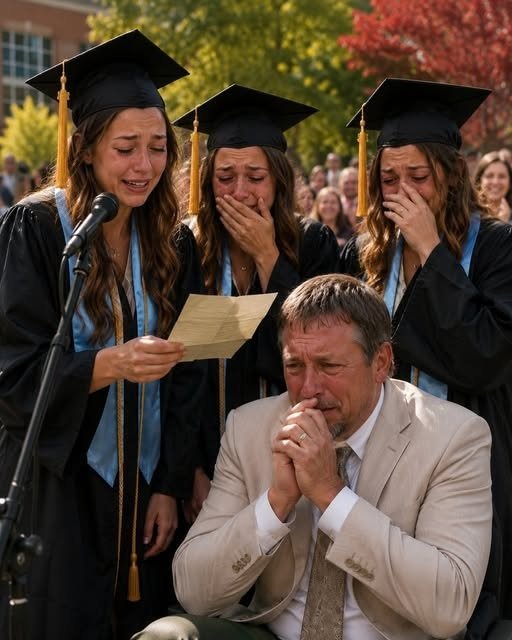
That was when I understood why they had chosen graduation.
This wasn’t a surprise.
It was a question.
They had spent months trying to decide whether the man who raised them deserved to know the truth about the man who left them.
June unfolded the receipt again.
“I want to read all of it.”
The dean stood several feet away, visibly confused, but he didn’t interrupt.
June began.
“‘Noah, I’m sorry. I can’t do this. Not because they’re too much. Not because I don’t love them. I am leaving them with you because you’re the only person I trust.’”
My vision blurred.
I had read those first words a thousand times.
I had never known there were more.
“‘Mara told me they were watching the house.’”
Mara.
Their mother.
I closed my eyes.
June continued.
“‘She found out the men who came looking for the girls weren’t social workers. They were connected to the clinic where she had been treated. She doesn’t know why they want them. She only knows they asked questions about the babies before they were born.’”
A murmur moved through the auditorium.
I shook my head.
“No.”
I didn’t mean the word as a denial.
I meant I couldn’t understand how I had lived twenty-two years without knowing any of this.
June kept reading.
“‘I tried to find out who they were. I made a mistake. They know my name now.’”
Ava covered her face.
Claire whispered, “Dad…”
But June wasn’t finished.
“‘If I stay, they will follow me back to you. If I leave the girls with you and make them believe I ran, maybe they’ll stop looking. Keep them away from the old house. Don’t let anyone convince you that I’m coming back.’”
I looked at the three women standing on the stage.
They weren’t babies anymore.
They were graduates.
Doctors, teachers, engineers—at least that’s what they had planned to become.
Three women who had somehow grown up while I was busy trying to keep the lights on.
And suddenly the question that had haunted me for twenty-two years sounded different.
Why had my brother left?
Maybe the question had always been wrong.
The real question was what he had been running from.
June turned the receipt over.
There was one final paragraph.
“‘Noah, there is something I couldn’t tell you because I didn’t have proof. Mara says the girls were healthy, but someone changed part of their medical records before we left the hospital. I don’t know who did it. I don’t know what they want. If you ever find the truth, please don’t look for me until you’re certain the girls are safe.’”
The auditorium was completely quiet now.
I felt sixteen different memories collide.
The strange phone calls.
The car that had appeared outside the hardware store for three nights in a row.
The envelope with no return address that I had thrown away.
The time, when the girls were four, that a man had asked me whether three little girls lived upstairs.
I had thought he was a salesman.
I had forgotten his face.
June hadn’t.
She reached into her gown again.
This time she pulled out a folded letter.
“This came with the photograph.”
I stared at the handwriting.
I knew it immediately.
My brother’s.
I hadn’t seen it in twenty-two years, but I knew every crooked letter.
“Where did you get that?”
“From Mom’s attorney.”
My stomach dropped.
“Mara’s attorney?”
June nodded.
“After she died, he contacted us. He said Mom had left instructions that the box wasn’t to be opened until all three of us graduated college.”
I looked at the stage.
“Why?”
“He didn’t know.”
Claire stepped toward me.
“But Mom did.”
Ava took the microphone.
“She left a second letter for us.”
She unfolded it.
“‘Girls, if you’re reading this, then you are old enough to know why your father left. I need you to understand something first. He did not abandon you because he was weak. He left because he believed leaving you with Noah was the only way to keep you alive.’”
My throat tightened.
Mara had known.
All these years, she had known.
And she had watched me raise their daughters without telling me why.
Part of me wanted to be angry.
Another part understood what fear could make people do.
June continued.
“‘Noah gave you something your father couldn’t give you at that moment: a normal childhood. Please don’t take that from him by making him carry our fear too.’”
I looked down at my hands.
Twenty-two years earlier, those hands had been shaking while I tried to figure out how to buckle three car seats.
Now they were scarred from work, spotted with age, and trembling for an entirely different reason.
Claire came down from the stage.
She walked straight toward me.
Then she knelt beside my chair.
“You were never second choice,” she said.
I couldn’t speak.
Ava joined her.
“Neither were we.”
June came last.
She placed the old receipt in my palm.
“We found Dad.”
I stared at her.
“What?”
She nodded.
“He’s alive.”
The words didn’t feel real.
For twenty-two years, I had imagined every possible ending.
Dead.
Drunk.
In prison.
Living under another name.
Starting a new family.
I had never allowed myself to imagine this.
Alive.
“Where?”
June glanced toward the photograph.
“Miller’s Truck Stop closed years ago. The building is a storage facility now.”
She paused.
“But we traced the photograph.”
I could barely breathe.
“And?”
“We found a man who used to work there.”
She handed me another sheet of paper.
“His name is Robert Hayes.”
I read the address.
Then I read the sentence underneath it.
“He told us your brother came through that night.”
My fingers tightened around the paper.
“What happened to him?”
June’s eyes filled with tears.
“He said your brother left town before sunrise.”
“And?”
“He left something behind.”
The old familiar fear returned.
“What?”
June looked at Ava and Claire.
Then she looked at me.
“A voicemail recording.”
My brother’s voice.
After twenty-two years.
I couldn’t decide whether I wanted to hear it.
The three girls sat around me after the ceremony while the crowd slowly disappeared.
The dean eventually came over and quietly asked whether we needed a private room.
We did.
In a small office behind the auditorium, June placed her phone on the desk.
“There are only forty-three seconds.”
I nodded.
She pressed play.
Static filled the room.
Then a voice came through.
Older than the voice I remembered.
But unmistakably his.
“Noah.”
I closed my eyes.
“If you’re hearing this, I didn’t make it back.”
My jaw tightened.
“I need you to know something.”
There was a long pause.
“I left those girls with you because I knew you would love them even if you hated me.”
My eyes burned.
“I didn’t deserve your forgiveness then.”
The recording crackled.
“Maybe I don’t deserve it now.”
Then his voice changed.
He sounded frightened.
“But Mara was right. Someone inside the hospital was selling information about newborns. Not just our girls. Babies whose parents couldn’t protect themselves.”
Claire covered her mouth.
“I found the man who was doing it,” he continued. “He knew I had seen the records. He told me if I went to the police, the girls would disappear before anyone could protect them.”
The recording stopped for a second.
Then came the sentence that broke me.
“So I made Noah believe I abandoned them.”
A tear rolled down my cheek.
“I knew he would hate me.”
My brother laughed once, bitterly.
“But I knew he’d never leave them.”
The recording ended.
No music.
No dramatic final sentence.
Just silence.
I sat there looking at the three women I had raised.
June reached across the table.
“Dad, we don’t want you to find him for us.”
I looked at her.
“Why?”
“Because we already did.”
My breath caught.
“What?”
Ava smiled through her tears.
“We found him six months ago.”
I stared at them.
“Then why didn’t you tell me?”
Claire answered.
“Because he asked us not to.”
The anger came fast.
“You talked to him?”
“All three of us.”
“For six months?”
They nodded.
I stood up too quickly and my knee protested.
“You knew where he was?”
June nodded again.
“Where?”
She took a slow breath.
“He’s in Oregon.”
I turned away.
Twenty-two years.
Twenty-two years of wondering whether my brother was alive.
Six months of my daughters knowing the answer.
I wanted to be furious.
Instead, I felt tired.
Not angry tired.
Twenty-two-years-of-carrying-something-too-heavy tired.
“Why didn’t you tell me?” I asked again.
June’s voice was quiet.
“Because we wanted to know who he was before we brought him back into your life.”
I turned around.
“And?”
Ava wiped her eyes.
“He isn’t the man we imagined.”
Claire added, “He never married.”
June said, “He never had other children.”
I sat down again.
“He’s been working at a repair shop under his real name for the last eleven years.”
“Why didn’t he contact me?”
June looked at the floor.
“Because every time he tried, someone warned him away.”
“Who?”
She shook her head.
“We don’t know yet.”
That answer should have frightened me.
Instead, it felt smaller than the truth we already knew.
I looked at the receipt in my hand.
The paper had survived twenty-two years.
So had the promise hidden on its back.
I finally understood why my brother had trusted me.
He knew exactly what I would do.
He knew I would complain about the cost of formula.
I would curse at three screaming babies at two in the morning.
I would burn pancakes.
I would work until my back hurt.
I would sit beside hospital beds.
I would take pictures.
I would show up.
Every single time.
And he had been right.
The next morning, I drove home with my daughters.
We stopped at the old hardware store first.
The apartment above it was smaller than I remembered.
The walls still carried faint pencil marks where I had measured their heights.
Ava found one.
“Six years old,” she said.
Claire found another.
“Eight.”
June stood by the kitchen doorway.
“There are three more.”
I looked.
Three tiny marks, almost hidden behind the doorframe.
The first said Ava.
The second said Claire.
The third said June.
I had forgotten making them.
They hadn’t.
That afternoon, the four of us sat around the kitchen table.
June placed her phone in front of me.
“Call him.”
I stared at the number.
My hand hovered above it.
I had imagined this moment for half my life.
In every version, I knew what I would say.
Now I had nothing.
So I pressed call.
It rang once.
Twice.
Three times.
Then someone answered.
Neither of us spoke.
I heard breathing.
Then my brother said my name.
“Noah.”
I closed my eyes.
“Hi, David.”
A long silence followed.
Then he whispered, “Are they okay?”
I looked at my daughters.
All three were watching me.
“They’re more than okay.”
His breath broke.
I heard him crying.
I had spent twenty-two years imagining that conversation.
I thought I would ask where he had been.
I thought I would demand an explanation.
Instead, I asked the only question that mattered.
“Why didn’t you trust me enough to tell me?”
His answer came quietly.
“Because I trusted you enough to know you’d protect them.”
That was the closest thing to an apology he could give me.
Maybe it wasn’t enough.
Maybe it never would be.
Forgiveness isn’t a switch.
It isn’t something you flip because someone finally explains why they hurt you.
But understanding changes the shape of anger.
We talked for twenty minutes.
Then forty.
Then nearly two hours.
There were questions he couldn’t answer.
There were things he regretted.
There were years none of us could get back.
But there was also a door that had finally opened.
Three weeks later, he came to our house.
He stood on the porch for almost a full minute before knocking.
I opened the door.
For a second, I saw the twenty-seven-year-old man who had once stood on this same doorstep with three babies.
Then I saw my older brother.
Gray hair.
Tired eyes.
Hands that wouldn’t stop shaking.
He looked past me.
Ava was in the kitchen.
Claire was setting the table.
June was holding three mugs.
David swallowed.
“I don’t know what to say.”
I stepped aside.
“Neither do I.”
He entered.
That was all.
No hug.
No instant forgiveness.
No miraculous repair of twenty-two missing years.
Just one man walking into a home he had left decades earlier.
We ate dinner.
It wasn’t special.
Claire over-salted the potatoes.
Ava laughed at her.
June complained about the coffee.
I burned the rolls.
And for the first time in twenty-two years, there were four adults sitting at my table who shared the same family story.
After dinner, David asked if he could see the girls’ graduation pictures.
I handed him the cheap camera.
He laughed when he saw it.
“You still have this?”
“Of course.”
He looked at the three girls standing together on the stage.
Then he looked at me.
“You did good, Noah.”
I shook my head.
“We did.”
He looked down.
“No.”
His voice cracked.
“You did.”
I didn’t argue.
Some things don’t need to be corrected.
Before he left, June stopped him at the door.
“Dad?”
He turned.
She was holding the old gas receipt.
“We’re keeping this.”
David nodded.
“You should.”
She looked at me.
“We’re framing it.”
I smiled.
Not because of what was written on it.
Because of what had happened after.
Twenty-two years earlier, that piece of paper had been a goodbye.
Now it was proof that three frightened babies had become three strong women, that one terrified twenty-seven-year-old had somehow become their father, and that sometimes the truth can take decades to find its way home.
That night, I placed the receipt on the kitchen counter beside my old camera.
The paper was yellow.
The ink was fading.
But the three names I had written on the back of that diaper bag twenty-two years ago were still visible.
Ava.
Claire.
June.
I ran my finger over them once, turned off the kitchen light, and left the receipt exactly where it was.
Website Disclaimer
The information provided on this website is for general informational and educational purposes only. While we strive to ensure that all content is accurate and up to date, we make no guarantees regarding the completeness, reliability, or accuracy of any information published.
The views and opinions expressed in articles belong to their respective authors and do not necessarily reflect the views of this website. Any action you take based on the information found on this website is strictly at your own risk. We will not be liable for any losses, damages, or inconveniences arising from the use of our content.
Some articles may contain opinions, third-party information, or external links. We do not endorse or guarantee the accuracy of content on external websites and are not responsible for their practices or policies.
All content on this website is provided in good faith and is intended for informational purposes only. Readers are encouraged to verify information independently and seek professional advice where appropriate.