# The Strange-Looking Metal Machine That Changed the Way People Clean Their Homes
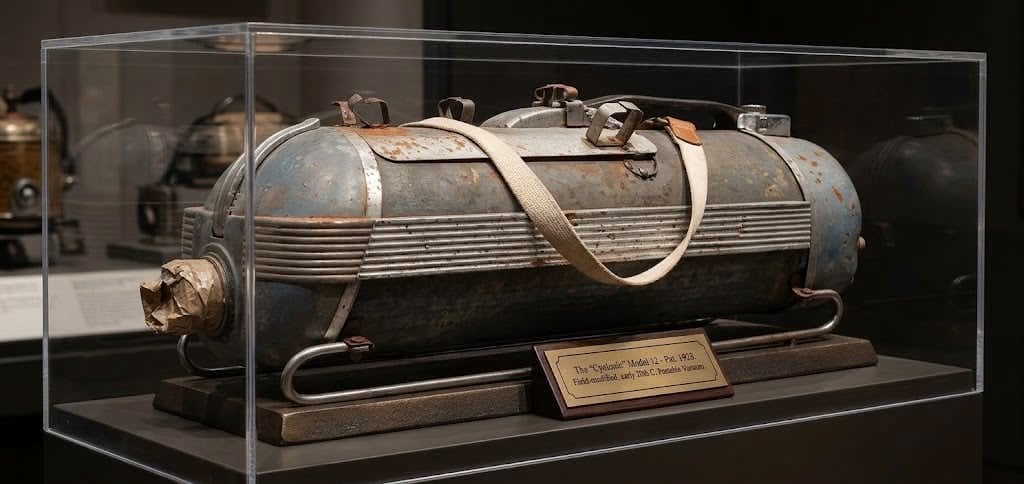
At first glance, the unusual metal device looked more like an antique piece of industrial equipment than something designed for everyday household use. Its bulky construction, strange shape, and complicated-looking mechanism left many people online wondering what it could possibly be. The answer turned out to be an early vacuum cleaner, a fascinating reminder of how much household technology has changed over the past century.
Before vacuum cleaners became common, keeping homes clean was a physically demanding task. People relied on brooms, brushes, dustpans, and carpet beaters to remove dirt and dust. Cleaning large rugs and carpets required considerable time and effort, and much of the dust simply moved from one place to another.
Inventors eventually began searching for a better solution. In 1869, American inventor Ives W. McGaffey patented the Whirlwind, a manually operated cleaning machine. It used a hand crank to create suction, although operating it was difficult and required considerable effort. Nevertheless, it represented an important step toward modern vacuum technology.
Another major development came in 1901, when British engineer Hubert Cecil Booth introduced a powerful motorized vacuum-cleaning system. His machine was enormous and usually operated outside buildings. Long hoses were brought through windows and connected to the cleaning equipment inside. Although impractical for ordinary households, Booth’s invention demonstrated the potential of powered suction cleaning.
A few years later, an American janitor named James Murray Spangler developed a more practical electric vacuum cleaner. In 1907, he created a portable upright design using an electric motor, a rotating brush, and a dust-collection bag. His invention was inspired partly by his own need to reduce the dust he encountered while cleaning.
Spangler eventually sold the patent rights to William Hoover, whose company helped transform the invention into a commercially successful household appliance. The Hoover name soon became closely associated with vacuum cleaners, particularly in Britain and other parts of the world.
As technology improved, vacuum cleaners became smaller, lighter, and easier to operate. Manufacturers introduced better suction systems, disposable dust bags, improved filtration, and attachments designed for furniture, stairs, and difficult-to-reach corners.
Later innovations brought bagless designs, cordless models, HEPA filtration, and robotic vacuum cleaners capable of navigating rooms with minimal human assistance. Today, some machines can even map entire homes, recognize obstacles, and return automatically to charging stations.
Looking back, it is remarkable that an invention once considered bulky, complicated, and expensive eventually became an essential appliance in millions of homes.
That strange metal machine was more than an antique curiosity. It represented the beginning of a technological revolution that changed an ordinary household chore forever.
Sometimes, the most familiar objects in our homes have the most surprising histories.
Website Disclaimer
The information provided on this website is for general informational and educational purposes only. While we strive to ensure that all content is accurate and up to date, we make no guarantees regarding the completeness, reliability, or accuracy of any information published.
The views and opinions expressed in articles belong to their respective authors and do not necessarily reflect the views of this website. Any action you take based on the information found on this website is strictly at your own risk. We will not be liable for any losses, damages, or inconveniences arising from the use of our content.
Some articles may contain opinions, third-party information, or external links. We do not endorse or guarantee the accuracy of content on external websites and are not responsible for their practices or policies.
All content on this website is provided in good faith and is intended for informational purposes only. Readers are encouraged to verify information independently and seek professional advice where appropriate.