I had heard rooms go silent before.
In my line of work, silence is rarely empty.
It usually means someone is calculating, someone is afraid, or someone has just realized the truth is bigger than the lie they brought with them.

That night, the silence came under chandeliers.
It came with lilies in the air, polished marble underfoot, and American flags lined behind a ballroom podium in Washington, D.C.
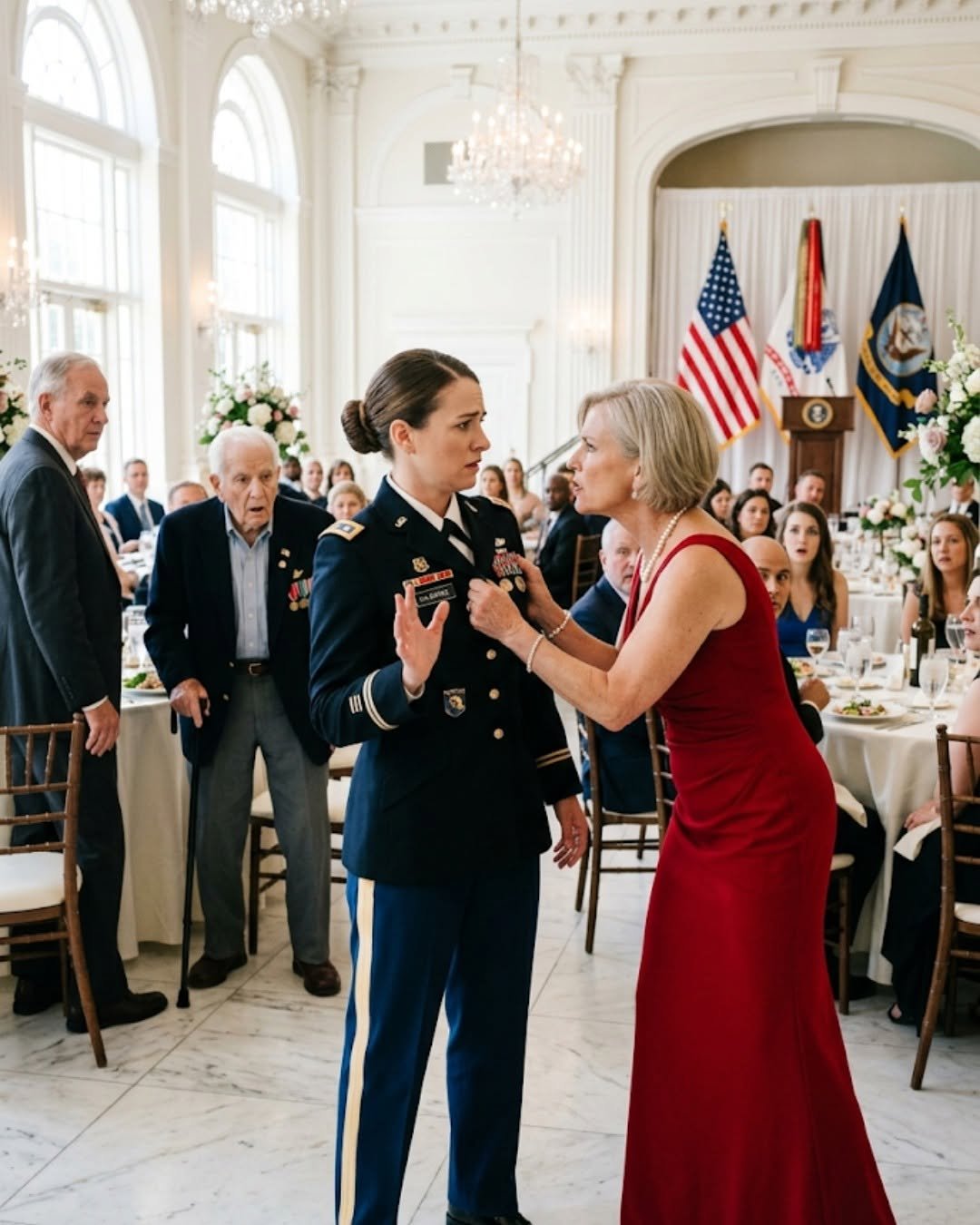
It came after my stepmother ripped my mother’s brooch from my dress uniform and accused me of wearing something I had not earned.
My name is Jennifer Carter.
I was forty-one years old that night, and people in the ballroom had been calling me General Carter for the better part of an hour.
Karen hated every syllable of it.
The gala at the Grand Hyatt was supposed to be simple.
The printed program listed my keynote for 7:30 p.m.
My name card sat at the front table.
A guest-of-honor folder had been handed to me by a young staffer who was balancing a paper coffee cup under one arm and trying not to shake.
The ballroom smelled like white lilies, floor polish, expensive perfume, and rainwater tracked in from the sidewalk.
A jazz quartet played near the stage, gentle enough that you could still hear medals click when officers shook hands.
I remember thinking, just once, that maybe I could enjoy the evening.
That was before Karen walked in.
My stepmother had chosen a red evening gown, the kind that announced itself before the person wearing it said a word.
She had always understood entrances.
She liked doorways, staircases, dinner tables, school auditoriums, hospital waiting rooms.
Any place where people were gathered was, to Karen, a stage.
Beside her was my father, Robert, in a dark suit he kept smoothing with one palm.
He looked older than I expected.
Or maybe he looked exactly the way he always had, and I was finally done making excuses for it.
Karen had been in my life for twenty years.
She missed graduations and called them scheduling conflicts.
She questioned my promotions and called that concern.
She called deployments “career choices,” as if war zones were networking events and fear was something I had added to my résumé.
Once, when I was thirty-two and home for three days between assignments, I sat at my own kitchen table eating grocery-store soup from a mug because I was too tired to cook.
Karen watched me from across the table and said, “Discipline is not the same thing as being loved.”
I was exhausted enough to let it pass.
Still, when my father had surgery two years later, I gave her a spare key to my house.
I stocked their freezer.
I drove him to two follow-up appointments when she said she was overwhelmed.
That is how people like Karen get close enough to wound you.
They do not break down your door.
They wait until you open it because you are trying to be decent.
At 7:06 p.m., she found me near the front of the ballroom, speaking with a senator and two officers I had known for years.
“Jennifer,” she said, leaning close enough that her perfume cut through the flowers. “You certainly know how to make an entrance.”
“It’s good to see you too,” I said.
The senator smiled and reached past her to shake my father’s hand.
“General Carter’s speech was outstanding,” he said. “Robert, you must be incredibly proud.”
My father opened his mouth.
Nothing came out.
That was when Karen’s face changed.
It was not dramatic.
It was not the kind of change people write songs about.
It was only half an inch, a little tightening around the mouth, a slight hardening in the eyes.
But I knew that look.
It was the look she wore whenever someone gave me praise she believed should have gone through her first.
Her eyes moved over my uniform.
They paused at the ribbon rack.
Then they stopped at the brooch above my heart.
It was small.
Two gold wings.
Old, worn smooth at the edges, more sentimental than valuable.
My mother had kept it wrapped in a handkerchief in her dresser drawer when I was a child.
After she died, it was one of the few things that came to me without a fight.
I had worn it that night because I wanted her with me.
I did not know she had already made sure of that.
Karen pointed at the brooch.
“That shouldn’t be there.”
At first, only the nearest people heard.
I looked down, though I already knew what she meant.
“What shouldn’t?”
“The brooch,” she said, louder. “It doesn’t belong on that uniform.”
A waiter stopped behind her with a tray of water glasses.
Two officers turned their heads.
My father tightened his fingers around the printed program.
“It belonged to my mother,” I said.
Karen gave a short laugh.
“So that’s the story now?”
The words landed exactly where she wanted them to land.
Not on the uniform.
Not on the room.
On the little girl in me who had once stood in a hallway listening to adults argue over which of my mother’s things were worth keeping.
My right hand started to lift.
For one second, I wanted to catch Karen’s wrist.
I wanted to pry her fingers back and tell that ballroom exactly what kind of woman tries to steal from the dead.
Instead, I stopped myself.
Control is not silence.
Control is choosing the exact second silence ends.
“Karen,” I said, very evenly. “Take your hand away.”
She smiled.
Then she reached forward and ripped the brooch from my uniform.
A tiny thread snapped.
Someone gasped.
The jazz quartet faltered for half a measure, then kept playing too quietly.
It was worse than if they had stopped.
The music made the whole thing feel ceremonial.
The ballroom froze.
Champagne glasses hovered near mouths.
A fork chimed against a plate somewhere behind me.
The waiter’s tray tilted just enough for one water glass to tremble in place.
My father stared down at the marble as if the floor had asked him for help and he was considering it.
Nobody moved.
Karen held the gold wings in her palm and lifted them for the people around us to see.
“You have no right to wear this,” she said. “You didn’t earn it. You just know how to make people think you did.”
I looked at my father.
I gave him the chance a daughter gives even after she knows better.
His lips moved.
No sound followed.
He folded the program in half.
Then in half again.
That was his testimony.
By 7:18 p.m., most of the ballroom had stopped pretending not to watch.
The guest-of-honor folder was still under my arm.
My keynote was still listed in black ink.
My name card was still at the front table beside an untouched glass of water.
Documented things have a strange mercy.
They sit there telling the truth while people lie beside them.
Then a cane tapped against the marble.
Once.
Twice.
The crowd shifted.
An elderly veteran came through the opening they made for him.
He wore an immaculate dress uniform.
His hair was white, his face deeply lined, and his hand on the cane looked fragile until you noticed the rest of him.
His posture had not surrendered anything.
He stopped in front of Karen and extended his hand.
“May I see that?”
For the first time all night, Karen hesitated.
She looked at the room, then at my father, then at the gold wings resting in her palm.
There was no graceful way out.
She dropped the brooch into the veteran’s hand.
He did not snatch it.
He received it.
That difference mattered.
He turned it toward the chandelier light.
His thumb moved over the back of the pin, slow and careful.
Then he stopped.
I saw his expression change before he said anything.
He looked at Karen.
Then he looked at me.
Then he looked down again at the wings.
“Ma’am,” he said, calm as a folded flag, “before you accuse a woman of wearing something she hasn’t earned, you should know exactly what you’re holding.”
Karen’s smile disappeared.
The veteran raised the brooch slightly.
The whole room leaned toward him.
“These wings were not jewelry,” he said.
His voice was not loud, but it reached the corners of the ballroom.
“They were a field recognition pin.”
I did not understand at first.
Neither did Karen.
My father did.
He whispered, “No.”
It was the first word he had managed all night, and it sounded like something being torn loose from inside him.
Karen turned toward him.
“Robert?”
He did not answer.
The veteran reached into the inside pocket of his jacket and pulled out a small worn envelope.
The paper had gone soft at the corners.
On the front was my mother’s maiden name in blue ink.
I knew her handwriting.
I had not seen it in years.
The veteran slid out a photograph.
In it, my mother stood younger than I had ever really known her, smiling beside two uniformed men under a small American flag on a hospital wall.
On her collar were the same gold wings.
The old man held the photo beside the brooch.
“This was taken before you were born,” he said to me. “Your mother served as a civilian medical liaison during an evacuation operation that never made the papers the way it should have.”
My throat tightened.
I could hear every glass in the room and none of them at all.
“She was not enlisted,” he continued. “She did not wear a uniform. But she saved uniformed men while wearing these wings so we would know who could get us through the gate.”
Karen stared at the photograph.
“That doesn’t make sense,” she said.
The veteran did not look at her.
“She pulled my brother out,” he said. “And two others. She stayed behind long enough that everybody who left owed their lives to a woman most records reduced to one line in an after-action attachment.”
He turned the brooch over again.
“There is an engraving here.”
He held it toward the light.
I could not read it from where I stood.
But my father could.
His face collapsed.
Not dramatically.
Not loudly.
It simply gave up pretending.
The veteran read the back of the brooch.
“For J.C., when she is ready to carry both of us.”
J.C.
Jennifer Carter.
My mother had left those wings for me.
Not by accident.
Not because nobody else wanted them.
For me.
I looked at my father.
He was crying now, silently, one hand still crushing the folded program.
Karen backed up half a step.
The movement was small, but everyone saw it.
The veteran looked directly at her.
“She earned this room before this room ever knew her name,” he said. “And her mother earned those wings before you ever put your hand on them.”
Nobody clapped.
That would have been too easy.
Instead, the silence deepened into something heavier.
Judgment, maybe.
Or shame.
A woman near the front table covered her mouth.
One officer lowered his eyes.
The waiter finally set the tray down before his hands could shake any harder.
Karen tried to recover.
“I was only saying that military honors should mean something,” she said.
“They do,” I said.
It was the first time I had spoken since the veteran stepped forward.
My voice came out steady.
“Which is why you should have kept your hands off one.”
Her mouth opened.
My father said, “Karen, stop.”
Two words.
Twenty years late.
But even late truth can still change the temperature in a room.
Karen looked at him as though he had betrayed her.
I almost laughed at that.
Not because it was funny.
Because betrayal always surprises the person who thought it was only a tool they got to use.
The veteran placed the brooch in my palm.
His hand was warm and dry.
“Your mother asked me to keep the letter until I found you,” he said.
“There’s a letter?” I asked.
He nodded toward the envelope.
“I came tonight because your name was in the program. I wasn’t sure you were her daughter until I saw the pin.”
My father made a sound then.
It was small, almost a breath.
I looked at him.
“You knew?”
He wiped at his face with his thumb, but tears kept coming.
“I knew she wanted you to have it,” he said. “I didn’t know about the letter.”
Karen’s eyes flashed.
“You let her wear it tonight knowing there was some military story attached to it?”
My father turned to her slowly.
“No,” he said. “I let you humiliate my daughter because I was a coward.”
The room shifted again.
There are sentences that arrive too late to fix the damage, but still early enough to stop the next lie.
That was one of them.
Karen looked around for an ally and found only faces.
The senator who had congratulated me earlier stepped back from her by one deliberate inch.
One of the officers near the stage folded his arms.
The young staffer with the coffee cup stood frozen beside the check-in table, eyes wide.
I took the envelope from the veteran.
My mother’s name sat across the front in blue ink.
For years, I had believed grief was the thing Karen could not take because it lived inside me.
I was wrong.
She had taken smaller things around it.
A drawer.
A story.
A pin.
A father’s courage.
And still, somehow, my mother had found one last way to hand me back the truth.
I opened the envelope with both hands.
The paper inside was thin.
The first line was simple.
Jennifer, if you are reading this in a room where people finally know your name, stand up straight.
I almost broke then.
Not because the room was watching.
Because my mother had known.
The letter did not explain everything.
It did not turn my childhood into something painless.
It said she had carried those wings during work she was never supposed to discuss.
It said she had asked that they be given to me when I was old enough to understand that service was not always recorded where applause could find it.
It said she hoped I would never confuse being overlooked with being unworthy.
I read that line twice.
Then I folded the paper carefully.
Karen was crying by then, but not the way guilty people cry when they understand what they have done.
She cried the way exposed people cry when the room no longer belongs to them.
“I didn’t know,” she whispered.
“No,” I said. “You didn’t ask.”
The veteran stood beside me while I pinned the brooch back onto my uniform.
My hands shook once.
Only once.
The torn thread still showed.
I left it that way.
At 7:30 p.m., the program said I was supposed to speak.
At 7:31, I walked to the podium.
Nobody announced me again.
Nobody needed to.
The ballroom was so quiet I could hear my own breath when I set the guest-of-honor folder down.
I looked at the American flags behind the stage.
I looked at the veteran in the front row.
I looked at my father, who could not meet my eyes yet.
Then I looked at Karen, standing near the side wall in a red dress that no longer made her look powerful.
“My mother once taught me,” I said into the microphone, “that not every act of service gets recorded by the people who benefit from it.”
The old veteran bowed his head.
I touched the brooch above my heart.
“She also taught me something tonight, though she has been gone for years. Being overlooked is not the same thing as being unworthy.”
That was when the applause came.
It did not rush in all at once.
It started with one pair of hands.
The veteran’s.
Then the officers.
Then the front tables.
Then the whole ballroom rose.
I did not look at Karen while they stood.
I looked at the brooch.
Two gold wings.
Old, softened, nearly stolen.
Still mine.
Later, my father found me near the hallway outside the ballroom.
The noise had faded behind us.
He looked smaller under the hotel lights.
“I should have spoken,” he said.
“Yes,” I said.
He flinched, but I did not soften it for him.
“I’m sorry,” he said.
“I believe you,” I answered. “But sorry is not a repair. It is only where repair begins.”
He nodded.
For once, he did not argue.
Karen did not come over.
She left before dessert was served.
I heard the elevator doors close down the hall and felt nothing dramatic.
No victory.
No rage.
Only the clean exhaustion that follows a storm you survived without becoming the storm yourself.
The veteran gave me his card before he left.
No grand speech.
No performance.
Just his name, his number, and one more sentence.
“Your mother would have liked the way you stood there.”
I carried that sentence home more carefully than the brooch.
The next morning, I placed the letter in a small frame on my dresser.
Not for guests.
Not for proof.
For the little girl who used to think silence meant nobody had chosen her.
And beside it, I placed the gold wings.
I still wear them sometimes.
Not because I need anyone to agree that I earned them.
Because my mother knew I would.
Website Disclaimer
The information provided on this website is for general informational and educational purposes only. While we strive to ensure that all content is accurate and up to date, we make no guarantees regarding the completeness, reliability, or accuracy of any information published.
The views and opinions expressed in articles belong to their respective authors and do not necessarily reflect the views of this website. Any action you take based on the information found on this website is strictly at your own risk. We will not be liable for any losses, damages, or inconveniences arising from the use of our content.
Some articles may contain opinions, third-party information, or external links. We do not endorse or guarantee the accuracy of content on external websites and are not responsible for their practices or policies.
All content on this website is provided in good faith and is intended for informational purposes only. Readers are encouraged to verify information independently and seek professional advice where appropriate.