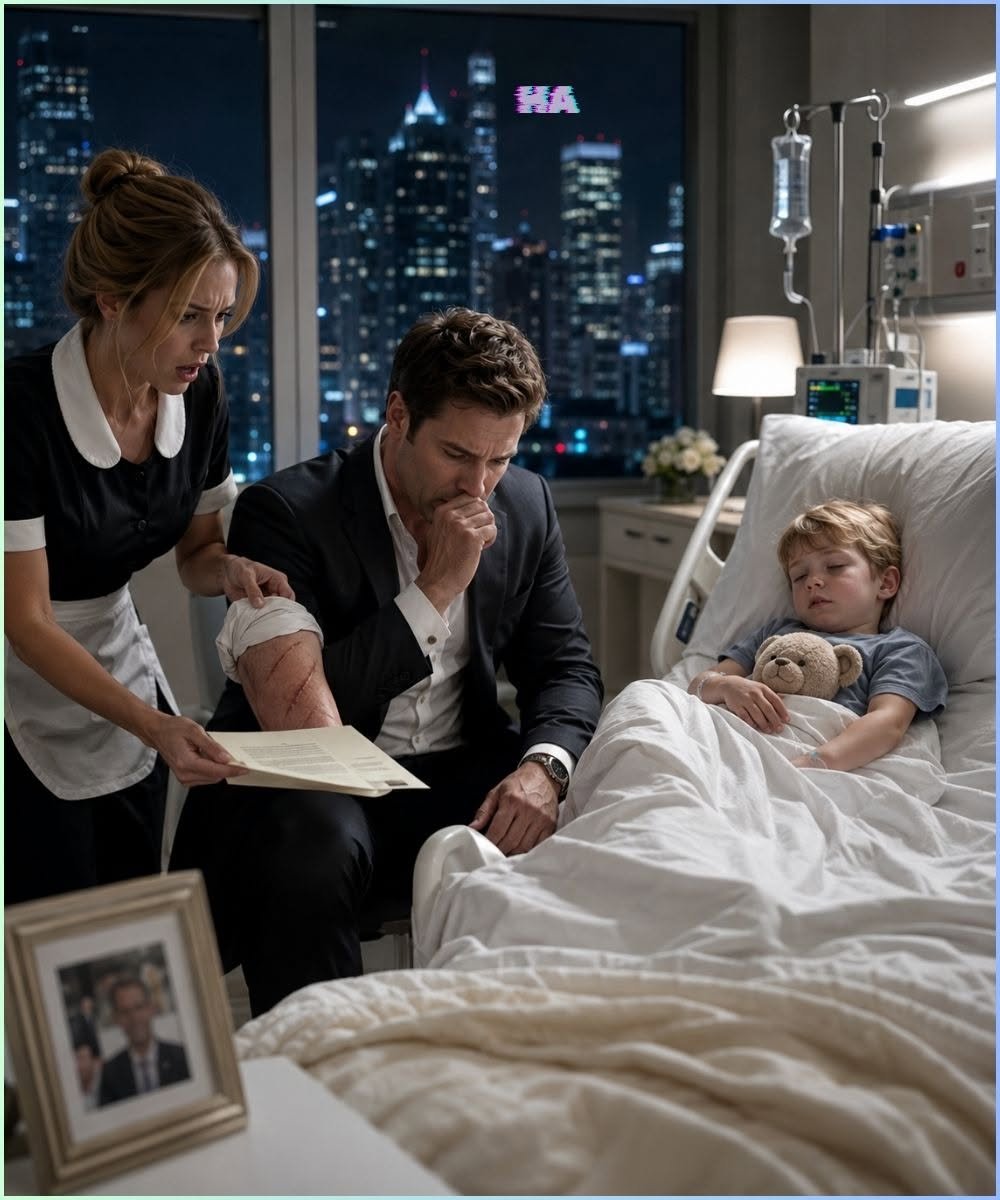
The child did not react to his presence.
“How is he this morning?” Marcus asked.
“I’ve only just met him.”
“Of course.”
Marcus’s gaze moved to Maria’s pocket, where the shape of her phone was visible beneath her apron.
For one terrifying second, she wondered whether he had seen her taking pictures.
“Dr. Sterling will be here at ten,” he said. “The nursery should be empty during treatment.”
“What treatment?”
Marcus turned toward her.
The friendliness left his face so quickly that Maria wondered whether it had ever been there.
“You ask a lot of questions.”
“I need to know when I can finish cleaning.”
“You can return after the doctor leaves.”
He walked toward the door, then paused.
“Curiosity is not rewarded in this home, Maria.”
She forced herself to meet his eyes. “I was raised to pay attention.”
“That can be a useful quality.”
His smile returned.
“It can also be a very expensive one.”
When he left, Maria looked at Jason.
The boy’s eyes had opened.
They were pale blue, unfocused, and filled with a silent exhaustion that made her chest hurt.
“Is somebody hurting you?” she whispered.
Jason’s lips moved.
No sound emerged.
At eight fifteen, Maria encountered Benjamin Miller for the first time.
She was dusting the living room when he appeared in the hallway holding an untouched cup of coffee. He wore dark trousers and a wrinkled white shirt with the sleeves rolled unevenly. His hair needed cutting. His face needed sleep.
Magazine covers portrayed him as a commanding businessman who had built Miller Meridian Technologies from a college apartment into a global software empire.
The man standing in the hallway looked as if he had forgotten why he had walked into the room.
His eyes found Maria.
“You’re new.”
“Yes, sir. Maria Gibson.”
He nodded slowly.
His gaze drifted toward Jason’s nursery.
“Is he awake?”
“I believe so.”
Benjamin’s fingers tightened around his coffee cup.
He stood less than ten feet from his son’s door but did not move toward it.
Maria waited.
“I should check on him,” he said.
The words sounded like an obligation he was trying to convince himself to fulfill.
Still, he did not move.
Maria lowered the dust cloth.
“His room was very cold. I turned up the heat.”
Benjamin looked at her then.
Something flashed across his face. Fear, guilt, or perhaps irritation at having those feelings noticed.
“Thank you.”
He turned away.
“Mr. Miller.”
He stopped.
“Jason opened his eyes when I spoke to him.”
Benjamin’s shoulders rose with a quiet breath.
For a moment, Maria thought he might return.
Instead, he walked toward his office and closed the door.
She watched him disappear and felt two opposing emotions at once.
Compassion for a man crushed by grief.
Anger at a father hiding from a child who no longer had anyone else.
At ten o’clock, Dr. Raymond Sterling arrived with a black medical case.
He was sixty-three, silver-haired, and soft-spoken. He greeted Evelyn by name and accepted coffee from the kitchen as though he had been visiting the penthouse for years.
Marcus returned from Benjamin’s office and met him near the nursery.
Maria carried a basket of folded towels into the hallway.
“The room is ready,” she said.
Dr. Sterling gave her a pleasant smile. “Thank you.”
Marcus opened the nursery door.
“We won’t need assistance.”
Maria continued past them, turned the corner, and entered the linen closet.
The closet door had narrow wooden slats. Through them, she could see part of the nursery when its door remained open.
She told herself she only wanted to understand the treatment. Perhaps there was an innocent explanation for the marks. Perhaps the doctor injected medication beneath Jason’s arm because the veins in his hands were damaged.
Then she heard Marcus speak.
“Use the same amount as last week.”
Dr. Sterling answered quietly. “His blood pressure is already dangerously low.”
“Then reduce it by five percent.”
“He’s three years old, Marcus. There isn’t much room left for adjustment.”
Maria’s breath stopped.
Marcus lowered his voice, but the penthouse was so quiet that each word carried.
“Benjamin questioned the latest test results. He needs to see continued decline.”
Dr. Sterling stared at him. “You told me he had stopped asking questions.”
“He had. The new consultant in Boston suggested another round of testing.”
“So let them test him.”
“And find what?”
The doctor looked toward the open door.
Maria pressed herself against the shelves.
Marcus stepped closer to him.
“You are being paid very well to prevent surprises.”
“I’m done after today.”
“You said that six months ago.”
“I mean it this time.”
Marcus laughed softly. “No, you don’t. You have three malpractice settlements I made disappear, a gambling account your wife knows nothing about, and half a million dollars from me sitting behind two shell companies. You walk away now, you lose your license, your marriage, and your freedom.”
Dr. Sterling’s hand trembled as he opened his medical case.
Maria saw the syringe.
She saw the clear liquid drawn from a vial.
She saw Jason lying on the changing table with his face turned toward the doorway, his blue eyes open but empty.
The doctor lifted Jason’s arm.
“Easy, buddy,” he murmured.
Jason did not resist.
That was the worst part.
He did not cry until the needle entered the bruised skin beneath his arm, and even then, the sound was no more than a weak breath.
Maria covered her mouth.
Dr. Sterling withdrew the needle and pressed cotton against the puncture.
“How long?” Marcus asked.
“Twenty minutes before the sedation deepens. The immune suppression will continue building over the next several days.”
“Good.”
“There is nothing good about this.”
Marcus checked his watch. “Benjamin has a board meeting this afternoon. By the time he sees the boy, Jason will appear weaker. That is the point.”
Dr. Sterling snapped his case shut.
“You said you only needed Benjamin declared temporarily unfit.”
“I told you what you needed to hear.”
The doctor looked at him with sudden fear. “You’re not planning to kill the child.”
Marcus’s expression did not change.
“I’m planning to solve a problem.”
Maria felt the world tilt beneath her.
The men left the nursery.
She remained motionless inside the closet until the elevator doors closed behind Dr. Sterling. Marcus walked into Benjamin’s office.
Only then did Maria run to Jason.
He lay exactly where they had left him.
Tears slid silently toward his ears.
Maria lifted him into her arms.
His body felt almost weightless.
“I saw them,” she whispered. “I saw everything.”
Jason’s head rested against her shoulder.
His breathing grew slower.
Dr. Sterling had said twenty minutes.
Maria carried him to the rocking chair and held him while the drug moved through his blood. She wanted to call emergency services, but she had no name for the substance, no recording, and no proof beyond photographs of bruises.
She also knew that if Marcus realized she had witnessed the injection, he could remove Jason before help arrived.
She needed Benjamin.
At eleven twenty, she knocked on his office door.
He did not answer.
She knocked again, louder.
“Mr. Miller?”
“Come in.”
Benjamin sat behind a large desk with three computer monitors glowing around him. Financial reports covered the surface. A video meeting occupied one screen. Men in suits waited while Benjamin muted the call.
“Yes?”
“I need to speak with you about Jason.”
His expression changed instantly, not into concern but into controlled dread.
“Is something wrong?”
“When was the last time you saw him?”
Benjamin stared at her.
“That isn’t what I asked.”
“He has injection marks under both arms.”
“Of course he does. He receives treatment.”
“Do you know what they’re giving him?”
“Dr. Sterling manages his medications.”
“Have you ever watched him give one?”
Benjamin’s jaw tightened. “Maria, I understand that you are concerned, but Jason’s physicians are among the most qualified specialists in the country.”
“I saw him get weaker immediately after the doctor left.”
“That is a normal reaction to some medications.”
“Who told you that?”
His gaze shifted to the computer screen.
“Mr. Miller, please look at me.”
He did, and Maria saw that the emptiness in his eyes was not indifference.
It was terror.
She had met people at hospitals who avoided test results because uncertainty allowed them to imagine survival. Benjamin was not ignoring Jason because he did not care. He was refusing to look because seeing the truth might destroy the last structure holding him upright.
“I have three investor calls today,” he said. “A board meeting at two and a financing agreement that could collapse if I’m not present. I cannot respond to every concern raised by a new employee who has no medical training.”
“I know what fear looks like.”
“You don’t know anything about me.”
“I know your son needs his father.”
Benjamin went pale.
Maria regretted the cruelty of the sentence the moment it left her mouth, but she could not take it back.
His face hardened.
“Leave my office.”
“Please check his arms.”
“I said leave.”
“Someone may be hurting him.”
“Get out.”
The video call continued silently behind him. Twelve executives watched from small squares on the monitor.
Maria looked at Benjamin for another moment.
Then she left.
His office door closed behind her.
A second later, his voice resumed in the calm, mechanical tone of a man discussing numbers while his life collapsed three rooms away.
Maria returned to the nursery.
Jason’s skin was colder. His eyelids barely moved when she touched his cheek.
“Your father is lost,” she whispered. “That doesn’t mean he doesn’t love you.”
Jason’s fingers wrapped weakly around her thumb.
Maria sat beside him until his breathing steadied.
Then she made a promise.
“I’m going to prove it.”
For the next six days, she observed everything.
The temperature in Jason’s room dropped whenever Eleanor Miller stayed overnight. Eleanor insisted cold air reduced germs, though she could not remember which doctor had supposedly advised it. Marcus reinforced the rule and accused Maria of interfering whenever she adjusted the thermostat.
Dr. Sterling came twice.
Maria photographed every new injection mark.
She wrote down times, medications, visitors, and changes in Jason’s condition. She recorded the label information on each bottle. At night, she researched the names from her cousin’s apartment.
One drug weakened immune response.
Another thinned blood.
The sedative could cause respiratory failure in children.
None appeared in the treatment summaries Evelyn kept in the household binder.
Maria attempted to speak with Benjamin twice more.
The first time, Marcus intercepted her outside his office.
The second time, Benjamin left for Boston before sunrise.
Meanwhile, Jason became more responsive whenever several days passed between Dr. Sterling’s visits. He accepted spoonfuls of oatmeal from Maria when no one was watching. He smiled faintly when she made a toy bear dance across the blanket.
Then another injection came, and he faded again.
The pattern was unmistakable.
On the following Tuesday, Benjamin attended meetings downtown. Eleanor had taken a car to Connecticut. Marcus left after breakfast.
Maria entered Benjamin’s office.
She knew searching it could cost her job. She also knew Jason might not survive another week.
The room smelled of coffee, leather, and the stale air of sleepless nights. Files covered one cabinet. Most concerned business operations.
A thick folder rested beneath a stack of quarterly reports.
Estate Planning Revision.
Maria opened it.
The first pages established trusts for charities, employees, and distant relatives. Deeper inside, she found the clause concerning Jason.
In the event of Benjamin’s death, disappearance, or medically certified incapacity, full guardianship of Jason Alexander Miller and temporary controlling authority over the Miller family trust would pass to Marcus James Webb until Jason reached twenty-five years of age.
Miller Meridian’s largest voting block belonged to that trust.
Marcus would control the company.
He would control Jason’s inheritance.
He would control nearly everything Benjamin had built.
Maria photographed each page.
A vehicle sounded in the private garage.
Voices approached.
There was no time to leave.
She returned the folder, dropped to the floor, and crawled beneath the desk as the office door opened.
Benjamin entered first.
“Telling me to delay an audit makes me want it sooner,” he said.
Marcus followed him. “It’s a routine internal review, Ben. It can wait.”
“The finance committee requested it.”
“The finance committee requests something every month. You have enough to deal with.”
Benjamin dropped his phone on the desk above Maria.
“Jason’s latest blood work makes no sense.”
Maria held her breath.
Marcus pulled out a chair. “Sterling explained it.”
“He blamed trauma.”
“Trauma changes the body.”
“For eighteen months?”
“Children process grief differently.”
Benjamin was silent.
When he spoke again, his voice was raw.
“I stood outside his room this morning for fifteen minutes.”
“Why didn’t you go in?”
“I couldn’t move.”
Marcus sighed sympathetically. “You’re exhausted.”
“I remembered Catherine sitting in that rocking chair. Jason was asleep against her, and she looked at me and said we had everything. Three days later, she was dead.”
“You survived something unbearable.”
“Jason survived it. I disappeared.”
“You provided the best care money could buy.”
“I hired people to do what I was too afraid to do.”
Marcus leaned forward.
“Then let me help you. Take a leave from the company. Go somewhere quiet. Let me handle the business and Jason’s care until you’re steady.”
Maria closed her eyes.
The trap was being offered as kindness.
Benjamin gave a bitter laugh. “You want me to hand over my son?”
“I’m his godfather.”
“You’re also the chief financial officer facing an audit.”
Silence filled the office.
Maria’s pulse accelerated.
Marcus spoke carefully. “Are you accusing me of something?”
“No. I’m saying the timing is strange.”
“I have protected this company while you worked half-days and disappeared during meetings.”
“I work eighteen hours a day.”
“You sit behind screens eighteen hours a day. That isn’t the same as leading.”
Benjamin pushed back his chair.
“Leave.”
“Ben—”
“Get out of my office.”
Marcus stood.
Maria saw his polished shoes turn toward the door.
He paused.
“When Catherine died, I was the one who identified her body because you couldn’t do it. I handled the press. I managed the board. I sat beside you while you stared at a wall for two weeks. Do not mistake my loyalty for ambition.”
The door closed behind him.
Benjamin remained at the desk for several minutes.
Maria could hear him breathing.
Then his phone rang.
He answered and left the room while speaking to an attorney.
Maria waited until the hallway fell silent before crawling out.
Her knees shook.
From beyond the partially closed office door, she heard Marcus speaking on his phone near the elevator.
“The audit is three months away,” he said. “We still have time.”
A pause followed.
“Sterling increased the dose last week. The child will decline faster.”
Maria opened the recording application on her phone and held it near the door.
“No, Benjamin does not suspect the poisoning. He thinks I’m moving against the company, which is manageable.”
Another pause.
“The guardianship petition is prepared. Once Benjamin is declared psychologically unfit, I take control of the trust.”
Marcus laughed under his breath.
“After that, neither of them matters.”
The elevator doors opened.
Before entering, Marcus added one final sentence.
“The first accident looked natural. So will this.”
The doors closed.
Maria stood frozen.
The first accident.
Catherine’s accident.
She replayed the recording to make sure she had not imagined the words.
The first accident looked natural.
Marcus had not merely exploited Benjamin’s grief.
He might have created it.
That night, Maria emailed copies of the photographs and audio recording to a secure account. She sent another copy to her cousin with instructions not to open it unless Maria failed to call before midnight.
She considered contacting the police immediately, but the recording contained implications, not a direct confession. Marcus had wealth, attorneys, and access to Jason. If officers arrived without enough evidence to hold him, he might remove the child or destroy the medication records.
Maria needed proof of what Dr. Sterling was injecting.
She also needed Benjamin to believe her.
Two nights later, she stayed past the end of her shift.
Evelyn left at eleven. Eleanor had returned to Connecticut. Benjamin attended a late dinner with investors. Marcus was supposedly at a hotel conference.
Maria rested in the staff room with the door open.
At two forty-three in the morning, she heard the elevator.
She stepped into the hallway.
Marcus entered carrying a leather medical case.
He froze when he saw her.
“What are you doing here?”
“Jason had a fever. I didn’t want to leave him.”
“You are not paid to make that decision.”
“Why do you have Dr. Sterling’s bag?”
Marcus looked down as though he had forgotten he was carrying it.
“He left it earlier.”
“The doctor wasn’t here today.”
His eyes rose to hers.
The pleasant mask fell away.
“You have become a problem.”
Maria took one step backward.
Marcus set the medical case on a console table.
“How much do you want?”
“What?”
“People like you always begin with concern. Eventually, it becomes a number.”
“There is no number.”
“There is always a number.”
“You’re hurting a child.”
“Be careful.”
“And you hurt Catherine.”
Marcus’s face changed.
Only slightly.
But Maria saw it.
“You’ve been listening where you shouldn’t.”
“I heard enough.”
He approached her.
Maria’s phone was recording from her apron pocket, but that would not protect her if he reached her before she could call for help.
“You are a housekeeper,” Marcus said. “A woman with debt, a sick mother, and no influence. I am an officer of a company worth thirty-eight billion dollars. Which one of us do you think the world will believe?”
“The one with evidence.”
His gaze dropped toward her pocket.
Maria turned and ran.
She reached the nursery and locked the door behind her. Marcus struck it once with his shoulder.
“Open the door.”
Maria grabbed the heavy wooden rocking chair and wedged it beneath the handle.
Jason lay in bed, his lips pale.
She lifted him.
“Maria.”
Marcus’s voice became calm again.
“You are frightening the child.”
“He’s frightened because you keep sticking needles into him.”
“Open the door, and we can discuss this.”
“No.”
The handle rattled.
Then silence.
Maria listened.
Footsteps moved away.
She waited ten seconds, twenty, thirty.
A faint sound came from the adjoining bathroom.
The nursery connected to a private bathroom, which opened into the main bedroom Catherine had once shared with Benjamin.
Marcus had entered through the other side.
Maria moved toward the hallway door just as he stepped from the bathroom.
He grabbed her wrist.
Jason cried weakly.
“Give him to me,” Marcus said.
“Let go.”
“You have no idea what you are interfering with.”
“He’s a little boy.”
“He is an obstacle attached to a trust.”
The cruelty of the sentence gave Maria strength she did not know she possessed.
She drove her knee into Marcus’s thigh and tore free.
He lunged again.
Maria turned her body to shield Jason. Marcus caught her shoulder and pushed her against the wall. A framed picture fell and shattered.
Jason screamed.
The sound was raw, furious, and startlingly loud.
Marcus recoiled for half a second.
Maria ran through the hallway door.
At that exact moment, the private elevator opened.
Benjamin stepped into the penthouse.
He heard Jason screaming and dropped his briefcase.
By the time he reached the nursery, Maria was on the floor holding his son. Marcus stood in the hallway. A syringe and vial had fallen from the leather medical case during the struggle.
Benjamin looked from the needle to the bruises beneath Jason’s sleeve.
Then to Maria.
“What did you do to him?”
“Nothing. Someone has been poisoning him.”
Marcus’s hand slipped inside his coat.
Benjamin turned.
“What are you reaching for?”
Marcus stopped.
“It’s my phone.”
“Take your hand out slowly.”
“Ben, she attacked me. She broke into the nursery and became hysterical.”
Maria held out her phone.
“I recorded him. I recorded Dr. Sterling. I photographed Jason’s arms and your will.”
Benjamin did not take it.
His face had gone colorless.
Marcus shook his head. “She is extorting you.”
“Then why do you have Sterling’s bag?”
“He forgot it.”
“Why are you here at three in the morning?”
“You called me.”
“No, I didn’t.”
Marcus’s jaw tightened.
Benjamin looked at Jason.
For the first time in months, he did not glance and retreat. He stared at the bruises. He touched one with a shaking finger.
Jason flinched.
Benjamin looked as if the reaction had cut him open.
“How long?” he whispered.
“More than a year,” Maria said. “Maybe since after Catherine died.”
Marcus moved toward the elevator.
Benjamin stepped into his path.
“No.”
“Get out of my way.”
“Give me your phone.”
“Ben, you are not thinking clearly.”
“That is what you need everyone to believe, isn’t it?”
Jason’s scream weakened into labored gasps.
Maria felt his body become heavy.
“Mr. Miller, we need an ambulance.”
Benjamin turned.
Jason’s lips were turning blue.
Maria called emergency services while Benjamin took his son into his arms.
The moment he felt Jason’s weight, something broke across his face.
“My God,” he whispered. “He weighs nothing.”
The operator instructed Maria to lay Jason on the floor. Benjamin knelt beside him while Maria checked his breathing.
Jason’s chest rose shallowly.
“Stay with me, buddy,” Benjamin said. “Daddy’s here.”
Marcus took another step toward the elevator.
Benjamin looked up.
“If you leave, I will spend every dollar I have finding you.”
Marcus smiled bitterly. “You should have spent some of it paying attention.”
Benjamin’s face twisted.
The words landed because they were true.
Marcus pressed the elevator button.
Before the doors opened, the penthouse entrance filled with paramedics and two building security officers responding to Maria’s emergency call.
Benjamin pointed at Marcus.
“Do not let him leave.”
The security officers hesitated.
Marcus was their employer’s closest friend and a senior executive of Miller Meridian.
Benjamin roared, “Lock down the building!”
They obeyed.
The paramedics placed Jason on a stretcher. Oxygen covered his face. A monitor emitted rapid alarms.
Maria followed until a paramedic blocked her.
“Family only.”
“She is family tonight,” Benjamin said.
The ambulance carried all three of them to Hudson Mercy Hospital.
Marcus remained in the tower under security supervision while city detectives were contacted.
At the hospital, Jason disappeared through double doors.
Benjamin paced the waiting room while Maria sat with her injured shoulder pressed against a bag of ice.
Neither spoke for almost an hour.
Then Benjamin stopped near the window.
“I used to read to him every night,” he said.
Maria lifted her head.
“Catherine would complain that I skipped pages because I was tired. Jason always knew. He would point at the book and make me go back.”
His reflection in the glass looked older than forty-two.
“After the accident, I tried to read to him once. He asked for his mother. I couldn’t answer. I left the room and told the nurse to finish.”
“You were grieving.”
“I was abandoning him.”
“You thought other people were helping.”
“I paid other people so I would not have to see how much he needed me.”
Benjamin turned toward Maria.
“Why didn’t I notice the marks?”
“They were hidden.”
“You noticed them on your first day.”
“I was looking.”
The answer was gentle, but it struck him harder than blame.
Benjamin lowered himself into a chair.
“I couldn’t look at him without seeing Catherine. His eyes are hers. The way he tilts his head when he is confused, that is Catherine. Every time I entered the room, I felt the car crash happening again.”
Maria placed the ice aside.
“Jason felt it happening every day too.”
Benjamin covered his face.
“I let Marcus turn my grief into a weapon.”
Maria did not tell him he was wrong. Forgiveness offered too quickly could become another way of hiding from responsibility.
“You failed him,” she said quietly. “But you are here now. What you do next matters.”
A doctor entered at four twenty in the morning.
Dr. Lauren Hayes wore blue scrubs and carried a tablet against her chest.
“Mr. Miller?”
Benjamin stood so quickly that the chair scraped backward.
“Is my son alive?”
“He is stable.”
Benjamin closed his eyes.
Maria released a breath she had been holding for nearly two hours.
Dr. Hayes continued. “His blood contains dangerously high concentrations of immunosuppressants, anticoagulants, and sedatives. The combination explains the recurring infections, bruising, muscle weakness, low body temperature, and respiratory distress.”
“Could any medical condition create those levels naturally?” Maria asked.
“No.”
Benjamin’s voice was almost inaudible. “Someone gave them to him.”
“Yes.”
“How long?”
“We cannot determine that from tonight’s tests alone, but based on his physical decline, I would estimate repeated exposure over many months.”
Benjamin gripped the back of the chair.
“Can he recover?”
“The most immediate danger is respiratory failure. We have stabilized his breathing and started treatment to remove the drugs from his system. His organs have been under tremendous stress, but children can be remarkably resilient.”
“That isn’t an answer.”
Dr. Hayes held his gaze.
“If he had remained in that apartment another night, I do not believe he would have survived.”
Benjamin sat down.
The doctor’s expression softened.
“You brought him in before it was too late.”
“She did,” Benjamin said, looking at Maria. “I almost sent her away.”
A detective arrived shortly after sunrise.
Sarah Walsh was in her mid-forties, with tired eyes and a practical gray coat. She listened without interruption as Maria described the injections, threats, estate documents, and recordings.
Benjamin authorized access to the penthouse and company files.
When Maria played Marcus’s statement about the first accident looking natural, Detective Walsh paused the recording.
“Was your wife’s crash investigated?”
Benjamin nodded. “The police concluded she lost control in the rain.”
“Did anyone inspect the car independently?”
“Marcus handled it.”
Walsh’s gaze sharpened. “Did he also arrange the funeral?”
“Yes.”
“Insurance records?”
“Yes.”
“Communications with investigators?”
Benjamin swallowed. “Yes.”
The detective closed her notebook.
“We will examine the original accident file.”
Benjamin looked toward Jason’s room.
“Arrest him.”
“I need probable cause strong enough to hold him. The recording and medical evidence should get us there, but I want every possible charge supported before his attorneys can move.”
“He tried to poison my son tonight.”
“Then help me prove it.”
Benjamin unlocked his phone.
“There are security cameras throughout the penthouse.”
Maria stared at him. “You have cameras?”
“I installed them after Catherine died. I kept thinking someone had been inside before the accident. Marcus convinced me it was paranoia.”
“Do they record the nursery?”
“Yes, but I stopped watching the footage.”
Detective Walsh leaned forward. “Where is it stored?”
“A private server controlled by the building system.”
“Who has administrative access?”
“Me, the security director, and Marcus.”
Walsh was already dialing.
“Then we move now.”
The footage had not been erased.
Marcus had attempted to delete specific hours, but the building system preserved backup copies for insurance compliance. By eight o’clock, detectives had video of Dr. Sterling injecting Jason on nine separate occasions. Audio captured Marcus instructing him to create visible decline.
Another camera showed Marcus entering the nursery at night and lowering the thermostat.
A recording from Benjamin’s office captured Marcus discussing the guardianship plan by phone.
At nine fifteen, Dr. Sterling was arrested at his private clinic.
At nine forty, Marcus Webb attempted to leave Miller Tower through the underground garage.
He made it halfway to his car before officers stopped him.
Detective Walsh called Maria at ten.
“We have them both.”
Maria stepped into the hospital hallway so Benjamin could remain beside Jason.
“Did Marcus confess?”
“No. He demanded an attorney before we finished reading the warrant.”
“And Dr. Sterling?”
“He lasted twelve minutes.”
Maria leaned against the wall.
Walsh continued. “Sterling says Marcus approached him eighteen months ago. Marcus knew about the malpractice complaints and gambling debts. He offered to make them disappear in exchange for managing Jason’s treatment.”
“Why Jason?”
“Sterling believed the original plan was to make the child chronically ill so Benjamin would take a leave from the company. Marcus intended to use Benjamin’s mental health history to obtain temporary control.”
“But Sterling knew Jason could die.”
“Yes.”
“How much was he paid?”
“Five hundred and forty thousand dollars through consulting companies.”
Maria closed her eyes.
“Detective, what about Catherine?”
“We found a payment from one of Marcus’s companies to a mechanic who serviced Catherine’s car two days before the crash. The mechanic disappeared shortly afterward.”
“Do you think Marcus killed her?”
“I think we have enough to reopen the case.”
Maria looked through the window of Jason’s hospital room.
Benjamin sat beside the bed holding his son’s hand.
For the first time since Maria had met him, his phone was turned off.
Three days passed before Jason woke fully.
The drugs left his system slowly. He developed a fever, then a lung infection, but responded to treatment. Benjamin remained in the hospital through every test, every restless hour, and every frightened awakening.
He read picture books aloud even when Jason appeared unable to hear him.
On the fourth morning, Benjamin sat beside the bed reading The Little Red Caboose.
He reached the final page and quietly skipped two sentences.
Jason’s eyes opened.
His voice was weak.
“You missed it.”
Benjamin froze.
Maria stood in the doorway holding two cups of coffee.
Jason lifted one small finger toward the book.
“The train,” he whispered.
Benjamin looked at the page.
Then he began to cry.
“You’re right, buddy. I missed the train.”
He returned to the previous page and read every word.
Jason watched him.
When the story ended, Benjamin pressed his son’s hand against his cheek.
“I’m sorry I left you alone.”
Jason blinked slowly.
“Mommy left too.”
The sentence shattered what remained of Benjamin’s composure.
He leaned over the bed, careful of the tubes.
“Mommy didn’t want to leave. And neither did I. I was scared, Jason. Daddy was scared and made a terrible mistake.”
“You come back?”
“I’m back.”
“Tomorrow?”
“Tomorrow.”
“Next tomorrow?”
“Every tomorrow I’m given.”
Jason considered this, then closed his eyes.
His fingers remained wrapped around Benjamin’s.
Maria started to leave, but Benjamin called her name.
“Stay.”
She stepped inside.
Jason opened his eyes again and looked at her.
“Maria.”
“Hi, sweetheart.”
“You made me yell.”
She smiled through tears. “You needed to yell.”
“Mr. Marcus mad.”
“He can’t hurt you anymore.”
Jason’s eyes shifted to his father.
“Daddy stop him?”
Benjamin’s voice trembled.
“Maria stopped him. Daddy finally listened.”
Jason reached one hand toward Maria.
She took it.
For several quiet minutes, the three of them remained connected beside the hospital bed.
One year later, Marcus Webb stood in a Manhattan courtroom while a judge sentenced him to life in prison without the possibility of parole.
The charges related to Jason included attempted murder, child endangerment, conspiracy, financial fraud, and obstruction of justice.
The investigation into Catherine’s death produced an additional truth.
The mechanic who had serviced her car was found living under another name in Arizona. Faced with financial records and phone messages, he admitted Marcus had paid him to damage the brake system.
Catherine had discovered irregular transfers from Miller Meridian weeks before the crash. She planned to tell Benjamin after gathering evidence.
Marcus learned what she was doing.
He arranged the accident, then positioned himself beside the grieving husband as loyal friend, protector, and adviser.
He comforted the man whose wife he had killed.
He became godfather to the child he later poisoned.
He did not destroy the Miller family through superior intelligence.
He survived because grief made everyone stop looking closely.
Dr. Sterling accepted a plea agreement in exchange for testimony. His medical license was permanently revoked, and he received a long prison sentence.
When the judge asked Benjamin whether he wished to make a statement, he walked to the front of the courtroom.
Marcus watched him without expression.
Benjamin unfolded a page, then set it aside.
“You once told me that Maria should have minded her place,” he said. “You believed her job, her income, and her lack of power made her invisible. That was your greatest mistake.”
Marcus looked toward the defense table.
Benjamin continued.
“You understood money. You understood fear. You understood how to use grief against people. What you never understood was love without ownership. Maria had nothing to gain by saving my son. She risked her job, her safety, and her mother’s financial security because a child needed someone to notice him.”
His voice shook, but he did not look away.
“I spent a year believing I was Jason’s victim because I had lost my wife. The truth is that Jason lost his mother and then lost his father to grief. I cannot recover those months for him. I can only make sure he never doubts again that I see him.”
Marcus finally raised his eyes.
Benjamin’s expression hardened.
“You will spend the rest of your life being remembered not as the man who almost stole an empire, but as the coward who tried to murder a little boy because he was afraid of an audit.”
After the sentencing, reporters filled the courthouse steps.
Benjamin ignored their questions.
Jason waited inside a black town car with Maria. He was four now, healthier but still smaller than other children his age. His cheeks had regained their color. His hair curled over his forehead.
When Benjamin entered the car, Jason climbed into his lap.
“Is the bad man gone?”
“Yes.”
“Forever?”
“Forever.”
Jason leaned against him.
Maria watched the courthouse disappear behind them.
Justice had arrived, but it did not restore Catherine or erase the nights Jason had suffered alone. It did not remove Benjamin’s guilt or Maria’s memories of the syringe entering a child’s bruised arm.
Justice was not a perfect repair.
Sometimes it was only a locked door between the innocent and the person who had hurt them.
That afternoon, Benjamin took Maria to a renovated brick building overlooking a small park.
A brass sign near the entrance had been covered with cloth.
“What is this?” she asked.
“Something I should have done months ago.”
He pulled away the cloth.
The sign read the Gibson Center for Child Advocacy.
Beneath the name was a smaller sentence.
When silence costs lives, attention becomes courage.
Maria stared at it.
“No.”
Benjamin’s smile faded. “You haven’t even seen inside.”
“I’m a housekeeper.”
“You were a housekeeper.”
“I don’t have a degree in social work.”
“You will have trained staff, attorneys, investigators, counselors, and medical consultants. You will decide which cases receive emergency support.”
“You want me to run a foundation?”
“I want you to lead the part that listens.”
Maria shook her head. “You can’t build an entire organization because you feel guilty.”
“I am building it because guilt without action is just another form of selfishness.”
She looked at him.
Benjamin glanced toward Jason, who was chasing pigeons near the park fountain under the supervision of a nurse.
“Forty-seven employees passed through that penthouse during the year Jason was being poisoned,” he said. “Nurses, drivers, assistants, security officers, household staff. Some noticed things. During the investigation, three admitted they thought the room was too cold. Two saw the bruises. One heard Jason crying after Sterling’s visits.”
Maria’s throat tightened.
“Why didn’t they say anything?”
“They were afraid of losing their jobs. They assumed someone richer, smarter, or more qualified must know the truth.”
Benjamin turned back to her.
“You did not assume. You looked.”
“I was terrified.”
“Courage is not the absence of fear. You taught me that.”
Maria looked through the building’s glass doors. Inside, she could see offices, a children’s playroom, interview spaces, and a wall covered with drawings.
Her mother’s voice returned from years earlier.
When you see someone drowning, baby, do not waste time asking whether saving them is your job.
Maria had resented that lesson when hospital bills consumed her savings and responsibility followed her from one crisis to another.
Now she understood its other half.
Saving someone did not always mean carrying them alone.
Sometimes it meant building a place where more hands could reach.
“Jason’s name should be on the building,” she said.
Benjamin shook his head.
“Jason survived because of you.”
“He survived because he fought.”
“Then we will put his name on the children’s recovery program.”
Maria looked at him.
“You planned that answer.”
“I hoped you would argue.”
For the first time, they laughed together without guilt following immediately behind it.
The Gibson Center opened four months later.
Its first case involved a seven-year-old girl whose school custodian noticed that she hoarded food and panicked whenever an adult raised a hand. The second involved brothers left alone for days while their guardian disappeared. The third came from a nanny who found unexplained medication hidden in a toddler’s juice.
Maria listened to each caller with the same patience she had offered Jason.
“Tell me everything,” she would say. “Do not leave out the detail everyone else told you was too small.”
Within two years, the center had helped protect more than one hundred children.
Benjamin funded the work but did not control it. Maria insisted on an independent board, transparent accounting, and an annual external audit.
When she told him why, he smiled sadly.
“I suppose I deserve that.”
“This is not about what you deserve. It is about what the children deserve.”
Benjamin stepped back from daily management of Miller Meridian. He hired a new chief executive, reduced his schedule, and moved from the penthouse to a townhouse with a backyard where Jason could run.
Every evening at seven thirty, Benjamin turned off his phone.
He cooked badly, learned to braid toy horses’ manes, attended therapy, and read every page of every book.
Some nights, Jason asked about Catherine.
Benjamin no longer left the room.
He showed photographs. He told stories about the way she sang off-key in the car and burned pancakes because she always tried to answer emails while cooking. He explained that love did not disappear when someone died, but it could become painful when people did not know where to place it.
Jason listened.
Then he asked whether his mother would have liked Maria.
Benjamin always gave the same answer.
“She would have loved her.”
On Jason’s fifth birthday, the backyard filled with paper lanterns, balloons, and children from his preschool. Maria arrived carrying a wooden train set.
Jason ran across the grass and threw himself into her arms.
“You came!”
“I told you I wouldn’t miss it.”
“You’re late.”
“It is three minutes after two.”
“That’s late.”
Maria laughed and set him down.
He had grown taller, though he remained thin. A faint cluster of scars beneath his arm was the only visible reminder of the injections.
Benjamin approached with two glasses of lemonade.
“He has been standing at the gate since lunch.”
“I told him I was coming.”
“He inherited his impatience from Catherine.”
Jason tugged Maria toward a table covered with drawings.
“I made this.”
He handed her a picture of three figures standing beneath a yellow sun. One was tall, one had long dark hair, and the smallest figure stood between them holding both their hands.
“That’s Daddy,” Jason explained. “That’s me. That’s you.”
Maria swallowed.
“What are we doing?”
“Not leaving.”
Benjamin looked away toward the garden.
Maria crouched so that she was eye level with Jason.
“Do you remember the night we met?”
“I remember cold.”
Her chest tightened.
“I remember you singing.”
“I didn’t sing.”
“You did.”
Maria thought back. In the rocking chair, terrified and furious, she had hummed one of her mother’s old lullabies without realizing it.
“Maybe a little.”
Jason touched the scar beneath his sleeve.
“I remember you said you saw me.”
Maria pulled him close.
“I still see you.”
Behind them, children shouted as balloons escaped into the sky.
Jason ran back to his friends.
Benjamin watched him go.
“His therapist asked him last week what makes a family,” he said.
“What did he say?”
“People who stay when you are sick.”
Maria looked at the children playing across the lawn.
“That is a heavy answer for a five-year-old.”
“He is getting lighter.”
“So are you.”
Benjamin smiled.
It was not the polished smile from magazine covers or the empty expression he once carried through the penthouse. It belonged to a man who had learned that healing did not erase guilt. It taught a person how to live honestly beside it.
“I used to think providing meant making sure Jason had the best of everything,” he said. “Doctors, schools, security, trust funds. I thought love could be arranged through resources.”
“Money can help.”
“It can. But it can also hire walls. I paid people to stand between me and my pain, and Marcus walked through the space I created.”
“You trusted the wrong person.”
“I also ignored the right one.”
Maria glanced at him.
“You were difficult.”
“I was cruel.”
“You were both.”
He accepted the judgment.
“I have apologized to you many times.”
“You have.”
“Will you ever stop reminding me?”
“No.”
He laughed.
Across the yard, Jason climbed onto a small play structure and called for his father.
Benjamin immediately set down his glass.
“I’m coming.”
Maria watched him cross the lawn.
He did not hesitate at the edge of Jason’s world anymore.
He entered it.
Years later, people would remember the Miller case because of the money, the betrayal, and the courtroom spectacle. Documentaries would call Marcus Webb a criminal mastermind. Business articles would analyze how close he came to controlling a multibillion-dollar company.
Maria always rejected that version.
There had been nothing masterful about what he did.
He found a grieving father and encouraged him to hide. He found employees afraid of authority and trained them to remain silent. He found a doctor already willing to trade ethics for money. He concealed cruelty behind professionalism because he trusted people to look away.
His plan failed when one woman decided a child’s suffering mattered more than her position.
On the fifth anniversary of Jason’s rescue, Maria stood in her office at the Gibson Center and watched rain slide down the window.
Her phone rang.
A young man on the other end said he worked maintenance in a luxury apartment building. A child on the twenty-first floor cried every night after a private tutor arrived. The parents traveled constantly. The building manager had warned him not to interfere.
“I might be wrong,” he said.
“You might be,” Maria answered.
“I could lose my job.”
“You could.”
“What am I supposed to do?”
Maria looked at the framed drawing Jason had given her years earlier.
Two figures held hands beneath a crooked yellow sun.
“Start by telling me everything you noticed.”
When the call ended, she contacted the center’s response team.
Then she heard laughter in the hallway.
Jason entered carrying a school backpack, followed by Benjamin. At eight years old, Jason was healthy, talkative, and obsessed with astronomy. He had recently decided he would become a doctor who never gave children medicine without explaining it first.
“We brought dinner,” Benjamin said.
Jason lifted a paper bag. “And I got an A on my science project.”
“You told her about the grade before the food,” Benjamin said. “You owe me five dollars.”
“You bet against your own son?” Maria asked.
“I bet he would mention the pizza first.”
Jason looked offended. “Science is more important than pizza.”
“Write that down,” Maria told Benjamin. “He will deny it when he is sixteen.”
They ate on the floor of her office, as they had done countless times before.
Jason described planets while Benjamin listened with exaggerated seriousness. Maria reviewed notes from the new case between bites of pizza.
Outside, the rain softened.
Inside, the building remained busy. Counselors spoke with families. Attorneys prepared emergency petitions. A nurse examined a child in a brightly painted room.
The work did not end because one boy had been saved.
There was always another call.
Another detail everyone had dismissed.
Another frightened person standing at the boundary between silence and action.
Maria no longer believed bravery belonged to fearless people. Fearless people rarely understood what courage cost.
Bravery belonged to the maid whose hands shook while she photographed bruises.
To the father who entered the room he had avoided and admitted he had failed.
To the child who learned to trust the world again.
To the worker who made a phone call after being warned not to interfere.
Jason leaned against Maria’s desk and held up a drawing from his backpack.
It showed a silver train traveling through dark mountains toward a bright city.
“What is this one?” she asked.
“The train Daddy forgot to read about.”
Benjamin groaned. “Are we ever going to let that go?”
“No,” Jason and Maria answered together.
Jason grinned.
“The train got lost,” he explained, “but then it found the track again.”
Maria studied the picture.
“And where is it going?”
“Home.”
Benjamin looked at his son, his eyes filling with the same wonder captured in the old photograph outside the nursery.
This time, he did not turn away from the feeling.
He reached for Jason’s hand.
Maria placed the drawing beside the first one.
For a moment, they sat together without speaking while the city lights came on beyond the rain.
Once, Benjamin Miller had owned nearly everything money could purchase and had almost lost the only life he could never replace.
Once, Jason had been too weak to cry while powerful adults called his suffering treatment.
Once, Maria Gibson had entered a glass tower believing she was only there to clean rooms.
Instead, she found a child hidden beneath blankets, a father buried beneath grief, and an evil that survived because everyone had been told it was not their place to question.
She questioned it anyway.
And because she did, a little boy lived long enough to laugh, draw trains, study stars, and remind his father to read every page.
Because she stayed, a broken man became a present father.
Because she looked, hundreds of children were seen.
Love had not arrived with money, authority, or a perfect plan.
It came quietly in a cold nursery.
It lifted a sleeve.
It noticed the marks.
And when the whole world said to walk away, it answered with the bravest words a frightened person could speak.
I see you.
I believe you.
I am staying.
THE END
Website Disclaimer
The information provided on this website is for general informational and educational purposes only. While we strive to ensure that all content is accurate and up to date, we make no guarantees regarding the completeness, reliability, or accuracy of any information published.
The views and opinions expressed in articles belong to their respective authors and do not necessarily reflect the views of this website. Any action you take based on the information found on this website is strictly at your own risk. We will not be liable for any losses, damages, or inconveniences arising from the use of our content.
Some articles may contain opinions, third-party information, or external links. We do not endorse or guarantee the accuracy of content on external websites and are not responsible for their practices or policies.
All content on this website is provided in good faith and is intended for informational purposes only. Readers are encouraged to verify information independently and seek professional advice where appropriate.