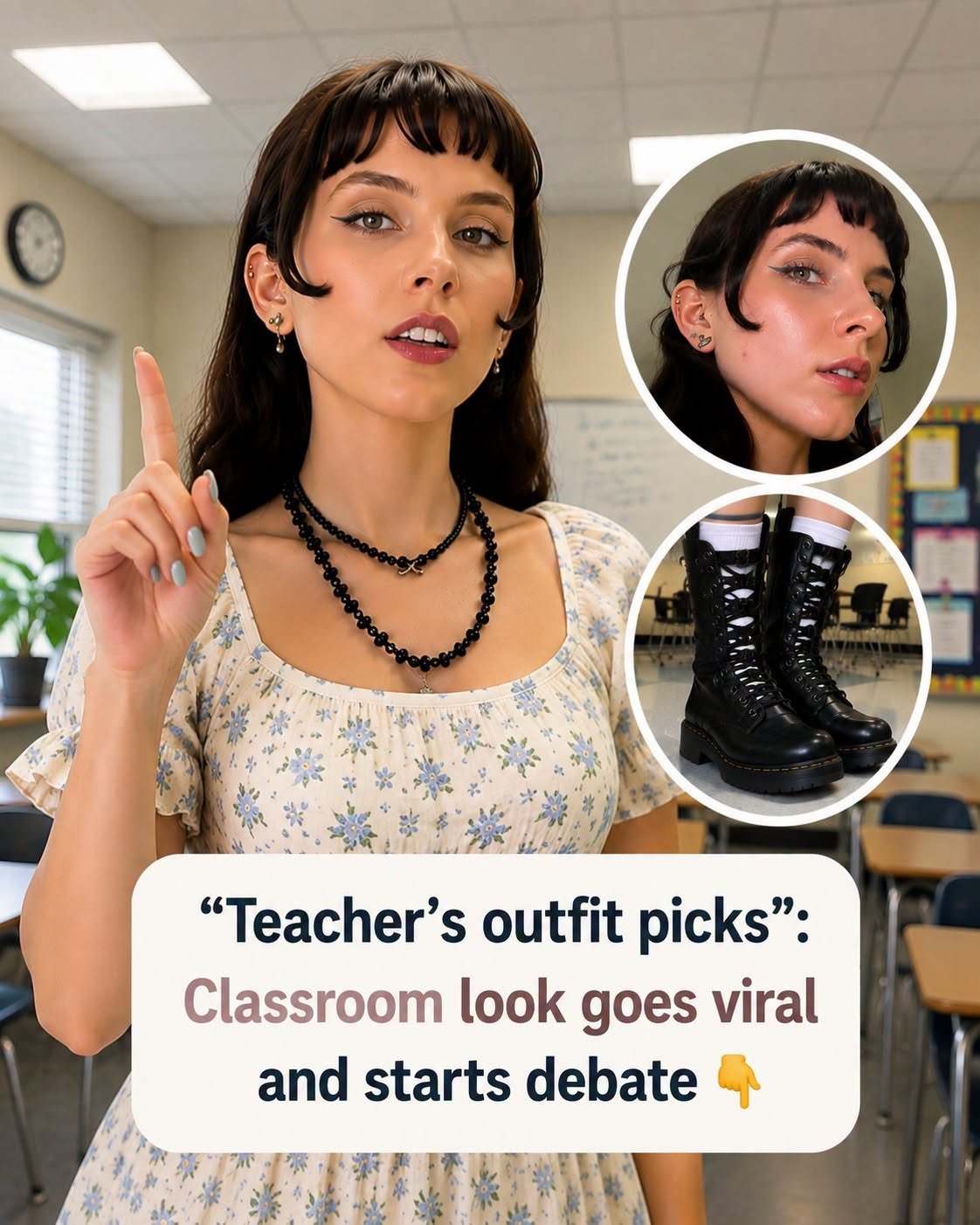
A teacher and social-media creator who goes by the name Sunshine Jones has become the subject of a widespread online discussion after videos showing her colorful outfits in a classroom attracted attention across TikTok and other platforms. Jones, who posts under the account @heymissteacher, regularly shares outfit-of-the-day videos as well as content about fashion, teaching and personal expression. Her distinctive style has earned her a large social-media following, but recent classroom videos have also generated criticism from people who question what teachers should wear and whether classrooms should be used as settings for social-media content.
The discussion intensified after one of Jones’ outfit videos circulated beyond her own TikTok audience. In the clip, she could be seen inside a classroom modeling a colorful outfit and accessories. Some viewers interpreted the video as harmless fashion content created by a teacher who enjoys expressing her personality through clothing. Others viewed the same footage very differently and argued that educators should maintain a more traditional professional appearance while at school.
The disagreement quickly moved beyond Jones herself and became a broader debate about expectations placed on teachers. Critics questioned whether outfit videos should be filmed inside classrooms and argued that educators should keep their personal social-media presence separate from their professional environment. Some went further, calling for stricter teacher dress codes and suggesting that visually distinctive clothing could become distracting in an educational setting.

Those claims represent opinions rather than established evidence about Jones’ teaching or her students. Publicly available clips showing someone’s clothing cannot establish whether that person is an effective educator, how students perform academically, or whether the outfits interfere with classroom instruction. There is also no basis for assuming that a short social-media video represents what happens throughout an ordinary school day.
One widely shared criticism argued that classrooms should be dedicated to teaching rather than treated as personal content studios. Other commenters made similar arguments about professionalism, saying they believed educators should follow clothing standards comparable with restrictions that schools sometimes impose on students. Those comments helped the video spread considerably beyond the audience that normally follows Jones.
Supporters strongly disagreed.
Many said they could not identify anything inherently inappropriate about the clothing shown in the videos. They noted that Jones was covered and argued that bright colors, unusual accessories and an unconventional personal style are not automatically incompatible with professionalism.
Some parents responding online said they believed their own children would enjoy having a teacher who dressed creatively. One recurring comparison was to Ms. Frizzle, the fictional teacher from The Magic School Bus, a character famous for wearing colorful outfits connected with the subjects she teaches.
That comparison captured the fundamental disagreement surrounding the videos.
Some viewers saw unnecessary distraction.
Others saw enthusiasm and personality.
The clothing itself had not changed.
Only the interpretation had.
Jones subsequently responded to criticism and explained more about the context surrounding her content. In one video, she pointed out that she had been preparing her classroom and had not yet met her students for the new school year. She said the clip should not be interpreted as footage of her posing for social media while actively responsible for teaching a class.
That distinction became important because some reposts characterized the footage as though it had been recorded during instructional time. Jones’ own explanation indicated that at least the video she was discussing was made while she was setting up the classroom before students arrived.
The debate also drew attention to another distinctive element of Jones’ appearance.
She wears a prosthetic right eye.

Jones has previously explained publicly that she lost her eye when she was five years old. Rather than always choosing a prosthesis designed to imitate a natural eye, she sometimes wears decorative prosthetic eyes featuring unusual colors and designs.
Her prosthetic eye has become part of both her personal style and her social-media presence.
When critics suggested that her appearance could distract students, Jones directly addressed that argument.
She explained that because she must wear a prosthetic eye, she prefers to have fun with it rather than treating it as something that needs to be hidden.
For Jones, the issue is connected to more than fashion.
She has argued that students will encounter people throughout their lives who look different from what they expect and that learning how to interact respectfully with people who have disabilities or unconventional appearances is itself valuable.
She rejected the idea that adults should remove every visually unusual person or object from children’s surroundings simply because someone might initially find it distracting.
Instead, she argued that students can learn how to manage their attention while accepting that people around them may look different.
Jones has also pointed out that she works with older students rather than very young children, although she defended teachers of younger students who choose colorful clothing as well.Economics
In her view, creativity and visual expression can contribute to a joyful classroom environment.
That is her perspective.
It should not be confused with a universal educational rule.
Likewise, critics’ assertions that unusual teacher clothing necessarily damages learning are opinions unless supported by evidence about a particular classroom.
The controversy therefore raises several different questions that are sometimes incorrectly treated as though they are one issue.
One concerns clothing.
Another concerns social media.
Another concerns disability and visible difference.
And another concerns what society expects teachers to look like.
Someone can believe that educators should be careful about filming social-media content at work without necessarily believing that teachers must dress conservatively.
Likewise, someone can support a teacher’s freedom to dress creatively while still believing schools should establish reasonable boundaries around personal content creation.
Those positions are not necessarily contradictory.
School policies also differ considerably.
Teacher dress requirements are generally established by individual employers, districts or institutions rather than by social-media commenters.
A viral post cannot determine whether Jones violated any workplace policy.
No credible evidence in the reporting reviewed for this article establishes that she was disciplined for the outfits shown in the viral clips.
That is an important distinction.
Online criticism is not the same thing as an employer finding misconduct.
Similarly, a person saying that an outfit is “unprofessional” does not make that classification an objective fact.
Professional clothing standards have changed substantially over time and can differ between workplaces, communities and occupations.
Teachers themselves often have particularly varied styles.
Some wear formal business clothing.
Others work in environments where practical or casual clothing is common.
Elementary teachers may dress differently from high-school teachers.
Art, science, physical-education and special-education classrooms can also involve different practical considerations.
Jones’ style sits toward the more visually expressive end of that spectrum.
That makes it noticeable.
Whether noticeable automatically means inappropriate is precisely what commenters have been debating.
Her supporters have argued that individuality can help teachers appear approachable and memorable.
Some commenters said the teachers they remembered most positively from their own school years were people who brought unusual personalities and interests into the classroom.
Others said Jones appeared enthusiastic about both fashion and teaching and saw no reason those interests could not coexist.
Critics continued to disagree.
They argued that teachers occupy positions of authority and therefore should model a more conventional version of professional presentation.
Some also objected less to the clothes than to the act of filming an outfit video inside a classroom.
That is another meaningful distinction.
A person might consider the clothing acceptable while questioning whether a workplace should appear in personal social-media content.
Jones’ explanation that she filmed while preparing the classroom rather than actively teaching addressed part of that criticism.
It does not require every viewer to agree with her decision.
But accurate discussion requires including the context she provided.
The viral reposts also demonstrate how easily context can disappear when social-media content moves between platforms.
A TikTok created for an established audience can be downloaded, clipped, reposted to X or another platform, and accompanied by a completely different description.
People encountering the repost may never see the original caption or the creator’s explanation.
They may therefore react to the framing supplied by the person reposting it rather than to the complete original context.
That appears to have contributed to the discussion surrounding Jones.
Once the video became part of a broader argument about schools, some reactions expanded far beyond her clothing.
Commenters began making generalized claims about public education, parenting, student behavior and the condition of schools.
Those broader political or cultural conclusions cannot reasonably be established from one teacher’s outfit video.
The available footage documents how one teacher chose to present herself online.
It does not provide evidence about an entire education system.
Jones has responded to the controversy rather than abandoning her position.
In her response, she defended the idea that teachers do not need to look identical or conform to one narrow image of what an educator should be.
She also connected her approach to her experience living with a visible disability.
Having lost an eye as a child, she knows personally what it means to look different.
Her decorative prosthetics appear to represent a deliberate rejection of the idea that difference must always be concealed.
That personal context changes how some supporters interpret her appearance.
What one critic might describe as distracting, another viewer may understand as disability visibility and self-expression.
Neither reaction alone tells the public how well Jones performs her professional responsibilities.
That would require substantially more information than an outfit video provides.
The discussion has nevertheless become an interesting example of how quickly ordinary social-media content can turn into a debate about professional identity.
Teachers increasingly exist in both physical classrooms and online spaces.
Some maintain entirely private accounts.
Others create educational content.
Some share humor about their profession.
Others, like Jones, mix teaching-related posts with fashion and personal interests.
That overlap creates questions previous generations of educators rarely had to consider.
How much of a classroom should appear online?
When should content be filmed?
What information about students must remain private?
How should educators separate personal expression from professional responsibilities?
Those are legitimate questions.
They are also different from simply deciding whether a colorful dress looks appropriate.
In Jones’ case, the most widely discussed footage did not show students being exposed, mocked or identified.
The controversy centered primarily on her own appearance and her decision to film herself in the classroom environment.
That narrower description is important because viral commentary can sometimes make an event sound substantially more serious than the underlying footage demonstrates.
There is also no evidence that students were prevented from learning because of the video.
Claims connecting Jones’ clothing with declining student respect or attention are therefore arguments made by critics, not documented outcomes from her classroom.
Supporters similarly cannot prove from TikTok alone that her fashion improves learning.
Both sides are interpreting limited public material.
What can be established is that Jones intentionally embraces an unconventional visual style.
She posts that style publicly.
A classroom has appeared as the setting for some of those videos.
She has explained that at least one disputed clip was filmed while she was setting up the room before meeting students.
She has also publicly defended decorative prosthetic eyes and colorful clothing as expressions of individuality rather than things she believes should be hidden.
The reaction has been sharply divided.
Some viewers want stricter boundaries.
Others see no meaningful problem.
And many appear less concerned about the clothing than about the intensity of the criticism directed toward a teacher for looking different.
For Jones, the attention does not appear to have changed her central argument.
Teachers, she believes, can remain educators while expressing personality through what they wear.
Critics remain free to disagree.
But disagreement should remain grounded in what the videos actually show rather than claims about her students or professional performance that cannot be verified.
Ultimately, the controversy is not evidence that colorful teachers are better educators or worse educators.
It is evidence that people hold very different expectations about what professionalism should look like.
Sunshine Jones chose to make those differences visible.
Her outfits attracted attention.
Her classroom setting intensified it.
Her prosthetic eye added another layer to the conversation.
And social media transformed an outfit-of-the-day video into a much broader debate.
Whether that debate changes anything about her future content remains to be seen.
For now, the available evidence supports a much simpler conclusion:
A teacher posted colorful outfit videos from a classroom setting, some viewers criticized them, others strongly defended her, and Jones responded by explaining the context and defending her right to be an expressive and visibly different educator.
Everything beyond that—including assumptions about her effectiveness as a teacher or the impact of her appearance on students—requires evidence that a viral outfit video simply cannot provide.
Website Disclaimer
The information provided on this website is for general informational and educational purposes only. While we strive to ensure that all content is accurate and up to date, we make no guarantees regarding the completeness, reliability, or accuracy of any information published.
The views and opinions expressed in articles belong to their respective authors and do not necessarily reflect the views of this website. Any action you take based on the information found on this website is strictly at your own risk. We will not be liable for any losses, damages, or inconveniences arising from the use of our content.
Some articles may contain opinions, third-party information, or external links. We do not endorse or guarantee the accuracy of content on external websites and are not responsible for their practices or policies.
All content on this website is provided in good faith and is intended for informational purposes only. Readers are encouraged to verify information independently and seek professional advice where appropriate.