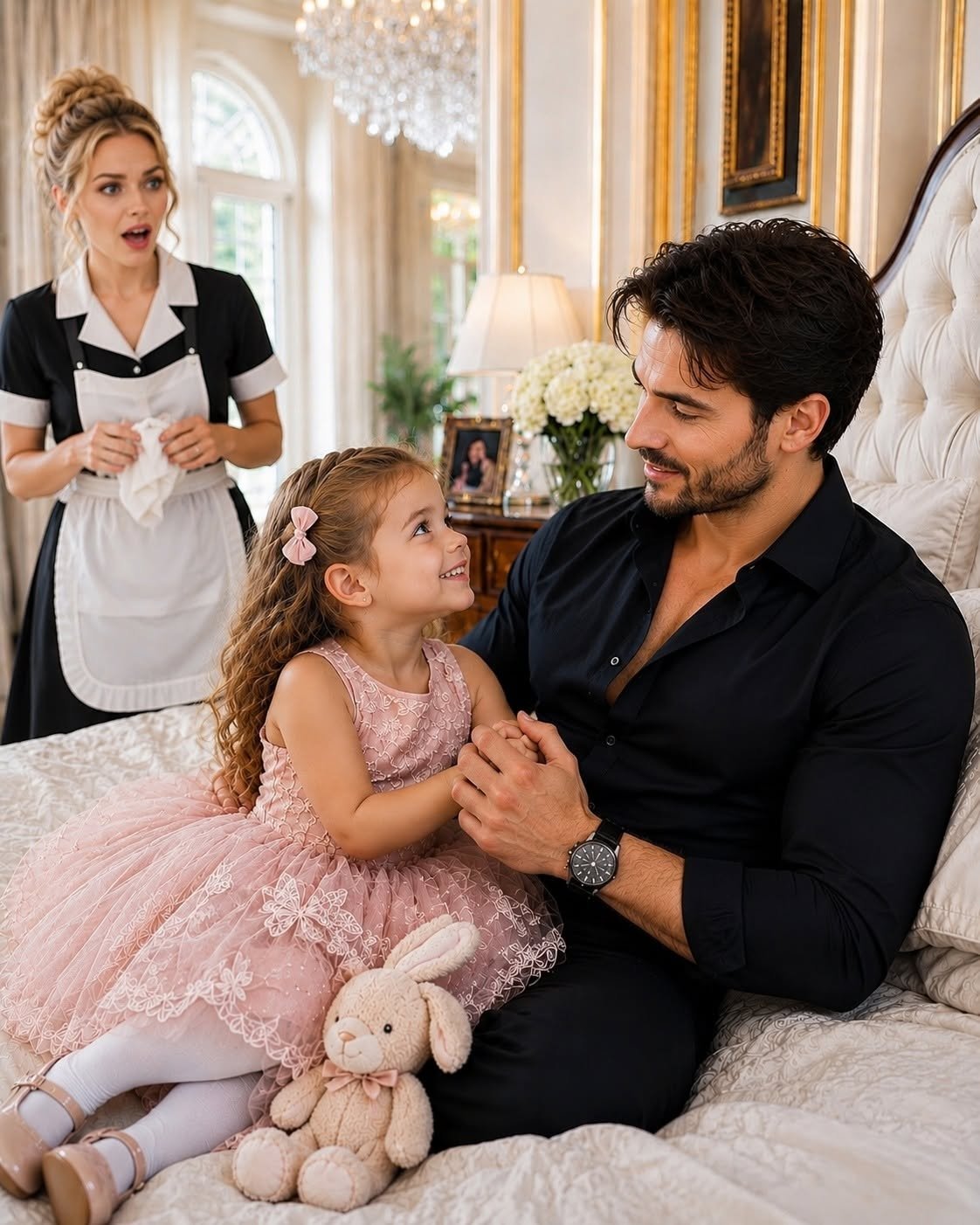
For months, I had watched that hand terrify grown men with nothing more than a lifted finger.
Now it trembled around my daughter’s.
“She can hear what none of you can,” he whispered again.
I swallowed hard. “Mr. Volkov, she’s deaf.”
His eyes shifted to me then. Gray, sharp, exhausted.
“Not like that.”
The guard nearest the door, a broad-shouldered man named Pavel, cleared his throat. “Sir, should I remove them?”
Damian’s expression changed instantly. Not angry, exactly. More like the old storm inside him remembered how to gather.
“Touch either of them,” he said quietly, “and you will regret having hands.”
Pavel stepped back.
I pulled Lila gently toward me. “Sweetheart, come here.”
But Lila did not look at me. Her gaze stayed fixed on Damian’s face. She lifted her free hand and signed slowly, her small fingers careful.
Hurts.
I felt my heart twist.
“Yes,” Damian murmured, watching her fingers as though they were words written in fire. “It hurts.”
My breath caught. “You understand sign language?”
His eyes did not leave Lila. “Some.”
That one word opened a crack in the room, and behind it I sensed a life no one in Grayhaven House spoke about.
Lila signed again.
Not sick.
Damian went still.
I stared at her hands, certain I had misunderstood.
“What did she say?” asked Pavel from the hallway.
I ignored him. “Lila, what do you mean?”
My daughter touched Damian’s chest again, then brought her hand to her own heart. Her brows pinched with concentration.
Not sick. Scared.
Damian looked away.
It was the smallest movement, just his eyes lowering toward the bedsheets, but in that room it felt like a confession.
He had shouted at doctors. Dismissed nurses. Refused medicine unless it came in sealed glass. Broken crystal tumblers against walls. Made every person in that mansion feel like his suffering was a locked door with danger behind it.
But my daughter had walked in and found fear.
I stepped closer. “Mr. Volkov, she doesn’t always have the words for what she senses. Sometimes she says things because she feels emotions strongly.”
Damian’s mouth curved, though not into a smile. “Children do not know how to lie properly. That makes them dangerous.”
Lila studied him for a moment, then signed one more word.
Music.
This time Damian’s face changed completely.
Color drained from what little remained in his cheeks. His fingers tightened around Lila’s hand, not enough to hurt, but enough for me to notice.
“What did she say?” Pavel asked again.
Damian did not answer.
I did. “She said music.”
The room held its breath.
Somewhere downstairs, a clock chimed eleven. Each note seemed to travel through the walls and settle heavily between us.
Damian turned toward the table beside his bed. On it sat medicine bottles, a silver-framed photograph turned facedown, a water glass, and an antique brass bell no one dared ring. His gaze landed on the photograph.
Then he looked back at Lila.
“What music?” he asked.
Lila shook her head, frustrated by the limits of speech and sign and the strange instinct that had led her there. She tapped her hearing device, then his chest, then made a little turning motion with her hands, like winding up a music box.
A muscle jumped in Damian’s jaw.
“Get everyone out,” he said.
Pavel straightened. “Sir?”
“Out.”
The guards withdrew at once, but I stayed where I was.
Damian’s gaze snapped to me. “That includes you.”
“No.”
It came out before I could stop it.
In Grayhaven House, saying no to Damian Volkov was like stepping onto ice without knowing how deep the lake was. But Lila was still beside him, still small, still mine.
“I’m not leaving my daughter alone,” I said, though my voice shook. “Not here. Not with anyone.”
For the first time, Damian Volkov looked at me as though I were more than a maid blending into wallpaper.
“What is your name?”
“You know my name.”
“I know what they call you when they need sheets changed or coffee brought. That is not the same thing.”
I hesitated. “Mara.”
“Mara,” he repeated, testing it like an unfamiliar key. “Your daughter is not in danger from me.”
“You’ll forgive me if I don’t find that comforting.”
Something almost amused passed through his eyes, then vanished beneath pain. He shifted, grimaced, and pressed his head back into the pillows. For a moment, the powerful man everyone feared looked old, though he could not have been more than fifty.
“Stay by the door,” he said at last. “But do not interrupt.”
I moved no farther than the foot of the bed.
Damian reached slowly toward the overturned photograph. His hand paused above it. Then he turned it upright.
I had cleaned that table three times a week and had never dared touch the frame.
The picture showed a little girl of about six sitting at a piano. She had dark curls, a serious mouth, and one hand lifted as if she had been caught mid-song. Beside her stood a younger Damian, his hand resting on her shoulder, his face softer than I could have imagined possible.
Lila leaned closer.
Damian turned the frame toward her.
“Her name was Anya,” he said.
The name made the air shift. It was not spoken like memory. It was spoken like a wound that had never closed.
I had heard rumors, of course. Everyone heard rumors in a house like Grayhaven. The staff whispered when they thought the walls weren’t listening. They said Damian Volkov had once had a daughter. They said she had died young. They said after that, he became harder, colder, less human.
But rumors are blunt instruments. They flatten grief into gossip.
Looking at his face now, I understood that whatever had happened to Anya had not ended. It had simply moved inside him and taken up permanent residence.
“She played a music box every night,” Damian said. “An ugly little thing with a painted swan on top. She loved it more than the piano I bought from Vienna, more than the violin teacher who charged enough to buy a small village.” His thumb brushed the edge of the frame. “It played the same eight notes over and over.”
Lila’s eyes widened.
She made the turning motion again.
“Yes,” he said softly. “A music box.”
I felt cold rise along my arms.
“How could Lila know that?” I asked.
Damian’s answer was barely audible. “That is what I would like to know.”
Thunder rolled somewhere beyond the estate, low and far away.
Lila touched the photo gently. Then she signed a question.
Where?
Damian stared at her.
I translated quietly. “She’s asking where Anya is.”
The silence that followed was terrible.
Damian lowered the photograph. “Gone.”
Lila’s face changed in the way children’s faces do when adults give an answer that is too small for the size of the question. She did not argue. She simply looked at the photo again, then at Damian’s chest.
Not gone.
My hands went cold.
Damian closed his eyes.
For one suspended second, I thought he might order us out after all. Or call the doctor. Or accuse my daughter of cruelty she could not possibly intend. Instead, he opened his eyes again, and there it was—the fear I had seen before.
Not fear of illness.
Fear of hope.
“Leave,” he said.
His voice had gone flat.
I took Lila’s hand immediately. “Come on, sweetheart.”
But as we reached the doorway, Damian spoke again.
“Mara.”
I turned.
His gaze moved from me to Lila and back again.
“Your daughter is not to be brought into this wing without my permission.”
“I understand.”
“And no one is to punish her for coming here today.”
I almost laughed from nerves. “Punish her?”
“In this house,” he said, “people sometimes mistake fear for discipline.”
I looked toward the hallway, where the guards stood pretending not to listen.
“I won’t let anyone touch her,” I said.
Damian studied me. “No. I suppose you won’t.”
Then he turned the photograph facedown again.
The dismissal was clear.
I carried Lila back to the servants’ quarters because my legs felt too unsteady to trust her to walk. She rested her head on my shoulder, rabbit tucked beneath her chin, her little body warm against me.
The moment we reached the narrow room we shared during my shifts, I shut the door and knelt before her.
“Lila.” I took both her hands gently. “You scared me.”
Her lower lip trembled.
I softened immediately. “I know you wanted to help.”
She nodded.
“You cannot go into rooms alone. Especially not his.”
She looked toward the direction of the east wing, though walls stood between us.
Sad man.
“Yes,” I said. “He is sad.”
Lila pressed one hand to her chest and made the turning motion again.
Music here.
I sat back on my heels.
“What music, baby?”
She frowned with effort, then hummed.
Lila rarely hummed. She could not hear herself the way other children could, but she felt vibration. Her little voice wavered uncertainly through the first few notes.
Eight notes.
Simple. Repeating.
A lullaby without words.
I had never heard it before.
Yet from somewhere deep within Grayhaven House, a sound answered.
It was faint. So faint that at first I thought the storm had shifted, or an old pipe had groaned in the walls.
Then it came again.
Tinny. Delicate.
Eight notes.
I rose slowly.
Lila looked up at me, eyes bright with recognition.
The music stopped.
Someone knocked.
I nearly jumped out of my skin.
Mrs. Albright, the housekeeper, entered without waiting for permission. She was a severe woman in her sixties, with silver hair pinned so tightly it seemed to pull at the corners of her eyes. She could fold a linen sheet into a perfect rectangle and reduce a grown man to shame with one raised eyebrow.
Today, however, she looked unsettled.
“Mara,” she said. “Mr. Volkov has requested that you and your daughter remain at Grayhaven tonight.”
I stared. “That’s impossible. My shift ends at five.”
“Your shift has changed.”
“I can’t stay overnight.”
Mrs. Albright’s expression softened by half an inch, which for her was practically weeping. “He has arranged a room in the west servants’ hall. Proper bedding. Supper. Anything the child needs.”
“My daughter is not a curiosity to be kept for his entertainment.”
A shadow crossed her face. “No one said she was.”
“Then why?”
Mrs. Albright glanced at Lila, who was busy making her rabbit bow to the chipped wooden chair.
“The doctor is returning this evening,” she said carefully. “Mr. Volkov wants the child nearby.”
“For what?”
“I am not told everything.”
That was a lie. Mrs. Albright knew which floorboard creaked in which corridor, which guard drank too much coffee, which guest preferred lies over sugar. If she did not know something, it was because she had chosen not to.
I crossed my arms. “Then tell him no.”
For a moment, the housekeeper looked almost impressed.
Then she said, “I did.”
I blinked.
“He said to ask you anyway.”
That unsettled me more than a command would have.
I looked at Lila. The rain outside had softened to mist, and she was pressing her cloth rabbit’s ear against her pink hearing device as if sharing a secret.
I thought of our apartment across town, with its unreliable heat and the neighbor whose television blared through the walls. I thought of the babysitter I could not pay and the grocery list folded in my pocket with more crossed out than written down.
Then I thought of Damian’s hand covering Lila’s and the way he had said Anya’s name.
“One night,” I said. “And my daughter stays with me.”
Mrs. Albright nodded. “Of course.”
Before dinner, the mansion changed.
Not visibly. The marble still gleamed. The portraits still watched from dark-paneled walls. The chandeliers still held their crystals like frozen tears. But the air was different. Staff moved in pairs. Guards spoke in murmurs. Doors that were usually open stood closed.
The poisoning had already made everyone suspicious. But Lila’s visit to Damian’s room had done something else.
It had disturbed the past.
I was carrying folded towels toward the guest bath when I heard voices from the library.
“You cannot seriously believe a child sensed poison in your heart.”
That was Dr. Elias Renner, Damian’s private physician. He was a careful man with gold-rimmed glasses and hands that smelled faintly of antiseptic and expensive soap.
Damian’s voice answered, weaker but cold. “I did not say poison.”
“You implied—”
“I said she heard something.”
A pause.
Then another voice spoke. Smooth. Female. Familiar, though I could not place it at first.
“Children repeat what adults whisper. Perhaps one of your staff has been telling stories.”
My fingers tightened around the towels.
Serena Vale.
Damian’s niece.
She visited twice a week in tailored coats and pearl earrings, always smelling of white flowers and winter air. To the staff she was polite in the way people are polite to furniture they might sit on later. She had taken charge of certain household matters since Damian’s illness, signing for deliveries, dismissing two footmen, changing security routines.
I had never liked how comfortable she looked in a house that did not belong to her.
“My staff,” Damian said, “knows better than to speak of Anya.”
The name dropped like a glass bead onto stone.
Silence.
Then Serena said gently, “Uncle, grief can make patterns out of nothing.”
“And ambition can make poison out of wine.”
My heart thudded.
Dr. Renner spoke quickly. “Damian, your condition worsens when you agitate yourself.”
“I am surrounded by people who tell me agitation is dangerous only when I begin asking useful questions.”
“Because useful questions can still exhaust you.”
“And unanswered ones can kill me.”
A chair scraped. I stepped back from the library door, but not quickly enough.
The door opened.
Serena stood there, one hand resting on the brass knob. Her blue eyes moved from my face to the towels in my arms.
“Mara,” she said. “How long have you been standing there?”
“Only a moment, miss.”
“I am not a miss.”
I lowered my gaze. “Ms. Vale.”
Her smile held no warmth. “Were the towels listening too?”
“I was taking them to the guest bath.”
“Through this hallway?”
“It’s the usual route.”
“Is it?”
Her eyes lingered on me long enough to make clear she knew I had heard something, whether I admitted it or not.
Behind her, Damian sat in a leather chair by the fire, wrapped in a dark robe, pale with effort. Dr. Renner stood beside him holding a medical bag.
Damian looked at me.
For a heartbeat, neither of us spoke.
Then he said, “Mara.”
“Yes, sir?”
“After you finish with the towels, bring your daughter to the music room.”
Serena’s expression did not change, but something sharpened beneath it.
“The music room?” she said lightly. “That room has been locked for years.”
“I know.”
“Do you think that is wise?”
“No.”
His eyes remained on me.
“I think it is necessary.”
The music room lay at the heart of the east wing behind double doors carved with vines and birds. I had passed it many times and never seen it opened. Dust had settled thickly into the grooves around the brass handles. A keyhole darkened the center plate like a watchful eye.
At eight o’clock, Mrs. Albright escorted Lila and me there.
Lila had eaten two bowls of soup, half a roll, and three strawberries from a dish Mrs. Albright pretended had been left over by accident. Now she clutched her rabbit and walked between us in her yellow boots, solemn as a tiny witness.
Damian was already waiting in a wheeled chair, though I suspected he hated being seen in it. Pavel stood behind him. Dr. Renner hovered nearby. Serena leaned against the wall, arms folded, expression composed.
Mrs. Albright held a ring of keys.
The first key did not fit.
Neither did the second.
At the third, Damian said, “The small iron one.”
Mrs. Albright paused. “Sir?”
“The small iron key.”
She found it near the back of the ring, blackened with age.
It turned with a reluctant click.
When the doors opened, the scent of dust and old wood drifted out.
The room beyond was beautiful in a sorrowful, abandoned way. Sheet-covered furniture formed pale shapes beneath the dim light. Heavy curtains hid the windows. A grand piano stood at the far end, its polished black surface dulled by years. On the walls hung framed music manuscripts and photographs turned gray by shadows.
Lila stepped forward.
I held her shoulder. “Wait.”
Damian lifted one hand. “Let her.”
She entered slowly, not afraid, only curious. Her boots left small prints in the dust.
No one followed at first.
The room seemed to belong to her.
She walked to the piano bench. Touched it. Then to a low shelf filled with books. Then to a small cabinet near the window.
There she stopped.
Damian’s breathing changed.
Lila pointed.
Mrs. Albright crossed the room and opened the cabinet.
Inside sat several objects wrapped in cloth: a porcelain bird, a stack of old recital programs tied with ribbon, a silver hairbrush, and a rectangular wooden box painted with a fading white swan.
The music box.
Serena exhaled softly. “How did she know?”
No one answered.
Mrs. Albright lifted the box with both hands and brought it to Damian.
His face had gone rigid.
“Open it,” Dr. Renner said gently.
Damian looked at him sharply. “Do not instruct me on grief.”
The doctor lowered his eyes.
For several moments, Damian did nothing. Then he reached for the tiny brass latch and opened the lid.
The music began at once.
Eight notes.
Thin, sweet, trembling from age.
Lila smiled.
Then the melody faltered.
A strange clicking sound interrupted the final note.
Damian frowned.
“It always did that near the end,” Serena said. “Don’t you remember?”
Damian’s eyes narrowed. “No.”
Serena’s mouth closed.
Lila touched the side of the box. She signed something quickly.
Again.
I translated. “She wants you to play it again.”
Damian wound the key with slow fingers.
The song repeated.
Eight notes. Then the click.
Lila leaned closer. Her small brows drew together. She pointed to the bottom of the box.
“Something’s inside,” I said.
Serena gave a short laugh. “It is a music box. Of course something is inside.”
“No,” Damian said. “She means underneath.”
Mrs. Albright took the box and turned it carefully. Beneath the worn velvet lining was a seam so fine I would never have noticed it. Pavel produced a pocketknife, but Damian stopped him.
“No blade.”
Mrs. Albright pressed around the corners until something loosened.
A hidden compartment slid open.
Inside lay a folded piece of paper, yellowed with time.
And a tiny brass key.
The room went utterly still.
Damian stared at the objects as if they had risen from a grave.
Mrs. Albright unfolded the paper with trembling hands.
“What does it say?” Damian asked.
She looked at the page, and all the color left her face.
“Mrs. Albright,” Serena said, too quickly. “Perhaps Damian should rest before—”
“Read it,” Damian ordered.
Mrs. Albright’s voice shook.
“Papa, if I cannot tell you myself, find the blue door under the stairs. Mr. Ilya said secrets are safer when they are sung twice.”
No one spoke.
The fire in the hallway cracked behind us.
Damian closed his eyes.
Ilya.
Even I knew that name.
Ilya Morozov had been Damian’s closest friend once. The older staff spoke of him in careful tones, as though he were another ghost the house had swallowed. He had managed Grayhaven’s books, arranged meetings, stood beside Damian in every photograph from years ago.
Then he had vanished shortly after Anya’s death.
Some said he betrayed Damian.
Some said Damian had him removed.
Some said no one truly knew.
Damian opened his eyes and looked at Serena.
“Did you know about this?”
Her face had become very calm. “Of course not.”
The answer was smooth.
Too smooth.
Damian looked at Dr. Renner. “And you?”
“No,” the doctor said. “I have never seen that note.”
Mrs. Albright still held the paper. She looked older than she had ten minutes earlier.
“Sir,” she whispered, “I remember the blue door.”
Everyone turned to her.
Damian’s voice dropped. “Where?”
“Under the servants’ staircase. It was sealed after the renovation. We were told the space had mold.”
“Who gave that order?”
Mrs. Albright glanced at Serena.
Serena lifted her chin. “I handled many repairs after the east wing was closed. I don’t recall every contractor’s detail.”
“No,” Damian said softly. “I imagine not.”
Pavel moved as if awaiting command.
Damian gripped the arm of his chair. “Take me there.”
Dr. Renner stepped forward. “Absolutely not. You are already pale. Your pulse—”
“My pulse has been discussed enough for one evening.”
“You may collapse.”
“Then I will collapse closer to an answer.”
Lila tugged on my sleeve.
Her expression had changed. The curiosity was gone. In its place was unease.
Home? she signed.
I looked down at her, torn.
She wanted to leave. I wanted to leave. Every reasonable part of me knew we should walk out of Grayhaven House and never come back.
But I looked at Damian.
He had just discovered that his dead daughter had left him a message hidden inside a music box. Whatever lay beneath the stairs had waited years. And somehow, impossibly, Lila had led him to it.
I knelt and brushed a braid from her cheek.
“Soon,” I signed. “Stay with me.”
We moved through the house in a strange procession: Damian in the chair pushed by Pavel, Dr. Renner beside him with a medical case, Serena walking behind with measured steps, Mrs. Albright holding the music box, and Lila and I at the rear.
The servants’ staircase was narrow and plain, hidden behind the kitchen corridor. Unlike the grand stairs with their marble rails, these steps were made for people meant to move unseen. Beneath them stood a storage alcove stacked with crates, old lamps, and rolled carpets.
Mrs. Albright directed two footmen to clear the space.
Behind a tall shelf, the wall had been plastered over.
But at the bottom, half-hidden beneath flaking paint, was a strip of blue wood.
Damian stared at it.
“Open it.”
Pavel examined the wall. “It’s sealed.”
“Then unseal it.”
It took twenty minutes, a crowbar, and more care than patience. Dr. Renner repeatedly checked Damian’s pulse until Damian threatened to check the doctor’s pulse with his cane. Even Serena stopped pretending indifference. She stood very still, one hand at her throat.
At last, the plaster cracked away enough to reveal a narrow blue door no taller than a child.
The brass key from the music box fit perfectly.
Pavel opened it.
A breath of cold air escaped.
Behind the door was not a room, but a crawlspace lined with old stone. At the back sat a metal strongbox wrapped in oilcloth.
Pavel pulled it out.
No one touched it for several seconds.
Then Damian said, “Mara.”
I startled. “Me?”
“You found the note.”
“Lila found the note.”
“Then stand with her.”
It was not permission. It was protection, though from what, I did not know.
The strongbox was locked, but the same brass key opened it.
Inside were three things.
A bundle of letters tied with blue ribbon.
A small cassette recorder.
And a sealed envelope marked in a child’s uneven handwriting:
FOR PAPA WHEN HE STOPS BEING ANGRY
Damian made a sound then.
Not a sob. Not quite.
Something deeper and more private.
He took the envelope as though it weighed more than the house.
His fingers shook so badly he could not open it.
“Allow me,” Mrs. Albright whispered.
He handed it to her.
She broke the seal and unfolded the letter.
This time, Damian did not ask her to read aloud. He took the paper himself.
His eyes moved across the page.
The hallway was so quiet I could hear Lila breathing.
Then Damian lowered the letter.
His face had changed. The harsh lines remained, the illness, the exhaustion—but beneath them was a father whose grief had just been given a voice.
“She wrote that she heard people arguing,” he said. His words came slowly, as if each one cost him. “She wrote that Uncle Ilya told her if anything happened to him, she must hide the blue box. She wrote that someone in the house was making plans.”
Serena’s voice was barely more than a whisper. “She was a child. Children misunderstand.”
Damian did not look at her.
“She wrote names.”
The color left Serena’s face.
Dr. Renner shifted. “Damian…”
At the sound of the doctor’s voice, Damian’s eyes lifted.
The hallway seemed to narrow around them.
“What did you know, Elias?”
Dr. Renner opened his mouth, closed it, then removed his glasses with slow care.
“I knew Ilya was afraid,” he said at last.
Serena turned on him. “Elias.”
He did not look at her.
Damian’s voice became dangerously quiet. “Afraid of whom?”
Dr. Renner rubbed both hands over his face. For the first time since I had known him, he looked less like a polished physician and more like a tired man who had spent too many years standing near a locked door.
“Not of you,” he said. “That is what matters.”
Damian’s laugh was hollow. “It matters very little if you do not finish the sentence.”
“Ilya believed someone was feeding you lies about Anya’s accident. He believed the records had been altered.”
“My daughter fell from the balcony.”
“That is what we were told.”
Damian’s hand tightened around the letter. “What are you saying?”
Dr. Renner glanced at Lila, then at me, and shame crossed his face.
“I am saying Anya may not have been alone when she fell.”
Serena whispered, “Enough.”
But there was no force behind it now.
Damian turned to her.
For once, Serena Vale looked frightened—not of punishment, not of scandal, but of a truth she could not fold neatly away.
“What do you know?” Damian asked.
She shook her head. “I was nineteen. I knew nothing.”
“Then why are you trembling?”
“Because this is cruel,” she said, and her composure cracked at the edges. “Because you are tearing open a grave based on a child’s note and another child’s strange guesses. Because this family has lived under your grief for fourteen years, and now you want to drag us back into it.”
Damian looked at her for a long moment.
Then he said, “An innocent person does not fear a grave being opened.”
Serena’s eyes filled, but no tears fell.
Lila stepped closer to the strongbox.
I caught her hand. “No, sweetheart.”
She pointed to the cassette recorder.
“Does it still work?” Damian asked.
Pavel took it out carefully. “Old batteries.”
Mrs. Albright disappeared and returned with fresh ones from the kitchen drawer. Her hands shook as she fitted them into the back.
The cassette clicked into place.
For several seconds, there was only static.
Then a little girl’s voice filled the servants’ corridor.
“Papa, I am playing the song so you know it is me.”
A pause.
Then eight notes played faintly in the background.
Damian’s face crumpled.
I looked away, not because I was embarrassed for him, but because some kinds of grief should not be stared at.
Anya’s recorded voice continued.
“Mr. Ilya says I must speak clearly. I am trying. I heard Aunt Celia and the man with the doctor bag. They said Papa must never know about the papers. They said if I tell, everyone will say I am making stories. But I am not making stories.”
Dr. Renner went rigid.
Serena frowned. “Aunt Celia?”
Damian whispered, “My sister.”
Aunt Celia.
Serena’s mother.
The tape crackled.
“I put the first key in my swan box. The second key is with Mr. Ilya because he says two keys are safer. He said if he has to go away, he will send it to the only person Papa still trusts. But Papa is angry at everyone, so I do not know who that is.”
There was a small sound on the recording, as if Anya had moved closer to the machine.
“Papa, please do not shout when you hear this. Shouting makes people hide. Mr. Ilya says quiet people find more doors.”
The tape clicked.
Silence.
No one moved.
Then Damian bowed his head over the recorder and wept.
Not loudly. Not dramatically. His shoulders barely moved. But tears slipped down his face and disappeared into the lines illness had carved there. Every person in that corridor, from the guards to the housekeeper, seemed to understand that the man before us was not the feared name whispered across Baltimore.
He was a father hearing his daughter ask him, too late, to become quiet enough to listen.
Lila pulled free of my hand and went to him.
I almost stopped her, but Damian looked up.
She placed her cloth rabbit on his knee.
For comfort.
Damian stared at it, then gently touched one worn ear.
“Thank you,” he whispered.
Lila signed, Don’t be angry.
I translated softly.
Damian let out a broken breath. “I do not know how.”
Lila considered this. Then she signed, Try small.
For the first time that evening, Mrs. Albright covered her mouth, and I saw her eyes shine.
Damian looked at my daughter for a long time.
Then he nodded once.
“I will try small.”
The house did not sleep that night.
Neither did I.
Lila finally drifted off in the west servants’ room, curled beneath a quilt Mrs. Albright claimed had been in storage but smelled freshly laundered. I sat beside her bed, watching the rise and fall of her breathing, while the mansion murmured beyond the walls.
Footsteps passed. Doors opened and closed. Low voices threaded through the halls.
At midnight, Mrs. Albright knocked and entered carrying tea.
“I thought you might need this.”
“Thank you.”
She sat in the wooden chair opposite me, though I had never seen her sit during working hours.
For a while we said nothing.
Then I asked, “Did you know Anya?”
Her eyes softened. “Yes.”
“What was she like?”
Mrs. Albright smiled faintly. “Serious. Too serious for a child, sometimes. She would ask questions that made adults uncomfortable. Why do people say they are fine when they are not? Why does her father trust men who never smile? Why do rich people have so many rooms and still look lonely?”
Despite myself, I smiled.
“She sounds wonderful.”
“She was.”
Rain whispered against the window.
“Do you think she really knew something?” I asked.
Mrs. Albright looked toward the door, as if the house itself might be listening.
“I think children are often dismissed when they notice what adults try to hide.”
Her answer settled heavily over me.
I thought of Lila. How often people assumed silence meant emptiness. How often strangers spoke around her instead of to her. Even doctors had done it, discussing her hearing loss over her head while she watched their mouths and understood more than they realized.
“She isn’t magic,” I said quietly. “Lila. People look at her like she did something impossible.”
Mrs. Albright nodded. “What do you think happened?”
I looked at my sleeping daughter.
“She feels vibrations. Patterns. She watches faces. She notices things people miss because they’re too busy listening for words.”
“And the music?”
“I don’t know.”
That was the truth.
Mrs. Albright took a slow sip of tea. “Sometimes houses remember.”
I looked at her.
She gave a small, tired smile. “An old woman is allowed one foolish sentence after midnight.”
Before dawn, Damian sent for me.
I did not want to go.
But Mrs. Albright stayed with Lila, and Pavel escorted me through the dim corridors without speaking. Grayhaven House looked different before morning, stripped of its grandeur. Shadows gathered in corners. Paintings seemed less proud. Even the marble floors looked cold and vulnerable.
Damian was in the library, wrapped in a blanket, seated near the dead fire. The strongbox sat open on the table. Letters were spread before him in careful rows.
Dr. Renner stood by the window.
Serena was gone.
“Where is Ms. Vale?” I asked before I could stop myself.
Damian’s eyes flicked toward me. “Resting, she says.”
The way he said it told me no one believed her.
He gestured to a chair. “Sit.”
I remained standing. “Why am I here?”
“Because your daughter found the first door. And because you are less afraid of me than most sensible people.”
“I’m very afraid of you.”
“But it does not decide for you.”
I had no answer to that.
Damian picked up one of the letters. “Ilya wrote these. He believed my sister Celia was moving money through accounts connected to my businesses. He believed she intended to make me appear unstable after Anya’s death so she could gain control of the family trust.”
“Did she?”
“She died three years later,” Damian said. “By then, I had already become exactly what she needed everyone to think I was.”
There was no self-pity in his voice. Only the flat recognition of a man reading the shape of his own mistakes.
“What does this have to do with the poisoning?” I asked.
Damian’s expression darkened.
“That is the question.”
Dr. Renner turned from the window. “The poison used in the wine was subtle. Slow. Whoever administered it understood his medication, his routines, and his distrust.”
“So someone close,” I said.
“Yes.”
“And now you think the old secret and the new poisoning are connected.”
Damian leaned back, exhausted. “Old sins grow roots. Sometimes they crack the floor years later.”
I looked at the letters.
“Why tell me this?”
“Because your daughter is involved now, whether I like it or not.”
“No,” I said immediately. “She is four. She is not involved in anything.”
Damian nodded. “You are correct. That was poorly said.”
The apology startled me more than his anger ever had.
He continued, “I mean only that people in this house saw what happened. They saw her lead us to the music box. If someone wants these secrets buried, they may wonder what else she knows.”
Fear opened cold inside me.
“I want to leave.”
“I have arranged a car.”
“I mean leave this completely. My job. This house. All of it.”
Damian’s face tightened, but he nodded again. “You should.”
I expected resistance. Orders. Bargains.
Not agreement.
“You’re letting me go?”
“I am not letting you do anything. You are a mother. You decide.”
The words were simple, but they landed somewhere deep.
For so long, my life had felt like a series of corners. Bills. Shifts. Appointments. Forms. People telling me what Lila needed without asking who she was. Men with power deciding the shape of rooms I had to clean.
Now the most feared man in Baltimore was telling me I had a choice.
I hated that it made me want to cry.
“I’ll pack after Lila wakes,” I said.
Damian reached into a drawer and took out an envelope.
“No,” I said before he could offer it.
“You have not looked inside.”
“I don’t need to.”
“It is not charity.”
“It always is when one person can afford to forget giving it.”
His eyes sharpened, but not with anger.
“My daughter left a message telling me quiet people find more doors,” he said. “You raised one. That deserves more than wages.”
I shook my head. “What she did wasn’t for sale.”
“I know.”
He placed the envelope on the table anyway.
“Then consider it back pay for every hour this house asked you to be invisible.”
That, I had no defense against.
I did not take it.
But I did not refuse a second time.
When I returned to the servants’ room, Lila was awake and sitting cross-legged on the bed while Mrs. Albright braided her hair properly.
“Your daughter has strong opinions about ribbons,” Mrs. Albright said.
Lila beamed and held up a blue one.
Blue.
I smiled despite everything. “Beautiful.”
We packed quickly. There was not much. Lila’s spare clothes, her drawing pad, the cloth rabbit, my worn purse, the lunch container I had forgotten to wash. Mrs. Albright folded the quilt and placed it in my bag.
“That isn’t ours,” I said.
“It is now.”
I opened my mouth.
She raised one eyebrow.
I closed it.
By seven, the car waited at the side entrance.
Grayhaven House was waking around us, but quietly, as if the night had taken something from it. Staff avoided my eyes. Guards watched corners. Somewhere upstairs, Damian Volkov was reading the words of ghosts.
As we reached the door, Serena appeared at the end of the hall.
She wore the same clothes from the night before. Her hair was pinned, but not perfectly. There were shadows beneath her eyes.
“Mara,” she said.
Mrs. Albright stiffened beside me.
Serena approached slowly, her gaze dropping to Lila.
“I wanted to apologize if I seemed harsh yesterday.”
The apology sounded rehearsed.
I held Lila’s hand. “It was a difficult night.”
“Yes.” Serena’s smile faltered. “For all of us.”
Lila leaned against my leg.
Serena noticed. Something like regret passed across her face, so quick I almost missed it.
“My mother was not a kind woman,” she said quietly.
Mrs. Albright drew in a breath.
Serena looked toward the east wing. “People think families keep secrets to protect reputations. Usually, they keep them because they are afraid of what love will demand once the truth is known.”
For the first time, she sounded human.
Then she reached into her coat pocket.
Pavel stepped forward instantly.
Serena froze. “It’s only this.”
She held out a small white card.
I did not take it.
“What is it?”
“My number. In case you remember anything else. Anything your daughter says.”
“My daughter is not part of this.”
Serena’s eyes flicked to Lila. “No. Of course.”
She set the card on the narrow table by the door.
As she turned to leave, Lila suddenly tugged free from me and stepped toward her.
“Lila,” I warned.
My daughter looked up at Serena and signed one word.
Sorry.
Serena stopped.
Her face crumpled—not fully, not dramatically, but enough that I saw the little girl she might have been before Grayhaven taught her how to polish every feeling smooth.
“For what?” Serena whispered.
Lila touched her own cheek, then pointed gently at Serena.
Crying inside.
Serena stared at her.
Then she walked away without another word.
In the car, Lila fell asleep before we reached the main road. The envelope Damian had given me lay unopened in my lap. I watched Grayhaven House recede through the rear window, its stone towers fading into morning mist.
I told myself we were done.
By noon, we were home.
Our apartment looked smaller than I remembered and more precious. Sunlight slipped through the thin curtains. The radiator clanked like an old man clearing his throat. The sink held two cups and a spoon. Ordinary things. Safe things.
I made grilled cheese for Lila and tomato soup from a can. She dipped the corner of her sandwich carefully, then offered her rabbit a bite.
For a few hours, I almost believed life could return to what it had been.
Then the envelope slipped from the counter where I had placed it.
Its contents spilled across the floor.
Money, yes.
More than I expected. More than I was comfortable touching.
But beneath it was something else.
A photograph.
Not of Damian.
Not of Anya.
Of me.
I picked it up slowly.
It showed my mother at about my age, standing in front of Grayhaven House. She wore a maid’s uniform and held a baby wrapped in a pale blanket.
On the back, in faded ink, someone had written:
Mara, six weeks old. Keep her far from this house.
My knees weakened.
I sat on the floor.
Lila looked up from her soup, her face questioning.
I turned the photograph over again, searching for some explanation hidden in the paper fibers.
My mother had never told me she worked at Grayhaven.
She had never told me I had been there as a baby.
She had never told me why we left Baltimore for six years when I was small, or why she flinched whenever black cars slowed near our building, or why, on her last day in the hospital, she gripped my hand and whispered, “Some doors open only when they hear the right heart.”
I had thought it was fever talking.
Now I was not sure.
My phone rang.
Unknown number.
I almost let it go.
Then I answered.
For a moment, there was only static.
Then Damian Volkov’s voice came through, low and strained.
“Mara,” he said, “do not bring Lila back here.”
My fingers tightened around the phone. “What happened?”
A pause.
When he spoke again, the fear had returned.
“Because I just found Ilya’s second key,” he whispered, “and it was hidden inside your mother’s grave.”
Website Disclaimer
The information provided on this website is for general informational and educational purposes only. While we strive to ensure that all content is accurate and up to date, we make no guarantees regarding the completeness, reliability, or accuracy of any information published.
The views and opinions expressed in articles belong to their respective authors and do not necessarily reflect the views of this website. Any action you take based on the information found on this website is strictly at your own risk. We will not be liable for any losses, damages, or inconveniences arising from the use of our content.
Some articles may contain opinions, third-party information, or external links. We do not endorse or guarantee the accuracy of content on external websites and are not responsible for their practices or policies.
All content on this website is provided in good faith and is intended for informational purposes only. Readers are encouraged to verify information independently and seek professional advice where appropriate.