My Son Raked Our Elderly Neighbor’s Yard for 10 Years — After Her Death, One Photograph Revealed His Father’s Secret
For ten years, my son Caleb woke before sunrise each autumn to rake our elderly neighbor’s yard, never expecting a penny in return. I raised him alone after his father, David, walked out when Caleb was just four, leaving me to juggle rent, bills, and extra work to keep us afloat.
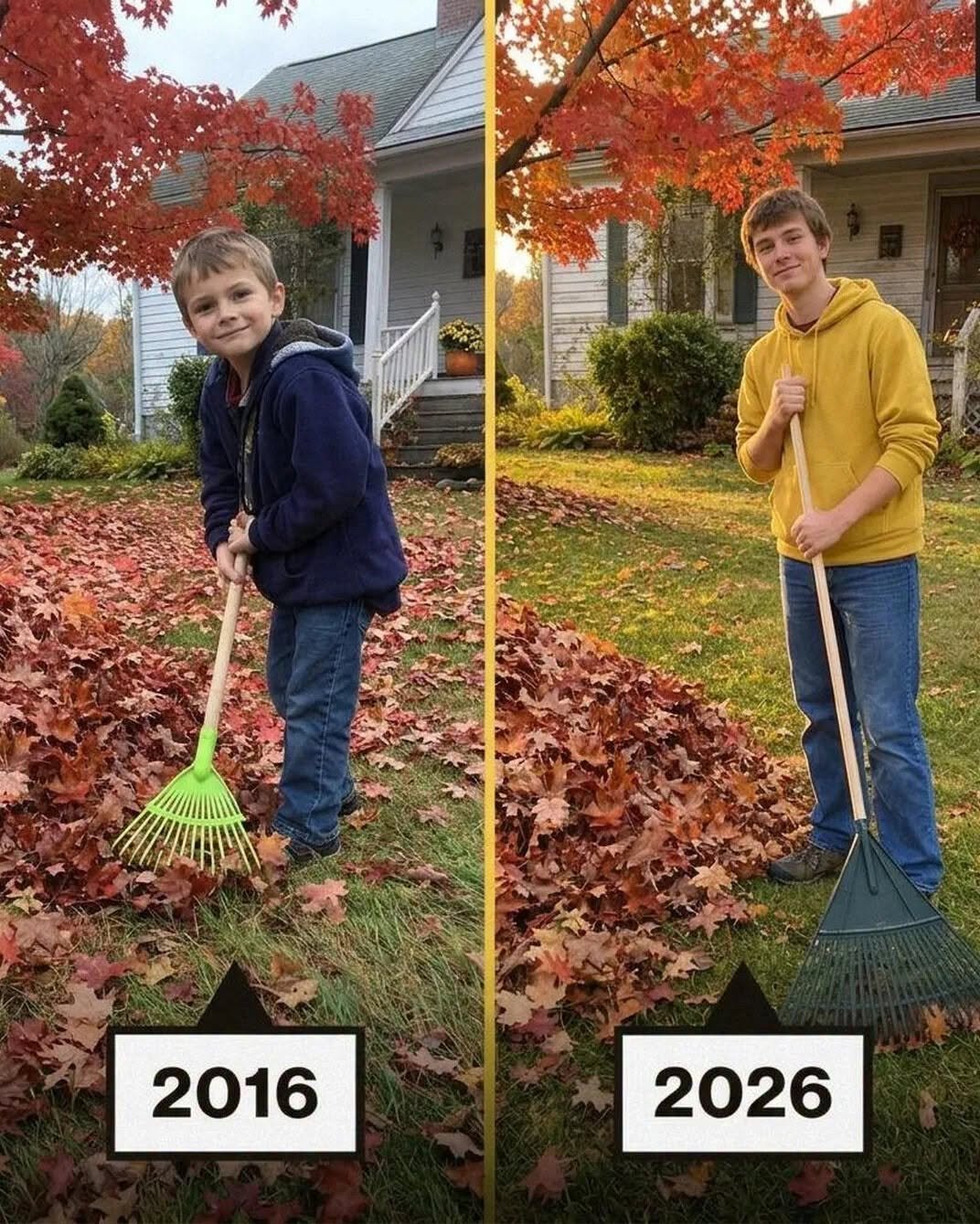
When Caleb was six, he noticed Mrs. Adler struggling with the mountains of maple leaves covering her lawn, so he grabbed his little plastic rake and went to help. The following year, he did it again, and soon the quiet tradition became part of his life, even as soccer practice, schoolwork, and growing responsibilities filled his days.
I often asked him why he spent so much time helping someone who wasn’t family.
His answer was always the same.
“Because she needs help, Mom. And I can help her.”
Mrs. Adler was a widow in her late seventies who lived alone in a modest house at the end of our street. Her husband had passed away years earlier, and she had no children nearby to help with the everyday tasks that had become increasingly difficult.
At first, she tried to pay Caleb for his work.
One autumn morning, she came outside carrying a small envelope.
“This is for you, sweetheart,” she said, holding it toward him.
Caleb shook his head.
“I don’t want your money, Mrs. Adler. You can use it for something you need.”
She looked at him for a long moment before smiling.
“Then you’ll have to let me give you cookies.”
That became their arrangement. Caleb raked the yard, gathered branches, and cleared the walkway, while Mrs. Adler rewarded him with homemade cookies and hot chocolate on chilly mornings.
Sometimes, I would look through the kitchen window and see the two of them sitting on her porch, talking as though they had known each other their entire lives.
She listened to his stories about school, celebrated his small victories, and encouraged him whenever he felt discouraged. In many ways, she became the grandmother he had never known.
And Caleb became the grandson she never had.
As the years passed, his little plastic rake was replaced by a proper garden rake. His small hands grew stronger, his voice deepened, and his visits became part of the rhythm of our neighborhood.
Even when he turned sixteen and started preparing for college, he never forgot his promise.
Every autumn, before the first soccer game of the season, Caleb would wake up early, pull on his old jacket, and head down the street to help Mrs. Adler.
I was proud of him, though I sometimes worried that he gave too much of himself to other people.
Life had not been easy for us. After David left, I had worked double shifts at a grocery store and cleaned offices at night. There were months when I struggled to make rent, and birthdays when I had to get creative because I couldn’t afford the gifts Caleb wanted.
He never complained.
Still, I knew the absence of his father hurt him more than he admitted.
Whenever classmates talked about their dads, Caleb would become quiet. On Father’s Day, he usually spent the morning helping me around the house before heading outside to shoot hoops alone.
I never spoke badly about David in front of him. I simply told him that his father’s decision to leave was not his fault.
But some wounds don’t disappear just because a child learns not to talk about them.
And then, shortly after Caleb turned sixteen, everything changed.
One cold October morning, I noticed that he hadn’t returned from Mrs. Adler’s house at his usual time. I assumed she had invited him inside for breakfast, as she often did.
When he finally came home, his eyes were red.
“Mom,” he said quietly, “Mrs. Adler is sick.”
I put down the laundry I was folding.
“What do you mean?”
“She fell yesterday. Her niece found her and took her to the hospital. The doctors say she needs help, and she might not be able to come home for a while.”
My heart sank.
Over the next few weeks, Caleb visited her whenever he could. He brought her flowers, read her letters from the mailbox, and sat beside her hospital bed telling stories about our neighborhood.
But Mrs. Adler’s health continued to decline.
One evening, Caleb came home and sat at the kitchen table without saying a word. I could tell from his face that something terrible had happened.
“She passed away this afternoon,” he finally whispered.
I wrapped my arms around him as he began to cry.
For ten years, he had shown up at her door without expecting anything in return. Now, the person who had become such an important part of his childhood was gone.
At her funeral, Caleb stood near the front, holding a small bundle of maple leaves he had collected from her yard. He placed them beside her photograph before stepping away.
“I promised I’d take care of her yard,” he whispered to me. “I didn’t think I’d have to stop.”
I held his hand.
“You gave her something more important than a clean yard, sweetheart. You made sure she wasn’t alone.”
Neither of us knew that Mrs. Adler had left behind something that would change how we understood our own family’s history.
Three days after the funeral, a woman named Helen called our home.
She introduced herself as Mrs. Adler’s niece and explained that she was sorting through her aunt’s belongings.
“Caleb was very special to her,” Helen said. “She spoke about him all the time. There’s something here I think he should see.”
She asked us to come by the house that weekend.
When we arrived, the place felt painfully quiet. The curtains were still open, a half-finished crossword puzzle sat on the coffee table, and a small mug rested beside her favorite armchair.
Helen led us into the living room and handed Caleb a wooden box.
“Your name is written on it,” she explained. “Your name, specifically. She wanted you to have this.”
Caleb opened the box carefully.
Inside were several old photographs, handwritten notes, and a folded envelope.
At first, the pictures seemed ordinary. There was one of Mrs. Adler and her late husband standing in front of their house. Another showed her sitting in a garden surrounded by flowers.
Then Caleb lifted a photograph from the bottom of the box.
He stopped breathing for a moment.
“Mom?”
Something in his voice made me lean closer.
It was an old photograph of a younger Mrs. Adler standing beside a man in his twenties. The man wore a dark suit and had one arm resting casually on her shoulder.
I recognized him immediately.
It was David.
Caleb’s father.
My hands began to tremble.
I hadn’t seen David in twelve years. He had disappeared from our lives when Caleb was four, leaving behind unanswered questions and promises he never kept.
Now his face was staring back at us from a photograph in the home of the woman my son had helped for a decade.
“Why does she have a picture of Dad?” Caleb asked.
I couldn’t answer.
Helen sat down beside us.
“Your aunt knew David when he was young,” I said slowly, still trying to understand what I was seeing.
Helen shook her head.
“She knew him much better than that.”
She explained that Mrs. Adler had lived on our street long before Caleb was born. David had grown up nearby, and as a young man, he had occasionally helped Mrs. Adler and her husband with household repairs.
According to Helen, David and Mrs. Adler had remained in contact even after he moved away.
But that wasn’t the most shocking part.
Helen pointed to the envelope inside the box.
“Your aunt wrote a letter for Caleb. She asked me to make sure he received it after she passed away.”
Caleb carefully unfolded the letter.
The handwriting was shaky, but the words were clear.
Dear Caleb,
If you are reading this, it means I am no longer here to tell you these things myself. For ten years, you have cared for me without asking for anything in return. You may think you were simply helping an old woman with her yard, but you gave me something I had almost forgotten how to feel: the comfort of knowing someone would come back.
Caleb wiped his eyes and continued reading.
There is something about your father that I believe you deserve to know.
When David was a young man, he came to me during one of the hardest periods of his life. He was frightened, confused, and struggling with problems he didn’t know how to face. I encouraged him to seek help and take responsibility for his choices. He promised me he would.
But as the years passed, I learned that he had left you and your mother. I was deeply disappointed in him. I never believed that whatever difficulties he faced could erase his responsibility to his family.
I felt a mixture of anger and sadness rising inside me.
For years, I had wondered whether David had simply stopped caring about us. Now I was learning that someone else had known him, watched his choices, and carried a part of his story that I had never heard.
Caleb kept reading.
I tried to encourage David to make things right. I told him that children remember who shows up, not who makes excuses. I cannot tell you everything that happened between your parents, because some of those details are not mine to share. But I can tell you this: his absence was never a reflection of your worth.
Caleb lowered the letter.
For a long time, neither of us spoke.
Then he turned the photograph over.
On the back, written in faded blue ink, were a few words:
“David, 1998. The boy who promised he would always protect the people he loved.”
Caleb stared at the sentence.
“Mom, what happened to him?”
I took a deep breath.
“I don’t know, sweetheart. And I don’t want to pretend that this photograph answers every question.”
Helen then handed us one final envelope.
“This was found inside the back of the picture frame,” she said. “Your aunt wanted Caleb to decide what to do with it.”
The envelope contained an old address and a short note with a name.
David.
There was no guarantee he still lived there, and no explanation of why Mrs. Adler had kept the information private for so many years.
Caleb folded the paper and placed it in his pocket.
On the drive home, he watched the autumn trees pass by the window.
Finally, he spoke.
“I spent ten years helping her because she was alone. I never knew she had a connection to Dad.”
“Neither did I,” I replied.
“Do you think she kept the picture because she thought he might come back?”
I swallowed hard.
“Maybe. Or perhaps she kept it because people are complicated, and she remembered the person he had been before he made choices that hurt others.”
Caleb looked down at his hands.
“I don’t know if I want to find him.”
“You don’t have to decide today,” I told him. “You don’t owe him a reunion just because we found an old photograph. If you ever choose to contact him, it should be because you want answers, not because you feel obligated.”
He nodded.
For the next several days, the letter stayed on his desk. Sometimes I found him reading it again, as though he hoped a new meaning might appear between the lines.
Then, one Saturday morning, he put on his jacket and picked up his rake.
“Where are you going?” I asked.
“Mrs. Adler’s yard.”
I followed him to the front window.
The maple leaves had begun covering her lawn again. Her house stood silent, its porch empty for the first time in years.
Caleb worked for nearly two hours, gathering the leaves into neat piles. When he finished, he placed a small bunch of red and yellow leaves beside her front steps.
He stood there for a moment, looking at the house.
“I think she’d want me to keep helping people,” he said when he came home.
I hugged him.
“She absolutely would.”
A few weeks later, Caleb made his decision about the address.
He wasn’t ready to contact David, and I didn’t pressure him. Instead, he placed the photograph and letter in a small box and kept them somewhere safe.
He understood that the discovery had given him information, not a complete explanation. He might one day seek answers from his father, but he would do so on his own terms.
As for Mrs. Adler’s house, her niece eventually arranged for it to be sold. Before the new owners moved in, Caleb asked permission to plant a young maple tree near the sidewalk.
Helen agreed.
Caleb dug the hole himself and carefully placed the sapling in the ground. He watered it, pressed the soil around its roots, and stepped back to admire his work.
“This way, there’ll always be something growing here,” he said.
Watching him, I finally understood what Mrs. Adler had meant in her letter.
My son had spent ten years believing he was simply helping an elderly neighbor. In reality, he had given her companionship, dignity, and the reassurance that someone still cared enough to knock on her door.
And in her final act, she had given him something, too: a reminder that his father’s choices did not define his future.
I still don’t know whether David will ever return to our lives. Perhaps he will, and perhaps he won’t. That decision belongs to him, just as the decision to forgive, reconnect, or move forward belongs to Caleb.
But I know one thing for certain.
The little boy who once struggled to carry a plastic rake grew into a young man who understood something many adults never learn: kindness is not a transaction, and doing the right thing doesn’t require an audience.
Sometimes, the smallest acts of compassion leave the deepest marks.
And sometimes, after years of giving without expecting anything in return, we discover that the people we helped were quietly carrying a piece of our own story all along.
Website Disclaimer
The information provided on this website is for general informational and educational purposes only. While we strive to ensure that all content is accurate and up to date, we make no guarantees regarding the completeness, reliability, or accuracy of any information published.
The views and opinions expressed in articles belong to their respective authors and do not necessarily reflect the views of this website. Any action you take based on the information found on this website is strictly at your own risk. We will not be liable for any losses, damages, or inconveniences arising from the use of our content.
Some articles may contain opinions, third-party information, or external links. We do not endorse or guarantee the accuracy of content on external websites and are not responsible for their practices or policies.
All content on this website is provided in good faith and is intended for informational purposes only. Readers are encouraged to verify information independently and seek professional advice where appropriate.