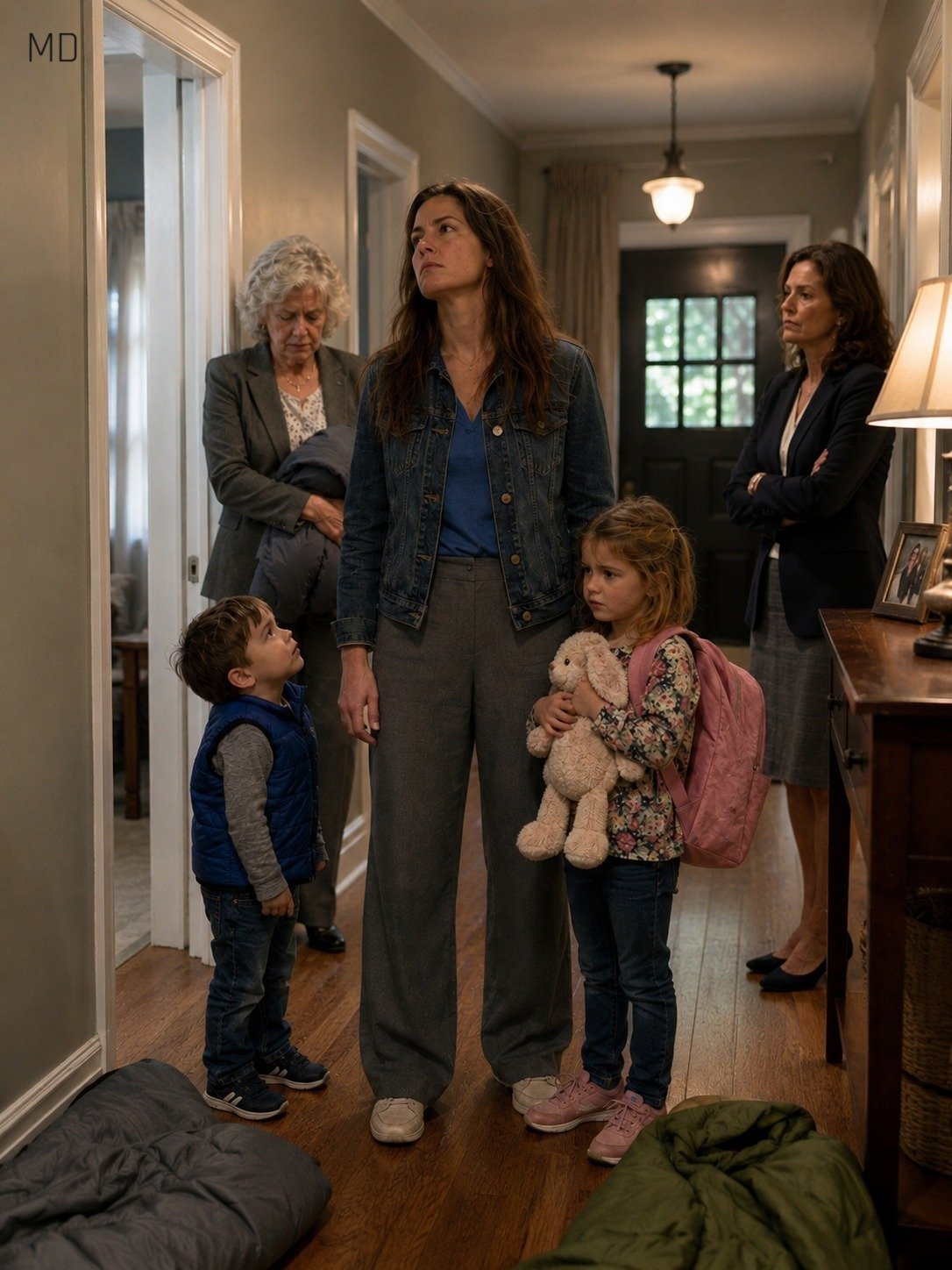
Lauren drove to her mother’s house on Thanksgiving carrying homemade pumpkin pie, a new tablecloth, and the quiet hope that this year might finally feel different. Her husband Ryan carried the suitcases while their children, Owen and Ellie, hurried inside excited to see Grandma. But from the moment they arrived, Lauren noticed the familiar pattern. Her sister Ashley and her children had already claimed the guest room, their belongings neatly unpacked while Lauren’s family coats hung awkwardly on the banister because no hooks had been left for them. Through dinner and cleanup, Ashley relaxed while Lauren washed dishes and handled responsibilities as she always had. Then, when bedtime came, Lauren asked where her children should sleep. Her mother opened a hallway closet, tossed two old sleeping bags onto the floor, and cheerfully suggested the children would think it was an adventure.
The moment shattered something inside Lauren. Her son Owen stood silently beside the sleeping bag, watching her face carefully, learning the same painful lesson Lauren had absorbed as a child — that some people in the family were protected while others were simply expected to “handle it.” For years after her father’s death, Lauren had quietly carried the financial weight of her mother’s life. She had paid the mortgage, insurance bills, emergency repairs, gymnastics tuition for Ashley’s daughter, and countless household expenses without recognition or gratitude. Meanwhile, Ashley was praised simply for showing up. Sitting in the car that night while her children slept in the back seat, Lauren finally realized the truth: she had spent years confusing responsibility with love and sacrifice with belonging.
The next morning, Lauren calmly began undoing the invisible support system she had built around her mother’s household. One by one, she canceled the automatic payments she had maintained for four years — mortgage transfers, insurance premiums, tuition payments, and home repair deposits. Her husband Ryan quietly supported every decision because he had long understood what Lauren was only beginning to accept: she had become less of a daughter and more of an unpaid safety net. When her mother later called in confusion about the missing payments, Lauren finally agreed to meet her face to face. At a coffee shop, she placed years of bank statements on the table and calmly explained that over one hundred thousand dollars had come directly from her own family’s savings and sacrifices.
For the first time, her mother truly understood what Lauren had carried alone. Lauren made one thing clear: she would no longer allow herself or her children to be treated as less important. She would help protect the family home because her father had loved it, but she would not continue funding everything while remaining invisible. That evening, Lauren returned home to her own small house, where every room held a real bed for every family member. She bought her children new sleeping bags for future camping trips — not because they lacked a place to sleep, but because now those sleeping bags represented adventure, comfort, and choice instead of rejection. Sitting on the porch with her husband and children, Lauren finally understood something her father had tried to teach her years earlier: the most important home she was meant to protect was the one she had built herself.
Website Disclaimer
The information provided on this website is for general informational and educational purposes only. While we strive to ensure that all content is accurate and up to date, we make no guarantees regarding the completeness, reliability, or accuracy of any information published.
The views and opinions expressed in articles belong to their respective authors and do not necessarily reflect the views of this website. Any action you take based on the information found on this website is strictly at your own risk. We will not be liable for any losses, damages, or inconveniences arising from the use of our content.
Some articles may contain opinions, third-party information, or external links. We do not endorse or guarantee the accuracy of content on external websites and are not responsible for their practices or policies.
All content on this website is provided in good faith and is intended for informational purposes only. Readers are encouraged to verify information independently and seek professional advice where appropriate.