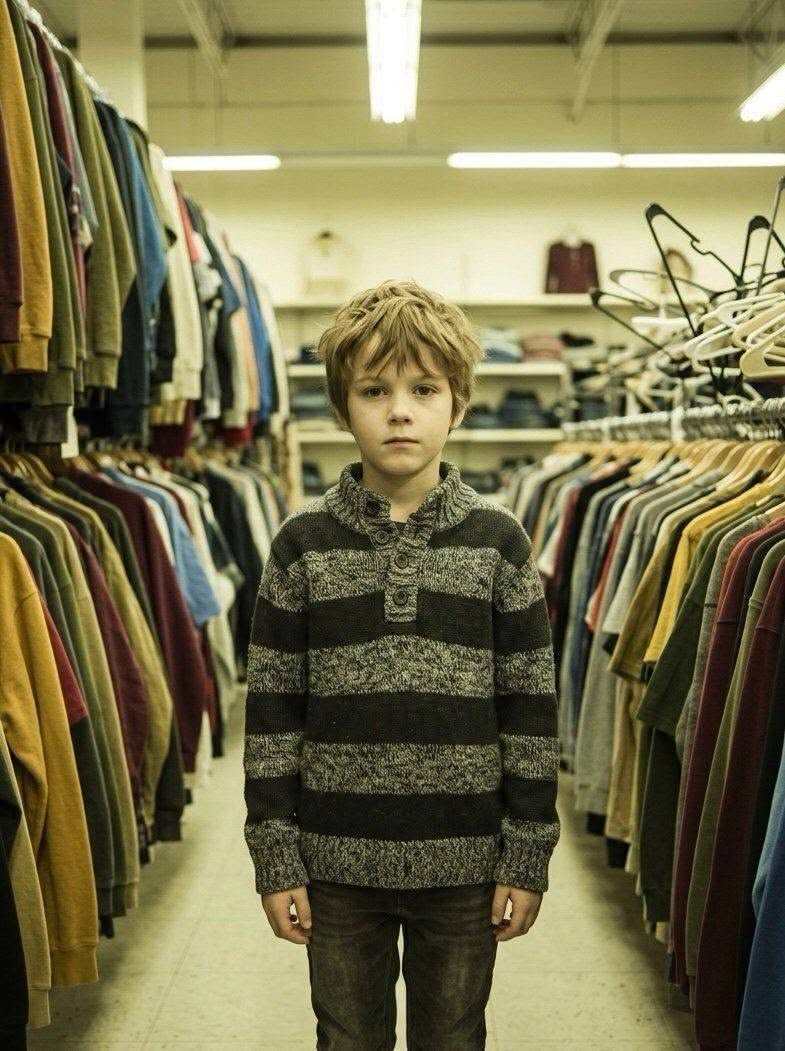
I held that coat against my son’s chest and tried to imagine him wearing it to school on Monday morning.
Ethan was eight years old. His old winter jacket had a broken zipper, thin sleeves, and a hole near the pocket that I had tried to repair twice. Every morning, he insisted he wasn’t cold, even when I could see him shivering at the bus stop.
That day, the temperature had dropped below freezing.
I had promised him we would find something warmer.
And now my husband, Mark, was standing beside me in Goodwill, shaking his head over a twenty-dollar coat.
“Put it back,” he said.
I stared at him.
“Mark, look at him. He’s freezing.”
“We’re not spending twenty dollars on that.”
“It’s a coat. He needs a coat.”
“He has one.”
I looked down at Ethan. He was pretending to examine a rack of toys, but I could tell he was listening. His little shoulders were hunched inside his worn jacket, and his hands were buried deep in his pockets.
I felt something break inside me.
“Fine,” I whispered. “You keep your money. I’ll figure it out myself.”
Mark didn’t answer.
I put the coat back on the rack, walked toward the fitting rooms, and wiped my eyes with the sleeve of my sweater. I hated crying in public. I hated that my son had to watch me beg for something so ordinary. Most of all, I hated that I had begun to feel ashamed of needing twenty dollars.
We weren’t rich, but we weren’t supposed to be this desperate, either.
Mark worked full-time at a local manufacturing plant. I worked part-time at a dental office, and together we had always managed to pay our bills. We weren’t taking vacations or buying new cars, but we had a small house, groceries in the refrigerator, and enough money to get through most months.
At least, that’s what I thought.
Over the past six months, Mark had become different.
He stopped buying coffee on his way to work. He canceled our inexpensive weekend outings. He began checking every receipt and asking me whether certain groceries were really necessary.
When I asked what was wrong, he always gave me the same answer.
“We need to be careful.”
Careful about what, he never explained.
I assumed he was becoming controlling. Maybe he was worried about money, but refusing a used coat for his own child seemed cruel.
On the drive home, Ethan sat quietly in the back seat.
“Mom?” he finally asked.
“Yes, sweetheart?”
“It’s okay. I don’t need a new coat.”
I turned toward him.
“You do need a warm coat.”
“But Dad said we can’t afford it.”
Mark tightened his grip on the steering wheel.
Neither of us spoke for the rest of the drive.
That night, after Ethan went to bed, I confronted my husband in the kitchen.
“Why are you doing this?”
Mark stood at the counter, staring at a stack of unopened envelopes.
“Doing what?”
“Making our son feel like he’s asking for too much. It’s twenty dollars, Mark. Twenty dollars.”
He rubbed his face.
“Please don’t start.”
“Don’t start? Our child is going to school in a jacket that barely closes, and you wouldn’t buy him a warm one.”
“You don’t understand.”
“Then explain it to me!”
He looked at me, and for a moment I thought he was finally going to tell me what was happening.
Instead, he said, “Just trust me.”
I laughed bitterly.
“Trust you? You won’t even tell me why we can’t afford a coat.”
He gathered the envelopes and walked away.
I watched him disappear down the hallway, feeling more alone in my marriage than I ever had before.
For the next several days, I tried to make sense of his behavior.
I checked our bank account. Our balance was lower than I expected, but there were no obvious withdrawals that explained his panic. I reviewed our bills and canceled a few subscriptions. I even started picking up extra hours at work.
Mark continued to avoid my questions.
Then, on Thursday evening, I found the key.
It was tucked inside the pocket of his old work jacket, hanging in the laundry room. A small brass key attached to a faded blue tag.
I recognized the tag immediately.
It belonged to the padlock on our detached garage.
The garage had been locked for almost a year. Mark told me he was using it to store tools and some equipment from work. I rarely went inside because it was cluttered, cold, and full of things he insisted he would organize someday.
But lately, I had noticed something strange.
He went out there almost every evening.
Sometimes he stayed for an hour. Sometimes longer.
When I asked what he was doing, he said he was working on a project.
I had assumed he was hiding something from me.
Standing in the laundry room with that brass key in my hand, I felt the old suspicion return.
I could hear Mark in the shower upstairs. Ethan was asleep.
I walked outside.
The air was bitterly cold, and the grass crunched beneath my slippers. I reached the garage, slid the key into the padlock, and turned it.
The lock clicked open.
I pulled the door upward.
At first, all I saw was darkness and the familiar smell of dust, oil, and old wood.
Then I switched on the light.
And froze.
The garage was no longer filled with the piles of junk I remembered.
Along one wall stood shelves stacked with boxes of winter clothes. Beside them were bags of children’s boots, gloves, scarves, and hats. A folding table held a sewing machine, spools of thread, and several coats with their zippers laid open for repair.
On another table sat a small laptop, a calculator, and a thick binder filled with handwritten notes.
I stepped closer.
The boxes were labeled by size.
Children’s coats — ages 5–7.
Children’s coats — ages 8–10.
Winter boots — assorted sizes.
I opened one of the boxes.
Inside were neatly folded jackets, most of them used but clean. Some had been patched. Others had new buttons or repaired zippers.
Then I noticed a sheet of paper taped to the wall.
At the top, in Mark’s handwriting, were the words:
WINTER WARMTH PROJECT — FIRST DISTRIBUTION: DECEMBER 15.
Beneath the heading was a list of names.
Children’s names.
Some had notes beside them: single-parent household, recent eviction, foster placement, family emergency.
My hands began to shake.
I picked up the binder and opened it.
The first pages contained receipts for used clothing purchased from thrift stores, donations from coworkers, and supplies for repairing damaged coats. There were records of money spent on boots, gloves, and thermal socks.
Then I found a bank statement.
Mark had been transferring part of his paycheck into a separate savings account every month.
The balance was far smaller than I expected, but the transactions told a story I hadn’t known.
He had been saving money to purchase winter supplies for families who couldn’t afford them.
I sank into the old chair beside the table.
For months, I had watched him become careful with every dollar. I had mistaken his sacrifices for selfishness. I had thought he was withholding money from his own family while secretly keeping something from me.
But the truth was more complicated.
And I still didn’t understand why he had refused the coat.
Then I saw a photograph tucked inside the binder.
It showed Mark standing beside a young boy in a hospital room. The boy was wearing a baseball cap and smiling weakly at the camera.
I recognized him immediately.
It was Daniel, Mark’s younger brother.
Daniel had died when Mark was twenty-two, after a long illness that had left the family struggling with medical expenses. I had heard stories about those years, but Mark rarely spoke about them.
I turned the photograph over.
On the back, he had written:
“He wore the same coat for three winters. I promised myself that if I ever had the chance, I’d make sure another kid wouldn’t have to feel that kind of cold.”
Tears blurred the words.
Suddenly, I understood that this wasn’t simply a project Mark had started to help other people.
It was a promise he had carried for years.
But one question remained.
Why had he refused to buy Ethan the coat?
I heard footsteps behind me.
I turned.
Mark stood in the doorway, still wearing his work clothes. His face went pale when he saw the open binder in my hands.
For several seconds, neither of us spoke.
Then I asked the question that had been tearing at me all week.
“Mark, why wouldn’t you buy our son a coat?”
He looked down at the floor.
“I was afraid you would find out about all of this before I was ready to tell you.”
“Find out what?”
He walked toward the table and pulled out a chair.
“The project was supposed to be finished by December. I had a budget, a list of families, and enough money set aside to get started. Then the furnace broke, the car needed repairs, and the insurance bill came in higher than expected.”
He rubbed his hands together.
“I thought I could make up the difference with overtime. But I couldn’t.”
I stared at him.
“So you decided Ethan had to go without?”
“No.” His voice cracked. “No, that’s not what I wanted.”
“Then why?”
He looked toward the boxes of coats.
“Because I made a terrible decision. I was so focused on keeping my promise to those families that I started treating every dollar like it belonged to the project. I convinced myself that if I delayed buying Ethan a coat for another week, I could finish everything on time.”
He swallowed hard.
“I thought I was doing something good. I didn’t realize how much I was hurting you both.”
I felt anger rise again, but it was mixed with something else now.
“You should have told me.”
“I know.”
“You should have trusted me enough to let me help.”
“I know.”
“And Ethan heard you say we couldn’t afford a twenty-dollar coat. He thinks his needs are a burden.”
Mark closed his eyes.
That was the moment his face crumpled.
“I never wanted him to feel that way.”
“Then you need to fix it.”
He nodded.
We stood in the garage for a long time, surrounded by boxes of clothing and the remains of a promise Mark had tried to fulfill alone.
Finally, I put the binder down.
“We’re going to buy Ethan a coat tomorrow.”
Mark didn’t argue.
“And we’re going to finish this project together, if we can afford to do it properly. But our family comes first. We don’t sacrifice our child’s basic needs to prove that we’re good people.”
He looked at me.
“You’re right.”
It was the first time in months that I believed he truly heard me.
The next morning, we went back to Goodwill.
This time, Mark walked straight to the winter clothing aisle. He found the navy blue puffer jacket I had held days earlier.
He checked the zipper, examined the lining, and held it against Ethan’s shoulders.
Then he looked at the price tag.
Twenty dollars.
He took it to the register.
Ethan watched him quietly.
“Dad?” he asked as we walked toward the car.
“Yeah, buddy?”
“Are you sure it’s okay?”
Mark stopped walking.
He knelt in front of our son, holding the coat in both hands.
“I’m sure,” he said. “And I need to tell you something. You should never feel bad about needing something you need. I made a mistake when I made you think otherwise. I’m sorry.”
Ethan wrapped his arms around his father.
I turned away for a moment, blinking back tears.
The coat wasn’t expensive. It wasn’t new. But that morning, it felt more valuable than anything we could have bought.
Over the following weeks, I helped Mark sort the clothes, repair buttons, and organize the donations. We reduced the project to something we could genuinely afford and invited friends and neighbors to contribute.
Some brought coats their children had outgrown. Others donated boots, gloves, or small amounts of money. A local tailor volunteered to repair damaged zippers, and a church offered a room where families could collect the clothing privately.
By December, we had gathered enough supplies to help several dozen children stay warm through the winter.
Mark never again treated the project as a secret he had to carry alone.
And I learned something, too.
Sometimes, the people we love are fighting battles we cannot see. Sometimes, their silence hides pain, guilt, or a promise they don’t know how to keep.
But good intentions do not excuse hurting the people closest to us.
Love requires honesty. It requires listening. And sometimes, it means admitting that the plan we thought was noble has become unfair to the people who need us most.
I still think about that navy blue coat.
I remember standing in Goodwill, holding it against my son’s chest, believing my husband had become a man I no longer recognized.
I was wrong about his intentions.
But I was right about one thing: Ethan deserved warmth, and he deserved to know that his needs mattered.
The lesson wasn’t that I should have trusted Mark without question.
It was that we should have trusted each other enough to tell the truth.
And every time I see Ethan run out the door wearing that slightly imperfect coat, I remember that sometimes the most important thing a family can do isn’t save the world.
It’s make sure the child standing right in front of them knows he is loved.
What would you have done in my position? Would you have been angry with Mark for keeping his project a secret, or understood why he was trying so hard to help other families?
Website Disclaimer
The information provided on this website is for general informational and educational purposes only. While we strive to ensure that all content is accurate and up to date, we make no guarantees regarding the completeness, reliability, or accuracy of any information published.
The views and opinions expressed in articles belong to their respective authors and do not necessarily reflect the views of this website. Any action you take based on the information found on this website is strictly at your own risk. We will not be liable for any losses, damages, or inconveniences arising from the use of our content.
Some articles may contain opinions, third-party information, or external links. We do not endorse or guarantee the accuracy of content on external websites and are not responsible for their practices or policies.
All content on this website is provided in good faith and is intended for informational purposes only. Readers are encouraged to verify information independently and seek professional advice where appropriate.