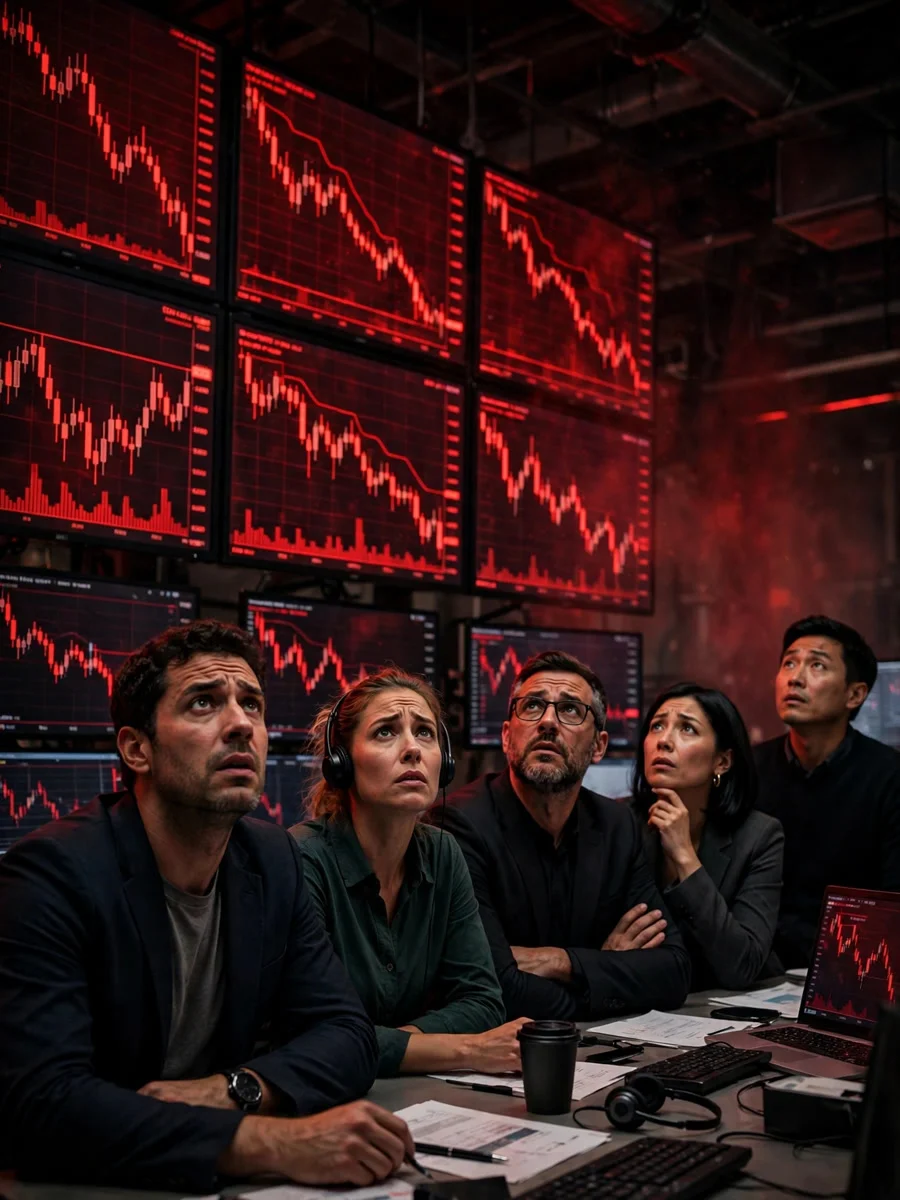
Friday on Wall Street was a day for the history books. Technology stocks plunged, and the Nasdaq Composite wiped out all of its gains for 2026 in a single session, falling 5.28 percent and ending the day in the red for the year. A market that spent the first nine months of the year hitting records on hopes about artificial intelligence is now standing at the door of a bear market.
A Brutal Friday
On Friday, November 20, 2026, the Nasdaq fell 1,261 points to close at 22,617.73. That one-day drop erased the index’s gains for the whole year — the Nasdaq is now down about 2.7 percent in 2026. It is also roughly 18 percent below its record close of 27,599.79 on October 6, and about $8.7 trillion in market value has been destroyed during the slide.
The S&P 500 fell 3.7 percent to 6,910.39, its seventh straight day of losses — its longest losing streak since February 2020. The Dow Jones dropped 950 points, or 1.93 percent, to 48,147.33. The whole week was devastating: the S&P 500 fell 8.61 percent for the week, the Nasdaq 10.02 percent and the Dow 8.02 percent, putting November on course to be the Nasdaq’s worst since 2008.
Is the AI Dream Falling Apart?
The biggest reason for the selloff is the same thing that pushed the market up: AI. Investors are now doubting whether the thousands of billions of dollars being spent on AI will ever pay off. Big technology companies have spent lavishly on computing clusters, chips and power infrastructure, and the question now is where the return is.
Those doubts were deepened by events at Nvidia. The chip giant’s chief executive, Jensen Huang, resigned suddenly on November 12, and reports followed that the US Securities and Exchange Commission was looking into Nvidia’s accounting practices. On Friday, Nvidia shares fell 14 percent — 22.9 percent for the week — and are now about 48 percent below their peak, wiping out roughly $3 trillion in value.
Not Even Anthropic’s IPO Was Spared
The same week, AI lab Anthropic carried out the biggest IPO in history, raising $81.3 billion at a $1.3 trillion valuation. On its first day, its shares closed at $97.17, up 17.1 percent from the $83 IPO price. But on Friday they fell 8.5 percent to $88.91, close to the IPO price. It is a sign that right now no company is safe in this market — new or old.
Chip stocks were hit hardest of all: the Philadelphia Semiconductor Index fell 10.73 percent in a single day. CoreWeave dropped 12 percent to $39.51, erasing all its gains since its March 2025 listing. The Nasdaq-100 has already entered a bear market, meaning it is more than 20 percent below its record.
What Comes Next?
The trouble is not limited to stocks. Minutes from the Federal Reserve’s October meeting showed that nearly all officials expect further rate increases, and the market now sees about a 92 percent chance of a rate hike in December — more bad news for shares.
But history says markets do come back after falls like this. The question is whether bargain hunters will start buying now, or whether the collapse of the AI trade will drag the whole market into a bear market. Trading next week will be short because of the Thanksgiving holiday, but investors will be watching Nvidia, AI spending and the Fed’s next move. One thing is clear: the AI excitement of 2026 is over, and the market is sobering up.
Website Disclaimer
The information provided on this website is for general informational and educational purposes only. While we strive to ensure that all content is accurate and up to date, we make no guarantees regarding the completeness, reliability, or accuracy of any information published.
The views and opinions expressed in articles belong to their respective authors and do not necessarily reflect the views of this website. Any action you take based on the information found on this website is strictly at your own risk. We will not be liable for any losses, damages, or inconveniences arising from the use of our content.
Some articles may contain opinions, third-party information, or external links. We do not endorse or guarantee the accuracy of content on external websites and are not responsible for their practices or policies.
All content on this website is provided in good faith and is intended for informational purposes only. Readers are encouraged to verify information independently and seek professional advice where appropriate.