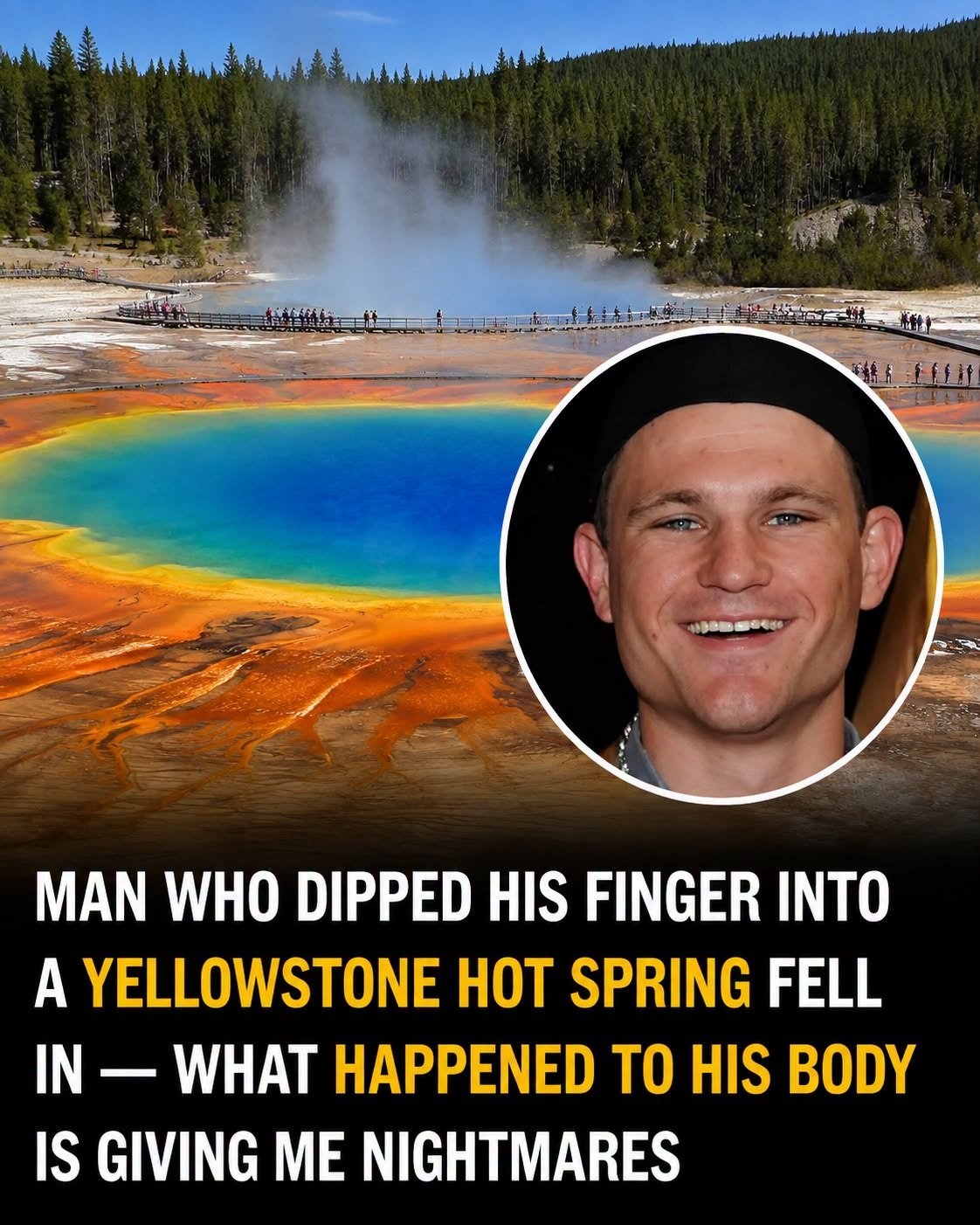
Yellowstone National Park is internationally known for dramatic landscapes, abundant wildlife and an extraordinary concentration of geothermal features. More than 10,000 hydrothermal features are found within the park, including hot springs, geysers, mudpots and fumaroles, and more than 500 of those features are geysers. Their beauty can make them appear inviting, but the environments surrounding them can be extremely hazardous.
Water heated by Yellowstone’s underground magmatic system can reach near-boiling temperatures, while apparently solid ground around thermal features may actually be only a thin crust covering dangerously hot water. Those hazards are why Yellowstone officials repeatedly instruct visitors to remain on established boardwalks and designated trails whenever they enter thermal areas.
The National Park Service warns that scalding water can exist immediately beneath fragile ground and that stepping away from protected routes can result in severe or fatal burns. Swimming or soaking in water that is entirely thermal in origin is prohibited. More than 20 people have died from burns after entering or falling into Yellowstone hot springs, according to current National Park Service guidance.
One of Yellowstone’s most disturbing thermal-area fatalities occurred on June 7, 2016, when 23-year-old Colin Nathaniel Scott of Portland, Oregon, visited Norris Geyser Basin with his sister, Sable. Contemporary reporting and investigative records described the siblings leaving the designated boardwalk in an area where visitors were not supposed to walk. According to accounts of the investigation, they were looking for a location where Colin could potentially soak in thermal water, an activity sometimes informally described as “hot potting.”
Deputy Chief Ranger Lorant Veress later explained to reporters that the pair had been moving through the thermal area specifically looking for a potential place to soak. That detail is significant because Colin’s fall was not described by investigators as an ordinary accident that occurred while he was safely walking along the established boardwalk. The National Park Service subsequently referenced the incident in its own safety material, stating that in June 2016 a man left the designated boardwalk at Norris Geyser Basin, slipped and fell into a hot spring.
Sable reportedly recorded portions of the excursion on her phone. Investigative accounts said the recording documented the siblings moving away from the boardwalk and also captured the moment when Colin slipped into the thermal feature, as well as his sister’s efforts to help him. Because of the intensely personal and disturbing nature of that material, the footage itself has not been publicly released as general entertainment. Descriptions of it appeared in reporting based on the official investigation.
Some retellings of the tragedy have claimed that Colin fell while dipping a finger into the spring to test its temperature. That specific detail has appeared in secondary accounts, but it should be treated more cautiously than the central facts documented by authorities. What is firmly established by National Park Service records is that Colin had left the designated boardwalk, slipped and fell into a hot spring in Norris Geyser Basin.
After Colin fell into the thermal water, his sister went to seek assistance. Rangers responded to the area and located his body in the spring later that day. Recovery presented another serious danger because Yellowstone’s geothermal environments can expose rescuers to unstable ground, extreme temperatures and potentially hazardous conditions. A thunderstorm eventually forced officials to suspend recovery efforts that evening.
When personnel returned the following morning, conditions had changed dramatically. Investigative reporting about the incident described the spring as both extremely hot and highly acidic at the time. Officials determined that Colin’s remains had been substantially broken down by the thermal environment overnight. Because of the nature of the incident, responsible descriptions should avoid unnecessary graphic details; the essential fact is that the combination of extreme heat and the spring’s chemistry prevented a conventional recovery.
The tragedy demonstrated that temperature is only one of several hazards associated with Yellowstone’s hydrothermal features. Yellowstone explains that its hot springs are created when surface water moves through underground rock, becomes superheated by the park’s magmatic system and then rises again. Some thermal environments are also strongly acidic or alkaline. These extreme conditions support specialized microorganisms known as thermophiles, but they can be extraordinarily dangerous to humans.

Norris Geyser Basin is particularly notable because it is Yellowstone’s hottest and one of its most dynamic hydrothermal areas. Conditions beneath the surface can be substantially hotter than visitors might imagine from looking at the landscape. Thermal features can also change over time, meaning familiarity with an area does not make leaving established routes safe. Yellowstone’s own geological guidance stresses that geyser basins are constantly changing and that thin crust can conceal boiling water or hot vapor underneath.
This is also why assigning a single temperature such as 199°F to all Yellowstone hot springs can be misleading. Temperatures vary substantially among individual thermal features and even within the same hydrothermal system. For example, the National Park Service has documented Maiden’s Grave Spring at about 200°F, while Abyss Pool has been measured at approximately 140°F. Both illustrate why visitors should never attempt to judge whether a thermal feature is safe based simply on its appearance.
The ground itself represents another danger. A surface that resembles ordinary soil can actually be a fragile mineral crust with scalding water immediately underneath. Yellowstone warns visitors that such crusts can break without warning. Consequently, staying on boardwalks is not merely a rule intended to prevent people from damaging scenery; those structures are positioned to keep visitors away from terrain that may be incapable of safely supporting their weight.
Boardwalk restrictions also protect Yellowstone’s unique ecosystem. Thermal features contain communities of bacteria, algae and fungi that thrive under conditions inhospitable to most forms of life. Walking through those areas or entering the water can damage these delicate organisms. Throwing objects into thermal features is prohibited as well because foreign material can interfere with vents and potentially alter the flow of thermal water.
Colin Scott’s death was not Yellowstone’s only serious thermal incident. National Park Service records document multiple visitors who have suffered major burns after entering thermal water or breaking through thin crust. In 2017, for example, another visitor suffered severe burns after falling into thermal water in the Lower Geyser Basin. In 2019, a man was seriously burned near Old Faithful, while subsequent incidents have involved both adults and children.
In October 2021, a 20-year-old woman suffered significant burns after entering Maiden’s Grave Spring while trying to rescue her dog. The National Park Service reported that the spring’s temperature was approximately 200°F. Her father managed to pull her from the water, but the dog later died. The incident again prompted Yellowstone officials to remind visitors that thermal environments can become life-threatening within seconds.
Another fatal incident was investigated at Abyss Pool in Yellowstone’s West Thumb Geyser Basin in 2022. Officials eventually identified the person involved and said their investigation found no evidence of foul play, although the exact circumstances surrounding that death remained unknown. Abyss Pool is more than 50 feet deep and has a temperature of approximately 140°F, according to the National Park Service.
The danger remains current rather than merely historical. In July 2025, Yellowstone reported that a 17-year-old suffered significant thermal burns near Lone Star Geyser after his foot broke through thin crust while hiking in the thermal area. Emergency personnel transported him to a hospital for treatment. Park officials again emphasized that visitors should remain on boardwalks and designated trails because scalding water can lie immediately beneath surfaces that appear stable.
Yellowstone’s current safety guidance is therefore unequivocal. Visitors should remain on boardwalks and designated trails, avoid touching thermal features or even their runoff, and never swim or soak in water entirely of thermal origin. Children should be kept close and should not be allowed to run on boardwalks. Pets are prohibited in thermal areas because they too can suffer fatal injuries after entering hot springs.
The restrictions also apply when visitors are trying to capture photographs or videos. Yellowstone specifically warns photographers not to leave boardwalks in pursuit of a better image. According to the National Park Service, hot springs have injured or killed more people in Yellowstone than any other natural feature, and boiling water can lie immediately beneath the ground throughout geyser basins. No photograph or video is worth stepping into an unsafe thermal area.
Colin Scott’s death remains an especially sobering example because the danger was preventable. The tragedy did not occur because Yellowstone’s hazards were unknown. Boardwalks and warnings existed precisely because park officials understood the risks associated with leaving established routes. His death subsequently became one of the incidents cited by the National Park Service when explaining why thermal-area regulations must be taken seriously.
At the same time, the incident should be remembered without turning Colin’s death into spectacle. He was a 23-year-old whose life ended during a visit to one of America’s most famous national parks, while his sister witnessed an extraordinarily traumatic event. The circumstances offer an important safety lesson, but graphic descriptions or sensational claims are unnecessary to communicate that lesson.
Yellowstone is extraordinary precisely because the geological forces beneath it remain active. The same underground heat responsible for its colorful springs, erupting geysers and steaming landscapes creates environments capable of causing catastrophic injuries. The National Park Service estimates that Yellowstone contains more than 10,000 hydrothermal features, representing one of the greatest concentrations of such features anywhere on Earth.
Visitors can experience those landscapes safely when they respect established boundaries. Boardwalks provide close views of some of Yellowstone’s most remarkable geothermal environments without requiring people to enter unstable terrain. Warning signs are similarly intended to communicate hazards that may not be obvious simply by looking at the landscape.
Nearly a decade after the 2016 tragedy, the fundamental safety message has not changed. Yellowstone continues to tell visitors to remain on designated routes and never enter its thermal springs. More than 20 people have died from burns after entering or falling into the park’s hot springs, and additional visitors have survived with serious injuries.
Colin Scott’s death at Norris Geyser Basin remains a tragic illustration of why those rules exist. The extraordinary geothermal forces that make Yellowstone one of the world’s most recognizable natural landscapes also create hazards that deserve absolute respect. Visitors can safely appreciate the park’s hot springs, geysers and thermal basins from designated viewing areas—but crossing those boundaries can transform an unforgettable trip into an irreversible tragedy.
Website Disclaimer
The information provided on this website is for general informational and educational purposes only. While we strive to ensure that all content is accurate and up to date, we make no guarantees regarding the completeness, reliability, or accuracy of any information published.
The views and opinions expressed in articles belong to their respective authors and do not necessarily reflect the views of this website. Any action you take based on the information found on this website is strictly at your own risk. We will not be liable for any losses, damages, or inconveniences arising from the use of our content.
Some articles may contain opinions, third-party information, or external links. We do not endorse or guarantee the accuracy of content on external websites and are not responsible for their practices or policies.
All content on this website is provided in good faith and is intended for informational purposes only. Readers are encouraged to verify information independently and seek professional advice where appropriate.