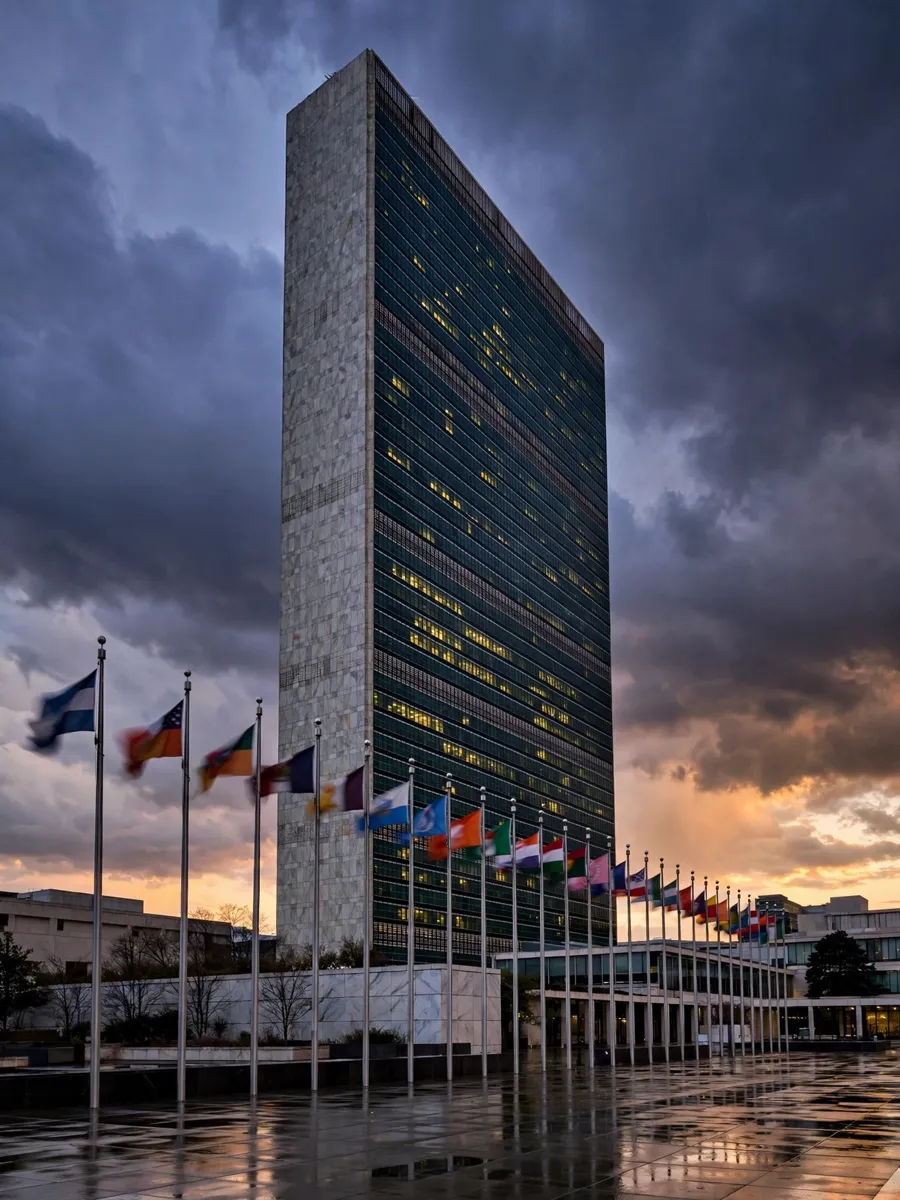
United Nations Secretary-General Antonio Guterres has condemned a drone attack in Kuwait that killed two Italian nationals, warning that rising tensions in the region threaten peace and security. Kuwait has blamed Iran for the strike and summoned the Iranian ambassador in protest, while Tehran has denied any involvement.
The attack took place on Thursday, 26 November 2026, when drones struck an air defence surveillance site in Kuwait. Two Italian technicians working at the facility were killed, and two other people were wounded: a Kuwaiti army captain and a Pakistani national. Kuwait’s Defence Ministry confirmed the two Italians died of their injuries after initially reporting that four people had been hurt by falling debris.
Who Were the Victims?
The two men who died were technicians employed by Rheinmetall Italia, the Italian unit of the German defence group Rheinmetall. They were carrying out maintenance work at a Kuwaiti military site equipped with radar antennas for the Skyguard air defence system when the facility came under attack.
Italian Foreign Minister Antonio Tajani told the Senate in Rome that the two men died following a powerful explosion at the site. Italy said it would lodge a formal complaint with the Iranian embassy over the incident.
It was the first deadly strike in Kuwait in months, and it landed in the middle of an already dangerous moment in the Gulf, with tensions between the United States and Iran running high and a US naval blockade in place around Iran.
Kuwait Summons Iran’s Ambassador
On Friday, Kuwait summoned Iran’s ambassador, Mohammad Totonchi, and handed him a formal protest note over what it described as continued Iranian attacks on the country. Deputy Foreign Minister Hamad al-Mishaan delivered the note and held Iran fully responsible for the attacks and their consequences, saying they violated Kuwait’s sovereignty, international law, the UN Charter and Security Council Resolution 2817.
Al-Mishaan said Kuwait reserved its inherent right to self-defence under Article 51 of the UN Charter, and the right to take all necessary measures to protect its security and the safety of its citizens and residents. The Foreign Ministry said the attack had caused extensive damage.
Iran denied any role in the strike. Foreign Minister Abbas Araghchi said in separate phone calls with his Kuwaiti and Italian counterparts that Tehran had no involvement, offered condolences, and proposed a joint investigation involving Kuwait, Iran and Italy to establish where the drones came from. Iran’s military also denied responsibility, and the Iranian embassy in Rome categorically rejected the claims in a post on social media.
UN Calls for Calm
Guterres’s spokesman, Stephane Dujarric, said the Secretary-General was deeply concerned by the continued escalation in the region and called on all parties to exercise restraint and refrain from actions that could further undermine regional peace and security or jeopardise ongoing diplomatic efforts. Guterres expressed solidarity with Kuwait and offered his condolences to the families of the victims.
Several Gulf states also issued condemnations of the attack. But the episode has deepened fears that the confrontation between the United States and Iran could spill over into neighbouring countries that have tried to stay out of the conflict.
A Region on Edge
The strike came as the US military said it had disabled a ship trying to breach the blockade around Iran, and as Iran’s Revolutionary Guard vowed to break the blockade, signalling action in the air and at sea. Some reports also suggested Iran had blamed Ukraine for the Kuwait attack, while Tehran raised the possibility that the incident was a false-flag operation designed to drag it into a wider war.
For now, the central question remains unanswered: who launched the drones. Kuwait says the evidence points to Iran. Tehran denies it and wants a joint inquiry. Italy, which lost two of its citizens, is demanding answers of its own.
What is not in doubt is the human cost. Two technicians who had travelled to Kuwait to maintain an air defence system never went home. Their deaths have turned a regional standoff into a diplomatic crisis involving three countries — and the United Nations is now urging everyone involved to step back before it grows any worse.
Website Disclaimer
The information provided on this website is for general informational and educational purposes only. While we strive to ensure that all content is accurate and up to date, we make no guarantees regarding the completeness, reliability, or accuracy of any information published.
The views and opinions expressed in articles belong to their respective authors and do not necessarily reflect the views of this website. Any action you take based on the information found on this website is strictly at your own risk. We will not be liable for any losses, damages, or inconveniences arising from the use of our content.
Some articles may contain opinions, third-party information, or external links. We do not endorse or guarantee the accuracy of content on external websites and are not responsible for their practices or policies.
All content on this website is provided in good faith and is intended for informational purposes only. Readers are encouraged to verify information independently and seek professional advice where appropriate.