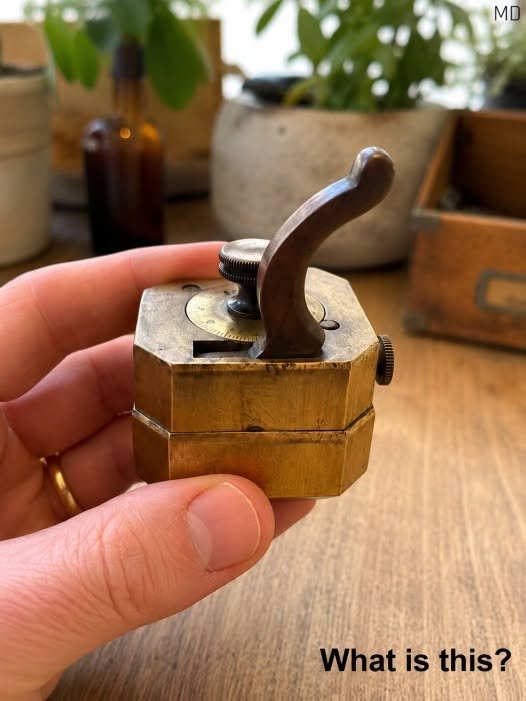
What seemed like an ordinary flea market purchase turned into a fascinating journey into the history of medicine. While browsing through a collection of vintage items, I noticed a small metal device with an unusual design. It didn’t look like anything I had seen before, and its purpose was a mystery. Intrigued by its craftsmanship and curious about its story, I decided to buy it. At the time, I assumed it was simply an interesting antique. However, after doing some research at home, I discovered that the object was actually a medical scarificator, a tool once used in a treatment known as bloodletting. What started as a simple purchase suddenly became a window into a very different era of healthcare.
For centuries, bloodletting was considered a legitimate medical practice. Doctors believed that many illnesses were caused by imbalances within the body and that removing a small amount of blood could help restore health. Although modern medicine has moved far beyond these ideas, bloodletting was once widely accepted and practiced across much of the world. The scarificator played an important role in this process. Rather than making cuts by hand, physicians could use the device to create several small, controlled incisions quickly and efficiently. While the treatment itself may seem unusual today, it reflected the medical understanding of its time and the ongoing effort to help patients with the knowledge available.
The more closely I examined the instrument, the more impressive it became. Hidden inside its compact design is a spring-loaded mechanism connected to several tiny blades. When activated, the blades briefly extend and then retract, creating small cuts on the skin. Considering the period in which it was made, the engineering is remarkably advanced. Every detail shows the skill and precision of the craftsmen who built it. Holding the scarificator felt like holding a piece of living history. Its worn surfaces and carefully constructed parts seemed to tell the story of generations of doctors and patients who relied on it during a time when medical science was still evolving.
Today, the scarificator serves as a powerful reminder of how far healthcare has progressed. Treatments once considered essential are now viewed through a completely different perspective thanks to advances in research, technology, and scientific understanding. Historical artifacts like this do more than satisfy curiosity—they highlight humanity’s constant pursuit of better knowledge and better ways to care for one another. What appears to be a simple antique can reveal an extraordinary story about innovation, learning, and change. This small device, discovered by chance at a flea market, became much more than an old tool. It became a symbol of medical history and a reminder that every generation builds upon the discoveries of the one before it.
Website Disclaimer
The information provided on this website is for general informational and educational purposes only. While we strive to ensure that all content is accurate and up to date, we make no guarantees regarding the completeness, reliability, or accuracy of any information published.
The views and opinions expressed in articles belong to their respective authors and do not necessarily reflect the views of this website. Any action you take based on the information found on this website is strictly at your own risk. We will not be liable for any losses, damages, or inconveniences arising from the use of our content.
Some articles may contain opinions, third-party information, or external links. We do not endorse or guarantee the accuracy of content on external websites and are not responsible for their practices or policies.
All content on this website is provided in good faith and is intended for informational purposes only. Readers are encouraged to verify information independently and seek professional advice where appropriate.