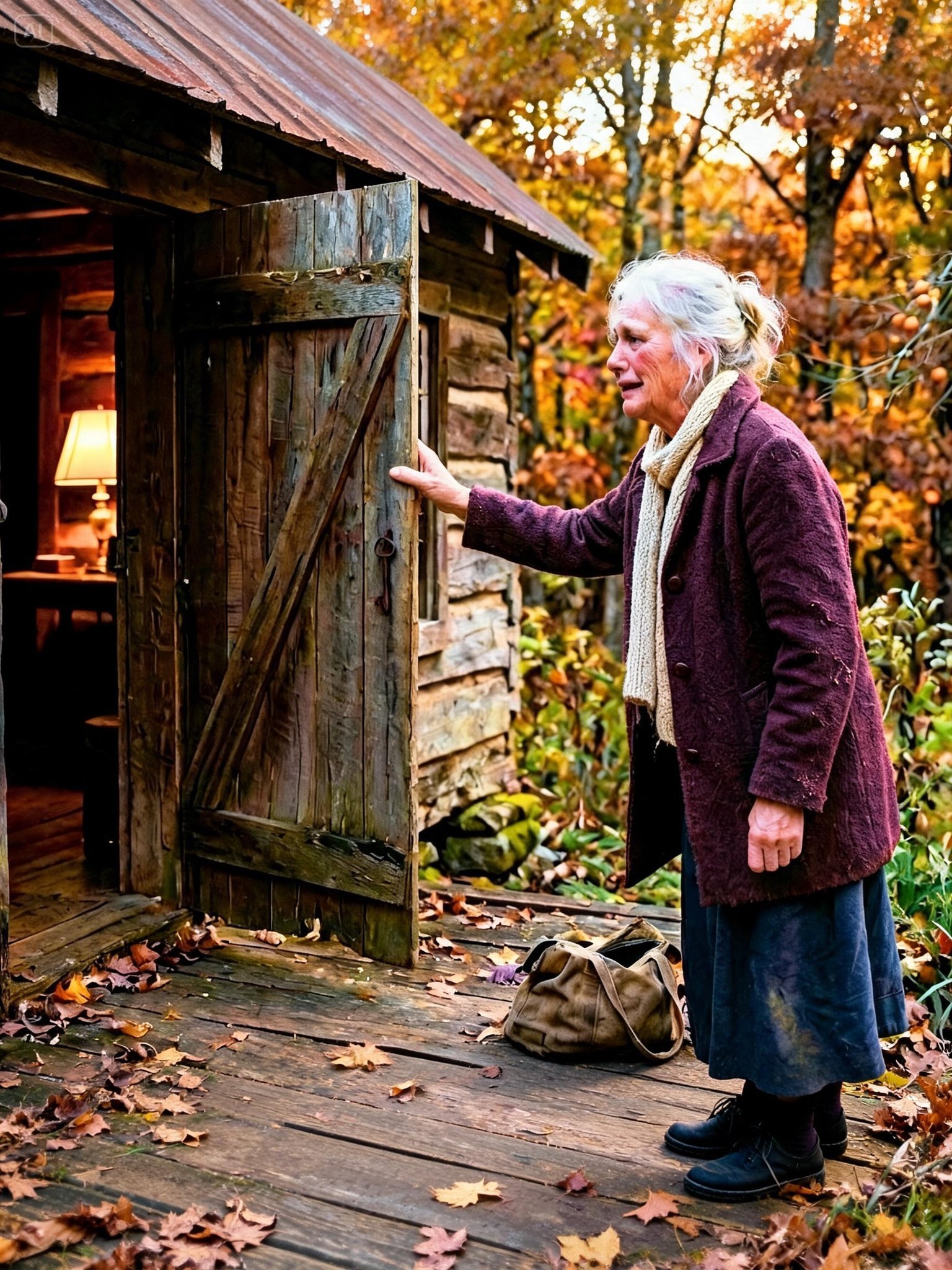
At seventy-two years old, Mary Beth Thistlewood learned that a mother could spend her whole life making a home for a child and still end up standing on a curb in the rain, watching that child drive away.
The rain came cold that October evening, slanting under the streetlights on Birch Street, turning the gutter water brown and shiny and carrying cigarette butts along the curb like little wrecked boats. Mary Beth stood beside a canvas bag that held two sweaters, three changes of underclothes, her husband’s shaving mug, a Bible with pressed flowers inside it, a photograph of her grandchildren from six years earlier, and a rusty iron key she did not yet understand.
Everything else she owned sat in a damp pile behind her.
Cardboard boxes. A chipped lamp. Two quilts tied with twine. A coffee can of tomato plants from the windowsill, already beaten flat by the rain. A rocking chair with one loose runner. Her life, set outside by strangers while her son checked his watch.
Garrett Thistlewood stood near his silver SUV with his collar turned up and his sunglasses still on though the sky was gray and evening had already begun to fall. He had been handsome once in a soft, boyish way, with Warwick’s brown eyes and Mary Beth’s crooked smile. Now his face had hardened into something expensive and tired. He had the look of a man always late for something more important than the person in front of him.
“Mom,” he said, “we talked about this.”
Mary Beth looked at him through the rain. “No, Garrett. You talked. I listened.”
His jaw tightened. He glanced toward the apartment door, where the landlord had already disappeared back inside with the satisfaction of a man who had removed a problem from his hallway.
“The shelter on Delaney has a bed open,” Garrett said. “I called ahead. They’re expecting you.”
The word shelter seemed to hang in the wet air between them.
For six years, Mary Beth had lived in the little one-bedroom apartment above the laundromat. It was not pretty. The stairwell smelled of detergent, mildew, and fryer grease from the diner next door. The pipes knocked in winter. The streetlights flickered. But she had kept the apartment spotless. She polished the old table every Sunday. She grew tomatoes in coffee cans on the sill. She wrote letters in the evenings to a cousin in Oregon who never answered and read secondhand novels in the rocking chair Warwick had bought her at an estate sale twenty years before.
It had been hers.
After Warwick died, she had held onto that apartment as if walls could keep grief from spreading. Warwick’s illness had lasted eight years. It had eaten their savings first, then their patience, then little pieces of Mary Beth’s body she never got back. She had lifted him, bathed him, changed sheets at midnight, argued with insurance clerks, counted pills, stretched soup, prayed over bills, and watched the man who once danced with her in the kitchen shrink into a body pain had made unfamiliar.
When he died, people said at least he was at peace.
Mary Beth had wanted to ask what peace was supposed to do for the person left with the rent.
She had tried. She truly had.
She worked part-time at the diner until her knees swelled so badly she could not stand through a breakfast shift. She sold Warwick’s tools, then her wedding silver, then the good walnut dresser his father had made. She took in alterations for women from church who complained if she charged more than five dollars for hemming slacks. She used coupons, ate oatmeal, turned the heat low, and still the numbers narrowed around her.
Then the landlord raised the rent three hundred dollars.
She called her only child on a September afternoon.
“Garrett,” she had said carefully, sitting at the kitchen table with the notice spread in front of her, “I need help for a little while.”
There had been a pause on the line. She knew that pause. It was the sound of her son arranging his face into sympathy while already preparing refusal.
“Mom, Prin and I are stretched thin,” he said. “The mortgage, the kids’ activities, the car payments. You know how it is.”
“I’m asking for four hundred a month for three months. Just until I find a roommate.”
“Mom.”
In the background, Mary Beth heard Prin’s voice, sharp and polished. Prin always sounded as though she were speaking across a counter to someone trying to return an item without a receipt.
Garrett lowered his voice. “There are programs for this kind of thing. County programs. Senior housing. Facilities.”
Facilities.
Mary Beth had looked at her coffee can tomatoes then, their little green fruit bright against the window.
“I am not a problem to be placed somewhere,” she said.
“Don’t make this emotional.”
But it was emotional. It was all emotional. Rent was emotional. Hunger was emotional. A bed was emotional. Having a son who could spend more on lawn care than his mother needed to keep a roof over her head was emotional.
Three weeks later, the eviction notice came.
Two weeks after that, Garrett arrived to help carry her belongings outside.
Now he stood in the rain pretending this was unfortunate but reasonable.
“Garrett,” Mary Beth said, “look at me.”
He did not.
He looked toward the SUV. Toward the apartment building. Toward the gutter. Anywhere but at the woman who had cut the crusts from his sandwiches until he was eleven because he said bread edges tasted bitter. Anywhere but at the woman who sat awake through his childhood fevers, paid for his first suit, co-signed his first car, and never once told him what it cost her to be proud of him.
“Mom,” he said, “I can’t do this right now.”
“You mean you won’t.”
He exhaled through his nose, annoyed now. “You have become impossible to help.”
The sentence struck harder than the rain.
Mary Beth felt herself sway. “Impossible?”
“You refuse reasonable options. You won’t listen to Prin. You won’t look at facilities. You won’t admit what stage of life you’re in. It’s embarrassing, Mom. I’m sorry, but it is. I can’t keep pretending this isn’t humiliating for everyone.”
For a moment, Birch Street disappeared.
There was only her son’s mouth. Her son’s clean shirt. Her son’s expensive watch. Her son saying embarrassment as if it were a heavier burden than being homeless.
Mary Beth bent slowly, picked up her canvas bag, and slipped the strap over her shoulder. Rain ran down her neck under the collar of her good wool coat.
Garrett’s face shifted. For one second, he looked like the boy he had been after breaking a neighbor’s window with a baseball, frightened by the damage but more frightened by the truth of himself.
Then the man returned.
“The shelter is on Delaney,” he said. “They have your name.”
Mary Beth nodded.
He gave her a stiff hug. His arms barely touched her. She smelled his cologne, clean and expensive, and remembered baby shampoo.
Then he got into the silver SUV and drove away.
He did not tap the brake lights at the corner.
The shelter on Delaney Street smelled of bleach, wet coats, old coffee, and despair so common it had become part of the walls. Mary Beth signed her name on a clipboard with a pen chained to the desk. A young woman with tired eyes gave her a folded gray blanket, a plastic bin for her belongings, and directions to a bottom bunk in a room with eleven other women.
That first night, Mary Beth lay on a thin mattress and listened to strangers trying to sleep without crying loudly enough to disturb one another.
The woman in the next bunk snored softly, then stopped, then whispered a name into the dark. Someone coughed. Someone prayed. Someone’s shoes squeaked down the hallway every twenty minutes. Rain hit the high windows and ran down the glass in trembling lines.
Mary Beth did not sleep.
She held the canvas bag against her chest with both arms and felt the outline of the rusty iron key through the fabric.
The key had arrived in the mail three days before the eviction, tucked in a manila envelope forwarded from an attorney’s office in Fayetteville. She had barely read the letter then. Everything had been boxes and phone calls and Garrett’s voice telling her to be practical.
Now, under the gray shelter blanket, she pulled the envelope from her bag.
A letter. A folded deed. The key.
The letter explained that a retiring country attorney had found an unclaimed property deed tied to the estate of her maternal great-grandmother, Ismay Thistlewood. Fourteen acres in the Ozark foothills outside Juniper Bend, Arkansas. A one-and-a-half-story hand-built cabin, last assessed in 1981. Current condition: derelict.
Derelict.
The word should have discouraged her.
Instead, it opened a small, stubborn space in her chest.
She remembered her mother mentioning the place once at a family reunion, waving it away while spooning potato salad onto a paper plate.
“That old cabin of Ismay’s? Falling down. Land’s worth nothing. Nobody wants to pay taxes on a ghost.”
Nobody had wanted it.
So it had waited.
In the morning, a woman from the next bunk handed Mary Beth a paper cup of instant coffee without asking if she wanted it. She was thin and tall with silver-white hair in a braid and sharp brown eyes that looked directly at things most people avoided.
“First night’s the worst,” the woman said.
Mary Beth wrapped both hands around the cup. “Does it get better?”
“No,” the woman said. “But you get better at surviving it.”
Her name was Rozelle Carrington.
By the fourth day, Rozelle had become the first true kindness Mary Beth had known since Warwick’s death. She taught Mary Beth which showers had hot water longest, which caseworker kept promises, and which church lunches were worth walking eight blocks in the rain. She showed her the public library two streets over, where a person could sit warm all afternoon without being asked to buy anything. At night, when the shame became too heavy and Mary Beth finally cried into her blanket, Rozelle sat on the edge of the bunk and said nothing at all.
That was when Mary Beth trusted her.
On the eighth day, Mary Beth showed Rozelle the deed and the rusty key.
Rozelle read the letter twice. Then she gripped Mary Beth by both shoulders.
“Woman,” she said, “that is land.”
“It says derelict.”
“It says yours.”
“It’s a ruin.”
“It is a roof with walls on ground nobody can tell you to leave.” Rozelle’s voice shook. “You are not homeless. You have been too poor to know you had a home.”
That evening, Mary Beth called Garrett from the shelter payphone.
She told him about the deed. About Juniper Bend. About the cabin.
He laughed. Not cruelly at first. Worse, almost fondly, as if she had become childish.
“Mom, Dad and I drove past that place once when I was in high school. It’s a shack in the middle of nowhere. No power, no water. You can’t live there. You’re seventy-two.”
“I know how old I am.”
“Be reasonable. There’s a place in Springdale with a sliding scale. Prin found it.”
“I’m going to the cabin.”
The line went still.
When Garrett spoke again, all softness was gone. “Fine. Go freeze to death in the woods. Don’t call me when you need an ambulance.”
He hung up.
Mary Beth stood with the receiver in her hand long after the dial tone began.
Something inside her changed then.
Not into rage. Rage still belonged to Garrett because rage required caring what he thought. This was quieter. Cleaner.
She was done asking permission to remain alive.
When she returned to the common room, Rozelle had an Arkansas map spread across the table and two cups of coffee waiting.
“All right,” Rozelle said. “Let’s figure out how to get you home.”
Part 2
The bus to Fayetteville cost forty-seven dollars.
Mary Beth paid with money Warwick had tucked into a birthday card the year before he died, a little emergency fold of bills she had kept hidden in the lining of her wallet for so long that the paper had gone soft at the creases. She had imagined using it for medicine, maybe, or a taxi in bad weather. Instead, she used it to leave the city where her son had abandoned her.
Rozelle walked her to the Greyhound station before dawn.
The streets were damp and nearly empty. Neon signs buzzed in diner windows. Trucks hissed over wet pavement. Rozelle carried the canvas bag, refusing to let Mary Beth take it no matter how many times she reached for the strap.
At the station door, they stopped.
“You write me when you get there,” Rozelle said. “You tell Denise at the shelter to read it out loud if she has to. I want to know you made it.”
“I’ll do better,” Mary Beth said. “When I get settled, you come to me.”
Rozelle laughed, but her eyes were wet. “Old woman, you don’t even know what’s waiting for you out there.”
“Then we’ll find out together one day.”
They held each other for a long time on the cold sidewalk. Mary Beth felt the bones in Rozelle’s back beneath her coat. She thought of all the women inside the shelter, all the lives folded up like extra blankets, all the stories nobody had asked for because the women telling them had become inconvenient.
When she finally climbed onto the bus, she pressed her forehead to the window and watched Rozelle grow smaller beneath the streetlamp until she was only a silver braid, then nothing.
The bus rolled west through a gray morning.
At first, Mary Beth watched gas stations, warehouses, and strip malls slide past. Then fields widened. Towns thinned. The land lifted little by little, the flatness giving way to folds of green and brown. By afternoon, trees crowded the road in thick walls of pine and oak. The sky seemed closer in the Ozarks, caught in the high ridges and broken by crows.
Mary Beth had not seen this country since childhood.
Her mother had brought her once to visit a great-aunt. Mary Beth remembered wild daisies, a pump handle cold under her palm, and an old woman in a black dress who smelled of lavender and woodsmoke. She had not known then that the old woman was Ismay. She had not known the cabin existed as anything but family clutter, a thing adults dismissed.
In Fayetteville, she found a taxi driver named Hollis who was willing to take her the last forty-three miles for fifteen dollars and the promise that he did not have to bring her back.
He was a heavy man with a kind face and a radio that crackled under the dashboard. When Mary Beth showed him the address, he whistled.
“Ma’am, there’s not much out that way.”
“There’s a cabin.”
“There used to be cabins everywhere out that way. Used to be doesn’t always mean still is.”
“I have the key.”
Hollis glanced at her in the mirror, saw her face, and did not argue.
They drove into hills that turned steeper and lonelier. The paved road narrowed. Then it became gravel. Then the gravel became a dirt track rutted by old rains and crossed by roots. Branches scraped the sides of the taxi. A creek appeared on the left, flashing silver through the trees, then vanished beneath a tangle of sycamore and cane.
They passed one mailbox in six miles.
Finally, the trees opened.
The cabin sat in a shallow bowl of land as if it had been dropped there by a century and forgotten.
It was smaller than Mary Beth expected and more beautiful than she was ready for.
Hand-hewn logs had weathered to silver gray. The porch roof sagged on one side where a support post had rotted at the base. Wild grapevine climbed the north wall in thick ropes, tugging at the eaves. The windows were blind with grime. A dogwood had grown straight up through the back corner of the woodshed, its branches bare now but graceful against the sky. Pine needles covered the yard. Leaves filled the porch corners. The chimney leaned but stood.
A ruin.
A home.
Hollis killed the engine. Neither of them moved for a moment.
“Ma’am,” he said gently, “I can take you back. There’s a motel in Fayetteville. Cheap one, but clean enough.”
Mary Beth opened the door and stepped out.
The air smelled of wet leaves, cold stone, and pine. Beneath that, faint and sweet, was woodsmoke from somewhere far off.
“Thank you, Hollis,” she said. “I’m home.”
He helped carry her canvas bag to the porch. She tried to give him her last five dollars. He refused, folding her fingers back over the bill.
“You get yourself inside before dark,” he said.
Then he drove away slowly, watching her in the mirror until the track curved and the trees hid him.
Mary Beth stood alone before the cabin.
Evening settled fast in the hollow. Shadows gathered under the trees. The boards groaned under her first step onto the porch, but they held. She took the iron key from her coat pocket. It was rusted dark, heavy at one end, its teeth worn but distinct.
Her hand shook as she slid it into the lock.
It fit.
The sound of the key turning was small, almost delicate, but Mary Beth felt it through her whole body.
The door stuck. She leaned her shoulder into it once, then again. Wood groaned. The old latch gave. The door swung inward and released a breath of air that had been waiting forty years.
Cedar. Dust. Cold stone. Mouse droppings. Dry leaves. Time.
Mary Beth stood in the doorway while her eyes adjusted.
The main room was dim but intact. A stone hearth filled one wall. A rough plank table stood near the window, gray with dust. Two ladder-back chairs leaned drunkenly beside it. Shelves sagged under jars gone cloudy. A black iron cookstove crouched in the corner like a sleeping animal. A narrow staircase climbed along the back wall to a half-story loft. The floor was littered with leaves and acorn caps. Something small skittered in the wall and vanished.
She had expected collapse.
Instead, she found endurance.
“Ma’am.”
The voice behind her made her gasp and clutch the doorframe.
A young man in a green uniform was walking up the track with a flashlight in one hand and a radio clipped to his belt. He held a wide-brimmed hat against his side. The patch on his shoulder read National Park Service.
“Ma’am,” he said again, slowing when he saw her fright, “I need you to step away from that structure.”
Mary Beth straightened. “This is my house.”
His expression shifted into practiced patience. “The adjoining land is federal. We get people passing through. Squatters sometimes. That cabin isn’t safe.”
“I’m not a squatter.”
“Ma’am—”
She pulled the folded deed from her coat pocket and held it out with fingers stiff from cold and pride.
“My name is Mary Beth Thistlewood. My great-grandmother built this cabin, and I have come home.”
The ranger took the deed.
He read it carefully. At first, his face held skepticism. Then curiosity. Then something like wonder.
He looked at the paper, then at Mary Beth, then at the cabin and the single canvas bag on the porch.
“My name is Emmett Valdez,” he said quietly. “And I think you’re going to need some help.”
Emmett did not leave that evening until he had checked the roof, the chimney, the floorboards near the hearth, and the back wall where grapevine had pulled hardest. He moved carefully, speaking aloud as he inspected.
“Roof is better than it looks. Porch is worse. Don’t step on that left side after dark. Hearth seems sound, but we’ll keep the first fire small. You have water?”
“No.”
He looked at the old pump at the kitchen sink. “Maybe you do. Maybe you don’t. We’ll find out tomorrow.”
He brought in wood from a stack behind the woodshed, old but dry beneath the top layer. He built a careful fire in the hearth, small enough not to shock the chimney. Flame caught slowly, then grew gold against the stone. Light filled the room in broken patches.
Mary Beth stood near the table, hands clasped so tightly her knuckles ached.
She was cold. She was frightened. Her knees hurt from the journey. Her son had told her to freeze in the woods.
And yet, for the first time since Warwick’s funeral, she did not feel like a guest in her own life.
Emmett set two bottles of water, a sleeve of crackers, and a battery lantern on the table.
“I live six miles up the ridge,” he said. “My grandmother lived alone on land in New Mexico until she was ninety-one, and everyone said she couldn’t. She outlived every person who said it.”
Mary Beth looked at him through tears she refused to let fall. “Why are you helping me?”
He considered the question. “Because somebody should.”
Before he left, he gave her an orange whistle on a lanyard.
“Three short blasts if there’s trouble. Sound carries out here.”
That first night, Mary Beth slept on old quilt ticking dragged near the hearth. She kept her coat on. The fire cracked and murmured. Wind moved under the eaves. Twice she woke certain she heard footsteps outside, but it was only acorns falling, or mice, or the old house speaking in its joints.
At dawn, light entered through filthy windows and turned the dust gold.
Mary Beth sat up stiffly.
The cabin was still standing.
So was she.
The first week was survival.
Emmett returned with a cousin who worked wells, and by sundown the kitchen pump coughed, groaned, spat rust-colored water, then ran clear and cold from a spring-fed well older than anyone living. Mary Beth cried when she cupped that water in her hands. She had not known water could taste like mercy.
On the fourth day, she walked two miles into Juniper Bend with a walking stick Emmett had cut for her. The town was little more than a general store, a post office window inside it, a church, and a feed shed with faded paint. A woman named Lorene sold her candles, matches, flour, beans, coffee, and a cast-iron skillet for three dollars because it had a wobble and “nobody but an old-time woman would know how to cook on it anyway.”
“I am an old-time woman,” Mary Beth said.
Lorene smiled. “Then it’s yours.”
Mary Beth cleaned.
Room by room, hour by hour, she cleaned until her back trembled and her hands smelled of vinegar, ash, and mouse nests. She swept out leaves and wasp husks. She scrubbed windows until the light came through. She burned rotted curtains in the yard. She dragged grapevines off the north wall with Emmett’s help and patched gaps with boards Darian, a carpenter friend of his, brought from a torn-down barn.
At night, she fell asleep so exhausted that loneliness could not catch her.
Garrett called once that first week on a borrowed phone Emmett had left her.
“Mom, this is insane,” he said.
“I’m busy, Garrett.”
“Busy doing what?”
Mary Beth looked around the cabin: the swept floor, the clean table, the fire warming the stone hearth, the kettle beginning to steam.
“I’m sweeping my floor,” she said.
Then she hung up.
For the first time in months, she laughed aloud.
Part 3
On the eleventh day, Mary Beth found the trunk.
It happened in the smallest upstairs room, the one tucked beneath the north eaves where the roof slanted so low she had to bend to cross it. The room must have belonged to a child once, though Ismay had never had children. Or perhaps it had been for guests, for storage, for dreams packed away with quilts and old dresses.
The air smelled dry and close. Dust lay thick on the floorboards. A single narrow window looked out over the ravine where yellow leaves clung to hickory branches. Mary Beth had gone up with a broom, a bucket, and the stubborn intention of making the room usable before winter.
She noticed the boards in the far corner because they did not match.
Most of the floor was oak, wide and dark with age. But three boards near the wall were pine, narrower, their edges slightly raised. Not new, exactly. Nothing in the room was new. But newer than the rest, replaced long after the cabin was built.
Mary Beth knelt slowly, one hand braced against the wall. Her knees objected. She ignored them.
Using a butter knife from the kitchen, she pried at the edge of the first board. It resisted, then gave with a faint dry pop. Beneath it was darkness.
Her heart began to pound.
She lifted the second board. Then the third.
Inside the hollow lay a trunk.
It was small, no larger than a carry-on suitcase, bound with leather straps so old they crumbled when she touched them. Dust coated the lid. The metal corners were green with age. It took all her strength to lift it from the hollow and set it on the floor in the shaft of afternoon light.
For several minutes, she only stared.
A sensible woman would have called Emmett. Or taken the trunk downstairs. Or waited until morning.
Mary Beth was tired of being sensible in ways that benefited everyone but herself.
She opened it.
Inside, wrapped in oilcloth, were letters.
Hundreds of them.
Letters in creamy envelopes tied with blue ribbon, sorted by year. Letters on hotel stationery, onion-skin paper, sheet music, postcards, pages torn from notebooks. Postmarks from Paris, Edinburgh, Cairo, New Orleans, San Francisco, Baltimore, New York. Some envelopes were addressed to Miss Ismay Martory. Later ones to Mrs. Ismay Thistlewood. Still later, simply to Ismay, Juniper Bend, Arkansas.
Beneath the letters lay twelve journals, leather-bound and hand-stitched, each one filled with the same looping copperplate hand. Pressed flowers rested between pages. Ticket stubs. Watercolor sketches. Bits of fabric. Poems copied in languages Mary Beth could not read.
She opened the oldest journal.
The first page read:
The private correspondence and travel journals of Ismay Martory Thistlewood, begun this 8th day of April 1911, Juniper Bend, Arkansas. For the eyes of one who comes after, if any such one ever comes.
Mary Beth sat down hard on the floor.
For the eyes of one who comes after.
Outside, wind moved through the trees. Downstairs, the hearth fire had burned low. Somewhere in the wall, a mouse scratched.
Mary Beth turned the page.
By lantern light that night, she met the woman her family had reduced to a ghost.
Ismay had come to Juniper Bend in 1910 at nineteen years old, a bride from Baltimore with a trunk of dresses, a few books, and no idea how dark the Ozark woods became after sunset. Her husband, Silas Thistlewood, worked the railroad. In the early pages, she wrote of homesickness, red clay, unfamiliar birds, and the humiliation of not knowing how to start a cookfire without smoking the room black.
Then Silas died in 1914 in a coupling accident.
The town expected Ismay to leave.
She did not.
She stayed in the cabin and learned to survive. She kept bees. Split kindling. Planted beans. Shot a rifle. Bartered honey and preserves. Walked to town in all weather. Read everything she could get by post. And she wrote letters.
She wrote to a poet in Paris whose name Mary Beth faintly remembered from high school. She wrote to a Scottish suffragist who sent pressed heather and described hunger strikes, marches, prison, and the taste of victory when women finally forced history to turn its face. She wrote to a Black schoolteacher in New Orleans about books, weather, justice, and the danger of hope. She wrote to a woman archaeologist in Egypt who sent back descriptions of sandstorms, blue beads, and the loneliness of being the only woman at a table of men who believed discovery belonged to them.
Ismay’s life had been small in geography and vast in reach.
Mary Beth read until her eyes burned.
The last page of the twelfth journal was dated spring 1962, the year before Ismay died.
I have lived a small life on a small piece of land, and I have loved it. But I have also lived a very large life in these pages, with friends I never touched and places I never stood. I hide them here because I do not know if the world is yet ready for a woman like me. Perhaps one day a granddaughter or a granddaughter’s granddaughter will lift this floor and know that her blood carried more than bread and mending. Know that you are also made of letters, child. Know that you are also made of elsewhere.
Mary Beth wept then.
She wept so hard she had to close the journal for fear her tears would stain the page. She wept for Ismay, buried under a churchyard stone that read only Beloved Wife. She wept for herself, for seventy-two years of believing she came from plain women whose lives had been only work, duty, and endurance. She wept for the girl she had been, who might have stood taller had anyone told her a woman in her bloodline had written across oceans.
She wept for being thrown away and then finding, beneath a floorboard, proof that hidden things were not worthless.
After a long time, she wiped her face on her sleeve, wrapped the journals carefully, and carried the trunk downstairs.
The cabin felt different now.
Not less cold. Not less broken. But inhabited by more than mice and memory.
In the morning, she told Emmett.
He stood in the kitchen with his hat in both hands while she showed him one letter, then one journal page. He did not touch anything until she told him he could. Even then, he washed his hands first.
“Mrs. Thistlewood,” he said softly, “this is important.”
“I know it is to me.”
“No,” he said. “I mean to more than you.”
That frightened her.
She spent three days doing nothing but reading and worrying. The trunk sat on the table like a living thing. She made tea and forgot to drink it. She started cleaning and found herself back in Ismay’s pages. At night, she dreamed of a young widow in a long skirt carrying water from the pump while letters from Cairo waited unopened on the table.
Then a woman named Tamsen Blackwood arrived with molasses cookies.
Tamsen taught eighth grade English at Juniper Bend School and drove an old Subaru that sounded like it was held together by prayer and wire. Lorene at the store had told her about the old papers. Tamsen came up the track on a Saturday morning, knocked on the porch post because the door was open, and introduced herself with the nervous reverence of someone approaching a church.
“I love old writing,” she said. “Lorene said you found letters.”
“I found a life,” Mary Beth replied.
Tamsen sat at the kitchen table for four hours.
She read three letters and a page from the first journal. She kept taking off her glasses to wipe them. When she finally looked up, her eyes were bright.
“Mary Beth,” she said, “I don’t think you understand what this is.”
“Then tell me.”
Tamsen drew a breath. “Some of these names are in textbooks. Some of these letters may connect to collections in major archives. This isn’t just family history. This is women’s history. Literary history. Rural history. It’s all tangled together.”
Mary Beth looked toward the window, where the woods pressed close.
“What happens now?”
“That depends on what you want.”
The question startled her. For years, what Mary Beth wanted had mattered only if it inconvenienced no one. Now this woman sat at her table and began with that.
“I don’t want to sell her,” Mary Beth said.
Tamsen nodded slowly. “Then we won’t.”
We.
It had been a long time since Mary Beth had heard that word and trusted it.
Tamsen returned the next Saturday with Orla Finch, a retired archivist from Missouri whose hands were knotted with arthritis but still gentle as prayer. Orla brought white cotton gloves, acid-free folders, and an authority so quiet no one thought to challenge it.
She opened the first bundle of letters, read a signature, and went utterly still.
“Do you know who this is?” she whispered.
Mary Beth did not.
Orla told her.
The name belonged to a poet Mary Beth had seen carved over a library entrance once, the sort of woman teachers spoke of as if she had lived in marble rather than hunger, letters, hotel rooms, and ink.
“She wrote to your great-grandmother for eleven years,” Orla said.
Soon there were more women.
Pip Ostergaard, a retired nurse with strong hands and bad knees, came because she heard help was needed and said she was “not dead yet, despite what the mirror claims.” Delphine Mwangi, a quilter from Chicago who had moved to Arkansas after her sister’s death, came for a fabric scrap Ismay had saved from a correspondent on the Gold Coast and stayed for the company.
They began meeting every Saturday.
Half joking, Tamsen called them the Cabin Circle. The name stuck.
They made strong coffee. They wore gloves. They sorted letters by year, sender, condition, and subject. They read aloud sometimes, not every word, but the ones that demanded air.
In those Saturdays, the cabin changed again.
It filled with women’s voices. Pip laughing over a scandalous 1923 letter from Cairo. Delphine bending close over a fabric scrap, explaining weave and dye with tears in her eyes. Orla whispering dates as if calling roll for the dead. Tamsen reading Ismay’s journal entries in her teacher voice, steady and full.
Mary Beth listened.
She had thought she was coming to the cabin to survive alone.
Instead, the cabin had made room for a circle.
Rozelle arrived in December.
Mary Beth sent the letter as promised, then another, then a bus ticket with money Tamsen quietly helped gather and pretended not to. Rozelle stepped off the bus in Fayetteville wearing her silver braid, carrying one suitcase and a look that dared the world to disappoint her again.
When she reached the cabin, she stood in the yard and took in the repaired porch, the smoke from the chimney, the pines, the women around the table visible through the clean window.
“Well,” Rozelle said, “looks like the ruin has manners.”
Mary Beth laughed and held her tightly.
“You came.”
“You said we’d find out together.”
By Christmas, Rozelle had taken the small downstairs room and made it hers with a quilt, a nail for her coat, and a jar of pinecones in the window. The shelter on Delaney Street no longer held either of them.
That winter was hard.
The cabin still leaked wind. The woodstove had to be fed through the night. Mary Beth’s hands cracked from cold and work. One January storm coated the ridge in ice and knocked a limb through the woodshed roof. Emmett and Darian came with tools. Garrett called once, left a message Mary Beth did not return, and sent a Christmas card signed by Prin in handwriting too neat to be sincere.
Mary Beth placed it in the kindling box, then changed her mind.
She put it in a drawer instead.
She had learned from Ismay that letters mattered, even the painful ones.
Part 4
Everything changed because of a Christmas pie.
Tamsen’s niece, Alina, came from Little Rock for the holidays and listened at dinner while her aunt told the story of Mary Beth, the cabin, and the letters under the floor. Alina worked in social media for a nonprofit and had the restless energy of a young woman who understood how fast the world could turn its head when shown the right doorway.
The next week, she came to the cabin with a camera.
Mary Beth agreed to photographs on one condition.
“Not my face,” she said. “This is Ismay’s story.”
Alina nodded. “Hands, then. The cabin. The letters.”
She photographed Mary Beth’s gloved hands turning a page. The pressed heather from Scotland. The blue bead from Cairo still folded in tissue. A stack of envelopes tied in faded ribbon. The rough floorboards where the trunk had been hidden. The cabin from the yard, smoke rising from the chimney into winter light.
Then she wrote a thread online.
In a falling-down cabin in the Ozarks, a seventy-two-year-old woman just found her great-grandmother’s secret life. Wait until you see who wrote to her.
By morning, it had been shared ninety thousand times.
By the end of the week, more than two million.
The phone began ringing at Lorene’s store because Mary Beth did not yet have a proper line. Lorene would take messages, then drive up after closing with scraps of paper stuffed in her coat pocket.
“Professor from Yale.”
“Curator from the Smithsonian.”
“National Public Radio.”
“Woman from the Library of Congress. She cried, by the way.”
Mary Beth sat at the kitchen table while Tamsen, Orla, and Rozelle helped sort the calls. Some were generous. Some were hungry. Some spoke of preservation with reverence. Others spoke of valuation before they asked what Ismay had written.
A private collector offered one hundred twenty thousand dollars for the trunk sight unseen.
Mary Beth held the phone and looked at the fire.
“No,” she said.
A university offered two hundred thousand and a named archive.
“No.”
A cable network wanted to option the story for a documentary series, with a figure so large Rozelle had to sit down when she saw it written.
Mary Beth listened politely.
“No.”
After the third refusal, Rozelle followed her onto the porch.
“Mary Beth,” she said gently, “that kind of money means heat, medicine, repairs. It means never worrying about rent again.”
“I know.”
“Then help me understand.”
Mary Beth looked out over the yard. Frost silvered the grass. The woods were black beyond the clearing. In the distance, the creek spoke under ice.
“My great-grandmother hid those letters because she didn’t know if the world was ready for a woman like her,” she said. “I’m not going to sell her to the first person with a checkbook. I’m going to share her.”
Rozelle nodded, slow and proud. “There’s a difference.”
“There is.”
In the end, Mary Beth accepted a partnership.
The Library of Congress and a university archive in Fayetteville would help digitize the collection. The originals would remain at Ismay House in a climate-controlled room built onto the cabin with grant money and donations that poured in after Alina’s photographs reached the world. Scholars could visit by appointment. Schoolchildren could come. Descendants of correspondents could touch copies of pages their own families had forgotten.
The Cabin Circle would run it.
Tamsen would curate. Orla would catalog. Pip would manage visitors. Delphine would lead the textile project. Rozelle, who had once slept in the shelter bunk beside Mary Beth, would keep the guest book and frighten away anyone who arrived with more ego than manners.
Mary Beth would be keeper of the door.
Work began in February.
The cabin became a storm of hammering, mud, sawdust, and purpose. Darian repaired the porch. Emmett helped raise reclaimed tin onto the roof. Mr. Hollinsby, a retired electrician from Juniper Bend, installed wiring for a small solar array in exchange for two blue-and-white stoneware plates Mary Beth insisted he take because he admired them so tenderly.
The archive room went onto the back of the cabin, small and sturdy, with proper insulation, sealed walls, and a humming unit that kept the air steady. Mary Beth watched the first shelves go in and felt something in her chest tremble.
A room for Ismay.
A room for what the world had nearly lost.
Garrett came in April.
Mary Beth was kneeling in the herb bed beside the porch, thinning mint that had taken over with the confidence of something born to survive. The cabin had a new sign at the mouth of the track now: Ismay House by Appointment. A school bus had visited two weeks earlier, ninth graders sitting in folding chairs in the yard while Tamsen read them Ismay’s 1919 letter about seeing women vote for the first time.
Mary Beth heard tires on the track and looked up.
The silver SUV appeared between the trees.
For a moment, she felt Birch Street under her feet again. Rain. Gutter water. Sunglasses. Her belongings on the curb.
Then the SUV stopped, and Garrett got out.
He had aged in fourteen months. Gray touched his temples. His posture had lost some of its certainty. He wore no sunglasses. He stood beside the vehicle as if unsure the ground would accept him.
“Mom,” he called.
“Garrett.”
They looked at each other across twenty feet of Ozark springtime.
“Can I come up?”
“You can come up.”
He walked toward the porch slowly, like a man entering court.
Mary Beth rose with one hand pressed to her back and gestured toward the rocking chairs Pip had found at an estate sale. Garrett sat carefully. Mary Beth poured him cold spring water from a pitcher on the table.
“Drink,” she said. “You look dehydrated.”
He obeyed.
His hand shook.
“Mom, I’m not here to ask for anything,” he said finally.
Mary Beth did not answer.
“I saw the article in the Gazette. Then my assistant showed me the posts online. About Ismay. About the letters.” His voice cracked. “I didn’t know.”
“No one did.”
“I drove past this place with Dad when I was seventeen. I remember him saying it wasn’t worth the gas to check on.”
“I remember hearing that story.”
“And you came anyway.”
“I came because there was nowhere else.”
He covered his face with both hands.
For a moment, Mary Beth saw him at six years old, crying after falling off his bicycle, and every old instinct in her rose up like a tide. To comfort. To excuse. To make it easier for him.
She gripped the arms of the rocking chair and stayed still.
When Garrett looked up, his eyes were red.
“I put my mother on a curb in the rain,” he said. “I told myself I was being practical. I told myself you were refusing help. I told myself a lot of things because the truth made me look like a coward.”
Mary Beth’s voice was quiet. “You were a coward.”
He flinched.
“Yes,” he said. “I was.”
Wind moved through the pines.
“Prin left in January,” he said. “She took the kids to Tulsa. The business has been rough. But I’m not here because of that. I just needed to say I know what I did. Or I’m beginning to know. Mom, I am so sorry.”
Mary Beth looked toward the open cabin door.
Inside, Rozelle was teaching Delphine how to make cornbread in a cast-iron skillet. Orla was in the archive room. Tamsen’s laughter rose from somewhere near the table. The house was full of women who had become family without blood.
“I am not ready to forgive you,” Mary Beth said.
Garrett closed his eyes. “I know.”
“But I am not going to turn you away either. That is not who Ismay was, and it is not who I intend to become.”
He bowed his head.
“There is a cot in the back room,” she continued. “You may stay two nights. You can help Pip move shelves on Saturday. You can chop the wood that needs chopping. You can meet the women who built this with me. You can eat what we eat and sleep where we sleep. Then we will see.”
Garrett wept quietly in the rocking chair.
“Yes, Mom,” he said. “Thank you.”
He stayed two nights.
Then he asked for two more.
By the end of the week, he had chopped a full cord of wood, bolted shelving units to the archive wall under Pip’s merciless supervision, and sat pale and silent while Tamsen read Ismay’s letter about standing on a steamer deck in 1936 and watching the Statue of Liberty shrink behind her, knowing she might never travel again and choosing gratitude anyway.
Garrett came back the next month.
The month after that, he brought Jasper and Nell.
Mary Beth had not seen her grandchildren in four years. Nell was taller than she remembered, shy and sharp-faced, with Prin’s posture and Garrett’s uncertain eyes. Jasper had grown into a lanky teenager who did not know what to do with his hands.
For one terrible second, they all stood in the yard like strangers.
Then Nell began to cry.
“I remember your tomatoes,” she said.
Mary Beth opened her arms.
The healing was not clean. Real healing rarely is. Garrett did not become a perfect son because he had apologized. Mary Beth did not stop remembering the rain because he chopped wood. Some Sundays she looked at him across the table and felt love and anger sitting together like two old dogs that refused to leave the room.
But he kept coming.
He listened more than he spoke.
When he drove away, Mary Beth stood on the porch until his taillights disappeared around the bend. She noticed, after a few months, that she no longer wished him harm.
That, she decided, was its own kind of beginning.
Part 5
Two years after Birch Street, Ismay House held its first public open day.
Three hundred forty people came.
They parked along the ridge road for half a mile and walked the rutted track in Sunday shoes, work boots, and sneakers, carrying folding chairs, covered dishes, notebooks, cameras, and children by the hand. Lorene brought cornbread from the general store. Hollis the taxi driver came with his wife and refused again to let Mary Beth give him gas money. Emmett stood at the edge of the crowd in his park service uniform, arms crossed, smiling quietly as if he had always known the cabin would become this.
The porch no longer sagged. The windows shone. The chimney drew clean. The herb bed beside the steps spilled mint, thyme, and lavender over its stone border. Behind the cabin, the archive room hummed softly, guarding Ismay’s letters from damp, heat, and time.
Mary Beth was seventy-four.
She stood on the porch in a navy dress Tamsen had helped her alter and Warwick’s wedding ring on a chain beneath the collar. Rozelle stood just inside the door. Garrett stood in the yard with Jasper and Nell, both of them older now, both watching their grandmother as if seeing her for the first time.
Alina had set up a microphone.
Mary Beth had not wanted one.
“You need it,” Rozelle said. “People came to hear you.”
“I don’t know why.”
“Yes, you do.”
The crowd quieted when Mary Beth stepped forward.
For a moment, she could not speak.
The sight of them overwhelmed her: scholars beside farmers, schoolchildren beside retired widows, locals who had once dismissed the cabin as a ruin standing beside strangers who had driven across state lines to see it. All of them waiting beneath the pines because a woman hidden under the name Beloved Wife had written herself into survival, and another woman had found her.
Mary Beth gripped the porch rail.
“Two years ago,” she began, “my son put me on a curb in the rain and drove away.”
A ripple moved through the crowd. Garrett lowered his head but did not leave.
“I had a canvas bag, a wool coat, and a rusty key in my pocket nobody in my family had ever wanted. I was seventy-two years old, and I had been told in a hundred small ways that my time was finished.”
Her voice grew steadier.
“My great-grandmother Ismay was a widow at twenty-three. She lived on this piece of land, and because she was quiet, rural, and a woman, the world decided she could not possibly have had a large life. So she hid the proof under a floorboard.”
Mary Beth looked toward the upstairs window.
“She waited sixty years for someone to come home.”
The crowd was utterly silent now.
“If I had stayed where I was told to stay, those letters would still be under that floor. Her voice might have rotted there. So I want to say this to anyone who has been told they are too old, too poor, too inconvenient, too late. They are wrong.”
Tamsen wiped her face with a dish towel. Orla’s gloved hands trembled around her cane. Pip stared fiercely at the ground. Delphine held Rozelle’s hand.
“We are not old furniture,” Mary Beth said. “We are not broken suitcases to be set on curbs. Some of us are letters waiting to be read. Some of us are keys waiting for the right lock. Some of us are cabins the world calls worthless right up until someone opens the door.”
Her voice cracked, but did not fail.
“It is never too late. You are not too late. I promise you with my whole heart that you are not too late.”
For one long breath, no one moved.
Then the applause came like weather breaking.
Mary Beth stepped back from the microphone and Rozelle caught her by the elbow.
“Well,” Rozelle whispered, “you told them.”
“I suppose I did.”
Garrett waited until the crowd thinned before coming to the porch. Jasper and Nell stood beside him. He did not try to embrace Mary Beth in front of everyone. He had learned, slowly, that forgiveness was not a thing to grab.
“I heard you,” he said.
“I know.”
“I’m still sorry.”
“I know that too.”
Nell stepped forward with a folded paper in her hand. “Grandma, I wrote something for the archive. About what I remember from your apartment. The tomatoes. The rocking chair. The laundromat sounds.”
Mary Beth took the paper.
Her granddaughter’s handwriting leaned uncertainly across the page.
“May I keep it?” Mary Beth asked.
Nell nodded.
Mary Beth pressed the paper to her chest.
“Yes,” she said. “We keep women’s stories here.”
The months after the open day brought more growth.
A small press in Little Rock published a selection of Ismay’s letters under the title Also Made of Elsewhere. Tamsen edited. Orla wrote footnotes. Delphine contributed an essay on fabric and memory. Pip wrote about finding herself useful again at sixty-eight. Mary Beth wrote the foreword in pencil first, then typed it slowly with two fingers on a donated laptop.
The first printing sold out in eleven days.
The second went to schools because Mary Beth insisted.
Letters began arriving from everywhere. A teacher in Ohio wrote that a boy in her class had started recording his grandmother’s stories after hearing Ismay’s words. A woman in Arizona wrote that she read the book aloud to her mother in a memory care unit and, for forty minutes, had her back. A young woman in Vermont wrote that she had been ready to quit graduate school and changed her mind after reading about Ismay writing to Egypt from a cabin in Arkansas.
Mary Beth read every letter.
She kept them in a wooden box on the kitchen table. When a new one arrived, she carried it to the porch and read it in the rocking chair while the afternoon light moved through the trees.
The Cabin Circle grew.
Junella, a seventy-one-year-old bookkeeper from Texarkana, arrived in a dented station wagon and asked if there was work for someone good with ledgers. There was. Cordell, a retired postal worker who remembered Ismay giving him peppermints when he was a child, brought three shoeboxes of his mother’s letters and asked if Mary Beth could help him understand what he had. She could.
By the end of the third year, the archive held not only Ismay’s correspondence but the beginnings of other family collections, most of them preserved by women nobody had thought important enough to ask.
Mary Beth turned seventy-five at the cabin.
Rozelle baked a lemon cake from her grandmother’s recipe. Tamsen brought flowers. Orla brought a magnifier for the archive. Pip brought a bottle of blackberry cordial she claimed was medicinal. Delphine brought a quilt square stitched with the words made of elsewhere in blue thread.
Garrett sent flowers and came the next day with Jasper and Nell. Jasper gave Mary Beth a handwritten letter four pages long. Prin sent a card for the first time in nearly three years.
I have been thinking about what I took from you, it said. I am sorry. I do not expect you to write back.
Mary Beth read it twice.
Then she placed it in the wooden box with the others.
She did not write back.
Not yet.
That night, after the dishes were washed and the women had gone home, Mary Beth walked alone into the yard.
The Ozark stars were cold and thick overhead. The pines moved in a slow wind. The cabin windows glowed behind her, warm squares of light against the dark. The house that had been called derelict now held letters, laughter, grief, scholarship, schoolchildren’s questions, old women’s second chances, and the steady breathing of Rozelle asleep in the downstairs room.
Mary Beth thought of Birch Street.
The rain. The curb. The silver SUV pulling away.
Then she thought of Ismay stepping off a train in 1910, young and unprepared, not knowing she would be widowed in four years and left to build a life nobody would understand. She thought of the floorboards waiting. The trunk waiting. The key waiting. The way a life can begin again at the exact moment someone else declares it over.
The true inheritance had never been the land.
Not really.
It was permission.
Permission to remain. To open the door. To be larger than the world’s idea of you. To believe that age was not an ending but a season with its own wild harvest.
Mary Beth stood under the stars until the cold worked through her sweater.
Then she went inside, locked the door behind her, and set the kettle on the stove.
On the kitchen table, Ismay’s journal lay open beneath the lamp. Beside it sat Nell’s page about tomatoes, Jasper’s letter, Prin’s card, and three new envelopes from strangers who had found courage in a dead woman’s handwriting and a living woman’s refusal to disappear.
Mary Beth ran her fingers over the edge of the old leather cover.
“For the eyes of one who comes after,” she whispered.
The fire snapped softly in the stove.
Outside, the woods pressed close, no longer swallowing the cabin, but sheltering it.
Mary Beth smiled, took up her pen, and began to write.
Website Disclaimer
The information provided on this website is for general informational and educational purposes only. While we strive to ensure that all content is accurate and up to date, we make no guarantees regarding the completeness, reliability, or accuracy of any information published.
The views and opinions expressed in articles belong to their respective authors and do not necessarily reflect the views of this website. Any action you take based on the information found on this website is strictly at your own risk. We will not be liable for any losses, damages, or inconveniences arising from the use of our content.
Some articles may contain opinions, third-party information, or external links. We do not endorse or guarantee the accuracy of content on external websites and are not responsible for their practices or policies.
All content on this website is provided in good faith and is intended for informational purposes only. Readers are encouraged to verify information independently and seek professional advice where appropriate.