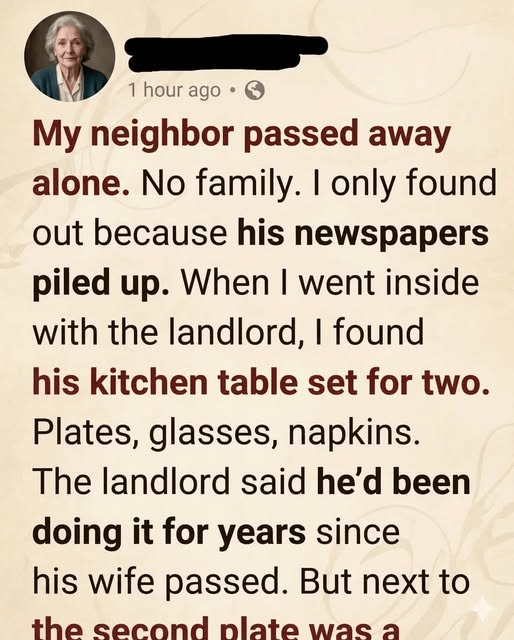
The newspapers were the first sign something was wrong. They had started piling up days ago—neatly at first, then sliding off the porch and curling in the humidity until they scattered across the walkway like fallen leaves. No one picked them up. No one opened the door. Mr. Halvorsen was the kind of neighbor you didn’t really know but always noticed—morning coffee by the window, a quiet nod in passing, lights out by ten. His routine was so consistent that his absence didn’t feel like nothing; it felt loud. I tried to convince myself there was a simple explanation, but somewhere deep down, I already knew there wasn’t.
On the seventh day, I called the landlord. We stood outside the door that afternoon as he knocked once, then again, harder this time, but the silence on the other side didn’t break. Eventually, he unlocked the door, muttering that the rent had always been paid on time. The moment it opened, the stillness inside felt wrong—not like a quiet home, but like something frozen in place for too long. We found him in the kitchen, seated at the table, slumped forward slightly as if he had simply paused mid-thought and never resumed. His expression wasn’t fearful or even peaceful—just… finished.
What didn’t make sense was the table. There were two place settings, arranged with care—two plates, two glasses, neatly folded napkins, and perfectly aligned silverware. But only one chair was occupied. The other sat across from him, pulled out just slightly, as if someone had been sitting there—or was expected to. The landlord quietly mentioned that his wife had died years ago, and something about that explanation only deepened the mystery rather than resolving it. This wasn’t neglect. It was preparation.
Then I noticed the notebook resting beside the second plate. It looked worn, softened by years of use, and for reasons I couldn’t fully explain, I picked it up and opened it. The first entry was dated twenty years ago, a simple reflection about dinner, written in his hand. Beneath it, in a softer, smaller script, was a reply—her reply. Page after page revealed a conversation that had never truly ended: his words, her imagined responses, small jokes, quiet arguments, memories revisited, apologies offered, love expressed in ink. He had been writing to her all this time, keeping her presence alive across the table, refusing to let silence win.
The final entry was recent. “You were quiet tonight,” he had written. Beneath it, one last reply: “That’s okay. So was I.” I closed the notebook carefully and placed it back where it belonged. The untouched glass, the folded napkin, the empty chair—it all felt sacred somehow, like a space that shouldn’t be disturbed. For a fleeting moment, I had the strange feeling that if I looked away too quickly, I might miss her returning to that seat. But no one came. Only silence remained—the kind that lingers after a long conversation ends. I stepped back and left everything as it was, because after twenty years, it was clear he had never truly been eating alone.
Website Disclaimer
The information provided on this website is for general informational and educational purposes only. While we strive to ensure that all content is accurate and up to date, we make no guarantees regarding the completeness, reliability, or accuracy of any information published.
The views and opinions expressed in articles belong to their respective authors and do not necessarily reflect the views of this website. Any action you take based on the information found on this website is strictly at your own risk. We will not be liable for any losses, damages, or inconveniences arising from the use of our content.
Some articles may contain opinions, third-party information, or external links. We do not endorse or guarantee the accuracy of content on external websites and are not responsible for their practices or policies.
All content on this website is provided in good faith and is intended for informational purposes only. Readers are encouraged to verify information independently and seek professional advice where appropriate.