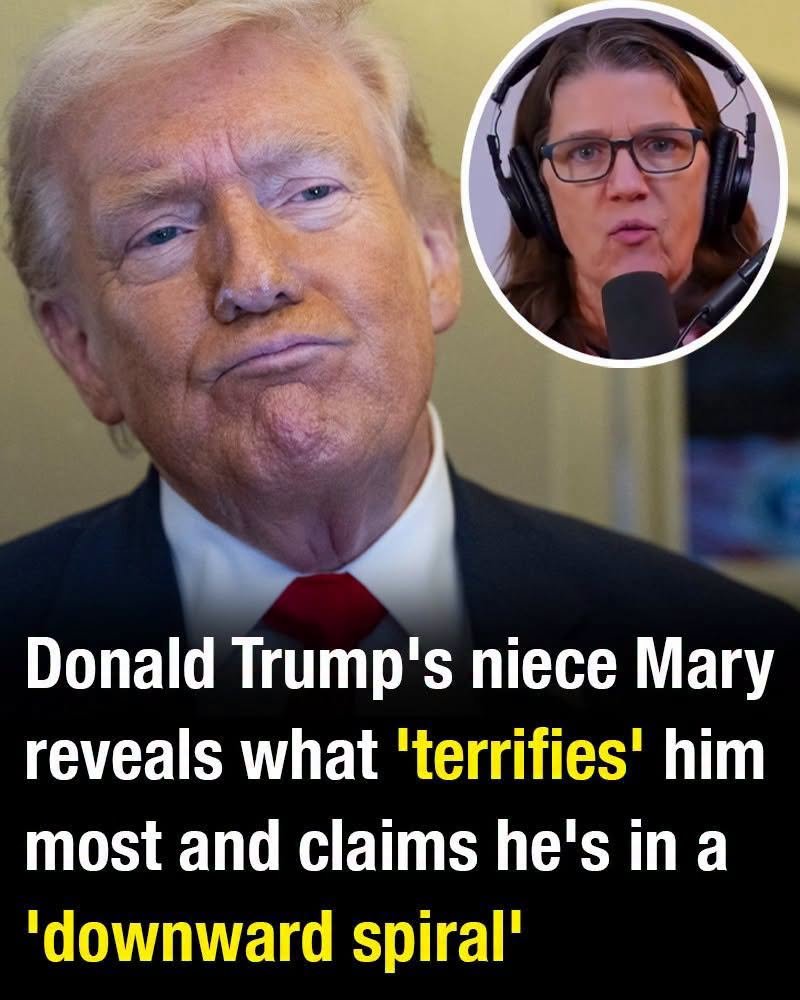
Mary Trump’s portrait of her uncle is not just a family feud; it’s a warning. She describes a man unraveling under the weight of his own ego, besieged by “constant narcissistic injuries,” whose greatest terror is public humiliation. Every stumble on the world stage, every confused post, every awkward summit moment, she suggests, cuts deeper than any political attack, because it exposes the one thing he cannot bear: weakness.
The White House response was swift and dismissive, branding her a critic whose judgments were driven by personal animosity rather than objective evidence. Supporters of the president pointed to public medical assessments and statements from his doctors, arguing that speculation about his health had become another weapon in an increasingly bitter political battle. Yet the debate continued, fueled by the sharp contrast between the confidence Trump projects in public and the concerns his critics repeatedly raise.
For Mary Trump, the family connection gives her criticism a particular intensity. As a psychologist and the daughter of Donald Trump’s late brother, Fred Trump Jr., she has spent years speaking publicly about what she considers the damaging patterns within the Trump family. Her books and interviews have portrayed a household where emotional vulnerability was discouraged, dominance was rewarded, and public image often mattered more than private relationships. Those accounts have made her a prominent critic, though her interpretations remain contested and should not be confused with a clinical evaluation of the president.
At the heart of her argument is a question that extends beyond one family: What happens when a powerful person becomes increasingly sensitive to criticism while surrounded by people who have strong incentives to protect his image? In politics, the consequences can reach far beyond personal relationships. Decisions, public statements, and responses to challenges can affect millions of people, making questions about leadership, judgment, and accountability especially important.
Still, claims about a public figure’s mental or physical condition require evidence, not simply dramatic language or the opinions of relatives. Political disagreements can easily turn personal, and neither supporters nor opponents benefit from treating speculation as established fact. Independent medical information, observable behavior, and verifiable reporting remain essential when evaluating such serious questions.
Mary Trump’s remarks nevertheless keep the spotlight on a long-running debate about her uncle’s personality, leadership style, and relationship with criticism. Her supporters see her as someone willing to challenge a powerful relative despite the backlash. Her detractors view her as a partisan opponent whose family history does not necessarily make her conclusions accurate.
Ultimately, the story is about more than a family divided by politics. It is about the tension between power and vulnerability, public image and private character, and the difficulty of separating documented facts from personal interpretation. Whether readers agree with Mary Trump or reject her assessment, the questions she raises continue to provoke debate about the responsibilities that come with the presidency—and the importance of holding every leader to standards grounded in evidence rather than personality alone.
Website Disclaimer
The information provided on this website is for general informational and educational purposes only. While we strive to ensure that all content is accurate and up to date, we make no guarantees regarding the completeness, reliability, or accuracy of any information published.
The views and opinions expressed in articles belong to their respective authors and do not necessarily reflect the views of this website. Any action you take based on the information found on this website is strictly at your own risk. We will not be liable for any losses, damages, or inconveniences arising from the use of our content.
Some articles may contain opinions, third-party information, or external links. We do not endorse or guarantee the accuracy of content on external websites and are not responsible for their practices or policies.
All content on this website is provided in good faith and is intended for informational purposes only. Readers are encouraged to verify information independently and seek professional advice where appropriate.