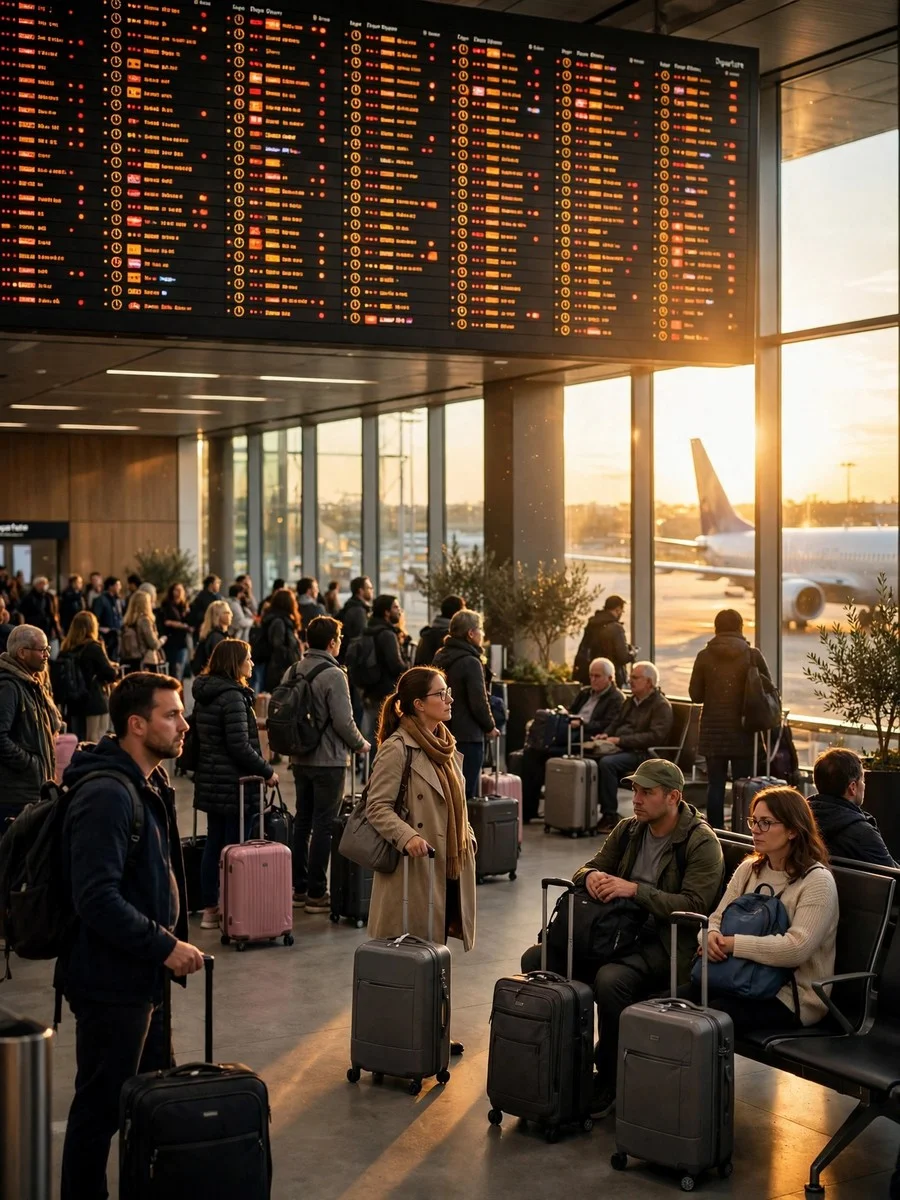
Millions of Americans heading home for Thanksgiving ran into a very modern kind of travel headache on Sunday, when a computer failure at Delta Air Lines threw flight schedules across the country into chaos. A system that calculates how much weight each plane can safely carry stopped working, forcing staff to fall back on pen-and-paper style manual checks while thousands of passengers waited at gates from New York to Los Angeles.
The disruption landed at the worst possible moment. Thanksgiving week is the busiest travel period of the year in the United States, and Delta’s main hub in Atlanta alone was expecting more than four million travellers between November 19 and December 1.
A Small System With a Big Job
Every flight begins with a calculation most passengers never think about. Before a plane can take off, ground crews must work out exactly how much weight is on board — passengers, bags, cargo and fuel — and how that weight is spread through the aircraft. Get it wrong and the plane may struggle to climb, handle poorly in the air, or put strain on its structure.
At Delta, those instructions are produced by a system called ALIS, the Automated Load Instruction System, planned at the airline’s operations centre in Atlanta. On Sunday morning, that automation failed across the network. Without the usual load sheets, ramp teams could not load planes in the normal way. In a radio call captured that morning, one employee explained to a pilot in Boston that crews were counting bags by hand and preparing manual reports instead.
Delays Spread From Coast to Coast
The knock-on effect was swift. Flight tracking data showed more than 1,000 Delta flights delayed by Sunday afternoon, and by the evening well over half of the airline’s flights for the day were running late. Around six per cent were cancelled altogether. At Hartsfield-Jackson Atlanta International Airport, the world’s busiest airport and Delta’s biggest hub, more than 60 per cent of departing flights were delayed, with roughly half of arriving flights late as well.
The Federal Aviation Administration put a roughly hour-long ground delay on some flights heading into Atlanta at Delta’s request on Sunday morning, lifting it around 11:30 a.m. The agency was quick to stress that the problem sat inside Delta’s own systems and had nothing to do with federal air traffic control.
Delta said about 70 per cent of the day’s delays and cancellations were linked to the automation failure, with bad weather accounting for the rest.
Manual Workarounds Kept Planes Moving
Rather than grounding the fleet, Delta switched to manual procedures. Staff worked through load calculations by hand so planes could keep departing safely, even if more slowly. The airline apologised to travellers, rebooked passengers whose connections were missed, and offered meals, hotel rooms and refunds where flights were cancelled.
By Sunday evening, Delta said the automated weight and balance system was working again, though it warned passengers to expect lingering delays as the schedule recovered. The airline said its teams were focused on completing the rest of the day’s flying, with cancellations only ever a last resort.
A Familiar Pattern of Tech Trouble
The episode is the latest in a growing run of technology failures disrupting everyday American life, from banking apps to transport networks. For travellers, it was a reminder of how much modern flying depends on invisible software working perfectly behind the scenes — and how quickly a single fault can ripple through an entire airline.
For families still planning their Thanksgiving journeys, the advice remains simple: check your flight status before leaving for the airport, arrive early, and allow extra time for connections. Delta’s system is back online, but with the holiday rush only just beginning, the weekend’s chaos will not be forgotten in a hurry.
Website Disclaimer
The information provided on this website is for general informational and educational purposes only. While we strive to ensure that all content is accurate and up to date, we make no guarantees regarding the completeness, reliability, or accuracy of any information published.
The views and opinions expressed in articles belong to their respective authors and do not necessarily reflect the views of this website. Any action you take based on the information found on this website is strictly at your own risk. We will not be liable for any losses, damages, or inconveniences arising from the use of our content.
Some articles may contain opinions, third-party information, or external links. We do not endorse or guarantee the accuracy of content on external websites and are not responsible for their practices or policies.
All content on this website is provided in good faith and is intended for informational purposes only. Readers are encouraged to verify information independently and seek professional advice where appropriate.