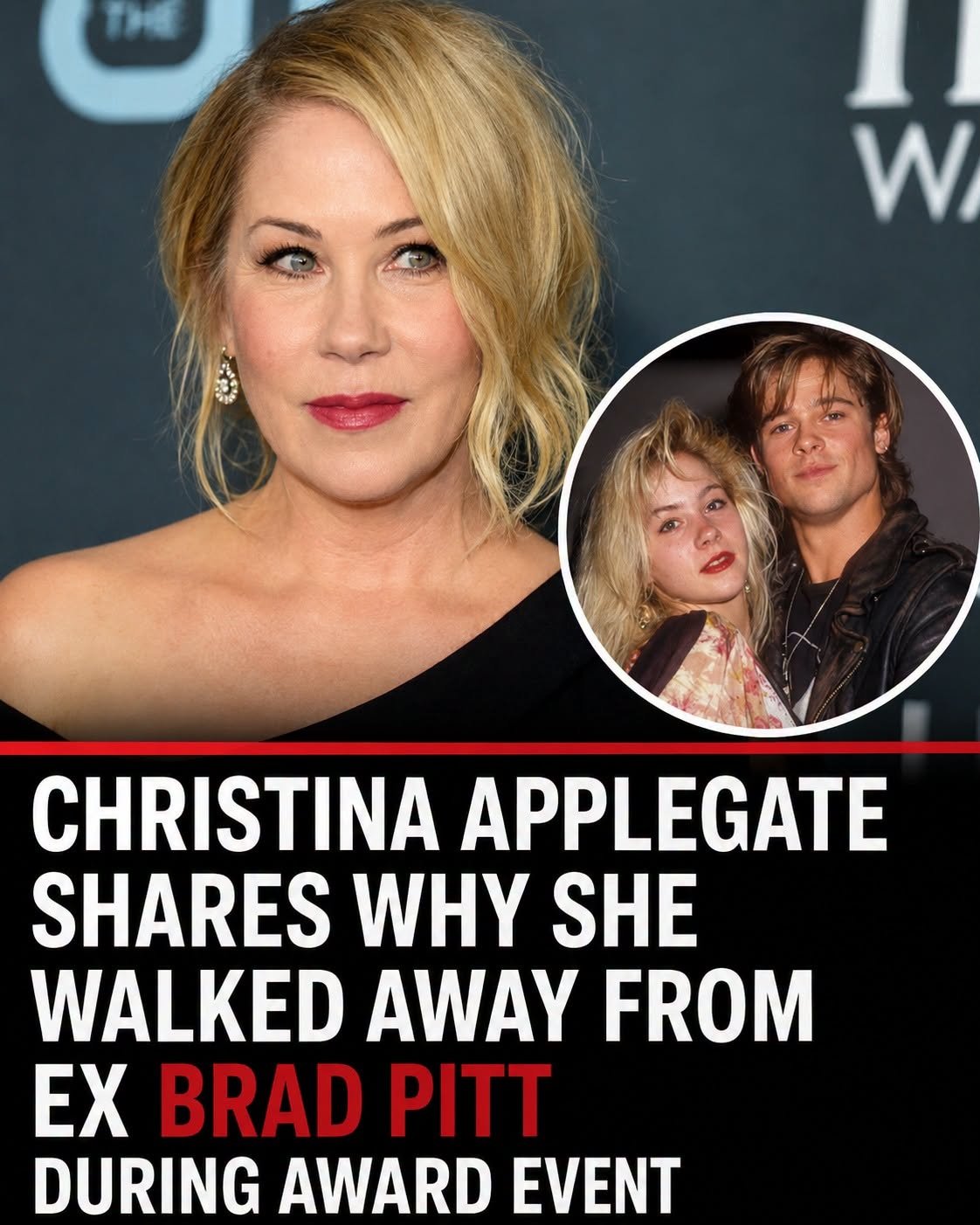
Christina Applegate has spent much of her life in the public eye, but some of the most revealing stories from her younger years happened before many of the people around her became internationally famous. In her memoir You with the Sad Eyes, Applegate looks back at growing up in the entertainment industry, her complicated relationship with fame and appearance, and memorable encounters with other young performers. Among those memories is a story that has followed her for decades: the night she attended the 1989 MTV Video Music Awards with Brad Pitt but ultimately left the event with Skid Row singer Sebastian Bach.
Applegate’s reflections arrive during a dramatically different period of her life. She publicly disclosed in 2021 that she had been diagnosed with multiple sclerosis, commonly known as MS, a disease affecting the central nervous system. Applegate has spoken openly in subsequent years about the significant impact the condition has had on her mobility and daily routine. Her health challenges also affected her work on Netflix’s Dead to Me, the acclaimed series in which she starred alongside Linda Cardellini. Rather than hiding those difficulties, Applegate has increasingly discussed them publicly and candidly.
Her memoir also revisits the pressures she experienced much earlier in life. Applegate became widely recognizable as Kelly Bundy on the Fox sitcom Married… with Children, which premiered in 1987 when she was still a teenager. The role made her famous at a remarkably young age and established an image of her that millions of television viewers recognized. Applegate has explained, however, that public perceptions of her appearance were very different from the way she viewed herself during those years. Behind the confidence associated with Kelly Bundy was a teenager struggling with intense insecurity.
In the memoir, Applegate describes feeling that her face was too ordinary even while audiences regarded her as a symbol of beauty. She has also described exercising excessively in pursuit of a physical ideal that never seemed achievable to her. Her recollections provide important context for understanding the pressures she placed on herself as a young performer. Rather than presenting her teenage fame as an uncomplicated success story, Applegate describes a period in which professional achievement existed alongside insecurity and an unhealthy pursuit of physical perfection.
At the same time, growing up around the Los Angeles entertainment industry meant Applegate encountered numerous young actors and musicians before some of them reached the height of their fame. She has recalled having strong feelings for Johnny Depp when she was younger. Another person in her social circle was Brad Pitt. Applegate describes Pitt during this period as a longtime platonic friend rather than the globally recognized movie star he would later become. Pitt’s major breakthrough in Thelma & Louise was still a couple of years away when the memorable awards-show episode occurred.
According to Applegate’s account, the friendship eventually developed a hint of romantic interest. In 1989, when Applegate was 17 and Pitt was 25, she invited him to accompany her to the MTV Video Music Awards, where she was appearing as a presenter. Because Applegate needed to arrive early for her responsibilities at the ceremony, Pitt also helped with transportation involving her mother, actress and singer Nancy Priddy. At that point, the evening appeared to be a conventional awards-show date between two young people working in entertainment.
Applegate remembers feeling particularly confident that evening. She wore a Ceil Chapman dress and has described feeling unusually good about herself in it. But another person at the event caught her attention: Sebastian Bach, then the frontman of the rock band Skid Row. Bach was part of the late-1980s rock scene, and Applegate recalled noticing the long-haired singer during the ceremony. By the end of the evening, her interest in Bach had overtaken whatever romantic possibility had briefly emerged between her and Pitt.
Applegate says she ultimately left the awards show with Bach instead of Pitt. The decision became one of those youthful moments that seemed relatively simple at the time but appeared much more striking after everyone involved became famous. Applegate has acknowledged the unusual perspective created by hindsight. Pitt was still establishing himself as an actor in 1989 and had not yet become the internationally recognized star associated with movies such as Thelma & Louise, Fight Club, Se7en and many later productions.
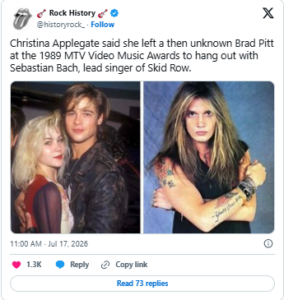
According to Applegate’s memoir, Pitt was understandably unhappy about how the evening ended. Her account says he was left to drive her mother home after Applegate departed with Bach. Applegate also recounts that Pitt nearly became involved in a confrontation during that drive and was angry with her afterward. These details are Applegate’s recollection of the event and should be understood as her personal account rather than as independently established details about Pitt’s private thoughts or motivations.
The incident apparently affected their friendship for some time. Applegate writes that she and Pitt did not speak for years afterward. She also recounts an unusual indication that the story had remained memorable: at different times later in life, two women who dated Pitt allegedly asked Applegate whether she really was the person who had left him behind at the MTV Video Music Awards. According to Applegate, both women had heard about the incident from Pitt. Her memoir does not identify those women in the passages describing the episode.
The incident apparently affected their friendship for some time. Applegate writes that she and Pitt did not speak for years afterward. She also recounts an unusual indication that the story had remained memorable: at different times later in life, two women who dated Pitt allegedly asked Applegate whether she really was the person who had left him behind at the MTV Video Music Awards. According to Applegate, both women had heard about the incident from Pitt. Her memoir does not identify those women in the passages describing the episode.
Applegate also emphasizes an important fact about her age at the time. She was only 17. Looking back as an adult, she recognizes that Pitt deserved better treatment that evening while also viewing her younger self as a teenager making an impulsive decision. According to her account, she and Pitt eventually discussed what had happened and reached a point where the old resentment surrounding the incident could be left behind. The passage is therefore less about an ongoing feud than about two people eventually putting an awkward youthful experience into perspective.
The humor in Applegate’s recollection comes partly from knowing what happened to their careers afterward. Pitt went on to become one of the most recognizable actors of his generation, earning major awards and starring in numerous internationally successful films. Bach remained closely associated with Skid Row’s breakthrough era and continued working as a musician and performer. Applegate herself developed a career extending far beyond Married… with Children, including prominent roles in Anchorman, Samantha Who?, Bad Moms and Dead to Me.
Yet the broader significance of Applegate’s memoir extends beyond celebrity anecdotes. Her memories of Pitt, Bach and Depp sit alongside much more personal discussions of childhood, relationships, body image, professional pressure and illness. By revisiting old diaries and memories, she examines the difference between the confident public figure audiences believed they knew and the private experiences taking place away from cameras. Her recollections about appearance are particularly revealing because they demonstrate that fame and public admiration did not automatically create self-confidence.
Her experience with multiple sclerosis gives those earlier memories additional weight. Applegate has publicly discussed the profound changes MS has brought to her physical life and acting career. The woman who once pushed herself through demanding workouts in pursuit of an impossible physical ideal now speaks about her body from a very different perspective. That contrast forms part of the emotional context surrounding her reflections on youth, fame and the standards she once imposed on herself.
The Brad Pitt story consequently works best not as evidence of a decades-long celebrity feud, but as one memorable chapter from Applegate’s adolescence. According to her own account, she went to the 1989 MTV Video Music Awards with a young actor who had not yet become a global superstar, noticed Sebastian Bach during the evening, and made the teenage decision to leave with the rock singer instead. Pitt was angry, their friendship was affected, and years later they were eventually able to move beyond it.
More than three decades later, the episode has become an amusing intersection of several famous careers. At the time, however, Applegate could not have known what Pitt’s career would become, nor could any of them have predicted the lives awaiting them. Her memoir allows her to revisit that evening with the perspective of adulthood while acknowledging both the humor and the thoughtlessness of her teenage decision. What survives today is not simply the story of the girl who once left Brad Pitt at an awards show, but Applegate’s larger reflection on how dramatically people, priorities and perspectives can change over the course of a lifetime.
Website Disclaimer
The information provided on this website is for general informational and educational purposes only. While we strive to ensure that all content is accurate and up to date, we make no guarantees regarding the completeness, reliability, or accuracy of any information published.
The views and opinions expressed in articles belong to their respective authors and do not necessarily reflect the views of this website. Any action you take based on the information found on this website is strictly at your own risk. We will not be liable for any losses, damages, or inconveniences arising from the use of our content.
Some articles may contain opinions, third-party information, or external links. We do not endorse or guarantee the accuracy of content on external websites and are not responsible for their practices or policies.
All content on this website is provided in good faith and is intended for informational purposes only. Readers are encouraged to verify information independently and seek professional advice where appropriate.