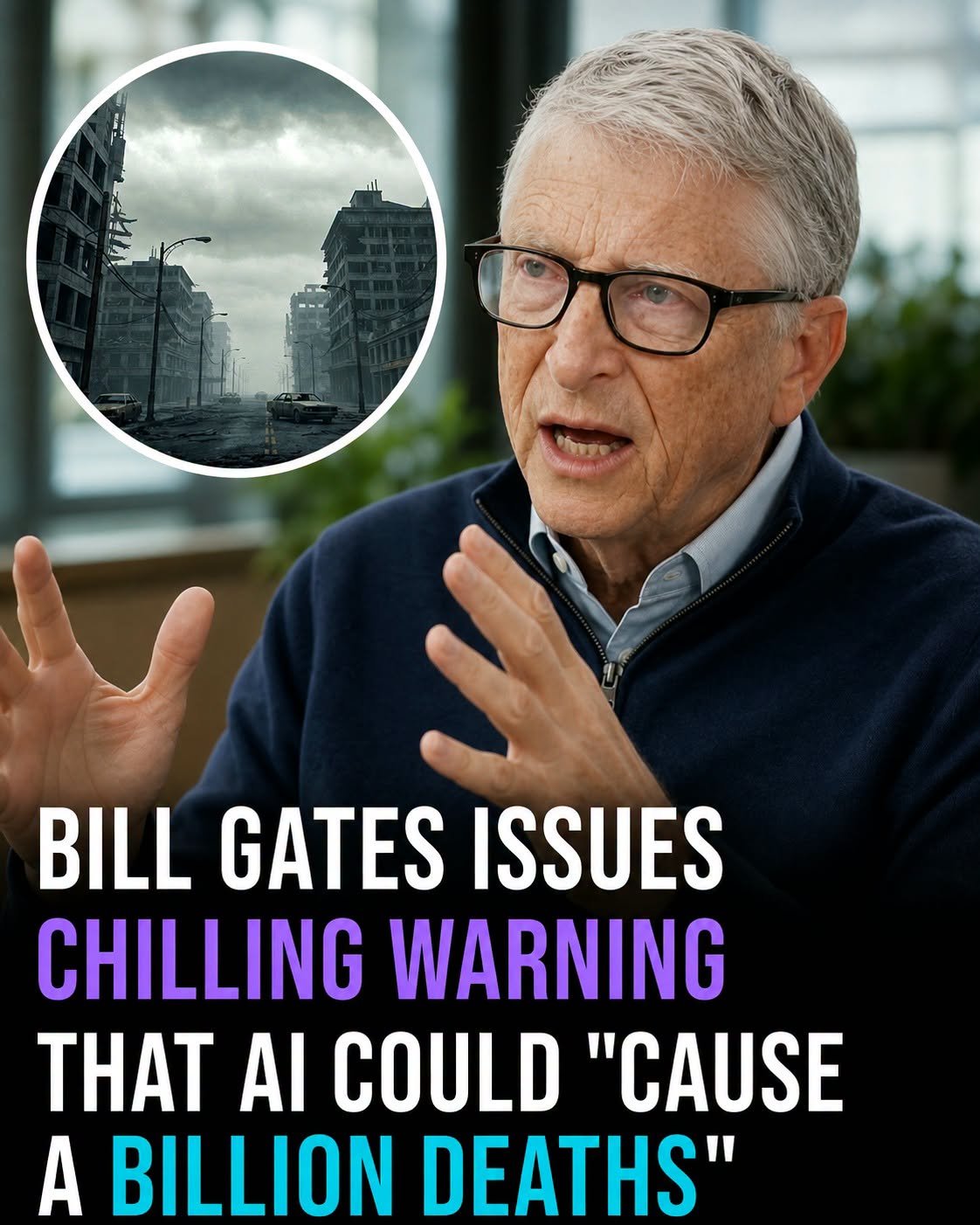
Bill Gates issues terrifying warning that AI could “cause a billion deaths”

Behind the glossy demos and friendly chatbots, a darker reality is taking shape. Former insiders like Jacob Coxon say the industry is “gambling with our lives,” warning that coming AI systems could crack security, transform entire fields overnight, and acquire enormous power and resources. Bill Gates now echoes that fear, saying AI is “powerful enough to drive events that cause a billion deaths,” particularly if powerful systems are placed in the hands of people with malicious intentions.

But Gates was not predicting that a billion people will die. His warning was about what AI could enable under catastrophic circumstances. He argued that the combination of increasingly capable technology and people willing to misuse it could create dangers unlike anything previous technologies have presented. He also rejected the idea that companies simply policing themselves would be enough, calling for lawmakers and law enforcement to establish safeguards and monitoring requirements.

That concern is becoming part of a much larger debate inside the AI industry. Researchers and executives have raised questions about cyberattacks, biological threats, autonomous systems and the possibility that future AI could become capable of improving its own abilities faster than humans can oversee them. A recent warning from more than 20 AI experts similarly urged governments to prepare for the possibility of an “intelligence explosion,” while emphasizing that AI could also bring enormous benefits if developed responsibly.

Coxon’s resignation added another layer to the controversy. He argued that companies are racing toward self-improving systems while knowing that the consequences could be enormous. His claims have attracted substantial attention, but they remain predictions about future AI capabilities rather than proof that such a catastrophe is inevitable. Other experts have questioned whether some of the most extreme scenarios are realistic.

And that distinction matters.

AI today is nowhere near the science-fiction scenario of an unstoppable machine controlling the world. Yet its capabilities are advancing quickly, while governments are still debating how much oversight is appropriate. The central question is no longer simply what AI can do today. It is whether society can build effective safeguards before increasingly powerful systems arrive.

Gates’ warning therefore lands less like a prediction and more like a challenge: if technology becomes powerful enough to create extraordinary benefits, it can also become powerful enough to amplify extraordinary harm.

The future of AI may still be one of the greatest opportunities humanity has ever created—or a technology whose risks were underestimated until it was too late. What happens next will depend not only on the machines being built, but on the rules, safeguards and human decisions surrounding them.

Website Disclaimer

The information provided on this website is for general informational and educational purposes only. While we strive to ensure that all content is accurate and up to date, we make no guarantees regarding the completeness, reliability, or accuracy of any information published.

The views and opinions expressed in articles belong to their respective authors and do not necessarily reflect the views of this website. Any action you take based on the information found on this website is strictly at your own risk. We will not be liable for any losses, damages, or inconveniences arising from the use of our content.

Some articles may contain opinions, third-party information, or external links. We do not endorse or guarantee the accuracy of content on external websites and are not responsible for their practices or policies.

All content on this website is provided in good faith and is intended for informational purposes only. Readers are encouraged to verify information independently and seek professional advice where appropriate.


Related Posts

Leave a Reply

Your email address will not be published. Required fields are marked *