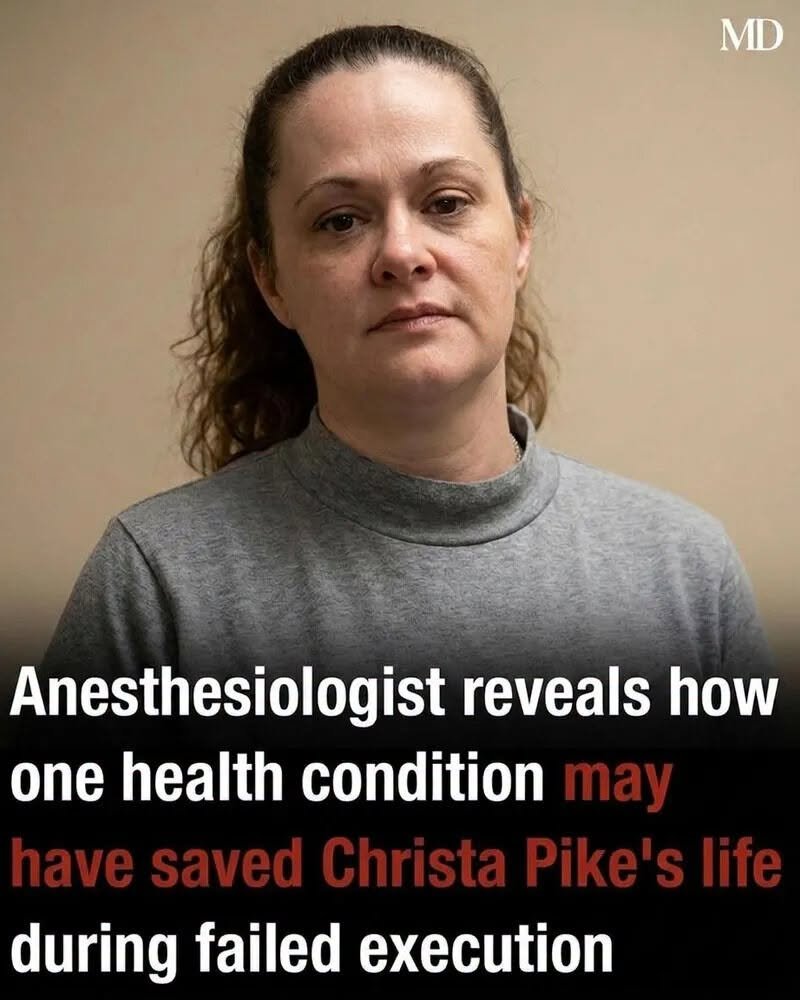
Anesthesiologist Explains Why Christa Pike Survived — One Medical Condition May Have Changed Everything

Christa Gail Pike remained critically ill in a guarded hospital after a September 30 execution attempt ended very differently from what officials expected. Pike, who had spent more than three decades on death row for the killing of 19-year-old Colleen Slemmer, received two doses of pentobarbital, yet the drugs reportedly did not properly enter her bloodstream. Her attorney, assistant federal defender Stephen Ferrell, said she initially remained unconscious and on a ventilator, while doctors could not predict whether she would recover. Court filings and statements from her legal team pointed to problems with the IV lines, while her defense team had already warned that a lifelong blood disorder and difficulty accessing her veins could complicate the procedure.

The execution at Riverbend Maximum Security Institution in Nashville began hours after the U.S. Supreme Court overturned a last-minute stay issued by a federal appeals court. Witnesses later described a prolonged procedure in which Pike remained alive after both the initial and backup doses had been administered. At one point, she reportedly complained of severe pain in her arm. Witnesses later heard her breathing and snoring even after the execution had continued for more than an hour. She was eventually transported to a hospital for emergency medical treatment.

According to Pike’s attorneys, the suspected problem involved the IV lines. They said the medication may have entered surrounding tissue instead of reaching the bloodstream, causing serious injuries to her arms, including swelling, burns and blisters. Her lawyers had previously argued that her medical history made establishing reliable intravenous access particularly difficult. They now say the warnings raised before the execution deserve a thorough investigation.

The failed execution immediately triggered questions about Tennessee’s lethal-injection procedures. Governor Bill Lee called the incident deeply disturbing and ordered an independent review. He also halted the state’s remaining scheduled execution for the year while officials investigate what went wrong. The Tennessee Department of Correction, meanwhile, has maintained that personnel followed the established execution protocol.

The incident was particularly significant because Pike appeared to become the first known person in the modern U.S. death-penalty era to survive after receiving the drugs intended to cause death. Death-penalty experts said the case was unprecedented, while critics argued that the ordeal demonstrated the dangers and uncertainty surrounding lethal injection.

Pike’s attorneys also sought to preserve evidence from the execution, including information about the drugs, needles, IV equipment and execution records. They have argued that the state should be held accountable for what they describe as an unnecessarily painful and traumatic procedure. The legal team has also renewed its call for Pike’s death sentence to be commuted to life imprisonment.

Pike was sentenced to death for the 1995 killing of Slemmer, a fellow student. Prosecutors said Pike and her boyfriend participated in the attack when Pike was 18. Her supporters have long argued that her traumatic childhood, mental-health history and allegations of severe abuse should have received greater consideration during the sentencing process. The U.S. Supreme Court’s September 30 decision allowing the execution to proceed was itself accompanied by a dissent from Justice Sonia Sotomayor, joined by Justices Kagan and Jackson, who argued that unresolved legal issues warranted keeping the stay in place.

Then, days after the failed execution, Pike’s condition changed. On October 6, her attorneys announced that she had regained consciousness and was able to speak. They said she remained hospitalized and continued to receive critical medical care, particularly for the injuries to her arms, but cautioned that her prognosis was still unclear and that a long recovery was expected.

The developments have now turned Pike’s case into a broader national debate over capital punishment, execution procedures and the responsibility of states to ensure that executions are carried out without unnecessary suffering. Tennessee is conducting its review while Pike’s attorneys continue seeking answers about exactly what happened inside the execution chamber.

For now, the questions surrounding the failed execution remain unresolved: why two doses of pentobarbital failed to end Pike’s life, how the IV procedure went wrong, what injuries she sustained, and whether the warnings presented before the execution were adequately addressed. As Pike begins what her attorneys describe as a potentially long recovery, those questions are likely to remain at the center of the legal and political battle surrounding her case.

Website Disclaimer

The information provided on this website is for general informational and educational purposes only. While we strive to ensure that all content is accurate and up to date, we make no guarantees regarding the completeness, reliability, or accuracy of any information published.

The views and opinions expressed in articles belong to their respective authors and do not necessarily reflect the views of this website. Any action you take based on the information found on this website is strictly at your own risk. We will not be liable for any losses, damages, or inconveniences arising from the use of our content.

Some articles may contain opinions, third-party information, or external links. We do not endorse or guarantee the accuracy of content on external websites and are not responsible for their practices or policies.

All content on this website is provided in good faith and is intended for informational purposes only. Readers are encouraged to verify information independently and seek professional advice where appropriate.


Related Posts

Leave a Reply

Your email address will not be published. Required fields are marked *